Category: Expert Advice

  • Why You Can’t Rewire Your Brain — And Why You Don’t Need To

    Why You Can’t Rewire Your Brain — And Why You Don’t Need To

    Look, I’ve watched the videos.
    You’ve watched the videos.
    We’ve all watched the videos.

    Some guy in a black hoodie sitting in a rented penthouse tells you:

    “You must REWIRE your brain to trade like a sniper.”

    And you think, “Ah yes, this is it. This is my villain origin story. By Tuesday I’ll be a Zen assassin.”

    Then Tuesday comes.
    You start strong.
    You breathe.
    You visualize.
    You channel Buddha.

    And by 9:12 AM you’re clicking like a caffeinated raccoon in a trash can, down three trades, swearing at the screen, and Googling whether it’s possible to legally file charges against gold.

    So let’s finally say the quiet part out loud:

    You cannot ‘rewire’ your brain.

    Not the way they’re selling it.

    Dopamine overrides can’t be meditated away.
    Tilt cannot be journaled out of existence.
    Fight-or-flight does not wait politely for your affirmations.

    When your limbic system fires, it’s not asking your permission.
    It’s flipping the breaker and locking the door.

    And once dopamine hijacks you?

    That whole “rewire your brain” fantasy evaporates faster than your TopStep account on NFP day.


    So… what DOES work?

    Systems.

    Guardrails.
    Constraints.
    Engineering.

    That’s it.
    That’s the entire secret.

    The traders who survive — the ones who actually make money — aren’t superheroes who rewired their instincts.
    They’re people who learned to build cages around their worst impulses so their best self can show up consistently.

    I didn’t fix my brain.
    I fenced it in.

    And guess what?

    Trading suddenly got a whole lot easier.


    The Fantasy vs. The Science

    The fantasy (YouTube version):

    • Rewire your neural pathways
    • Become emotionless
    • Eliminate fear
    • Upgrade your brain
    • Trade like a monk-warrior-cyborg

    The science (actual neuroscience):

    • Once dopamine spikes, the rational brain is offline
    • Tilt is involuntary
    • Impulse overrides happen faster than conscious awareness
    • Willpower is the last reliable tool in high-stress decisions
    • Humans don’t change “internally” — their environment changes their behavior

    If you want consistency, you have to design around your biology, not fight it.


    Want to hear a real breakthrough? Here it is:

    I used to think I needed to fix myself.
    Become calmer.
    Become wiser.
    Become the person who could take five losses in a row without breaking.

    Spoiler:
    I am not that person.
    I will never be that person.
    My wiring doesn’t work that way.

    But here’s what I AM:

    A very good trader when I’m not hijacked by dopamine.

    So instead of trying to retrain my brain, I built a system that does not let hijacked-Mike touch the mouse.

    A $250 automated stop loss on a per trade basis and a $600 master-account daily loss limit.

    That’s it.
    That’s the whole hack.

    And it works.

    Not because it makes me stronger.
    Because it stops me when I’m weak.

    The guardrail is the strength.


    You don’t transform your brain.

    You transform your environment.

    Pilots don’t “rewire” their brains to avoid crashing planes.

    Surgeons don’t “rewire” themselves to never make errors.

    They use:

    • checklists
    • constraints
    • procedures
    • circuit breakers
    • lockouts
    • verification steps
    • structural safeguards

    Why?
    Because humans under pressure make predictable mistakes.
    And smart systems prevent those mistakes from becoming fatal.

    Trading is no different.

    The moment I stopped trying to become superhuman, I started becoming consistent.


    The real reason this truth isn’t popular on YouTube

    Because “rewire your brain” sells a fantasy.
    “Install a $600 forced stop” sounds like broccoli.

    But broccoli wins.
    Fantasy loses.

    The trading gurus want you chasing enlightenment.
    The markets want you following rules.

    One will take your money.
    The other will protect it.


    Final Thought

    If you’re struggling, if you’re tilting, if you’re blowing accounts and saying “I KNOW better, why can’t I DO better?”…

    It’s not because you’re broken.

    It’s because you’re human.

    And the system you need isn’t inside your skull —
    it’s in the guardrails you build around it.

    Stop trying to rewire your brain.
    Start engineering your environment.

    Your future equity curve will thank you.

  • The Boredom Trap: What Nobody Tells You About Trading Mastery

    The Boredom Trap: What Nobody Tells You About Trading Mastery

    Most traders never get good enough to even see the boredom trap.

    That’s the cruel little secret of trading mastery.

    You spend years grinding, sweating, bleeding, blowing accounts, rebuilding, questioning your sanity…

    …all so you can eventually sit down at your desk, execute a handful of trades, and feel…

    nothing.

    No thrill.

    No panic.

    No drama.

    Just… mechanical, procedural execution— like that scene in The Matrix when Neo finally sees the code for what it is, stops dodging, and effortlessly controls the fight against Agent Smith. The bullets slow. The chaos dissolves. He’s no longer reacting — he’s simply operating inside the system with total calm.

    Congratulations.

    You’re now boring.


    But here’s the danger:

    Boring is not the enemy.

    But boredom is.


    Why The Boredom Trap Exists

    When you were in the “struggle phase,” every trade felt important.

    Every session was an emotional referendum on whether you were good enough.

    Every mistake triggered a self-examination.

    You were alive in the fight.

    But eventually, if you actually do the work, something incredible happens:

    • The setups become obvious.
    • The entries become automatic.
    • The exits happen without bargaining.
    • The losses no longer shake you.
    • The wins no longer thrill you.

    You are simply… executing.

    That’s mastery.

    That’s where the real money is made.

    And that’s also where many traders slowly start self-sabotaging.


    The Two Types of Traders Who Reach Mastery

    1️⃣ The Identity Seeker

    They were addicted to becoming a trader.

    The challenge was the thrill.

    The struggle defined them.

    Now that it’s just execution? They feel empty.

    So they unconsciously seek out ways to bring back the feeling — often by taking dumb risks they don’t need to take.

    2️⃣ The Operator

    They weren’t in it for the thrill.

    They were in it to build something durable.

    To master a complex skill and run it like a business.

    For them, the absence of emotional spikes is not boring — it’s deeply satisfying.

    They scale quietly.

    They compound wealth.

    And they don’t need drama to feel alive.


    Which One Are You?

    Here’s the test:

    If you secretly fear that once trading feels easy, you’ll lose interest — that’s a good sign.

    It means you’re self-aware enough to recognize the trap before you fall into it.

    If you’re excited to make trading so boring that you forget what you traded yesterday?

    You’re wired for long-term wealth.


    What to Do About the Boredom Trap

    1️⃣ Build Rituals of Professionalism

    Treat your trading desk like an operating room.

    Pre-session checklist.

    Post-session logs.

    High-level journal entries.

    It’s not entertainment. It’s precision.

    2️⃣ Find Satisfaction in Clean Execution

    Every perfect HSE exit? A private fist bump.

    Every day you followed your rules? Another brick laid.

    Build your identity around the behavior, not the P&L.

    3️⃣ Avoid the Dopamine Drift

    The second you start “spicing things up” with unnecessary size or marginal setups, catch yourself.

    That’s boredom whispering in your ear.

    Ignore it.

    4️⃣ Respect the Machine

    Once you’ve built the machine, your job is to operate it, maintain it, and keep it fed.

    You don’t need to tinker with it every day.

    5️⃣ Create Meaning Outside the Charts

    Boring trading gives you something far more valuable than excitement:

    Freedom.

    Use it.

    Spend time with your family.

    Build something new.

    Mentor someone.

    Write.

    Travel.

    Leave the charts alone after the session ends.

    The goal isn’t to fill your emotional needs through trading.

    It’s to let trading fund the life you want to live.


    The Real Mastery

    You don’t master trading by chasing excitement.

    You master trading by building a machine that produces capital without your emotions being involved.

    Boredom isn’t failure.

    Boredom is the victory lap.

    Stay sharp.

    Stay grounded.

    Stay boring.

  • Don’t Be a Me: How I Got Suckered by a Telegram Signals Group

    Don’t Be a Me: How I Got Suckered by a Telegram Signals Group

    Early in my trading journey, I was starving for information. Hungry. Obsessed. I had a mentor, but I didn’t want to become a nuisance with my constant stream of rookie questions. So I did what every ambitious but impatient new trader does: I went looking for answers everywhere.

    YouTube? Check.

    Discord and Telegram? Check.

    Trading “gurus” with live streams and promises of secret sauce? Sadly, check.

    That’s how I ended up in a Telegram signals group.


    The Allure of Easy Trades

    This group was pumping out “signals” all day long. Every ping was like a dopamine hit. “Sell gold slowly,” the message would say. Then came the entry signal. Then, barely minutes later, the exit signal.

    Sometimes the move in my favor was so tiny it didn’t even cover the spread. Yet the provider would declare victory like they’d just nailed the trade of the year. I’d still be sitting in drawdown wondering what I was missing.

    Occasionally, yes, the trades made a little money. But just as often, the group would call it a “win” on a whisper of movement before the reversal took me under. And when the market really went against them? That’s when the stop loss magically got “adjusted” or the trade just got memory-holed. Rarely, and I mean rarely, would they flat-out admit they were wrong.

    Meanwhile, I was bleeding — financially and mentally. I thought I was the idiot. I thought I was the one who couldn’t execute what these “pros” were handing me on a platter.


    The Punchline: They Weren’t Even Traders

    Here’s the part that still makes me shake my head. Eventually, I discovered that the group I’d joined wasn’t even run by real traders. They weren’t analyzing charts, managing risk, or trading live accounts. They were simply copy-pasting signals from another group — which, surprise, turned out to be another scam.

    So not only was I paying for bad signals, I was paying for recycled bad signals. Think about that: I was losing money on knockoff trades from a knockoff provider. That’s like buying a fake Rolex and finding out it’s just a knockoff of another fake Rolex.

    At that point, the lesson became clear: if someone can churn out dozens of “winning” trades a day in a Telegram channel, they’re not traders — they’re marketers. And the only thing they’re trading is your subscription money for their lifestyle.


    The Hard Truth

    It took me longer than I’d like to admit to realize what was going on. The entire point of that signals group wasn’t to help me trade. It was to look successful enough to hook the free-trial crowd into paying full freight. I paid. I traded. I lost. They “won.”

    I wasn’t just taken for the subscription fee. I was taken for every dollar of drawdown those false victories left me holding.

    And here’s the kicker: the most damaging part wasn’t even the money. It was the false belief it planted — the idea that a “real trader” is in a trade all the time. That there’s always a setup. That more trades = more opportunities. That’s poison.


    What I Learned the Hard Way

    Yes, I eventually absorbed useful knowledge from various sources. But in the early days, I didn’t know how to filter it. I didn’t know how to separate good context from bad advice. And I sure as hell didn’t know that a Telegram channel blasting out trades like a firehose was closer to a carnival hustle than a trading plan.

    Trading isn’t about signals. It’s about discipline, structure, and patience. It’s about knowing when not to click as much as when to click. And no $50-a-month signal group is going to hand that to you.


    Don’t Be a Me

    So here’s the warning I wish someone had tattooed on my forehead when I was new:

    If you’re in a Telegram group that declares victory when the market barely sneezes, you’re not learning how to trade. You’re paying tuition to scammers whose business model depends on making you think you’re the problem.

    Don’t be a me. Save your cash. Save your mental health. Find a real mentor, build your own system, and understand that no one is going to sell you a shortcut to mastery.

  • How to Handle the Weekend After a Bad Trading Week

    How to Handle the Weekend After a Bad Trading Week

    There’s a very specific kind of pain that only traders know.

    You’ve had a rough week.

    You’re sitting in drawdown.

    You’re disappointed, angry, frustrated.

    And worst of all?

    The markets are closed.

    You can’t fix it.

    You can’t take action.

    You just sit there.

    Marinating in your own bad decisions.


    The trader’s weekend dilemma:

    When you’re in a losing streak, the weekends feel longer.

    Because unlike most normal people, weekends aren’t rest for traders — they’re emotional purgatory.

    • Your brain obsesses over charts that aren’t moving.
    • You replay trades you should’ve exited earlier.
    • You run fantasy simulations of what would’ve happened “if only.”

    The urge to make the pain stop starts to build.


    Here’s where it gets dangerous:

    The natural instinct is to reach for a dopamine hit to alleviate the discomfort:

    • Binge Netflix.
    • Scroll social media endlessly.
    • Overeat.
    • Numb yourself with alcohol.
    • Start planning “big” trading adjustments.
    • Fantasize about how you’ll make it all back Monday morning.

    Anything to make the emotional sting feel less sharp.


    But here’s the truth nobody wants to hear:

    Every time you seek relief, you train your brain to seek immediate comfort instead of long-term discipline.

    And that’s the exact dynamic that shows up when:

    • You revenge trade to erase losses.
    • You overtrade trying to feel “back in control.”
    • You hold losing trades beyond your stop because “it might come back.”

    Seeking relief becomes your default trading behavior.


    The real work is done in this weekend pain.

    This is your training ground.

    Not the charts.

    Not the trades.

    Right here. Inside this discomfort.

    Because trading success isn’t about feeling great while you trade.

    It’s about executing correctly while you feel like absolute garbage.


    What to do instead:

    1️⃣ Sit in the pain.

    Feel it. Let it wash over you without trying to numb it.

    This is the currency you’re paying for your growth.

    2️⃣ Reflect with brutal honesty.

    • What actually happened this week?
    • What rule did you break?
    • Where did your emotional brain hijack you?

    3️⃣ Journal with purpose, not fantasy.

    • Write down what you’ll do differently.
    • Write out your process for catching yourself next time.
    • Don’t write “how you’ll make it back.” That’s poison.

    4️⃣ Respect Monday.

    Monday is not your redemption day.

    It’s just another session. Another opportunity to execute cleanly.

    If you try to erase last week’s losses emotionally, you’ll just compound them.


    In truth:

    This weekend pain is exactly why most people never make it as traders.

    They’re not willing to sit in the discomfort long enough to retrain their nervous system.

    But if you can build the muscle to act correctly inside discomfort,

    You’re doing the real work most traders will never do.


    Final thought:

    The pain you feel this weekend is the tuition.

    How you process it determines whether you’re building mastery or simply running laps around your same old cycle.

    If you want comfort, there are easier careers.

    If you want mastery, lean into the pain.


  • Pivot Points: The Trader’s Map of Mayhem

    Pivot Points: The Trader’s Map of Mayhem

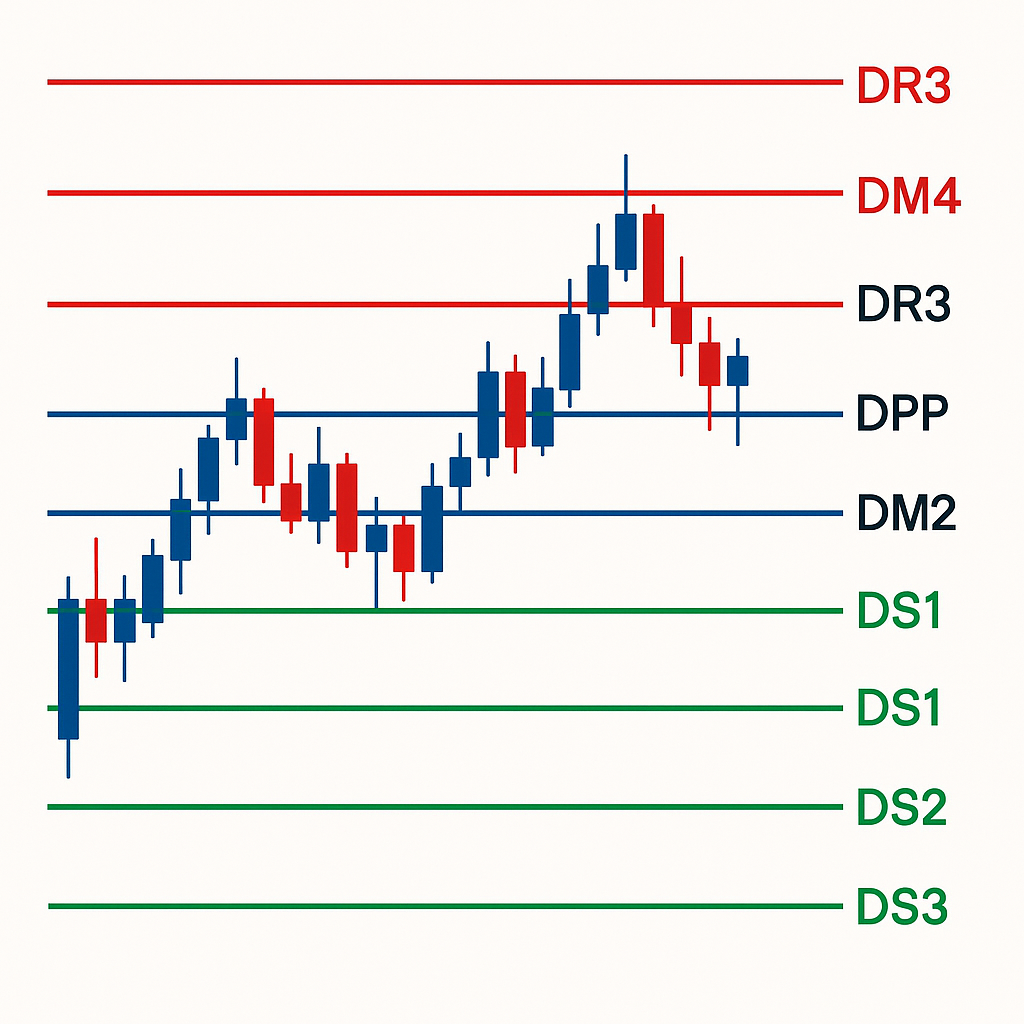
    If you’ve ever sat there staring at your chart thinking, “Where the hell is this thing going?” — welcome to the club. That’s why traders lean on pivot points. They’re not crystal balls. They’re not insider tips from some guy who “knows a guy.” They’re just math.

    But here’s the thing: math works. Pivots give you a framework for where the market might slam on the brakes, do a U-turn, or gun it like a teenager in dad’s Camaro. They’re not guarantees. They’re guideposts. And if you’re trading without them, you’re basically running through a minefield in flip-flops.


    The Mother Pivot

    Everything starts with the Pivot Point (PP) itself. Think of it as the gravitational center of yesterday’s chaos:PP=High+Low+Close3PP=3High+Low+Close​

    That’s it. No secret sauce. Just the average of the high, low, and close. The market’s way of saying, “Here’s the middle ground — now let’s fight about it.”


    The Resistance & Support Gang

    Once you’ve got your pivot, you spin off the levels that traders live and die by:

    • R1 (Resistance 1):

    R1=(2×PP)−LowR1=(2×PP)−Low

    • S1 (Support 1):

    S1=(2×PP)−HighS1=(2×PP)−High

    • R2:

    R2=PP+(High−Low)R2=PP+(High−Low)

    • S2:

    S2=PP−(High−Low)S2=PP−(High−Low)

    • R3:

    R3=High+2×(PP−Low)R3=High+2×(PP−Low)

    • S3:

    S3=Low−2×(High−PP)S3=Low−2×(High−PP)

    Call them “levels,” call them “lines in the sand.” I call them the places you’ll regret ignoring when price slaps you in the face.


    The Midpoints — Because Humans Hate Waiting

    Traders are impatient. That’s why I also plot the midpoints — the halfway houses between the big levels:

    • M1: Between S1 and S2
    • M2: Between S1 and PP
    • M3: Between PP and R1
    • M4: Between R2 and R3

    They don’t get as much hype, but they matter. Markets often pause there, like they’re catching their breath before the next sprint.


    Same Formula, Different Flavor

    Here’s the beauty (or the horror, depending on how you see it): the formulas don’t change. Only the timeframe does.

    • Daily pivots (DPP, DR1, DS1, etc.) → previous day’s OHLC
    • Weekly pivots (WPP, WR1, WS1, etc.) → previous week’s OHLC
    • Monthly pivots (MPP, MR1, MS1, etc.) → previous month’s OHLC

    That’s it. Pivots are universal. Same math, different battlefield.


    Or Skip the Math (Because Life Is Short)

    If you’d rather not do the arithmetic every night like some medieval accountant, I’ve got you covered. I built a simple spreadsheet where you just plug in the open, high, low, and close. It spits out all the pivots for you — daily, weekly, monthly.

    👉 Grab it here and make a copy

    Use it. Abuse it. Just don’t blame me if you ignore the levels and get steamrolled.


    The Bottom Line

    Pivot points won’t make you a genius. They won’t turn your $500 account into a Lambo. But they will give you a reliable map — one that the market respects often enough to keep them on my charts every single session.

    Trading without pivots? That’s like skydiving without checking the parachute. Sure, you might be fine… until you’re not.

    See you in the streams. Bring your helmet.

  • Why Chart Gold on Spot If Futures Drive the Market? Here’s Why.

    Why Chart Gold on Spot If Futures Drive the Market? Here’s Why.

    If you’ve been in the game long enough, you’ve probably noticed something weird:

    Everyone says the big money is trading gold futures—and they’re right.
    But when it’s time to map your pivots, chart your structure, or draw that sweet, sweet trendline, what do most pro traders use?

    Spot gold.

    So what gives?

    Let’s unpack why charting on spot (XAUUSD) is still the move—even if futures (GC1!) are setting the tempo.


    🧭 Spot Is the Anchor

    Spot gold is the market’s baseline consensus price—the global “now” price for an ounce of gold. It trades nearly 24/5, doesn’t expire, doesn’t roll, and doesn’t jump 30 bucks because of a contract change.

    If you’re looking for smooth continuity, spot gives you a chart that behaves like a sane adult. No weird gaps, no surprises at expiration. Just pure price history and structure.

    It’s the equivalent of using a ruler that’s actually straight.


    📉 Futures Drive Flow—But Mirror Spot

    Yes—gold futures dominate volume, especially during the New York session. COMEX is where the whales play. Central banks, hedge funds, algos, the “I moved the market by accident” crowd—they’re doing business in futures.

    But here’s the secret: futures and spot are glued together by arbitrage. If they diverge too far, high-frequency traders pounce. They long one, short the other, and lock in free money until the gap closes.

    Which means your levels on spot still matter, because everyone knows price can’t drift too far from the real-world gold value. And when it does? Smart money just brings it back.


    🧮 Why We Calculate Pivots on Spot

    Pivot formulas—classic, Camarilla, Woodie’s—are almost always built off daily high/low/close values. And on a spot chart, those values are stable, smooth, and globally agreed upon.

    But if you try to run those same calculations on futures during contract roll (when traders shift from one month’s contract to the next), you’ll often get:

    • Confusing price gaps
    • Shrinking or expanding ranges
    • A pivot level that means nothing on the new contract

    Spot gives you clean data. You don’t have to wonder if your S1 is off because COMEX just switched from June to August delivery.


    💡 Real-World Application: What Smart Traders Do

    • Chart on spot. Identify your structure, your supply and demand zones, and your pivots with confidence. It’s cleaner, smoother, and doesn’t play games.
    • Watch futures. That’s where the order flow shows its hand. Especially in the NY session, when GC1! volume spikes, use it to gauge momentum, volatility, and where the institutions are stepping in.

    Think of it like this:

    Futures light the match. Spot shows where the fire will spread.

    And if you understand both? You’re not just playing the game. You’re reading the rulebook while the others are still looking for the board.

  • Why Now Is the Perfect Time to Get Into Trading (Before Everyone Else Does, and Most of Them Quit)

    Why Now Is the Perfect Time to Get Into Trading (Before Everyone Else Does, and Most of Them Quit)

    There are moments in history when it pays to be early. Not just because you beat the rush, but because you’re already built for what comes next, long after the crowd burns out. This is one of those moments.

    As AI begins sweeping across white-collar industries, displacing analysts, marketers, consultants, and managers, a massive shift is coming: millions of people are going to try trading. Some already are. The pandemic was just the preview. What’s coming is bigger, more chaotic, and ultimately—more survivable for those who start now.


    Phase 1 (Now – 2026): The Flood

    AI is coming for jobs. Smart, ambitious people are about to be made redundant in record numbers. They’ll look for new income sources, and guess what keeps popping up on YouTube?

    “Trade from home!”

    “Make money in the markets!”

    “Prop firms will fund you!”

    Combine that with AI tools giving people a false sense of confidence, and you’ll get an explosion of new traders armed with:

    • A ChatGPT script
    • A few backtests
    • A dangerously inflated ego

    These traders will pile into the markets—and promptly get smoked.

    Because trading isn’t about having tools. It’s about having judgment under pressure. And that doesn’t come from TikTok. It comes from screen time, structure, and elite coaching.

    If you start now, you’ll be learning while the crowd is still overconfident. By the time they realize how hard this game really is, you’ll be calm, capable, and eating their exits.


    Phase 2 (2026 – 2028): The Great Washout

    As fast as they come in, they’ll start dropping like flies:

    • Failed prop firm challenges
    • Blown accounts
    • Social media silence
    • Regulation tightening

    Discords die. Reddit gets quiet. Influencers pivot to crypto mining or real estate. Everyone’s burned out or bitter.

    But not you.

    Because you’ve already:

    • Built your process
    • Learned real risk control
    • Tuned your emotional regulation

    You’re not chasing hype—you’re sharpening edge. You’re one of the few left standing, and it shows in your P&L.


    Phase 3 (2028 – 2032): The Thin Air

    By now, most humans have either quit, automated themselves out of trading, or become too afraid to click.

    AI is trading against itself. The market becomes faster, cleaner, colder. Behavioral mistakes are rarer—but when they happen, they’re massive.

    That’s your game now:

    • Fewer trades
    • Bigger size
    • Cleaner reads
    • Precision sniping

    There’s still money—serious money—but only for those who can wait, stalk, and strike without hesitation. Everyone else? Gone.

    And here’s the best part:

    New retail traders will still come in every cycle. Dumb money never dies. It just gets rebranded.


    So Why Get In Now?

    Because if you wait until everyone else floods in, you’ll be learning while they’re flailing.

    If you wait until they all leave, it’ll be too hard to learn.

    But if you start now, you get the best of both worlds:

    • You build competence while volatility is still rich with opportunity
    • You develop confidence while others are developing bad habits
    • You outlast the exodus and rise into the rare air where real traders live

    You won’t win by being faster than the bots. You’ll win by being better than the humans who think they can out-bot the bots.

    That takes a process. A system. And coaching that doesn’t sell you hype.


    One More Thing:

    If you’re going to get into trading right now, make sure you’re learning from people who:

    • Actually trade (not just teach)
    • Understand both human behavior and machine logic
    • Know what it takes to survive the phases ahead

    That’s what we do at The Barcelona Trader. We teach real systems. We coach real traders. And we’re doing it in real time—on Zoom, on stream, in the markets every day.

    If you’re ready to start before the flood and stay long after it recedes, you’re in the right place.

    Let’s build something that lasts.

  • When You Don’t Know What You Don’t Know: The Trader’s Early Years

    When You Don’t Know What You Don’t Know: The Trader’s Early Years

    There’s a special kind of purgatory in trading. Not the blow-up-your-account-on-a-whim kind. I’m talking about the early years. The “I think I might be getting good but also I might be an idiot” phase. The silent, maddening ambiguity of not knowing if your strategy is flawed, the market’s just acting up, or you’re the problem.

    Spoiler: it’s probably all three. But the worst part? You can’t tell.

    If this is you, I’ve got good news and bad news. The good news: you’re not alone. The bad news: that doesn’t make the fog go away.


    Welcome to the Dunning-Kruger Forest, Population: You

    At first, you think you’ve found it—the setup, the edge, the holy grail with three confirmations and a candle pattern that whispers sweet profits into your ear. You win a few trades and suddenly the world makes sense.

    Then you lose. Then you lose again. And now every candle looks like it’s gaslighting you. Your confidence? Gone. Your strategy? A fever dream. Your trading desk? A crime scene.

    The ambiguity of this stage is brutal. You don’t yet have the reps to know if your idea would work in the long run. You haven’t been burned enough to recognize a broken system—or to realize that maybe your system is fine, but you keep throwing your hand on the stove.


    What You Need to Know About Shortcuts

    Here’s where I have to stop you, gently but firmly, and drop a word of caution.

    There are no shortcuts in this game. None. Zero. It doesn’t matter how clever you are or how many motivational YouTube reels you watch and no matter what that scene in Limitless makes you believe, if only you had the right drugs.

    Sure, some people pick things up faster than others—just like some folks can learn a new language in six months while others take six years. But everyone has to learn the grammar, the syntax, the meaning behind the noise. Trading is no different.

    If you’ve come into this because you need to make money fast—or because you’re hoping to be the exception—you’re going to be especially tempted to engineer a shortcut. And the cruel irony is, if you are that one-in-a-million with a special knack, you’ll only know it in hindsight. There’s no reliable way to tell upfront.

    So please hear this: I don’t know a single successful trader who hasn’t blown multiple accounts. Not one. They’ve all had their ‘this is the bottom of the pit’ moments. You are doing yourself a disservice if you don’t give yourself the room to try, fail, and try again.

    Think about how babies learn to walk. There is no such thing as the baby who stands up one day and just struts off across the room like a tiny little Steve Jobs in a diaper. Every single one of them falls. It’s not just expected—it’s how they learn balance, strength, and how to recover.

    Same with trading. If you haven’t fallen down, you don’t even know what you don’t know.


    How to Tell If This Is You

    Here’s a quick check. If you answer “yes” to more than a few of these, you’re in the early fog—and that’s okay:

    • Are you changing your rules every week because “this week’s market was different”?
    • Do you find yourself winning and still feeling confused?
    • Do you lose and immediately go back to the drawing board, convinced your strategy is trash?
    • Do you get shaken out of trades right before they do what you originally expected?
    • Do you feel like trading is 70% technical and 30% sorcery?
    • Are you suspicious that other traders are seeing something you’re not?

    Sound familiar?


    The Real Problem: No Control Group

    In science, if something fails, you rerun the experiment. You isolate variables. You tweak one thing at a time.

    In trading? Good luck. Markets change. Your discipline fluctuates. News bombs drop. And the sample size is never large enough for comfort. So you don’t know if your system works. You don’t know if your edge is real. And that not-knowing will eat you alive if you let it.


    What You Can Do

    Here’s the lifeline: you need structure. Not answers. Not certainty. Structure.

    • Pick a strategy and stick to it for 100 trades.
    • Track everything—setup type, execution, emotion, result.
    • Categorize your losses: was it you, the market, or the system?
    • Revisit only after you’ve collected real data—not vibes.

    And above all, start building the muscle of self-trust. That means obeying your own rules. That means exiting when you said you’d exit. That means not revenge-trading because your feelings got hurt.


    Final Word

    The early years are foggy for everyone. That’s not a failure. That’s the climb. And clarity doesn’t come from brilliance—it comes from endurance, data, and doing the work. The traders who make it through aren’t necessarily the smartest. They’re the ones who kept walking through the fog without throwing away the map.

    If that’s you—keep going.

    You’re not lost. You’re just early.

  • Dear Trader: If You Just Blew Your Account, Read This

    Dear Trader: If You Just Blew Your Account, Read This

    Let me guess:

    You’re staring at your screen right now, heart pounding, trying to make sense of what just happened.

    Your account’s gone—or nearly gone.

    You broke your rules. Again.

    You told yourself this time would be different. That you had it under control. That you were finally “disciplined.”

    But now you’re here.

    Angry. Embarrassed. Maybe even ashamed.

    And some quiet, vicious little voice is asking:

    Are you really cut out for this?

    I know that voice. I’ve heard it too.

    I’ve blown accounts. I’ve taken losses so big they made my chest ache. I’ve looked at the screen and felt like the dumbest person alive for doing exactly what I told myself I wouldn’t do.

    So before you go spiraling—or worse, giving up—read this.

    First: You’re Not Alone

    You’re not the first trader to blow an account.

    You’re not the tenth. Or the hundredth.

    You’re just the one doing it today.

    That doesn’t make you special. It makes you normal.

    Every consistently profitable trader has sat where you’re sitting. The difference is: they didn’t quit, and they didn’t lie to themselves about what had to change.

    This moment isn’t the end of your journey.

    It’s the tuition. And it’s expensive for a reason.

    Second: The Loss Isn’t the Problem

    The amount you lost—$2,000, $12,000, $50,000—that’s not the real problem.

    The real problem is what caused it:

    You ignored your plan.

    You let emotion drive the bus.

    You thought just this once you could outsmart the risk.

    And you didn’t. Because you can’t.

    If you’re serious about becoming a trader, you need to get this through your head:

    Every exception becomes the new rule.

    You make one emotional trade today, you’ll justify another tomorrow.

    And eventually, the market takes its pound of flesh. Always.

    Third: Pain Is a Terrible Teacher… Unless You Listen

    You’re in pain right now. Good.

    That means you care. That means this matters to you.

    But pain without reflection is just suffering.

    If you don’t sit down—right now—and write out exactly what happened and why, you’re not a trader. You’re a gambler with a keyboard.

    Ask yourself:

    • Where did I deviate from my rules?
    • What was I feeling when I did it?
    • What signal did I ignore?
    • What do I never want to feel again?

    Be honest. Be brutal. Be better.

    Fourth: The Only Way Forward Is Through

    You don’t fix this with revenge trades.

    You don’t fix it with a new indicator, a new mentor, or a $1,000 challenge you’re “definitely going to pass this time.”

    You fix it by confronting your weaknesses.

    You fix it by doing the boring stuff: journaling. Logging trades. Setting alarms. Enforcing stop losses even when it feels uncomfortable. Especially when it feels uncomfortable.

    You fix it by becoming someone your future self can trust.

    Last: You Can Still Make It

    I don’t care how bad today was.

    I don’t care how many times you’ve blown it.

    You can still become the trader you set out to be.

    But only if you stop lying to yourself.

    Trading is the most honest mirror you’ll ever look into.

    It reflects exactly who you are under pressure.

    But if you’re brave enough to face that reflection—and change what you see—you will get there.

    And when you do, it won’t feel like a victory parade.

    It’ll feel like calm.

    Like silence.

    Like self-trust.

    That’s what’s waiting for you on the other side of this.

    Now close the chart.

    Stand up.

    And go get it right next time.