Tag: business

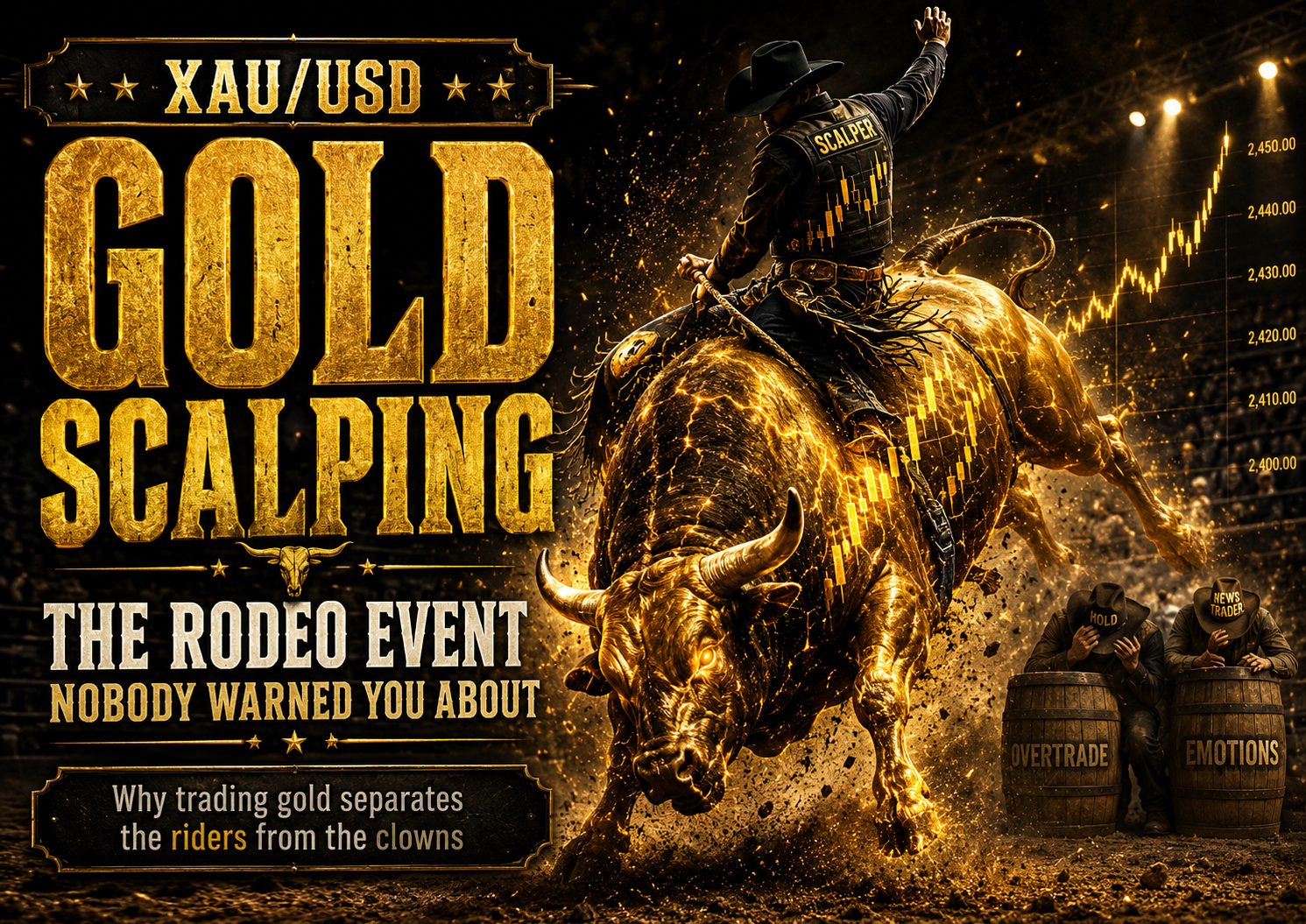
  • Gold Scalping Is the Rodeo Event Nobody Warned You About

    Gold Scalping Is the Rodeo Event Nobody Warned You About

    There are easier ways to trade.

    Let’s get that out of the way first.

    You can swing trade stocks. You can wait for clean daily setups. You can buy an index fund and spend your afternoon pretending you understand wine. You can trade slower markets, wider timeframes, gentler instruments, and strategies where you have the luxury of making decisions like a civilized adult with oxygen in your brain.

    Gold scalping is not that.

    Gold scalping is walking into the rodeo, looking past the pony rides, the funnel cake stand, and the guy selling commemorative belt buckles, and saying:

    “Yeah. I’ll ride that one.”

    The one in the back.

    The one with steam coming out of its nostrils.

    The one that already threw three traders through a fence before breakfast.

    That’s XAU/USD.

    That’s gold.

    And if you scalp it on the 10-second, 1-minute, or 5-minute chart, you are not casually participating in the market. You are strapping yourself to one of the most violent, reactive, macro-sensitive instruments on earth and trying to extract money from it in real time.

    That is not easy.

    That is not beginner trading.

    That is not “just follow the indicator, bro.”

    That is the main event.

    Gold Does Not Care About Your Feelings

    Gold is a beautiful market from a distance.

    On a higher timeframe, it can look almost elegant. Clean trends. Strong levels. Obvious macro themes. Central banks. Inflation. Safe-haven flows. War risk. Fed expectations. Dollar weakness. Yield pressure. All very sophisticated. All very CNBC-friendly.

    Then you drop to the scalping chart and the elegance disappears.

    Now it’s not a market.

    It’s an animal.

    Gold can rip ten dollars in one direction, reverse, fake the reversal, trap both sides, run the stops, pause just long enough to make you think you understand it, and then punch through the level you were using as emotional support.

    Gold does not move politely.

    It does not say, “Excuse me, valued retail trader, I appear to be changing direction.”

    It just changes direction.

    Violently.

    Usually right after you explain to someone why it can’t.

    That is what makes it so difficult. Gold is not driven by one thing. It is pulled around by the dollar, Treasury yields, Fed expectations, inflation data, geopolitical risk, liquidity shifts, central bank activity, and whatever fresh bit of global nonsense just crawled out of the newswire wearing a helmet.

    You are not just trading candles.

    You are trading candles while the macro world throws chairs.

    The Clowns and the Barrels

    Every rodeo has clowns.

    Important job, actually. Brave people. Respect.

    But in trading, the clown role looks a little different.

    These are the traders who jump into the barrel the second price moves against them. They panic. They flatten. They reverse. They revenge trade. They call every normal pullback “manipulation.” They blame the broker, the spread, the market maker, Jerome Powell, the moon cycle, and occasionally the Rothschilds if the drawdown is large enough.

    They want the glory of the ride without the bruises.

    They want to trade gold without being humbled by gold.

    That is not how this works.

    Gold scalping demands a different kind of trader. You cannot be theatrical. The market already has enough drama. You cannot be fragile. Gold will find the fragile part. You cannot be lazy. Gold punishes lazy reads. You cannot be stubborn. Gold is bigger than your opinion, your setup, your indicator, your livestream, and whatever inspirational quote you posted that morning.

    To scalp gold well, you have to become the kind of person who can sit in chaos without becoming chaos.

    That is the game.

    That is the skill.

    That is the rodeo.

    Why Gold Scalpers Are Different

    A lot of traders make decisions slowly.

    Gold scalpers don’t get that luxury.

    We are watching structure, momentum, volume, session timing, liquidity, dollar movement, yields, news risk, volatility, candle behavior, and whether the market is moving cleanly or behaving like a raccoon trapped in a vending machine.

    And we are doing it fast.

    Sometimes in seconds.

    That does not make us better people. Let’s not get carried away. We are still mostly weirdos staring at screens and muttering things like “respect the wick” to no one in particular.

    But it does mean we are training a very specific skill set.

    Gold scalping forces you to become sharper.

    It forces you to read pressure, not just patterns.

    It forces you to understand when a setup is real and when it is just market karaoke — something that looks like the song but isn’t actually the song.

    It forces you to manage fear, greed, hesitation, overconfidence, and that deeply stupid little voice that says:

    “Maybe give it a little more room.”

    That voice has blown more accounts than bad analysis ever has.

    The Biggest Bull in the Arena

    There are traders who prefer calmer markets, and there is nothing wrong with that.

    Not everyone needs to ride the bull.

    Some people should trade slower charts. Some should swing trade equities. Some should invest passively and live happy, normal lives with hobbies and stable blood pressure.

    Bless them.

    But gold scalpers are not built that way.

    We are drawn to the instrument because it is alive. Because it moves. Because it tests us. Because when you are right, it pays. And when you are wrong, it makes sure you understand the terms and conditions.

    Gold is the biggest, meanest bull in the arena.

    It bucks because that is what it does.

    It throws people because that is what it does.

    It humiliates the overconfident, exposes the undisciplined, and charges directly at anyone who thinks a good strategy is a substitute for emotional control.

    And still, we climb on.

    Not because we are reckless.

    At least, not if we plan to survive.

    We climb on because we know that mastering something difficult changes us.

    This Is Worthwhile Because It Is Hard

    There is a reason gold scalping feels different.

    It is not just about money.

    Money matters, obviously. Let’s not pretend we’re here for spiritual enrichment and a tote bag.

    But the deeper reward is what the process demands from you.

    You have to become more disciplined.

    You have to become more honest.

    You have to stop lying to yourself in real time, which is very inconvenient because real time is exactly when most people prefer lying to themselves.

    You have to learn the difference between confidence and impulse.

    You have to learn the difference between patience and paralysis.

    You have to learn the difference between taking a good trade that loses and taking a bad trade that happens to win.

    That last one alone is graduate-level trading psychology.

    Gold scalping is worthwhile because it gives you no place to hide.

    The market gives you immediate feedback. Sometimes generous. Sometimes brutal. Sometimes delivered with the emotional warmth of a parking ticket.

    But if you stay with it, and if you actually respect the craft, you begin to change.

    You stop needing every trade.

    You stop chasing every move.

    You stop treating red candles like personal attacks.

    You stop needing to be right and start needing to be clean.

    That is when the trader starts to emerge.

    The Highlight of the Rodeo

    The gold scalper is not the person watching from the stands.

    The gold scalper is not the guy near the exit saying, “Honestly, I prefer ETFs.”

    The gold scalper is not hiding in the barrel the second price twitches against him.

    The gold scalper is in the middle of the arena.

    Hand wrapped.

    Eyes forward.

    Crowd loud.

    Gate about to open.

    And when it opens, there is no theory left.

    No Twitter thread.

    No backtested fantasy.

    No motivational speech.

    Just you, the market, your rules, your read, and the animal underneath you trying to throw you into next Thursday.

    That is the job.

    That is the challenge.

    That is why this is special.

    Because if you can learn to scalp gold with discipline, patience, humility, and precision, you are not just learning a trading strategy.

    You are learning how to perform under pressure.

    You are learning how to stay composed while money moves against you.

    You are learning how to act without freezing, exit without ego, and win without getting drunk on yourself.

    That skill matters.

    Inside trading and outside of it.

    So yes, there are easier ways to trade.

    There are safer rodeo events.

    There are quieter corners of the market where traders can sip coffee, wait for the daily candle to close, and talk about risk-adjusted returns like they’re discussing cabinet finishes.

    Good for them.

    We wish them well.

    But some of us came for the bull.

    Some of us came for gold.

    And if you are one of those traders — if you have chosen to step into this arena and take on the wildest, meanest, most unforgiving instrument in the show — then understand what that says about you.

    You are not playing small.

    You are not looking for easy.

    You are taking on something genuinely difficult.

    Something worthwhile.

    Something that will humble you before it rewards you.

    And when you finally start riding it clean, even for a few seconds at a time, you will know something most traders never get to know.

    You did not find the easiest game in the market.

    You found the biggest bull.

    And you climbed on anyway.

  • When the AI Machines Start Fighting Each Other

    When the AI Machines Start Fighting Each Other

    You’ve probably heard that AI is going to change the markets.
    What you might not have thought through is this:

    What happens when it’s not just one AI driving price—
    but multiple AIs, run by billion-dollar firms, battling each other in real time?

    Because that’s not the future. That’s the very near present.

    The firms with the deepest pockets—Citadel, Renaissance, BlackRock, Millennium—are already training machine learning systems to read order flow, scrape news, track macro sentiment, and front-run retail behavior.
    But now they’re doing something more:

    They’re training their models to predict and counter other AIs.

    Which means you’re not just trading against machines anymore.
    You’re trading inside a war zone of competing, adaptive machines trying to outmaneuver each other at lightspeed.


    So what does that mean for retail traders?

    Let’s start with the truth:

    Retail trading is not going away.
    But the nature of the opportunity is changing.

    You’re not getting in early on clean textbook breakouts anymore.
    You’re not front-running retail psychology the way you could 10 years ago.
    And you’re definitely not smarter than a Citadel-built LLM trained on six billion data points and four decades of market behavior.

    But—and this is important—you don’t need to be.

    Because as smart as the machines are, they’re not perfect.
    They overshoot. They trigger false moves. They make volatility.
    And in that chaos? Opportunities still exist—if you know where to look and how to survive long enough to act on them.


    What makes retail trading still viable—even in an AI-dominated market?

    1. Liquidity still needs participation.

    Big money needs volume to execute.
    That means retail isn’t just tolerated—it’s part of the ecosystem.
    You provide the order flow that keeps the machine humming.

    2. The machines still create exploitable patterns.

    AI doesn’t make the market cleaner. It makes it faster.
    But every time it fakes out another AI—or clears liquidity—you get structure, price action, and reversion plays.
    If you’re focused and adaptable, those moments are gold.

    3. Speed isn’t the only edge. Timing and restraint are too.

    You’re not going to beat the machines on reaction time. But you can beat other traders on timing, risk control, and patience.
    That’s how you stay alive—and profitable—in the storm.

    4. You’re small. That’s your advantage.

    Big funds can’t scalp in and out of a 20 pip move on gold without moving the market.
    You can.
    Your size makes you nimble. Use that to your advantage.


    So yes—the market is getting more machine-driven.

    It’s going to be faster. Weirder. More unforgiving.

    There will be flash moves that seem senseless.
    Traps that feel personal.
    And setups that used to work… until they don’t.

    But if you’re disciplined, focused, and trading a real edge—not just vibes and hope—you’ll still have space to succeed.

    You just won’t be able to wing it anymore.


    Retail trading isn’t dead. But lazy trading is.
    The machines are fighting each other now.
    Your job is to stay out of the crossfire—and know when to strike.

  • Many Gurus Just Make Up New Words for the Same Trading Terms

    Many Gurus Just Make Up New Words for the Same Trading Terms

    If you’re new to trading and feel like every guru is speaking a different language, you’re not crazy. You’re just surrounded by a bunch of guys trying to copyright Fibonacci.

    Here’s the truth:

    Most of them are describing the exact same things.

    They just rename everything to sound smarter—or to sell you something.

    Let’s decode a few:

    • Supply and Demand ZonesThese are just Support and Resistance with a rebrand.Same zones. Same price reaction. Slightly better graphics.
    • Contraction > Expansion > TrendOr if you’re into Wyckoff: Accumulation > Manipulation > Distribution.Or if you’re into memes: Chop > Fakeout > Dump.Same movie, different subtitles.
    • Liquidity GrabStop hunt. Nothing new here. Just the market doing what it does best:faking you out so it can run the other direction and ruin your morning.
    • ImbalanceA fancy word for “Price moved too fast and left a gap.”You could just say “gap,” but that won’t get you followers on TikTok.
    • Fair Value Gap (FVG)Price might come back here. Or not. Who knows.But call it a Fair Value Gap and suddenly it sounds like Morgan Stanley left a breadcrumb trail for you to follow.
    • Institutional CandleThis is just an engulfing candle, people.JP Morgan didn’t specially handcraft that wick for you. Calm down.
    • Premium and Discount ZonesHighs and lows of a range.In other words: Buy Low. Sell High. Revolutionary stuff, right?
    • Breaker Block vs Order BlockOne faked out. One didn’t. But sure, let’s treat it like a cosmic distinction that unlocks the secrets of the universe.
    • Mitigation ZoneThe market came back to a level and respected it.Otherwise known as… Support. Again.
    • Smart Money Concepts (SMC)This one’s special because it’s just structure, liquidity, and S&R…with attitude.

    None of these terms are wrong. They’re just… dressed up.

    Like putting aviators on a cat and calling it a tiger.

    And the worst part?

    I learned all of this the hard way.

    I spent months—years—listening to every guru, every strategy, every contradictory opinion. I chased one shiny system after another thinking I was missing some crucial piece of the puzzle.

    Turns out, they were all saying the same thing. Just using different vocabulary to sell it as exclusive.

    So if you’re confused, frustrated, or feel like everyone else gets it but you?

    You’re not behind. You’re just at the part of the journey where the fog hasn’t cleared yet.

    Stick with it.

    Pick a language that makes sense to you, and stop jumping ship every time someone on YouTube invents a new term for “price bounced.”

    Because in the end, trading isn’t about knowing every term.

    It’s about knowing yourself.

    And sticking to a system long enough for it to actually work.

    That’s the part no one can sell you.

  • Trading Is Like Learning to Fly—But the Sky Is Made of Data

    Trading Is Like Learning to Fly—But the Sky Is Made of Data

    When you first start trading, you probably imagine yourself mastering price action, calmly executing, and steadily growing your account like a seasoned assassin.

    And then reality hits:
    You spend the first month just figuring out how the hell to arrange your monitors.
    You install indicators you don’t understand.
    You hear terms like RSI, VWAP, MACD, Renko, EMAs—and suddenly it feels like you’re trying to fly a 747 in the dark… with the cockpit manual written in a different language.

    Welcome to the real beginning.

    The truth is, trading is a bit like flying on instruments.

    The market isn’t something you can physically see.
    It’s not a mountain you can climb or a ball you can chase.
    It’s a data stream. A shifting emotional tide. A multi-billion-dollar organism that’s alive, but invisible.

    And your indicators?
    They’re the cockpit instruments telling you where you are—relative to structure, trend, momentum, liquidity. You’re not seeing the market. You’re reading it. Feeling it through dials, lines, and flashing lights.

    And guess what?
    Learning to trust those instruments takes time.

    Because indicators don’t always agree. Sometimes they lag. Sometimes they lead. Sometimes they lie.
    You have to watch what they say when the market does XY, or Z. You have to get a feel for how they behave in motion. That means repetition. Observation. Context.

    Yes, your mentor will help.

    They’ll give you a starting setup. Maybe introduce you to the indicators that work for them.
    But over time, you’ll figure out which ones speak to you.
    Which ones give you confidence.
    Which ones let you breathe.

    And that discovery?
    That’s not the “advanced stage.” That’s the actual learning curve.

    It’s the quiet work that makes the difference between “following a system” and owning your process.

    My setup didn’t happen overnight.

    I tweaked. I replaced. I threw half of it out and started over.
    Eventually, I stopped asking, “What indicator is best?” and started asking:
    “Which one helps me see more clearly—and act more confidently?”

    That’s when it clicks.
    That’s when your station becomes yours.
    That’s when you stop flying blind—and start flying on feel, with instruments that were built around your brain.

    So yeah—don’t rush it.
    Your mentor’s system is your launchpad.
    But your real edge? That gets built dial by dial, over time, by you.

    Update: I have written a follow-up to this piece here.