There are easier ways to trade.
Let’s get that out of the way first.
You can swing trade stocks. You can wait for clean daily setups. You can buy an index fund and spend your afternoon pretending you understand wine. You can trade slower markets, wider timeframes, gentler instruments, and strategies where you have the luxury of making decisions like a civilized adult with oxygen in your brain.
Gold scalping is not that.
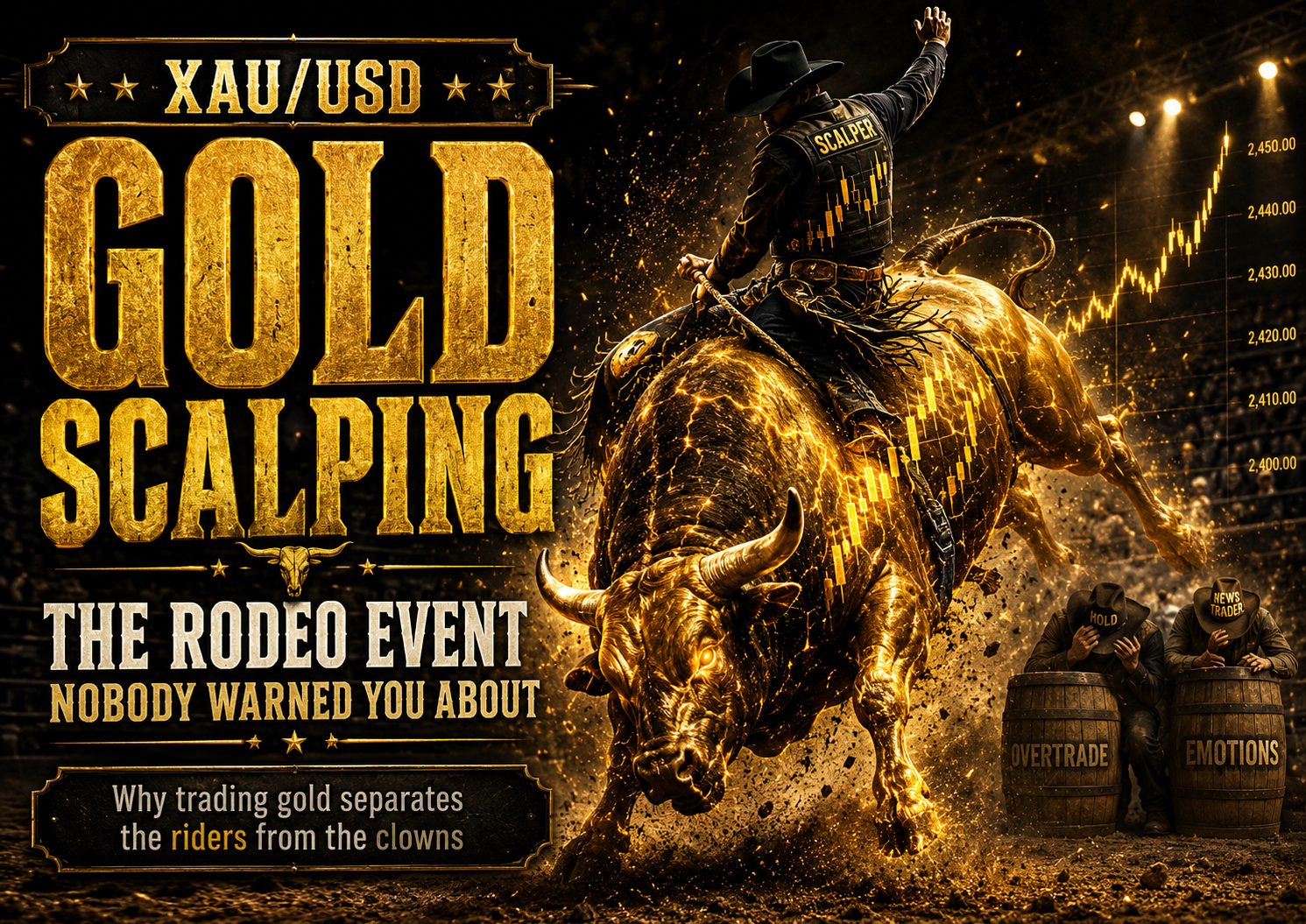
Gold scalping is walking into the rodeo, looking past the pony rides, the funnel cake stand, and the guy selling commemorative belt buckles, and saying:
“Yeah. I’ll ride that one.”
The one in the back.
The one with steam coming out of its nostrils.
The one that already threw three traders through a fence before breakfast.
That’s XAU/USD.
That’s gold.
And if you scalp it on the 10-second, 1-minute, or 5-minute chart, you are not casually participating in the market. You are strapping yourself to one of the most violent, reactive, macro-sensitive instruments on earth and trying to extract money from it in real time.
That is not easy.
That is not beginner trading.
That is not “just follow the indicator, bro.”
That is the main event.
Gold Does Not Care About Your Feelings
Gold is a beautiful market from a distance.
On a higher timeframe, it can look almost elegant. Clean trends. Strong levels. Obvious macro themes. Central banks. Inflation. Safe-haven flows. War risk. Fed expectations. Dollar weakness. Yield pressure. All very sophisticated. All very CNBC-friendly.
Then you drop to the scalping chart and the elegance disappears.
Now it’s not a market.
It’s an animal.
Gold can rip ten dollars in one direction, reverse, fake the reversal, trap both sides, run the stops, pause just long enough to make you think you understand it, and then punch through the level you were using as emotional support.
Gold does not move politely.
It does not say, “Excuse me, valued retail trader, I appear to be changing direction.”
It just changes direction.
Violently.
Usually right after you explain to someone why it can’t.
That is what makes it so difficult. Gold is not driven by one thing. It is pulled around by the dollar, Treasury yields, Fed expectations, inflation data, geopolitical risk, liquidity shifts, central bank activity, and whatever fresh bit of global nonsense just crawled out of the newswire wearing a helmet.
You are not just trading candles.
You are trading candles while the macro world throws chairs.
The Clowns and the Barrels
Every rodeo has clowns.
Important job, actually. Brave people. Respect.
But in trading, the clown role looks a little different.
These are the traders who jump into the barrel the second price moves against them. They panic. They flatten. They reverse. They revenge trade. They call every normal pullback “manipulation.” They blame the broker, the spread, the market maker, Jerome Powell, the moon cycle, and occasionally the Rothschilds if the drawdown is large enough.
They want the glory of the ride without the bruises.
They want to trade gold without being humbled by gold.
That is not how this works.
Gold scalping demands a different kind of trader. You cannot be theatrical. The market already has enough drama. You cannot be fragile. Gold will find the fragile part. You cannot be lazy. Gold punishes lazy reads. You cannot be stubborn. Gold is bigger than your opinion, your setup, your indicator, your livestream, and whatever inspirational quote you posted that morning.
To scalp gold well, you have to become the kind of person who can sit in chaos without becoming chaos.
That is the game.
That is the skill.
That is the rodeo.
Why Gold Scalpers Are Different
A lot of traders make decisions slowly.
Gold scalpers don’t get that luxury.
We are watching structure, momentum, volume, session timing, liquidity, dollar movement, yields, news risk, volatility, candle behavior, and whether the market is moving cleanly or behaving like a raccoon trapped in a vending machine.
And we are doing it fast.
Sometimes in seconds.
That does not make us better people. Let’s not get carried away. We are still mostly weirdos staring at screens and muttering things like “respect the wick” to no one in particular.
But it does mean we are training a very specific skill set.
Gold scalping forces you to become sharper.
It forces you to read pressure, not just patterns.
It forces you to understand when a setup is real and when it is just market karaoke — something that looks like the song but isn’t actually the song.
It forces you to manage fear, greed, hesitation, overconfidence, and that deeply stupid little voice that says:
“Maybe give it a little more room.”
That voice has blown more accounts than bad analysis ever has.
The Biggest Bull in the Arena
There are traders who prefer calmer markets, and there is nothing wrong with that.
Not everyone needs to ride the bull.
Some people should trade slower charts. Some should swing trade equities. Some should invest passively and live happy, normal lives with hobbies and stable blood pressure.
Bless them.
But gold scalpers are not built that way.
We are drawn to the instrument because it is alive. Because it moves. Because it tests us. Because when you are right, it pays. And when you are wrong, it makes sure you understand the terms and conditions.
Gold is the biggest, meanest bull in the arena.
It bucks because that is what it does.
It throws people because that is what it does.
It humiliates the overconfident, exposes the undisciplined, and charges directly at anyone who thinks a good strategy is a substitute for emotional control.
And still, we climb on.
Not because we are reckless.
At least, not if we plan to survive.
We climb on because we know that mastering something difficult changes us.
This Is Worthwhile Because It Is Hard
There is a reason gold scalping feels different.
It is not just about money.
Money matters, obviously. Let’s not pretend we’re here for spiritual enrichment and a tote bag.
But the deeper reward is what the process demands from you.
You have to become more disciplined.
You have to become more honest.
You have to stop lying to yourself in real time, which is very inconvenient because real time is exactly when most people prefer lying to themselves.
You have to learn the difference between confidence and impulse.
You have to learn the difference between patience and paralysis.
You have to learn the difference between taking a good trade that loses and taking a bad trade that happens to win.
That last one alone is graduate-level trading psychology.
Gold scalping is worthwhile because it gives you no place to hide.
The market gives you immediate feedback. Sometimes generous. Sometimes brutal. Sometimes delivered with the emotional warmth of a parking ticket.
But if you stay with it, and if you actually respect the craft, you begin to change.
You stop needing every trade.
You stop chasing every move.
You stop treating red candles like personal attacks.
You stop needing to be right and start needing to be clean.
That is when the trader starts to emerge.
The Highlight of the Rodeo
The gold scalper is not the person watching from the stands.
The gold scalper is not the guy near the exit saying, “Honestly, I prefer ETFs.”
The gold scalper is not hiding in the barrel the second price twitches against him.
The gold scalper is in the middle of the arena.
Hand wrapped.
Eyes forward.
Crowd loud.
Gate about to open.
And when it opens, there is no theory left.
No Twitter thread.
No backtested fantasy.
No motivational speech.
Just you, the market, your rules, your read, and the animal underneath you trying to throw you into next Thursday.
That is the job.
That is the challenge.
That is why this is special.
Because if you can learn to scalp gold with discipline, patience, humility, and precision, you are not just learning a trading strategy.
You are learning how to perform under pressure.
You are learning how to stay composed while money moves against you.
You are learning how to act without freezing, exit without ego, and win without getting drunk on yourself.
That skill matters.
Inside trading and outside of it.
So yes, there are easier ways to trade.
There are safer rodeo events.
There are quieter corners of the market where traders can sip coffee, wait for the daily candle to close, and talk about risk-adjusted returns like they’re discussing cabinet finishes.
Good for them.
We wish them well.
But some of us came for the bull.
Some of us came for gold.
And if you are one of those traders — if you have chosen to step into this arena and take on the wildest, meanest, most unforgiving instrument in the show — then understand what that says about you.
You are not playing small.
You are not looking for easy.
You are taking on something genuinely difficult.
Something worthwhile.
Something that will humble you before it rewards you.
And when you finally start riding it clean, even for a few seconds at a time, you will know something most traders never get to know.
You did not find the easiest game in the market.
You found the biggest bull.
And you climbed on anyway.