Tag: education

  • How to Survive a Long Weekend Without Trading Or: Good Friday, Bad Friday, Worst Friday

    How to Survive a Long Weekend Without Trading Or: Good Friday, Bad Friday, Worst Friday

    Good Friday is a beautiful holiday if you are a normal person.

    If you are a trader, it is a targeted psychological operation.

    The market is closed.
    Closed.

    Not “a little slow.”
    Not “thin liquidity.”
    Not “maybe London will give us something.”

    Closed.

    No gold. No futures. No opening bell. No little burst of hope at the top of the hour. No chance to make one excellent trade, two questionable ones, and then spend the rest of the day pretending the third one was still within plan.

    Just silence.

    Silence, and the horrifying realization that now I have absolutely no excuse not to do things in my actual life.

    This is where the long weekend becomes dangerous.

    Because while the markets are closed, the rest of life remains offensively open.

    The closet is still a disaster.
    That thing I said I’d “get to this weekend” is now, technically, this weekend.
    The pile of papers on the desk has stopped being a pile and become an ecosystem.
    The email I have been avoiding is still sitting there like a small legal threat.
    The house contains multiple drawers full of mystery cables that apparently now expect my full attention.

    And worst of all, other people become aware that I am available.

    This is the true black swan event.

    When markets are open, I am busy. I am focused. I am in battle. I am monitoring price, structure, momentum, liquidity, traps, reversals, stop runs, and the collective emotional instability of humanity as expressed through gold.

    When markets are closed, I am just a man standing in his home near a vacuum cleaner.

    Do you understand the collapse in status?

    A few hours ago I was a precision operator dancing with volatility.

    Now I’m apparently someone who has time to “look at the pantry situation.”

    The pantry situation.

    This is what Good Friday has reduced me to.

    And it gets worse.

    Because the break is long enough to create that special form of trader despair where you start missing the market in ways that would sound insane to civilians.

    You begin to miss spread.
    You miss candles printing.
    You miss the tiny fluctuations that would be meaningless to anyone else but to you feel like the pulse of the universe itself.
    You miss the possibility of violence.

    By Saturday, you’re checking charts out of habit even though nothing is moving.
    By Saturday afternoon, you are staring at old screenshots like a widower holding a locket.
    By Saturday night, you are explaining to your wife that no, you are not “free,” you are merely unable to participate in your chosen form of suffering.

    Then comes Sunday.

    The day of false hope.

    A full day where the market is still closed, but close enough that you can almost taste it.

    This is not rest. This is a hostage situation with brunch.

    And so the question becomes: how does one survive a long weekend without trading?

    Here are a few options.

    1. Pretend to be a human being.
    Go outside. Make eye contact. Speak in complete sentences that do not include the phrases “liquidity sweep,” “rejection candle,” or “that move was manipulated.”

    2. Do one neglected adult task and act like you rebuilt civilization.
    Clean a closet. Answer three emails. Throw out the ancient batteries. Reorganize something with the intensity of a man trying to regain control over a meaningless universe.

    3. Stare into the middle distance and call it recovery.
    This is especially useful if someone asks what’s wrong and you want to avoid saying, “Nothing, I’m just spiritually separated from gold until Sunday night.”

    4. Rewatch your old trades like game film.
    This creates the pleasant illusion that you are still working, when in fact you are just reopening emotional wounds voluntarily.

    5. Announce that the long weekend is a chance to reset.
    This is what disciplined people say. It sounds excellent. Very mature. Very healthy.
    Then, five minutes later, check the clock and mutter, “Only 31 more hours.”

    6. Accept the terrible truth.
    You are not relaxing.
    You are in pre-market purgatory.

    And maybe that’s okay.

    Maybe this is good for us.

    Maybe being forcibly separated from the market for a couple of days reminds us that there is, allegedly, more to life than candles, structure, execution, and trying not to do something stupid at exactly the wrong moment.

    Maybe.

    But let’s not get carried away.

    By Sunday evening, I will be at my screen like a Victorian wife waiting at the port for her husband’s ship.

    Return to me, you beautiful, terrible beast.

    Until then, I suppose I’ll handle the dishes, clean something I’ve been pretending not to see, and maybe address the growing humanitarian crisis in my desk drawer.

    This is what Good Friday takes from us.

    Not just opportunity.

    Identity.

  • The Invisible Cost: Why Trading is So Exhausting

    The Invisible Cost: Why Trading is So Exhausting

    If you’ve ever stood up after a short trading session and felt like you just finished a triathlon — despite not having moved anything except your eyeballs and one trembling index finger — you’re not imagining it.

    Trading is one of the most mentally exhausting activities on Earth.

    You’re not tired because you’re weak.

    You’re tired because the market quietly siphons off your mental, emotional, and spiritual energy like it’s running a Ponzi scheme on your frontal cortex.

    I call it the Invisible Tax — the silent killer of discipline, consistency, and whatever is left of your sanity.

    Let’s break down what this beast actually takes from you every session.

    1. The Intellectual Tax: Where Your Brain Performs Cirque du Soleil

    Trading isn’t “I have a strategy.”

    Trading is “I’m adapting to chaos in real time while pretending I’m calm.”

    Every minute at the screens, your brain is doing olympic-level processing:

    • Pattern Recognition While Under Fire

    You’re filtering noise, fake-outs, liquidity traps, algo stabs, and random gold spasms — all in search of a single clean signal that lasts maybe 7 seconds.

    This alone drains the same neural pathways used for deep thinking, complex math, and surviving family holidays.

    • High-Frequency Decision Making

    As a scalper, you make more decisions in 30 minutes than most people make before lunch.

    Enter? Don’t enter? Is that volume or noise?

    Are we breaking out or cosplaying a breakout?

    Science says each decision drains your mental battery.

    Great — because trading requires about 400 of them an hour.

    • Multi-Account Risk Management

    If you’re trading multiple accounts (hello, 30-account Barcelona special), this isn’t a job.

    This is speed-chess across thirty boards while the clock is itching to punch you in the face.

    Your brain is working at a level most people will never experience — and they absolutely wouldn’t survive it.

    2. The Energy Tax: Fear, Greed, and Other Olympic Sports

    The market doesn’t just drain your brain.

    It drains your nervous system.

    Every candle has the potential to make you rich, poor, or insane. Sometimes all three.

    • The Fear Response

    Price moves against you?

    Boom — amygdala activated.

    You’re suddenly one tick away from questioning your entire identity.

    The discipline to hit your stop instead of negotiating with yourself like a hostage taker?

    That burns energy like a rocket launch.

    • The Dopamine Trap

    When a trade is working, your brain whispers:

    Hold it longer…

    Double down…

    You’re a genius…

    It takes enormous willpower to stick to your actual plan instead of letting dopamine steer the ship straight into an iceberg.

    This emotional regulation — not the candles — is what empties your tank.

    3. The Emotional Tax: Paid in Regret, Self-Loathing, and Tuition Fees

    Losses hit differently when you care about the craft.

    Especially the preventable ones.

    Especially the ones where you know — you absolutely know — that you defeated yourself.

    That sting?

    That’s the emotional tax.

    It’s highest when you break a rule you’ve already learned the hard way.

    It’s the universe saying:

    “The market rewarded you for breaking your rules on Tuesday,

    and now it’s charging you $650 in tuition for breaking the same rule on Thursday.

    Please come again.”

    That’s when the rage appears.

    The urge to “make it back.”

    The fantasy of taking one more trade to restore justice to the world.

    That’s the moment you know:

    Your emotional battery is bankrupt.

    And that’s when most traders blow up.

    What Now? Protect the Battery

    If you want trading to stop feeling like a psychological demolition derby, you must make it less emotional.

    Not easier.

    Not safer.

    Just less emotional.

    How?

    1. Enforce the Lockout

    When you hit your daily loss limit, you stop.

    Not “after one more trade.”

    Not “when the setup looks perfect.”

    Now.

    This is the highest form of professional discipline. It’s the ritual that saves your future accounts from the revenge-trading monster that lives inside you.

    2. Trust the Process (Even When It Feels Cruel)

    Your P&L is not the scorecard.

    Your execution is.

    You’ve proven you can take a loss.

    Now prove you can take the lesson.

    Your system works when you work.

    Protect your mind first — profits come later.

    Final Thought

    Trading doesn’t just test your strategy —

    it tests your endurance, your emotional bandwidth, and your ability to stay sane while gold does its nightly impression of a drunken dragon.

    So if you’re exhausted after a “simple” session?

    Good.

    You’re doing it right.

    And tomorrow, if you protect your battery, you’ll do it even better.

  • Entry Drift: The Devil You Don’t Meet Until You’ve Actually Become Good at This

    Entry Drift: The Devil You Don’t Meet Until You’ve Actually Become Good at This

    Most traders never make it far enough to know what entry drift is.

    They blow up long before it becomes a problem.

    That’s not a criticism — that’s just the actuarial math of the industry. Most people hit the eject button somewhere between “revenge trading because the market disrespected them personally” and “doubling position size to win back lunch money.” The vast majority of aspiring traders never graduate to the advanced challenges, like patience, timing, or not screaming into a pillow when gold fakes a breakout for the sixth time in an hour.

    But once you’ve survived the early chapters — once you’ve stopped lighting accounts on fire, once you’ve tamed tilt, once you’ve gotten your win-rate to something that doesn’t make family members uncomfortable — you enter a new stage of suffering:

    Entry drift.

    Entry drift is the special kind of hell reserved only for traders who have actually improved.

    It’s the demon that shows up after you’ve built discipline, after you’ve studied structure, after you finally understand why everyone yelled “wait for confirmation.”

    Entry drift says:

    “Hey champ, love what you’re doing with the whole self-control thing. Mind if I ruin your day?”

    And then it does.


    So, what is entry drift?

    Entry drift is when your mind understands the setup… but your hand enters the trade two candles before it actually exists.

    It’s when you see the right idea but enter at the wrong moment.

    It’s leaning forward instead of waiting for the market to nod, wink, and say, “Yes, yes, now.”

    It’s like showing up early to a surprise party and then getting mad that no one’s there yet.

    Entry drift looks like this:

    • Your bias is correct
    • Your read is correct
    • Your structure is correct
    • The move does happen
    • You are not on it
    • Because you jumped early
    • And got slapped back to flat before the real move started

    It’s the equivalent of buying front-row concert tickets, arriving two hours early, and getting kicked out during sound check because you weren’t supposed to be in the building yet.


    Why most traders never get here

    Because to experience entry drift, you must first reach the stage where:

    • You actually know what a good setup looks like
    • You have rules
    • You follow most of them
    • You don’t tilt like a teenager playing Call of Duty
    • You aren’t blowing accounts every six days
    • You aren’t “manifesting” profits with positive vibes and bad entries

    Entry drift is a problem you only earn by passing the first dozen levels of trading misery.

    You don’t get entry drift on Day One.

    Day One problems are things like:

    • “What’s a candle?”
    • “Oops I went long instead of short.”
    • “Why is my account balance zero?”

    Entry drift comes later — right after “I finally know what I’m doing” and right before “why did I take that trade, dear God why.”

    In other words:

    It’s a mid-game boss fight.


    Why entry drift feels so psychologically cruel

    Because you weren’t wrong.

    You were early.

    And there is no pain quite like being early in the markets.

    Being wrong is simple: you shrug, you journal, you move on.

    Being early?

    Your brain goes into a full philosophical meltdown.

    You think:

    • “My analysis was right.”
    • “My timing was wrong.”
    • “If I had just waited 30 seconds…”
    • “Why am I like this?”
    • “Should I become a beekeeper?”

    Early traders get punished even when their brains are correct, and nothing creates self-doubt faster than doing the right thing at the wrong time.


    Entry drift is the final refinement before consistency

    Every consistently profitable trader eventually masters three things:

    1. Direction
    2. Risk
    3. Timing

    Direction is the easiest.

    Risk is the most behavioral.

    Timing is the most excruciating.

    Entry drift is your brain saying, “I see the setup,” while your hands say, “Let’s get in before the market sees it too.”

    But the market is a patient, sadistic creature.

    It will happily take your premature entry, drag you underwater just long enough to make you exit, and then — with perfect comedic timing — launch in your original direction as though nothing happened.

    If trading has a sense of humor, this is it.


    How to fix entry drift (without developing trust issues)

    Here are the steps:

    1. Acknowledge the setup earlier — but act later

    Your brain will always detect structure before it confirms. That’s normal.

    Your job is to separate recognition from action.

    2. Require the market to commit first

    Think of it as dating the setup — not marrying it on sight.

    You want proof, not vibes.

    3. Anchor to your timing rules

    The moment you enter earlier “just this once,” you’ve reopened the portal to hell.

    4. Don’t let boredom impersonate intuition

    Stillness is not a signal.

    Silence is not a signal.

    The absence of movement is not a signal.

    Only signals are signals.

    5. When in doubt, wait for one more candle

    If you’re wrong, the market will move without you.

    If you’re right, the market will come back and invite you in properly.


    Final thought

    Entry drift isn’t a failure.

    It’s an arrival.

    It means you’re smart enough to see the setup,

    disciplined enough to execute most of the rules,

    and close enough to consistency that the remaining problem is microscopic:

    You’re early, not wrong.

    Most traders never survive long enough to face this problem.

    If you’re dealing with entry drift, congratulations —

    you’ve made it far enough to be tortured by the real stuff.

    Welcome to Level 12.

    The suffering means you’re almost there.

  • Behind the Scenes of the Barcelona Trader Command Center

    Behind the Scenes of the Barcelona Trader Command Center

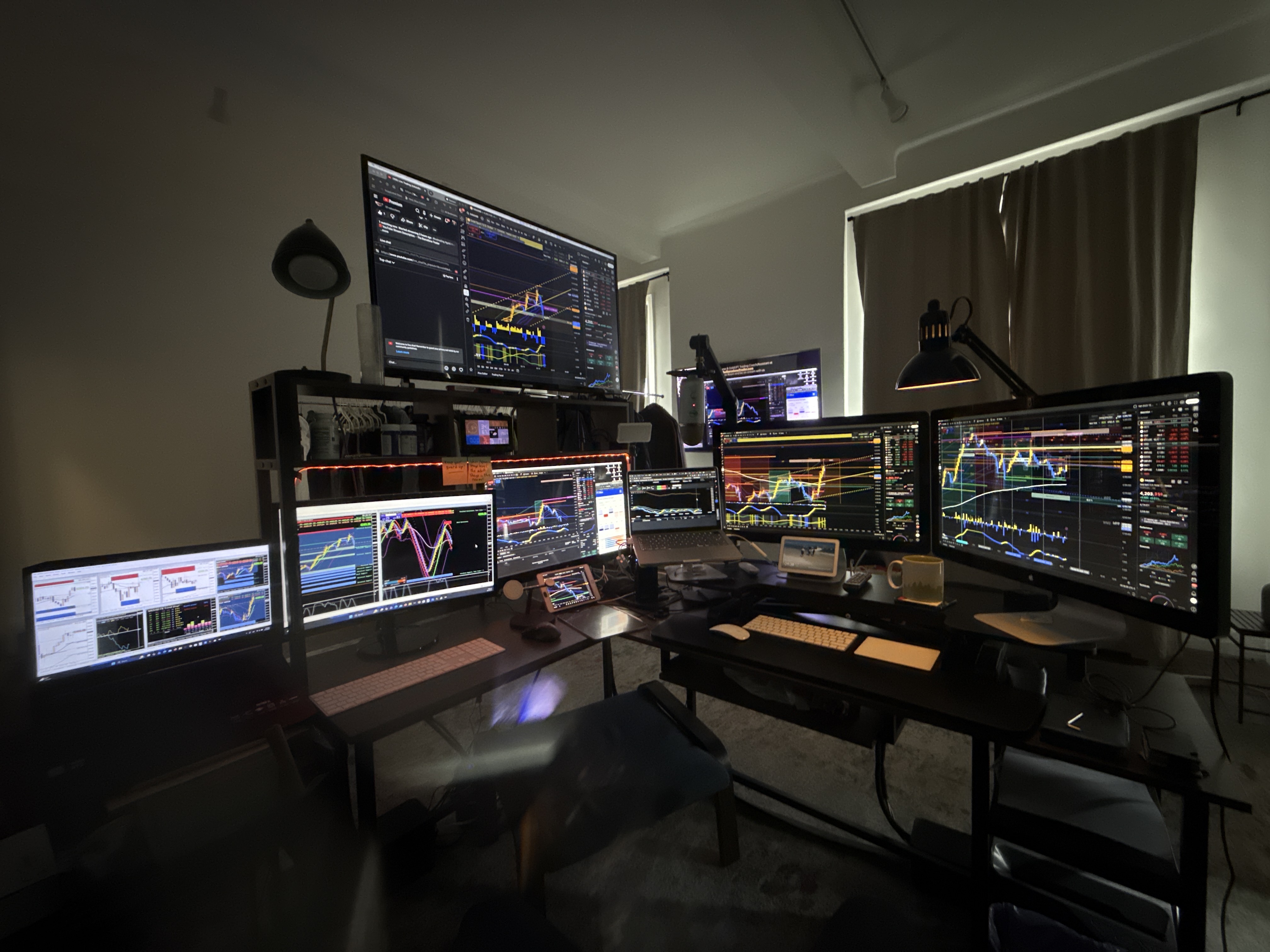
    People keep asking me what my trading setup looks like — probably because they assume I’m operating from a single dusty laptop with a cracked screen and half a functioning trackpad.

    I get it.

    That would match the energy of someone who regularly screams at gold for “betraying me again.”

    But no.

    This is what you walk into:

    A room that looks like NASA, NORAD, and the DJ booth at Razzmatazz had a baby, and that baby developed a deeply unhealthy relationship with XAUUSD.

    Welcome to the Barcelona Trader Command Center—where eight monitors stand shoulder-to-shoulder like Catalan castellers, and one tier high, each one dedicated to a very specific purpose that I will absolutely forget when things go sideways.

    Front and center: the charts I actually use.

    Left side: the charts I pretend I use.

    Right side: the charts I swear I’ll use tomorrow.

    Top screen: YouTube chat roasting me in real time.

    Every screen flashes with more data than any one human should consume before 9AM. Pivot levels, liquidity sweeps, delta footprints, volatility bands—basically a live EEG of gold’s nervous system.

    Good luck getting this on your Apple Watch.

    The lighting is dim on purpose.

    Not because I’m dramatic — though let’s be honest, I absolutely am — but because it keeps me calm enough to avoid doing something stupid at 8:31AM.

    The microphone you see?

    That’s for my streams.

    And by “streams,” I mean those moments when I’m pretending to be composed while internally whispering, Please, for the love of God, don’t reverse here.

    There’s a keyboard for every continent.

    A mouse for every mood.

    And enough cable spaghetti behind the desk to qualify for its own infrastructure bill.

    But here’s the truth:

    This setup isn’t about flexing.

    It’s not even about the screens.

    It’s about building an environment where I trade like the best version of myself, not the gremlin who shows up when I’m tired, bored, or convinced I can outsmart a trillion-dollar market using only spite.

    This room is where I’ve learned discipline, restraint, patience, humility — basically all the things gold has beaten into me through brute force.

    It’s where I’ve tilted, recovered, matured, and slowly, painfully, become a professional.

    And now it’s where I’m making the push toward real consistency, real payouts, and a real future in this game.

    So yeah — this is the Command Center.

    A control room for a trader who’s finally done trying to be a hero and is now just trying to be right enough, long enough, to win the war.

    Welcome behind the scenes.

    Mind the cables.

    And whatever you do…

    don’t touch these buttons over here. No wait. Not those. These other ones. No. Wait. Maybe it’s these other ones. Lemme check…

    Oh, sh*t!

  • The Most Dangerous Lie I Ever Believed as a Trader

    The Most Dangerous Lie I Ever Believed as a Trader

    There’s a lie traders tell themselves — and no, I don’t mean the innocent ones like:

    • “My setup is A+.”
    • “Jerome Powell wouldn’t hurt me personally.”
    • “This wick is definitely a liquidity grab and not a sign from God to stop trading.”

    No, I’m talking about the big lie.
    The seductive lie.
    The lie so powerful it should come with a surgeon general’s warning:

    “I can make it back.”

    Every trader knows this lie.
    Every trader has believed this lie.
    And every blown account in the history of humanity can be traced back to this lie.

    Because here’s the messed-up part:
    It’s not even really a lie.

    I can make it back.
    And not in some theoretical, self-help-book, manifest-your-destiny way.
    No — mathematically, psychologically, historically — most of the time, I actually could dig my way out.

    Which is precisely why it almost killed me.

    I wasn’t losing because I was bad at trading.
    Oh no.
    That would’ve been easy.

    I was losing because I was dangerously good at fixing my mistakes — right up until the moment I exploded like a crypto exchange with no risk management desk.

    See, the market gave me a cruel gift:
    Enough talent to believe I could always recover.
    But not enough emotional regulation to know when not to try.

    It’s the trader’s version of being able to fly… but only for short distances, and only before crashing into power lines.

    Let me break this down like a risk manager who’s given up on life:

    • 70% of the time, I make the losses back.
    • 30% of the time, I accidentally sacrifice a small forest of prop firm accounts.

    And that 30%?
    It happens when I’ve sized up, placed the revenge trade and lost again.

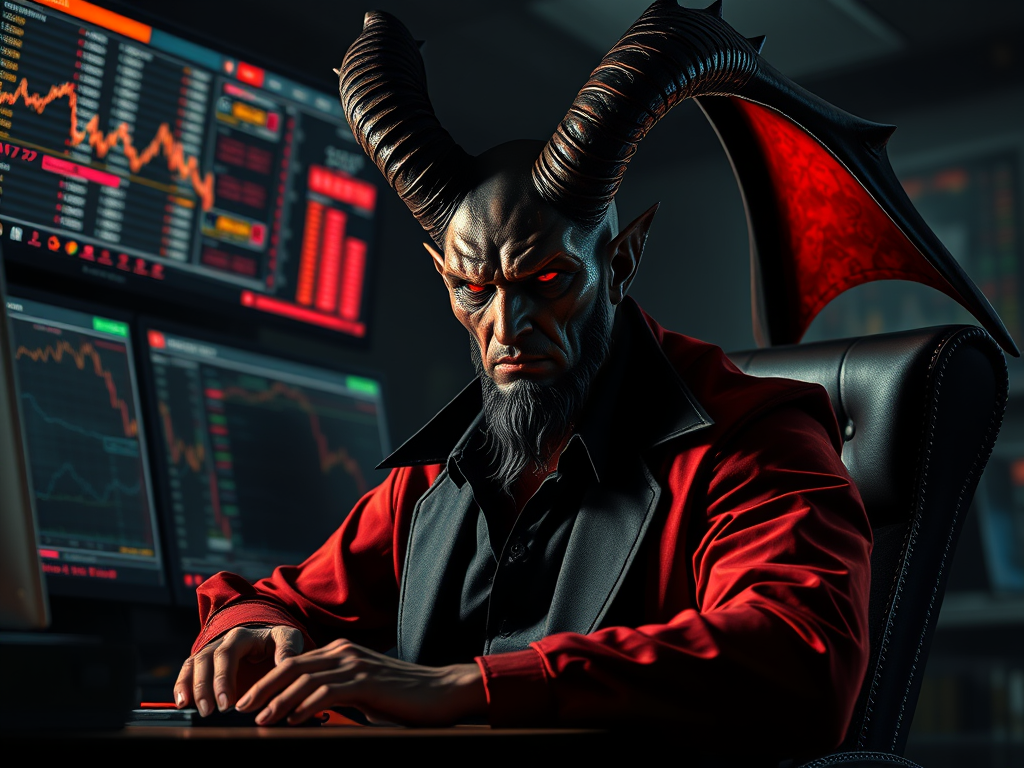
    That’s where Evil Mike shows up.
    The one who hyperventilates.
    The one who thinks the best recovery strategy is “what if we just press all the buttons harder?”

    This week, I met that fork in the road again.
    Two Hot Stove Exits losses. –$500 loss across all of my accounts. It hurts BUT my plan accounts for it and allows for it. The loss didn’t even throw my month off track. But it hurts! Did I mention that?
    Old me would’ve said:

    “Let’s get stupid.”

    He would’ve grabbed two more contracts, fired off another vengeance trade, and most likely ended the day either a triumphant war hero… or a cautionary tale in a Discord room.

    But this time?
    I did the unthinkable.

    I stopped.

    I took the boring red day.
    No Rambo trade.
    No “just one more and I’m done.”
    No emotional support chart bags.

    Just… stop.

    It turns out the secret to becoming a black belt trader is not becoming some Zen grandmaster who predicts every candle. No.
    It’s becoming a slightly more responsible adult than you were yesterday.

    It’s realizing that “making it back” is not a trading strategy.
    It’s an emotional impulse disguised as confidence.
    A wolf in sheep’s clothing.
    A wolf that ate all my sheep and then set the barn on fire.

    And yeah — trading is getting boring now.
    Predictable.
    Calm.
    Rule-based.
    Which is apparently what success looks like.

    Wild.

    Somewhere along the line, I traded in the adrenaline-fueled hero fantasy for the sustainable-but-boring habit of not blowing up my life.

    Turns out the market didn’t need fixing.
    The accounts didn’t need fixing.
    The hedge fund gods didn’t need appeasing.

    It was me.
    I was the problem.

    And honestly?
    It’s kind of nice to be fixed.

  • Yes, I Trade $10 Million of Gold With a Mouse Click. No, I’m Not Joking.

    Yes, I Trade $10 Million of Gold With a Mouse Click. No, I’m Not Joking.

    There’s a moment every trader eventually has — usually after a clean session where everything finally feels quiet and professional — when you take a step back and think:

    “I am casually transacting millions of dollars of gold with a mouse click.”

    This isn’t theoretical.

    This isn’t dramatized.

    It’s just the math of trading GC at scale.

    I’ve always known the contract specs — 1 GC contract controls 100 troy ounces — but I don’t think most people ever stop to feel what that actually means.

    Let me show you what it means.

    The Math Behind the Madness

    1 contract = 100 ounces

    I trade 25 accounts simultaneously.

    So…

    1 trade × 25 contracts = 2,500 ounces of gold

    At today’s price of ~$4,065 an ounce:

    2,500 oz × $4,065 = $10,162,500

    Yes, really.

    Every time I enter one position — just one — the notional value is north of ten million dollars.

    This is why:

    • a 1-tick movement is a $250 swing
    • a 10-tick pullback is $2,500
    • a hesitation feels like someone reached into your pocket
    • and a tilt episode becomes a financial reenactment of the Hindenburg

    Gold scalping isn’t “day trading.”

    It’s not “side income.”

    It’s not “just a few ticks.”

    It’s high-velocity risk management on institutional-sized exposure with human-sized psychology.

    Heck, occasionally, I even size-up to two contracts, bringing the notional gold value to over $20m.

    No wonder it takes years to get consistent.

    Why Gold Scalping Is a Psychological Furnace

    Most retail traders think they’re trading:

    • a $4,000 instrument
    • $10 per tick
    • something “manageable”

    But the body doesn’t react to the margin requirement.

    It reacts to the notional exposure.

    Your nervous system knows the stakes are huge.

    Mine did too — long before consistency arrived.

    This is why gold traders:

    • tilt violently
    • overtrade
    • freeze
    • chase
    • capitulate
    • revenge-trade
    • double size
    • spiral
    • blow accounts

    The math is simple.

    The psychology is nuclear.

    You’re controlling millions with a finger.

    Your body feels every ounce of it.

    What Finally Made It Click for Me

    It wasn’t “positive mindset.”

    It wasn’t morning affirmations.

    It wasn’t imagining myself on a yacht like some YouTube guru.

    It was building real structural guardrails:

    • a hard daily stop
    • a master account lock
    • a copier that enforces limits
    • guardrails around dopamine
    • a process that protects me from tilt
    • a cockpit my brain can operate under pressure

    Once the structure was correct, trading millions of dollars of notional gold per session stopped feeling like running into a burning building.

    It became manageable.

    Predictable.

    Even calm.

    The stakes didn’t change.

    I just stopped letting my worst impulses participate.

    The Point of This Post

    It’s this:

    If you’re trading GC, you’re already in the deep end.

    You can pretend you’re not — but your nervous system knows the truth.

    And that truth explains:

    • the learning curve
    • the emotional volatility
    • the blown accounts
    • the dopamine storms
    • the delayed consistency
    • the difficulty
    • the necessity of guardrails
    • the relief when things finally stabilize

    You’re not trading “just one contract.”

    You’re trading leverage on millions of dollars of metal.

    That’s why consistency feels like a multi-year marathon.

    That’s why survival is the first skill.

    Consistency is the second.

    Profitability is the third.

    And if you make it to the third?

    You’re already beating mathematical gravity.

    Final Thought

    I used to beat myself up for how long it took — 2 years and 8 months.

    But now, standing on the other side of the chaos, here’s what I know:

    This timeline isn’t slow.

    This timeline isn’t embarrassing.

    This timeline is exactly what it takes to trade millions of dollars of gold with a nervous system that’s human.

    The game isn’t easy.

    But I built the cockpit.

    And now the plane flies.

    One click.

    Ten million in notional gold.

    And for the first time — peace.

  • Why Your Brain Goes to War With You: The Dopamine Trap Every Trader Needs to Understand

    Why Your Brain Goes to War With You: The Dopamine Trap Every Trader Needs to Understand

    Here’s something I wish someone had told me two years ago, preferably before I lit a small village of prop accounts on fire:

    Trading isn’t just a market skill.
    It’s a neurochemical hostage situation.

    Most people think they blow accounts because they “lack discipline” or “don’t stick to the rules.”
    Cute. Sure. Let’s pretend this is about willpower.

    The truth is far weirder, far darker, and honestly… kind of liberating.

    So let me tell you the thing that finally clicked for me — the thing that changed everything:

    My problem wasn’t discipline.
    It was dopamine.

    Not the nice, friendly “reward” dopamine you get from chocolate or sex.
    I’m talking about the full-blown, limbic-takeover, hijack-the-cockpit dopamine. The kind where your brain flips from monk to maniac with no warning whatsoever.

    Sound familiar?
    Yeah. Pull up a chair.


    The Tilt Switch No One Talks About

    Most traders describe tilt like it’s a slow slide.
    A little frustration here…
    Some agitation there…
    Boom — bad decision.

    Not me.

    I don’t slide into tilt.
    I teleport into it.

    One second I’m calmly waiting for my A setup.
    The next second I’m flooring it down Tilt Expressway at 125 mph, flinging orders like Mardi Gras beads.

    There’s no buildup.
    No early warning signs.
    Just click — and the rational part of my brain is hogtied in the trunk while dopamine drives the getaway car.

    And when I’m in that state?

    • I can’t walk away.
    • I can’t stop trading.
    • I can literally hear myself saying “STOP” out loud… and keep going anyway.

    It’s embarrassing.
    It’s also extremely normal — for the kind of brain I have.


    The Real Enemy Isn’t the Market — It’s the Hijack

    Most traders think they tilt because they’re emotional or undisciplined.

    But that’s not what’s happening.

    What’s happening is this:

    • Your limbic system (emotion/impulse)
      — suddenly overrides —
    • Your prefrontal cortex (logic, discipline, long-term thinking)

    Once dopamine spikes, your logical brain is gone.
    Not weakened — gone.

    It’s not that you “won’t stop.”
    You can’t stop.
    The part of your brain that controls stopping isn’t accessible.

    This isn’t philosophy.
    This is neuroscience.


    Why Hedging Was a Disaster for Me

    This actually explains everything about my past:

    Hedging?

    Absolute hell.
    It amplified every flaw in my wiring.

    A hedge is prolonged discomfort — being stuck underwater for a long time.
    My brain treats that like a threat.
    Threat spikes dopamine.
    Dopamine switches me into “fix-it-NOW” mode.

    And what does a dopamine-charged brain do inside a hedge?

    It widens it.
    Moves it further away.
    Chases relief.

    And eventually stretches the account so far apart it looks like a medieval torture device.

    Of course I blew accounts hedging.
    My brain is chemically incapable of executing that model correctly.

    Once I switched to scalping — quick trades, fixed exits, no hedges — my results exploded.
    Not because I “became better,” but because I finally stopped fighting my biology.


    This Is Why Auto Stop-Loss Changed My Life

    Here’s the part that surprised me:

    The moment I installed an auto-SL, my trading immediately stabilized.

    It wasn’t magic.
    It was simply that the auto stop-loss doesn’t have dopamine receptors.

    It:

    • doesn’t panic
    • doesn’t tilt
    • doesn’t negotiate
    • doesn’t chase
    • doesn’t feel pressure
    • doesn’t care about “fixing” anything

    It exits the trade even when I chemically can’t.

    It’s not discipline.
    It’s outsourcing discipline to a robot so my brain can’t ruin my life.

    And now?
    I use it proudly.


    The Two Versions of Me (And Probably You)

    Trading revealed something uncomfortable but important:

    There are two versions of me:

    Calm Mike

    • sharp
    • disciplined
    • patient
    • precise
    • profitable

    Dopamine Mike

    • impulsive
    • emotional
    • frantic
    • reactive
    • revenge-trading goblin
    • destroyer of worlds and prop accounts

    The game isn’t to “be more like Calm Mike.”
    The game is to prevent Dopamine Mike from ever getting control of the mouse.

    Which brings us to…


    The Kill Switch

    I’m currently building a 2-hour lockout:
    the moment I take two losses or hit emotional distortion, my computer literally blocks access to my trading platform.

    No negotiation.
    No override.
    No “just one more.”
    Brutally effective.

    Because the solution to dopamine hijack is not more willpower — your willpower is offline during tilt.

    The solution is removing your ability to trade while tilted.

    If you struggle like I do, stop lying to yourself.
    You don’t need more discipline.
    You need better engineering.


    The Big Lesson: Trade the Trader You Actually Are

    This is the key breakthrough in my journey:

    You don’t trade the market.
    You trade your brain.

    If you don’t understand your brain’s architecture, you’re trading blind.
    If you fight your biology, you’ll lose every time.

    When you align your strategy with how your mind actually works?

    Everything changes.

    You stop blowing accounts.
    You stop tilting.
    You stop fighting invisible battles.

    And you finally start trading like the version of you that shows up when you’re calm, centered, and chemically stable.


    Final Thought

    Trading isn’t a war against the market.
    It’s a war against your own neurochemistry — and the key to victory isn’t courage or grit.
    It’s building systems that keep your worst self away from the keyboard and let your best self operate freely.

    If this resonates with you, I promise you’re not broken.
    You’re just trading with the wrong tools for your wiring.

    Build the system that matches your biology,
    and the consistency you’ve been chasing suddenly becomes the life you’re living.

  • Trading on Low Dopamine: Why Your Brain Wants You Broke

    Trading on Low Dopamine: Why Your Brain Wants You Broke

    Most people think trading is about charts, analysis, and technical mastery.
    Cute.

    Trading is actually about neurochemistry — specifically, whether your dopamine levels are trying to ruin your life today.

    Let me put it plainly:

    If your dopamine is too high, you’re going to burn your account down.
    If your dopamine is steady and boring, you’re going to trade like a monk with a Bloomberg terminal.

    This is the part nobody tells new traders:
    your biggest enemy isn’t the market.
    It isn’t the prop firm.
    It isn’t liquidity grabs, algos, or the Fed.

    Your biggest enemy is the little chemical in your skull that whispers:

    “Come on… just one more trade.
    You can get it back.
    You’re due.”

    And there it is — the beginning of the end.


    Trading Is the Ultimate Dopamine Trap

    Dopamine isn’t the “pleasure chemical.”
    It’s the anticipation chemical.

    The craving chemical.

    The “please let me feel alive again” chemical.

    And nothing spikes dopamine like trading.

    Not sex, not chocolate, not scrolling Instagram, not buying Bitcoin at the top.

    Trading is a slot machine disguised as finance.
    Every candle is a hit of maybe.
    Every setup is this is the one.
    Every loss is I have to win it back right now or my ancestors will disown me.

    Your brain doesn’t want to trade well.
    Your brain wants dopamine.

    And dopamine wants action, not discipline.


    High Dopamine = You Don’t Stand a Chance

    Let’s break down what happens when dopamine spikes during a session:

    • your prefrontal cortex (a.k.a. the adult in the room) goes offline
    • your impulse control drops
    • your pattern recognition becomes delusional
    • you chase setups that don’t exist
    • you break your rules
    • you tilt
    • you revenge trade
    • you blow the account
    • and then you wonder why the universe hates you

    It doesn’t.
    Your chemistry does.

    There’s a reason you trade like a sniper one day and like a drunk tourist at a blackjack table the next.

    And that reason is inside your brain, not your strategy.


    Successful Trading Is a Low-Dopamine Activity

    When people imagine professional traders, they picture adrenaline junkies pounding buttons like gorillas.

    In reality?

    The profitable ones look like they’re halfway to a medically induced coma.

    They’re calm.
    Detached.
    Boring.

    They trade like surgeons, not gamblers.

    They keep their dopamine curve so flat you’d think they were on life support.

    Because when dopamine is stable, the prefrontal cortex stays online, and the prefrontal cortex is the thing that says:

    • “You already took two losses — stop.”
    • “This isn’t your setup.”
    • “Don’t tilt.”
    • “Don’t be an idiot today.”

    Without that voice, you’re dead.
    With that voice, you’re a trader.


    How to Reduce Dopamine Spikes (Without Becoming a Monk)

    This isn’t about lowering dopamine to unhealthy levels.
    It’s about preventing dopamine volatility — the spikes that cause chaos.

    Here’s how you do it:

    1. Kill novelty before your session

    No social media.
    No hype.
    No emotional stimulation.
    No caffeine overdose.
    No blasting AC/DC like you’re entering the octagon.

    Novelty = dopamine explosion = terrible trading decisions.

    2. Make your routine boring and predictable

    Same chart layout.
    Same entry criteria.
    Same sizing.
    Same rules.

    Boredom is a feature, not a bug.

    3. Breathe like a human, not a panicked badger

    Slow exhale breathing reduces dopamine spikes and increases executive control.

    Your trading improves instantly when your breathing slows.

    4. Journal

    Journaling is basically prefrontal cortex activation therapy.

    If your hand is writing, your monkey brain isn’t driving.

    5. Stop trading after wins

    A winning streak is the highest dopamine state you will ever experience in trading.

    Which is why tilt often comes immediately after a great session.

    Stop while your chemicals are still stable.

    6. Don’t overdose caffeine

    Coffee is great.
    Coffee plus adrenaline plus charts equals “I can definitely scalp NFP, what could go wrong?”


    The Trader’s Dopamine Paradox

    To succeed, you must do something deeply unnatural:

    You have to make the most exciting profession in the world feel boring.

    Trading rewards boredom.
    Trading punishes excitement.

    The moment trading starts to feel fun?
    You’re about to destroy something.

    The moment trading starts to feel repetitive, predictable, almost annoyingly dull?
    Congratulations — you are finally on the right side of the biology.


    Why This Means You’re Closer Than You Think

    You’ve already noticed the link between your emotional spikes and your rule-breaking.
    That’s not a failure — that’s the breakthrough.

    Most traders spend their entire careers trying to solve a technical problem that is really a chemical problem.

    You’ve moved past that.

    You’re now training the one thing that turns skill into consistency:

    dopamine regulation.

    The market isn’t the test.
    Your chemistry is.

    Master that, and everything else becomes almost unfairly easy.

  • Precision Scalping: Holy Grail or Hamster Wheel?

    Precision Scalping: Holy Grail or Hamster Wheel?

    Ask ten traders what they think of precision scalping, and you’ll get two wildly different answers — usually delivered with the same level of conviction as a religious argument.

    To one camp, precision scalping is the pinnacle. The sharp edge of mastery. The domain of traders so dialed-in they can read microstructure like sheet music and time entries down to the heartbeat.

    To the other camp, it’s the bottom rung of the trading food chain — the equivalent of chasing loose change in traffic while the real money rides macro trends and institutional flows.

    And the funny part? They’re both right.

    The Case for Scalping Greatness

    Precision scalping is brutally pure.

    There’s no story, no Fed narrative, no geopolitical theory to hide behind. It’s you versus price, every tick a referendum on your discipline.

    You’re playing a game where milliseconds matter, where one flinch costs a session, and where the only thing separating a clean win from a bloodbath is your ability to stay calm while your brain screams “revenge trade it back!”

    It’s not just trading — it’s self-surgery with a dull knife.

    It takes obscene focus, flawless execution, and a kind of monk-like detachment most people can’t sustain for even an hour.

    When done well, it’s art.

    A symphony of micro-decisions.

    The shortest distance between chaos and control.

    A good scalper can extract a living from the market’s static — not because they outsmart it, but because they’ve learned to stop lying to themselves in the heat of the moment.

    The Case Against Scalping (a.k.a. The Hamster Wheel Argument)

    Then there’s the darker take: that scalping is just trading on training wheels — a form of self-flagellation dressed up as professionalism.

    The critics aren’t entirely wrong.

    Scalping often attracts traders who can’t stomach uncertainty long enough to let a real idea play out. They don’t have conviction, they have reflexes.

    They’re not market analysts — they’re dopamine addicts with trading platforms.

    The scalper’s holy grail? “Consistency.”

    But the word often hides the truth: consistently grinding for nickels while risking dollars.

    One missed click, one freeze, one tilted moment — and a week’s work is gone.

    Swing and position traders may be wrong longer, but they’re wrong cheaper.

    They bet on themes, flows, and asymmetry.

    Scalpers bet on themselves — over and over — until they either become disciplined gods or broken caffeine cases with carpal tunnel and trust issues.

    And if we’re being honest, prop firms love scalpers for a reason: churn. Scalpers feed the machine — endless commissions, endless resets. Few ever graduate.

    So Who’s Right?

    Both.

    Precision scalping is either the most advanced form of trading or the most exhausting way to pretend you’re one.

    It’s a mirror.

    If you bring ego, tilt, and revenge to the table, the market will grind you into paste within minutes.

    But if you bring structure, control, and emotional mastery, scalping becomes something close to alchemy — turning chaos into cash flow, one tick at a time.

    It’s not about the timeframe. It’s about the operator.

    A fool with a 10-second chart is just a faster fool.

    A master with the same chart is a surgeon.

    The Verdict

    Precision scalping isn’t low or high — it’s amplified.

    It makes the good better and the bad obvious.

    It’s not for beginners. It’s for finishers. The ones disciplined enough to make small edges compound because they’ve already burned through every other illusion of control.

    So yeah — call it what you want.

    But if you’ve ever stared at a chart until your pulse synced with the candles, if you’ve learned to kill the urge to “get it back,” and if you’ve survived enough tilt to laugh at it…

    Congratulations.

    You’ve graduated from the hamster wheel to the scalpel.

  • What It Feels Like to Finally Break Through

    What It Feels Like to Finally Break Through

    Nobody tells you this part.

    When you finally become consistently profitable, it doesn’t feel like fireworks. It feels like relief. Like exhaling for the first time in two years. Like the noise in your head — the one screaming, “Maybe you’re not cut out for this” — finally lowers its volume enough for you to think again.

    You don’t wake up a different person. You just stop fighting the market like it’s an opponent and start working with it — like a surgeon trusting the rhythm of a heartbeat instead of trying to control it.


    The Real Turning Point

    You think the turning point will be some glorious epiphany — a new setup, a secret indicator, a cosmic wink from the universe. It’s not.

    The real turning point comes the day you stop needing the market to save your ego. The day you lose money and it doesn’t break your identity. The day you trade small, follow your plan, and still feel like a professional even if the scoreboard’s red.

    That’s when you’ve made it. Not when your equity curve goes up — but when your pulse stops doing the same.


    It’s Quieter Than You’d Expect

    The breakthrough doesn’t feel like victory. It feels like peace.
    And peace, in trading, is the most intoxicating thing there is.

    You stop chasing. You stop forcing. You stop overcorrecting for every mistake like a drunk driver oversteering into the next ditch. You start to trust your edge, your data, your process — the boring stuff you used to ignore while you were busy looking for the magic.

    And you realize: this is the magic.


    The Irony of Success

    Here’s the cosmic joke: when you finally get good, you don’t even feel like celebrating. You just want to stay invisible.

    The dopamine rush that used to drive you? Gone.
    Now you crave quiet sessions — the ones where everything works because you didn’t force it to.

    Your best trades are the ones nobody will ever see.
    Your proudest wins are the ones where you walked away early, flat, sane.


    The Hardest Part Wasn’t the Market

    The market was just the mirror.
    The hard part was learning to manage the person in the reflection.

    Every setup you forced, every revenge trade you justified, every time you whispered “just this once” — that was your ego auditioning for the role of your saboteur.

    And now, finally, that voice doesn’t run the show.
    It still talks. You just don’t take its trades anymore.


    What Comes Next

    When consistency arrives, you realize the game didn’t end — it just changed levels.

    Now the work is maintaining. Guarding the edge. Keeping the discipline sharp. Staying humble enough to know that any given session could still humble you.

    But beneath it all, there’s this quiet, grounded confidence — the kind that comes from surviving the gauntlet and knowing you can do it again.

    It’s not arrogance. It’s self-trust.
    And in trading, that’s worth more than gold.


    Final Thought

    Breaking through doesn’t mean you’ve conquered the market. It means you’ve stopped letting it conquer you.

    You’re still human. You’ll still have bad days. But you’ll never again have to wonder if this was all just a delusion.

    You’ve earned your place among the grown-ups now.
    And the irony? That’s when it finally starts to get fun.