Tag: self-improvement

  • How to Fail as a Trader(A helpful guide for anyone trying to burn their dreams to the ground)

    How to Fail as a Trader(A helpful guide for anyone trying to burn their dreams to the ground)

    Let’s flip this thing.

    Charlie Munger—Warren Buffett’s famously cranky sidekick—used to preach a concept called inversion:

    “Tell me where I’m going to die, that way I’ll never go there.”

    So, instead of asking how to succeed in trading, let’s explore the more entertaining route:
    How to absolutely, unequivocally FAIL.
    Blow it. Flame out. Wreck your accounts, your confidence, and possibly your marriage.

    Ready? Let’s begin.


    Step 1: Trade When You’re Bored

    Forget waiting for real setups. If the chart is open and you’ve got fingers, it’s showtime.
    Better yet—trade while checking Discord, eating lunch, and watching other traders on YouTube.
    The market rewards divided attention, right?


    Step 2: Hold Your Losers (Because Hope Is a Strategy)

    Once it goes against you, double down on optimism.
    Tell yourself it’s just a “deep pullback.”
    Talk to it like a plant.
    Wait long enough and you’ll either be right… or margin called.


    Step 3: Ignore Your Hot Stove Exit

    You created it for a reason.
    Now ignore it for no reason.
    Tell yourself this time is different.
    Keep burning your hand and wondering why your trading confidence is toast.


    Step 4: Start Sharp, Finish Stupid

    Nail your first few trades. Then get cocky.
    Loosen your rules.
    Scale up.
    Try something “new” mid-session.
    Finish the day with regret and a self-pity burrito.


    Step 5: Abandon the Setup When It Doesn’t Work

    That A+ breakout setup failed? Time to declare it dead.
    Don’t bother with probabilities or long-run edge.
    Just chase whatever worked five minutes ago for that guy on YouTube.


    Step 6: Attach Your Self-Worth to Your P&L

    If you made money, you’re a genius.
    If you lost money, you’re a fraud.
    Your entire identity should swing on a 3-minute candle.


    Step 7: Don’t Journal Your Bad Sessions

    That’s too painful. Just pretend it didn’t happen.
    Better yet, gaslight your future self by only recording the wins.
    Future-you will love not knowing what went wrong.


    Step 8: Compare Yourself to Other Traders

    Especially the ones with Lambos in their thumbnails.
    They’re definitely showing their real P&L.
    You’re clearly behind.
    Panic accordingly.


    Step 9: Break the Rules That Just Saved You

    The structure worked yesterday, so obviously today it’s optional.
    Wing it. Trust your gut.
    You’re due, after all.


    Bonus Step: Take It All Very Personally

    This isn’t just trading. This is your worth.
    Your legacy.
    Your last shot at proving you’re not a complete disappointment.
    No pressure.


    So… Want to Succeed Instead?

    Then do the opposite.

    • Trade when the setup earns it.
    • Exit when the risk says so.
    • Let your edge breathe.
    • Treat process like religion.
    • Feel the feelings—but don’t trade the feelings.
    • And journal like your future self is trying to avoid your current mistakes.

    Inversion exposes the rot.
    Now you know what it looks like.
    Walk the other way.

    And if you’re not sure which way that is, we can help.
    This is exactly what we coach—every day, in real time, with real skin in the game.

    Let’s not just survive. Let’s build something that lasts.


  • Want to Blow Your Trading Account? Just Try Harder

    Want to Blow Your Trading Account? Just Try Harder

    In most high-performance arenas—sports, business, even creative work—when you’re behind, you can fight your way back.

    You refocus.
    You push harder.
    You create the next opportunity to score.

    A basketball player gets scored on? They sprint down the court and attack the rim.
    A founder loses a client? They jump on five sales calls and close the next one.
    Even a musician bombs a set? They lock themselves in the studio and come out sharper.

    Effort becomes the antidote to failure.

    But in trading?

    Effort gets you killed.

    You can’t hustle a setup into existence.
    You can’t push harder and force your way back into the green.
    You can’t attack the market and expect it to reward your grit.

    In fact, the more emotionally urgent it feels to act—the more dangerous it is to do anything.


    The Tools That Built You Will Break You Here

    If you’re wired like me, this is maddening.

    Because you’ve spent your whole life outworking your setbacks.
    Pain meant it was time to move.
    Discomfort meant it was time to do something.

    But in trading, those instincts betray you.

    • The urge to act becomes overtrading.
    • The urge to prove yourself becomes revenge trading.
    • The urge to fix things becomes refusing to exit a loser.

    It’s like being in a boxing match where the only winning move is to keep your gloves up and wait—not strike. Even when you’re hurt. Even when the crowd is jeering. Even when you know you could land one clean shot if you just swung.

    That’s what makes this game harder—and greater—than anything I’ve ever done.


    Here, Discipline Is Effort

    When you’re down in trading, the best thing you can do is often the hardest thing:

    Nothing.

    • You pause.
    • You obey the system.
    • You exit the trade even though your gut is screaming “Wait!”

    It doesn’t feel like effort.
    There’s no adrenaline spike. No high-five moment.
    Just silence and self-control and the long, slow build of mastery.

    But that invisible effort?
    That’s what gets you funded. That’s what makes this a career, not a phase.


    If You’re Wired to Win, This Will Hurt Before It Heals

    So if you’re reading this, and you’ve spent your whole life turning pressure into performance, just know:

    Trading doesn’t care how hard you try.
    It only cares whether you wait to strike.

    That’s the test.
    And if you can pass it, the game does reward you—massively.

    But only if you can endure the one thing that most high performers never learn to sit with:

    Discomfort without action.

    That’s the real work.
    And the ones who master that?

    They don’t just win trades.
    They become unshakeable.

  • The Discomfort You’re Trying to Escape Is Exactly Where Mastery Lives

    The Discomfort You’re Trying to Escape Is Exactly Where Mastery Lives

    Here’s a brutally honest truth about trading that almost nobody tells you when you start:

    It’s going to make you feel like absolute hell.

    Not every time. Not forever. But for long stretches, especially when you’re closing in on real consistency. That’s when the internal war gets loud.

    • You’ll feel anxiety rise in your chest.
    • You’ll feel shame over mistakes.
    • You’ll feel desperate to “fix” losses quickly.
    • You’ll feel the overwhelming urge to just feel better right now.

    And if you’re like most people, you’ll instinctively search for anything that offers relief — news, analysis, someone to talk to (even an AI), a revenge trade, anything to pull you out of that discomfort.

    That’s the trap.

    Because trading mastery isn’t about eliminating that discomfort.

    It’s about learning to trade inside it.


    Your brain thinks it’s protecting you.

    What you’re feeling in those moments isn’t weakness — it’s biology. The same emotional wiring that kept our ancestors alive on the savannah is now screaming at you while you sit at your desk looking at flashing candles.

    “You’re in danger.

    Get out of this trade.

    Fix that loss.

    Do something — anything — to stop feeling this.”

    This is why we freeze. This is why we hesitate. This is why we revenge trade. This is why we exit too early.

    And this is why most people will never succeed at trading.


    The mission isn’t to feel better.

    This is the single most important shift:

    You don’t need to eliminate the discomfort.

    You need to execute cleanly in its presence.

    That’s it.

    You execute anyway.

    You follow your exit rule anyway.

    You honor your process anyway.

    You let the emotional discomfort scream, and you simply refuse to negotiate with it.


    The ironic part?

    Over time — and only through repetition — your brain starts to trust you. It learns that the discomfort isn’t fatal. That you’re safe even when losing. That you’re capable of holding the tension without needing to fix it instantly.

    That’s when you wake up one day and realize:

    “I still feel the tension, but it doesn’t control me anymore.”

    That’s how real traders are built.


    So if you’re in that stage right now — scared, frustrated, raw, hyper-aware of every mistake — understand this:

    You’re not broken.

    You’re not failing.

    You’re standing directly inside the forge where true mastery is made.

    The discomfort you want to escape is exactly where your edge lives.

  • The Final Frontier – Your Trading Psychology

    The Final Frontier – Your Trading Psychology

    When you’re just starting out in trading, everyone tells you the real challenge is “psychology.”
    They’re not wrong.
    They’re just… premature.

    Because if you’re a beginner, chances are psychology isn’t your biggest problem yet.
    At that stage, your biggest problem is that you don’t actually know what you’re doing.

    • You’re guessing at setups
    • You don’t know your edge
    • You have no defined risk
    • And your “trading plan” is whatever someone on YouTube said looked good last night

    Let’s call it what it is: you’re still in technical bootcamp.
    You don’t need a sports psychologist—you need to stop hitting buy because a candle “looked bullish.”

    But… once you’ve been at this a while—once you’ve got a system, you understand structure, you’ve journaled trades, maybe even passed an eval or two—then yeah…

    That’s when psychology becomes the final boss.

    It sneaks in after you’ve already done the hard part.
    And suddenly, you are the last thing standing between your system and your results.

    Not the chart. Not the Fed.
    Not Jerome Powell sneezing mid-sentence.
    You.

    This is the final frontier. And it’s a mindf*ck.

    Because now it’s not about knowledge—it’s about control.
    It’s about execution under pressure.
    It’s about making the right decision while your brain is telling you to do the opposite.

    So what can you do?


    🧠 Here are a few ways to start mastering your own psychology:

    1. Trade smaller
      If your hands are shaking, your size is too big. Period.
    2. Pre-plan your trade
      Define your entry, stop, and target. If it’s not on paper, it’s improv.
    3. Journal everything
      And I mean everything. Not just what you did—but how you felt.
    4. Take breaks after losses
      Your next trade shouldn’t be emotional triage.
    5. Create hard rules for max daily loss
      One rule can save you from one bad day nuking your month.
    6. Check your mental state before every session
      Hungry? Angry? Rushed? You’re compromised. Don’t trade compromised.
    7. Use alarms instead of staring at the chart
      Give your nervous system a chance. Constant screen watching = constant cortisol.
    8. Focus on process, not outcome
      Did you follow your plan? That’s the win. The P&L comes later.

    A Great Video You Should Watch

    I recently came across a fantastic breakdown of this topic by The Traveling Trader—and I’ve got to say, he nails it.
    The way he explains the psychological shifts, the traps, and the actionable tools is legit. It’s not fluff. It’s not a motivational speech. It’s real.

    So if this post hits a nerve—and you know psychology is what’s holding you back right now—go watch his video. I’ve embedded it below.

    👇👇👇
    Watch it. Rewatch it. Bookmark it. And then do the work.
    Because the chart won’t save you.
    Your plan won’t save you.
    Only you, with a calm brain and a click-ready finger, will.

  • The Part No One Talks About

    The Part No One Talks About

    There’s a part of the trading journey that almost no one warns you about.

    It’s not the beginning—when you’re reckless and euphoric and think you’re going to master the markets in six months.
    It’s not the blow-up phase either—when you burn an account and realize this game isn’t as easy as the YouTubers made it look.

    No, this part is later.
    This part is worse.

    It’s when you’re doing almost everything right… and it still isn’t showing up in your P&L.

    You’re finally sticking to your plan.
    You’re not revenge trading.
    You’re managing risk.
    You’re walking away when the market’s not clean.
    You’re doing all the internal work—but the external results still suck.

    This is the part where it’s darkest before the dawn.

    It’s brutal. Because the dopamine is gone. The chaos is behind you. But the consistency hasn’t paid off yet.

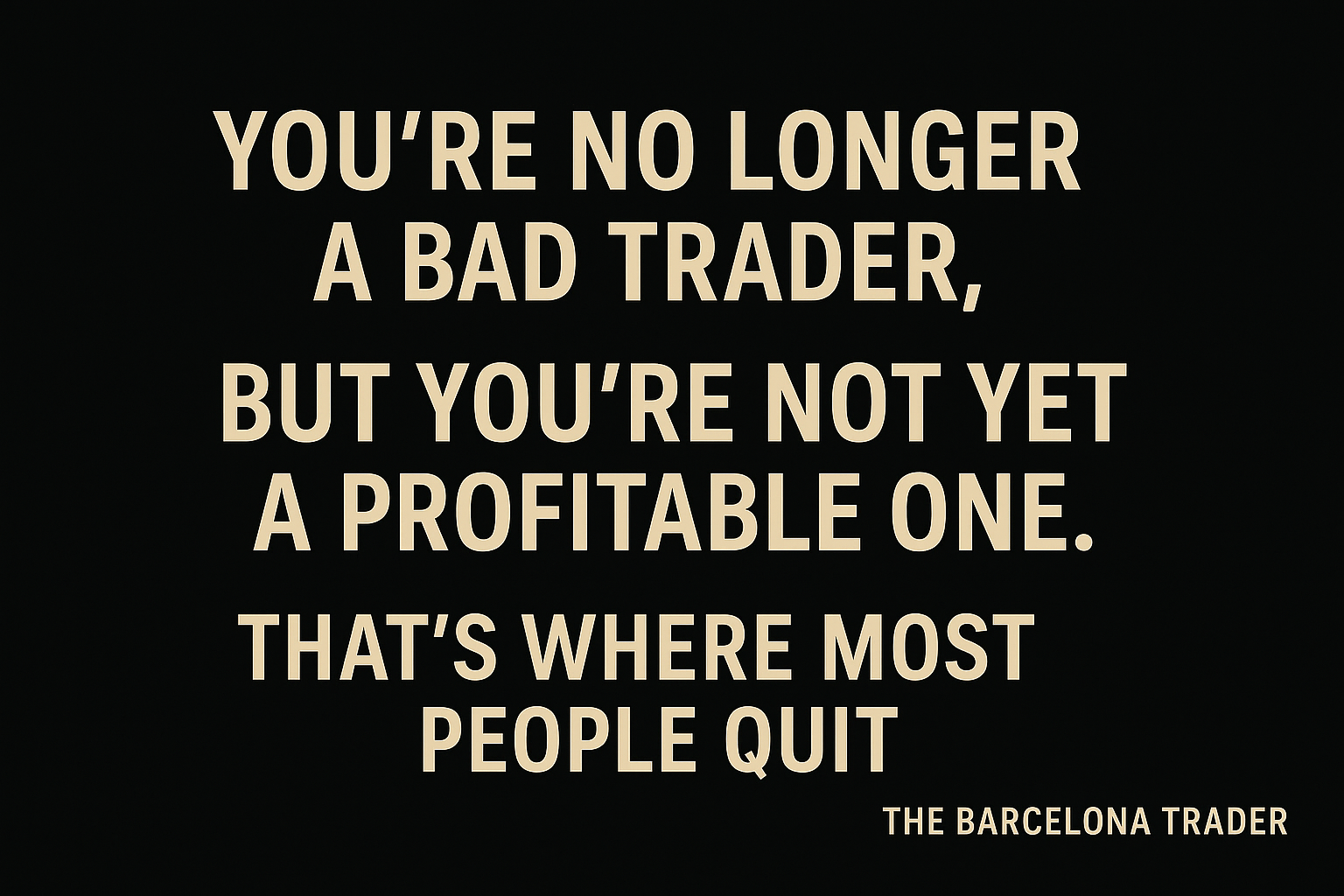
    You’re no longer a bad trader.
    But you’re not yet a profitable one.

    You’re stuck in the hallway between who you were… and who you’re becoming.

    And let me tell you—this is where most traders quit.
    Not because they’re failing. But because they’re improving… and it still feels like failure.

    But here’s the truth:
    This phase isn’t punishment. It’s proof.
    Proof that you’re getting closer.

    You’re not making impulsive trades anymore—so you’re not getting lucky.
    You’re not violating your plan—so there’s no home-run outliers.

    You’re left with the truth.
    The slow, grinding truth of a process that hasn’t finished yet.

    Keep going.

    This is the stretch where all the invisible work starts to compound.
    Where your equity curve feels flat, but your discipline curve is steep.
    Where your P&L is quiet, but your brain is finally rewiring.

    If you’re here, don’t quit.
    Don’t go looking for a new system.
    Don’t start over.
    Just keep showing up.

    Because if you make it through this phase—
    The results come fast.
    And they come from you—not a signal, not a fluke, not a lucky week.

    They come from the foundation you’re laying right now.

    You’re closer than you think.
    Stay in it.