Author: Mike McCready

  • Learning to Trade Is Like Learning A Language Fluently

    Learning to Trade Is Like Learning A Language Fluently

    Learning to trade is a lot like learning to speak a new language.

    At first, it’s kind of exciting. You start picking up some common phrases:
    “Support and resistance.”
    “Break of structure.”
    “Liquidity sweep.”

    You can look at a chart and say things like,
    “Oh, I see what’s happening here,”
    and even ask a few intelligent-sounding questions in the group chat.

    You’re the trading equivalent of someone confidently asking where the bathroom is in Paris and thinking, “This isn’t so hard.”

    Then one day…
    The market responds in slang.
    With a thick regional accent.
    During a high-speed philosophical debate.
    While throwing chairs.

    Suddenly you’re staring at the chart thinking:
    “I have no idea what this thing is saying.”

    Early progress is deceptive.

    You make some gains. You get a few setups right.
    You think you’re getting fluent.
    But then price action gets weird.
    It disrespects your levels. It ignores your confluences.
    It fakes you out and punishes you in a language you didn’t even know it spoke.

    That’s when most people quit.

    They think the system stopped working.
    They think the market “changed.”
    But really, they just hit the part of the language where real understanding begins:
    Nuance. Context. Subtext.

    And you only learn that with time.

    Real fluency comes through immersion.

    Reading price.
    Watching how it reacts around key zones.
    Understanding what it usually does—and how to spot the moments when it’s doing something else.
    You stop translating every candle in your head and start responding instinctively.

    Eventually, you can carry a full conversation with the chart.
    You understand when it’s lying.
    When it’s testing you.
    When it’s building a trap.
    When it’s whispering, “Get in now.”

    That’s fluency.
    And there’s no shortcut.

    Just like language, you can’t learn it from flashcards.
    You have to live in it.
    Trade in it.
    Fail in it.
    And come back again and again until one day, you realize:

    You’re not guessing anymore.
    You’re fluent.

  • Dear Trader: If You Just Blew Your Account, Read This

    Dear Trader: If You Just Blew Your Account, Read This

    Let me guess:

    You’re staring at your screen right now, heart pounding, trying to make sense of what just happened.

    Your account’s gone—or nearly gone.

    You broke your rules. Again.

    You told yourself this time would be different. That you had it under control. That you were finally “disciplined.”

    But now you’re here.

    Angry. Embarrassed. Maybe even ashamed.

    And some quiet, vicious little voice is asking:

    Are you really cut out for this?

    I know that voice. I’ve heard it too.

    I’ve blown accounts. I’ve taken losses so big they made my chest ache. I’ve looked at the screen and felt like the dumbest person alive for doing exactly what I told myself I wouldn’t do.

    So before you go spiraling—or worse, giving up—read this.

    First: You’re Not Alone

    You’re not the first trader to blow an account.

    You’re not the tenth. Or the hundredth.

    You’re just the one doing it today.

    That doesn’t make you special. It makes you normal.

    Every consistently profitable trader has sat where you’re sitting. The difference is: they didn’t quit, and they didn’t lie to themselves about what had to change.

    This moment isn’t the end of your journey.

    It’s the tuition. And it’s expensive for a reason.

    Second: The Loss Isn’t the Problem

    The amount you lost—$2,000, $12,000, $50,000—that’s not the real problem.

    The real problem is what caused it:

    You ignored your plan.

    You let emotion drive the bus.

    You thought just this once you could outsmart the risk.

    And you didn’t. Because you can’t.

    If you’re serious about becoming a trader, you need to get this through your head:

    Every exception becomes the new rule.

    You make one emotional trade today, you’ll justify another tomorrow.

    And eventually, the market takes its pound of flesh. Always.

    Third: Pain Is a Terrible Teacher… Unless You Listen

    You’re in pain right now. Good.

    That means you care. That means this matters to you.

    But pain without reflection is just suffering.

    If you don’t sit down—right now—and write out exactly what happened and why, you’re not a trader. You’re a gambler with a keyboard.

    Ask yourself:

    • Where did I deviate from my rules?
    • What was I feeling when I did it?
    • What signal did I ignore?
    • What do I never want to feel again?

    Be honest. Be brutal. Be better.

    Fourth: The Only Way Forward Is Through

    You don’t fix this with revenge trades.

    You don’t fix it with a new indicator, a new mentor, or a $1,000 challenge you’re “definitely going to pass this time.”

    You fix it by confronting your weaknesses.

    You fix it by doing the boring stuff: journaling. Logging trades. Setting alarms. Enforcing stop losses even when it feels uncomfortable. Especially when it feels uncomfortable.

    You fix it by becoming someone your future self can trust.

    Last: You Can Still Make It

    I don’t care how bad today was.

    I don’t care how many times you’ve blown it.

    You can still become the trader you set out to be.

    But only if you stop lying to yourself.

    Trading is the most honest mirror you’ll ever look into.

    It reflects exactly who you are under pressure.

    But if you’re brave enough to face that reflection—and change what you see—you will get there.

    And when you do, it won’t feel like a victory parade.

    It’ll feel like calm.

    Like silence.

    Like self-trust.

    That’s what’s waiting for you on the other side of this.

    Now close the chart.

    Stand up.

    And go get it right next time.

  • Many Gurus Just Make Up New Words for the Same Trading Terms

    Many Gurus Just Make Up New Words for the Same Trading Terms

    If you’re new to trading and feel like every guru is speaking a different language, you’re not crazy. You’re just surrounded by a bunch of guys trying to copyright Fibonacci.

    Here’s the truth:

    Most of them are describing the exact same things.

    They just rename everything to sound smarter—or to sell you something.

    Let’s decode a few:

    • Supply and Demand ZonesThese are just Support and Resistance with a rebrand.Same zones. Same price reaction. Slightly better graphics.
    • Contraction > Expansion > TrendOr if you’re into Wyckoff: Accumulation > Manipulation > Distribution.Or if you’re into memes: Chop > Fakeout > Dump.Same movie, different subtitles.
    • Liquidity GrabStop hunt. Nothing new here. Just the market doing what it does best:faking you out so it can run the other direction and ruin your morning.
    • ImbalanceA fancy word for “Price moved too fast and left a gap.”You could just say “gap,” but that won’t get you followers on TikTok.
    • Fair Value Gap (FVG)Price might come back here. Or not. Who knows.But call it a Fair Value Gap and suddenly it sounds like Morgan Stanley left a breadcrumb trail for you to follow.
    • Institutional CandleThis is just an engulfing candle, people.JP Morgan didn’t specially handcraft that wick for you. Calm down.
    • Premium and Discount ZonesHighs and lows of a range.In other words: Buy Low. Sell High. Revolutionary stuff, right?
    • Breaker Block vs Order BlockOne faked out. One didn’t. But sure, let’s treat it like a cosmic distinction that unlocks the secrets of the universe.
    • Mitigation ZoneThe market came back to a level and respected it.Otherwise known as… Support. Again.
    • Smart Money Concepts (SMC)This one’s special because it’s just structure, liquidity, and S&R…with attitude.

    None of these terms are wrong. They’re just… dressed up.

    Like putting aviators on a cat and calling it a tiger.

    And the worst part?

    I learned all of this the hard way.

    I spent months—years—listening to every guru, every strategy, every contradictory opinion. I chased one shiny system after another thinking I was missing some crucial piece of the puzzle.

    Turns out, they were all saying the same thing. Just using different vocabulary to sell it as exclusive.

    So if you’re confused, frustrated, or feel like everyone else gets it but you?

    You’re not behind. You’re just at the part of the journey where the fog hasn’t cleared yet.

    Stick with it.

    Pick a language that makes sense to you, and stop jumping ship every time someone on YouTube invents a new term for “price bounced.”

    Because in the end, trading isn’t about knowing every term.

    It’s about knowing yourself.

    And sticking to a system long enough for it to actually work.

    That’s the part no one can sell you.

  • Trading Is Like Learning to Fly—But the Sky Is Made of Data

    Trading Is Like Learning to Fly—But the Sky Is Made of Data

    When you first start trading, you probably imagine yourself mastering price action, calmly executing, and steadily growing your account like a seasoned assassin.

    And then reality hits:
    You spend the first month just figuring out how the hell to arrange your monitors.
    You install indicators you don’t understand.
    You hear terms like RSI, VWAP, MACD, Renko, EMAs—and suddenly it feels like you’re trying to fly a 747 in the dark… with the cockpit manual written in a different language.

    Welcome to the real beginning.

    The truth is, trading is a bit like flying on instruments.

    The market isn’t something you can physically see.
    It’s not a mountain you can climb or a ball you can chase.
    It’s a data stream. A shifting emotional tide. A multi-billion-dollar organism that’s alive, but invisible.

    And your indicators?
    They’re the cockpit instruments telling you where you are—relative to structure, trend, momentum, liquidity. You’re not seeing the market. You’re reading it. Feeling it through dials, lines, and flashing lights.

    And guess what?
    Learning to trust those instruments takes time.

    Because indicators don’t always agree. Sometimes they lag. Sometimes they lead. Sometimes they lie.
    You have to watch what they say when the market does XY, or Z. You have to get a feel for how they behave in motion. That means repetition. Observation. Context.

    Yes, your mentor will help.

    They’ll give you a starting setup. Maybe introduce you to the indicators that work for them.
    But over time, you’ll figure out which ones speak to you.
    Which ones give you confidence.
    Which ones let you breathe.

    And that discovery?
    That’s not the “advanced stage.” That’s the actual learning curve.

    It’s the quiet work that makes the difference between “following a system” and owning your process.

    My setup didn’t happen overnight.

    I tweaked. I replaced. I threw half of it out and started over.
    Eventually, I stopped asking, “What indicator is best?” and started asking:
    “Which one helps me see more clearly—and act more confidently?”

    That’s when it clicks.
    That’s when your station becomes yours.
    That’s when you stop flying blind—and start flying on feel, with instruments that were built around your brain.

    So yeah—don’t rush it.
    Your mentor’s system is your launchpad.
    But your real edge? That gets built dial by dial, over time, by you.

    Update: I have written a follow-up to this piece here.

  • Why the World Trades Gold (And Why We Do Too)

    Why the World Trades Gold (And Why We Do Too)

    Gold is a funny thing. It has no earnings, no dividends, no quarterly reports. You can’t eat it, and it’s not especially useful for modern industrial processes. But somehow, it still commands the attention of central banks, hedge funds, sovereign wealth managers, and your cousin Dave who owns “a little physical, just in case.”

    The reason is simple: gold is trust on a chain. It’s the asset that steps in when fiat feels fragile, when bonds look shaky, or when the geopolitical tea leaves start swirling in unpredictable ways. It doesn’t promise yield — it promises stability. And in a world increasingly short on that, gold gets traded. A lot.


    🌍 Global Gold Trading — Bigger Than Most People Realize

    Let’s talk scale. Each day, depending on the source and how you count it, roughly $130–$200 billion worth of gold changes hands globally across all markets — futures, spot, ETFs, OTC, and physical. That’s more than the daily volume of the S&P 500.

    To break that down:

    • Hourly, we’re talking $5–8 billion.
    • Per minute, about $100–150 million.
    • Per second, you could argue the world blinks and $2 million in gold just moved.

    This isn’t just day traders poking at XAUUSD. We’re talking about:

    • Central banks quietly adjusting their reserves.
    • Algorithmic traders scalping GC1! contracts.
    • Physical deliveries being arranged via the LBMA or the Shanghai Gold Exchange.
    • Bullion dealers hedging forward contracts through COMEX futures.

    And yes — retail traders (like us) taking breakout scalps off key pivots at 7:32 a.m. because we think the DXY’s losing steam.


    🧠 Why We Trade Gold

    We could trade anything — indices, currencies, soybeans if we felt like it. But we trade gold.

    Why?

    Because gold moves. It gives us real opportunities every single day. Whether it’s reacting to a Fed comment, a war headline, or just bouncing off a key level, gold offers the kind of intraday volatility that scalpers dream about. Not random chaos — but consistent rhythm. It stretches and contracts in ways you can come to know, if you pay attention long enough.

    That’s why our team doesn’t try to be masters of everything. We specialize. Because every instrument has its own personality, and developing instinct — real gut feel — only happens when you commit to learning one market inside and out. For us, that’s gold.

    Over time, the setups start to scream instead of whisper. The traps get easier to spot. And edge starts to look a lot like intuition.

    So no, we don’t trade everything.

    We trade the one thing that rewards mastery.


    🧭 Who Sets the Price?

    Despite all these trading venues, there’s one main benchmark the world references — COMEX futures. That’s where most of the price discovery happens. Spot gold (XAUUSD) follows it. The Shanghai Gold Exchange reflects it. Even over-the-counter billion-dollar private deals are priced off it.

    Central banks may not click the “Buy” button on GC1!, but when they rebalance reserves, they’re staring at that same number you and I are.

    And so while gold might feel old-school, the ecosystem around it is anything but. It’s global, fast, liquid, and surprisingly modern — with price feeds pinging from New York to London to Shanghai in milliseconds.


    So if you’ve ever wondered how gold really moves — who moves it, when, and why — the following table gives you a cheat sheet to the major players and platforms. From spot to futures to physical, here’s how the world trades gold:

    🌐 Gold Price Market Comparison: Who’s Driving What?

    FeatureCOMEX (Futures)SGE (Shanghai Gold Exchange)OTC Market (e.g., LBMA)XAUUSD (Spot Gold)
    Role in Price Discovery🏆 Primary benchmark — sets global toneSecondary — reflects Chinese physical demandInfluences via large private flows💡 Follows futures, reflects global sentiment
    TransparencyHigh — public, regulated, real-time dataMedium — less real-time depthLow — private & bilateralMedium — varies by broker, influenced by liquidity feeds
    ParticipantsHedge funds, banks, asset managersChinese institutions, refiners, central bank-affiliatesCentral banks, sovereigns, bullion banksRetail traders, brokers, liquidity providers
    CurrencyUSDCNY (Yuan)USDUSD
    SettlementMostly cash-settled contracts (GC1!)Physical delivery onlyPhysical & forwards, swapsCash-settled, no physical delivery
    Volume & LiquidityVery high (esp. front-month contracts)High, domestic to ChinaMassive but opaqueHigh — driven by retail + broker-dealer liquidity pools
    Pricing Influence🧭 Global benchmark— base reference for allFollows COMEX + adds regional premium/discountPrices referenced to COMEXMirrors COMEX/OTC but often leads intraday sentiment
    Arbitrage PotentialYes — vs SGE & OTCYes — via premium arbitrageLimited but presentNo — derivative of other markets
    Used by Central Banks?🏦 Yes — for reserve benchmarking and hedgingYes — esp. ChinaYes — primary for physical reserve acquisitionNo — not directly used by central banks
    Market Hours23 hours/day (CME Globex)Chinese trading hours (approx. 13 hours/day)24/7 (unofficial)24/5 (with gaps at rollover and weekends)

    🧠 Key Takeaways

    • COMEX: Serves as the primary platform for global gold price discovery, influencing other markets worldwide.
    • SGE: Reflects China’s domestic gold market dynamics and often trades at a premium or discount to COMEX.
    • OTC Market: Comprises large, private transactions that can influence pricing but lack transparency.
    • XAUUSD: Represents the spot price of gold in USD, closely tracking COMEX and OTC prices, and is widely used by retail traders.
  • When You Hope There’s Only One More Thing to Fix

    When You Hope There’s Only One More Thing to Fix

    There comes a point in every serious trader’s journey where you start whispering to yourself, “Maybe it’s just this one last thing.” One more dial. One more adjustment. One more rule you finally start obeying like it actually matters.

    It’s not perfectionism exactly. You’re not trying to be flawless. You’re just… tired. Tired of the ups and downs. Tired of knowing you’re close. Tired of watching your system almost work—if only you could stop screwing it up.

    It’s not delusion. It’s hope.

    It’s earned hope backed by thousands of hours of screen time and heartbreak.

    At this stage, you don’t need a new system. You don’t need another coach. You don’t need to watch another damn YouTube video of a dude in a Bugatti explaining risk management while wearing a tank top and gold chain.

    You already know what works.

    You just need to do it.

    Again. And again. And again.

    That’s where I am.

    After years of refining my process, blowing up accounts, clawing my way back, writing rulebooks and ignoring them, building trading AI to keep me sane—I finally believe this may actually be it. The last adjustment. The final behavioral shift that lets everything lock in.

    And I’m writing this not just to remind myself, but to speak to anyone else standing in this same weird psychological hallway:

    You are not asking the wrong question.

    There is a point where you don’t need to fix ten things.

    Just one.

    And it’s the boring one.

    It’s the emotional one.

    It’s the “Can I do this again tomorrow?” one.

    If you’re hoping it’s just one more thing, and you’re showing up with honesty, humility, and self-awareness—you might not be dreaming.

    You might be right.

  • Why Do Trading Gurus Tell You to Go to The Gym?

    Why Do Trading Gurus Tell You to Go to The Gym?

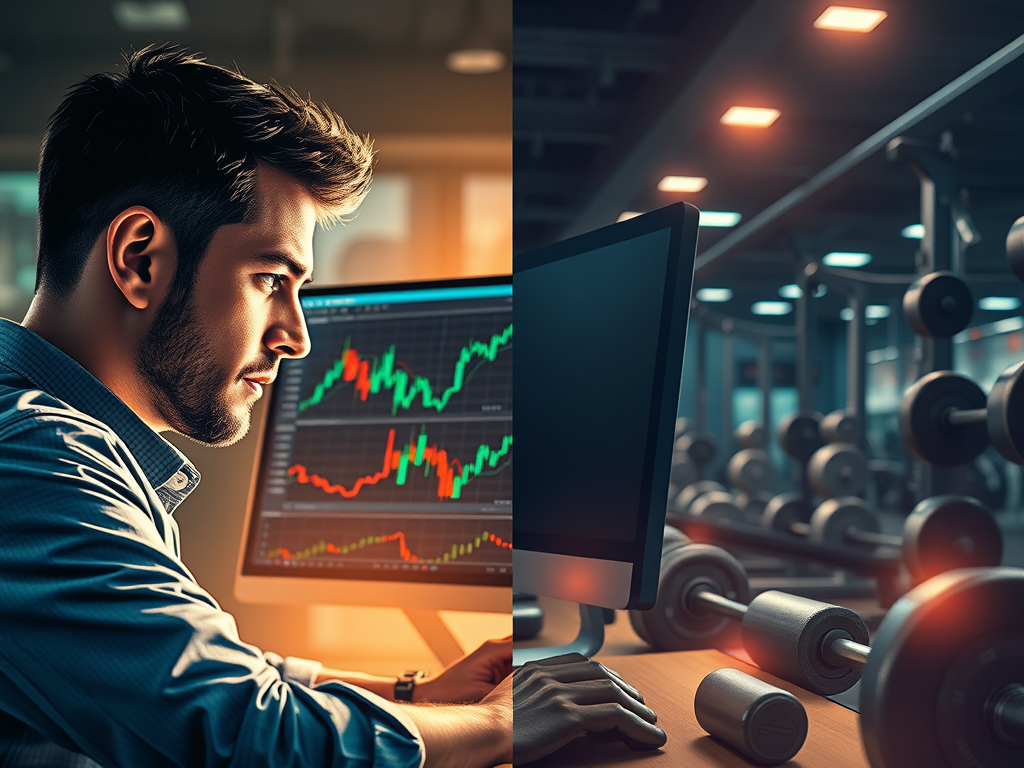
    Every trading bro on YouTube eventually tells you to hit the gym.

    They’ll say it’s about discipline. Routine. Optimizing your dopamine levels so you can crush the markets and become a peak-performance alpha ninja or whatever.

    But here’s the truth: they don’t actually know how to say what they mean—so they default to pushups and protein shakes.

    What they’re trying to say is this: if you want to succeed at trading, you have to build self-trust. And lifting weights is one of the few ways people have figured out how to do that.

    Because it’s not about looking good shirtless while you stare at a chart. It’s about keeping promises to yourself when no one’s watching. It’s about becoming the kind of person who shows up, even when it sucks. Especially when it sucks.

    And that same muscle—the one you build in the gym when you force yourself to do one more rep—that’s the one you use when you close a losing trade instead of hoping it turns around.
    That’s the one you use when you don’t click buy, even though you’re bored and itching to trade, because your setup isn’t there yet.

    Trading is just a mirror for that.

    No one cares if you skip leg day or break your trading rules—except Future You. And Future You is sick of your excuses.

  • Trading Can Be Like Learning to Ride a Bike

    Trading Can Be Like Learning to Ride a Bike

    You can read every book ever written on how to ride a bike.
    You can study the mechanics, watch slow-motion videos, break down the physics of balance and torque…
    But the first time you actually get on a bike?

    You’re going to fall.

    Trading is exactly like that.

    You think, “I’ve got this. I’ve been watching charts for weeks. I understand support and resistance. I even know what a fair value gap is.”

    Then you place a real trade.
    You watch it turn red.
    And suddenly—
    You realize you don’t know anything about balance.

    Because just like a bike, trading requires feel.
    Micro-adjustments. Confidence through wobbles. A relationship with risk that can’t be taught—only lived.

    Enter: The Training Wheels

    For most of us, that means a mentor.
    Someone who’s been through the crashes and can help you stay upright long enough to build some muscle memory.

    They’ll tell you when to brake, when to pedal, when to coast, and when to get the hell off the sidewalk.
    They’ll show you what not to do.
    And if they’re good, they won’t just hand you a strategy—they’ll help you build your own balance.

    But even with training wheels, you’re going to tip over.
    Your stops will get hit. You’ll fumble an entry. You’ll panic, hold too long, exit too early.
    That’s not failure. That’s learning to ride.

    The Most Dangerous Phase?

    When the training wheels come off, and you think you’ve got it figured out.
    You get overconfident. You start taking corners too fast. You forget the market is still the pavement—and it doesn’t care how good you felt yesterday.

    You’re still building reflexes.
    Still calibrating judgment.
    Still earning the ability to stay upright without thinking about every tiny move.

    But eventually—if you stick with it—you stop wobbling.
    You ride clean. You navigate with confidence. You feel when something’s off.
    You even start to enjoy the ride.

    And that’s when you know:

    You’re not trying to learn trading anymore.
    You’re just… trading.

  • I Am My Edge

    I Am My Edge

    People are always chasing “edge” in trading.

    They want the secret indicator. The right signal.

    They think somewhere out there — maybe in a Discord, maybe behind a paywall — there’s a method that will let them finally win.

    But here’s what I’ve learned:

    The edge isn’t out there.

    It’s in here.

    It’s not the strategy. It’s not the setup.

    It’s not the candle pattern or the moving average or the Renko box that whispered “buy me.”

    I am my edge.

    Because give two traders the same chart, the same level, the same conditions — and one will walk away with profit, the other with pain.

    Why? Because edge isn’t the strategy. It’s the person using it.

    It’s how I wait.

    It’s how I enter.

    It’s how I manage the trade when it goes my way — and how I manage myself when it doesn’t.

    It’s the risk I take.

    The discipline I enforce.

    The self-awareness I build when I walk away from B setups, even when I’m bored and hungry for action.

    I’ve spent years thinking the edge was some external advantage.

    Some tool I hadn’t discovered.

    Some technique I hadn’t mastered.

    But now I know the truth:

    The real edge is how consistent I can be —

    when the market isn’t.

    It’s how I respond to chaos.

    How I stay calm when the dollar’s sliding, gold’s snapping, and my last trade just clipped my stop by a pip and reversed 200 in the right direction.

    (It’s fine. I’m fine.)

    My edge is knowing that I only need a few good setups a day.

    That the rest is noise.

    That discipline isn’t boring — it’s lethal.

    So no, I don’t need a crystal ball.

    I don’t need to know what gold will do next.

    I just need to stay locked in long enough for the opportunity to show itself —

    and sharp enough to act when it does.

    I am my edge.

    And if I forget that —

    I lose it.