Author: Mike McCready

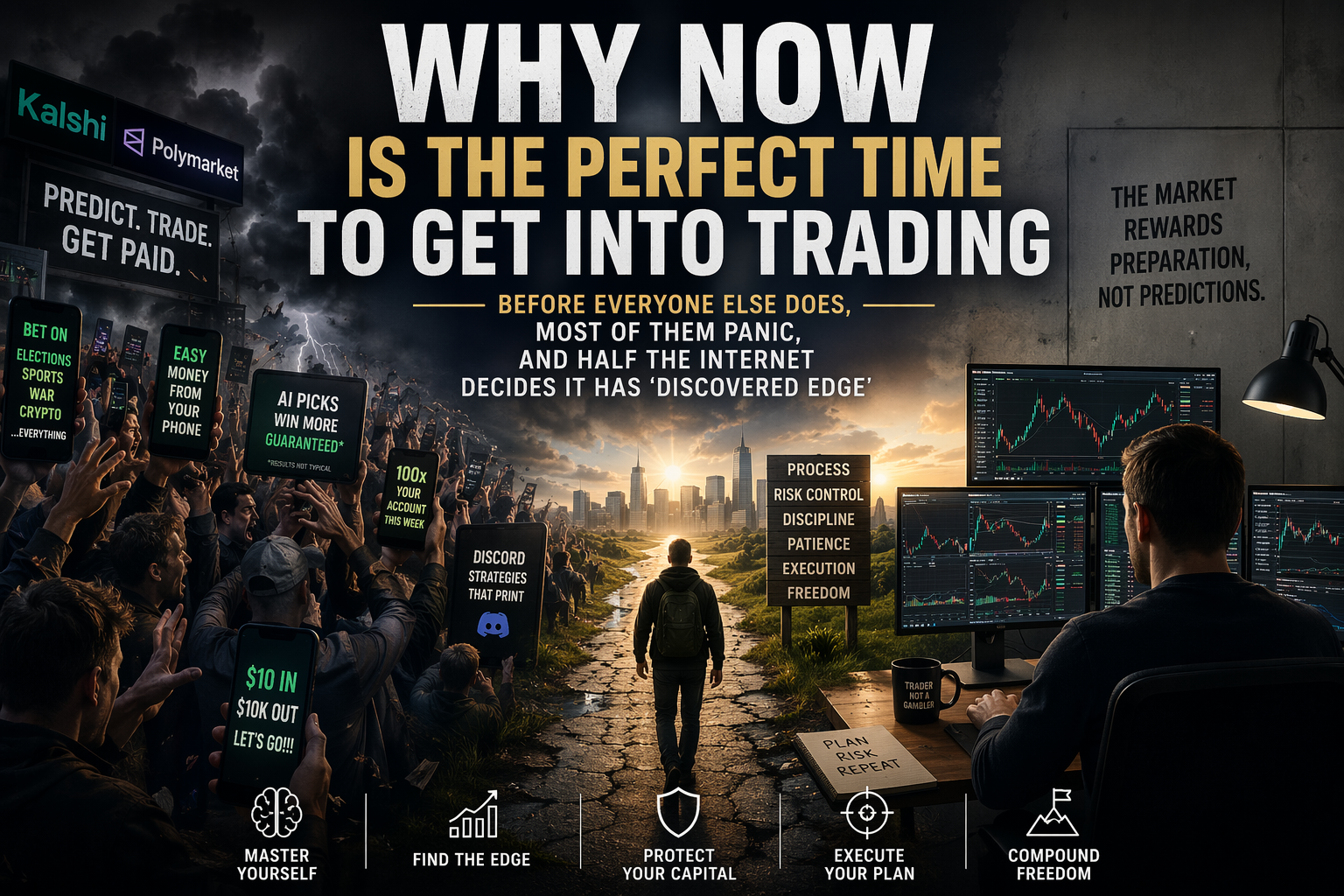
  • Why Now Is the Perfect Time to Get Into Trading – Before Everyone Else Does, Most of Them Panic, and Half the Internet Decides It Has “Discovered Edge”

    Why Now Is the Perfect Time to Get Into Trading – Before Everyone Else Does, Most of Them Panic, and Half the Internet Decides It Has “Discovered Edge”

    There are moments in history when it pays to be early.

    Not just because you beat the rush, but because you have time to become the real thing before the crowd arrives in a cloud of confidence, apps, Discord links, and deeply inspirational self-delusion.

    This is one of those moments.

    A while back, I made the argument that AI was going to disrupt white-collar work, that many smart and capable people would start looking for alternative ways to earn, and that trading would become one of the obvious places they’d land. That thesis has only gotten stronger.

    Because now we’re no longer dealing with a thought experiment. We’re watching the early signs already. The IMF said in January that nearly 40% of global jobs are exposed to AI-driven change, with major implications for the kinds of professional and technical roles many people once thought were relatively safe.

    And when people feel their footing slipping, they do what modern people do: they open an app and attempt to negotiate with uncertainty.

    Which brings us to a useful preview of what’s coming.

    You can already see a version of this impulse in the rise of prediction markets like Kalshi and Polymarket. These platforms have exploded in visibility and volume. Reuters reported in March that global prediction-market trading volume hit $47 billion in 2025, and that the sector was drawing serious interest from traditional finance. Reuters also reported that Intercontinental Exchange, the parent company of the New York Stock Exchange, invested $600 million more into Polymarket in late March as event-based trading keeps growing.

    That tells you something important.

    More and more people are getting comfortable with the idea that they can supplement income, regain some control, or monetize their judgment by tapping at a glowing rectangle and making wagers on uncertain future outcomes. Politics. Economics. Geopolitics. Sports. The fate of civilization before lunch. Reuters has also reported broader 2026 side-hustle and career-pivot pressures as workers try to assemble a livable financial life from multiple income streams and reinvention strategies.

    And I get it.

    This economy has a way of making people feel like they should have at least three revenue streams, a newsletter, a consulting lane, a personal brand, and perhaps a tasteful mushroom tincture business just to afford soup.

    So people flock to whatever looks like agency.

    But prediction markets also illustrate an important distinction.

    They can create the illusion that all market-related activity is basically the same. It isn’t.

    A lot of prediction-market activity is much closer to gambling with a news addiction than it is to professional trading. At times it starts to resemble a slightly dressed-up version of “who knew what first.” Reuters reported scrutiny over Iran-related prediction bets in March, including concerns about whether these markets can reward unusually early or unusually good information in ways that edge uncomfortably close to insider-style dynamics. And reporting this week on newsroom ethics around prediction markets underscored the same broader problem: when access to information becomes tradable, the line between insight and informational unfairness can get very thin, very fast.

    That is not the same thing as learning to trade.

    Trading, done seriously, is not just having a take on the future and an app in your hand. It is a craft. A profession. A discipline. It is process, execution, risk management, emotional control, market understanding, and the ability to function under pressure without turning one bad decision into an interpretive dance of financial self-harm.

    That difference matters.

    Because as more people get used to monetized uncertainty, more of them are going to drift toward actual trading too. Some will come from the world of prediction apps. Some will come from layoffs, career anxiety, or shrinking opportunity in white-collar work. Some will simply be looking for a skill that feels more durable and self-directed than waiting to be reorganized out of existence by software and a cheerful email from Human Resources.

    That impulse is understandable.

    What is not understandable is how casually many people will be sold the fantasy.

    They’ll be told that with the right AI prompt, a few backtests, an indicator pack, and a face that says “I’ve recently discovered conviction,” they can become traders.

    They cannot.

    Not right away.

    Not because they are dumb. Not because they are weak. Not because the gods have singled them out for humiliation near a ring light.

    But because trading is not mainly an information problem. It is a judgment-under-pressure problem.

    And that is where the suffering starts.

    AI can help people learn faster. It can help them organize information, test ideas, summarize concepts, and accelerate the early stages of education. That part is real. The tool is real.

    What it cannot do is regulate your nervous system for you when you are in a live trade and your brain has suddenly become a small regional theater staging a production called Maybe It’ll Come Back. It cannot make you patient when price is choppy. It cannot stop you from revenge trading because your last setup failed and now you have decided to challenge the market to a duel over twelve dollars and your remaining dignity.

    That part is still human.

    And that is exactly why this may be the best time in years to start learning seriously.

    Because we are entering the period when more people will come toward trading for valid reasons, but most of them will still underestimate what the craft actually demands.

    Phase 1: The Surge

    The first thing to understand is that more people are going to explore trading over the next few years, and many of them are going to be perfectly intelligent people.

    That is what makes this so interesting.

    This is not mainly a story about fools rushing in.

    It is a story about smart, stressed, capable, ambitious people walking into a brutally unforgiving domain with the wrong mental model.

    They will think access is competence.

    They will think software is discipline.

    They will think information is edge.

    They will think “I understand the setup” is the same thing as “I can execute it repeatedly under pressure with risk under control and my ego in a medically supervised condition.”

    It is not.

    And because it is not, many of them will have a rough experience.

    Not because they deserve one.

    Because they are entering a field that is routinely marketed as easier, faster, and more intuitive than it really is.

    That is why starting now matters.

    If you begin now, you are not getting ahead of some cartoon mob of idiots in clown shoes carrying candlestick charts and motivational podcasts. You are getting ahead of a large incoming wave of underprepared people, many of whom will need years to understand what trading actually requires.

    That gives you something incredibly valuable: time.

    Time to build process before the noise gets louder.

    Time to develop judgment before overconfidence gets industrialized.

    Time to become calm and capable while other people are still mistaking enthusiasm for skill.

    Phase 2: The Washout

    This is the part that sounds harsh, but it is simply reality: most people who try trading will not stay with it long enough, seriously enough, or humbly enough to become consistently good.

    Some will lose money and leave.

    Some will discover they were attracted to the fantasy more than the craft.

    Some will be taught badly.

    Some will size badly.

    Some will confuse motion with mastery.

    Some will explain every loss using a rotating wheel of excuses that includes the algos, the market makers, Jerome Powell, Europe, spread widening, cosmic injustice, and whatever one candle did to them personally at 9:37 a.m.

    And some will quit not because they lacked potential, but because the learning curve is steeper and lonelier than they were led to believe.

    That last category matters to me.

    Because I do not think the coming washout is funny in some gleeful way. I think a lot of people are going to come into this trying earnestly to adapt to a changing world. Many of them will be decent, hardworking, intelligent people. They will simply be trying to learn something difficult under financial and emotional pressure, while being sold a version of trading that looks like freedom and often behaves like a psychological stress position.

    That is not mockery-worthy. That is just modern life with better graphics.

    But it is also true that a washout will happen.

    It always does.

    And when it does, the people who remain will not necessarily be the flashiest or the loudest. They will be the ones who built habits, process, emotional control, and respect for risk. The ones who stopped trying to win arguments with the market and started learning how to work.

    That is where the real separation begins.

    Phase 3: The Thinner Air

    Longer term, I still think the environment gets more selective.

    More automation.

    More machine participation.

    Less obvious sloppiness floating around for anyone with a chart, a prayer, and a deeply moving commitment to being early for the wrong reason.

    That does not mean there will be no edge for humans.

    It means the bar rises.

    The edge migrates toward patience, precision, selectivity, self-control, and the ability to execute without flinching, freelancing, or composing an entire constitutional crisis in your own head because one setup failed.

    That is a different game than the hype version.

    But it is still a real one.

    And here is the beautiful part: every cycle still brings new participants. Every cycle produces fresh overconfidence, fresh shortcuts, fresh magical thinking, fresh attempts to turn uncertainty into income with insufficient preparation and a suspiciously expensive microphone.

    Human nature is not going anywhere.

    Which means opportunity is not going anywhere either.

    It just becomes less forgiving about who gets to capture it.

    So Why Get In Now?

    Because this is the sweet spot.

    You are early enough to build skill before the next big rush fully matures.

    You are early enough to learn the hard parts before the culture gets even more saturated with AI-assisted confidence and low-friction speculation.

    You are early enough to develop real competence while many others are still discovering that trading is not a loophole, not a productivity hack, not a monetized vibe, and not a substitute for emotional regulation.

    That is the opportunity.

    Not to mock people.

    Not to prey on anyone.

    To get serious before seriousness becomes unavoidable.

    The people who start now, and treat this like a profession, will be in a very different position from the people who arrive later assuming that access to tools means access to edge.

    And that gap is likely to widen, not shrink.

    There is another reason this matters right now. Reuters reported this week that the SEC approved the removal of the old pattern day trader restriction, which had limited small accounts under $25,000 to three day trades in five business days. Critics warned the change could open the door to more impulsive, higher-risk retail behavior. In plain English, one more barrier has been lowered between undercapitalized enthusiasm and a memorable afternoon.

    That does not mean people should not learn trading.

    It means they should learn it properly.

    Because easier access does not make the profession easier. It just increases the number of people who can discover that fact firsthand.

    One More Thing

    If you are going to get into trading now, learn from people who respect both the opportunity and the difficulty.

    Learn from people who actually trade.

    Learn from people who understand that human behavior matters as much as market structure.

    Learn from people who are not selling trading as an escape hatch for the desperate, but as a demanding craft for people willing to do the work.

    That is what we try to do at The Barcelona Trader.

    Real systems.

    Real coaching.

    Real markets.

    Real-time pressure.

    If you want to begin before the next wave fully crashes onto the beach with its apps, narratives, side-hustle panic, and brave little delusions, this is a very good time to start.

    Maybe the best time in years.

    Because the future is likely to contain more uncertainty, more speculation, more people trying to earn from volatility, and more confusion about the difference between clicking on risk and actually knowing how to manage it. The early signs are already here, from AI-driven job anxiety to booming prediction markets to regulatory changes that make active trading easier to access for smaller accounts.

    And that is exactly why trading should be treated with more seriousness, not less.

    A lot of people are about to come looking for agency.

    Some will find gambling.

    Some will find noise.

    Some will find a temporary obsession and a very educational bruise.

    A few will find a craft.

    Better to start becoming one of those people now.

  • Charts & Indicators – Spring/Summer 2026

    Charts & Indicators – Spring/Summer 2026

    Charts and Indicators: Spring 2026 Edition

    Welcome, disciples of the candle. If you’ve found your way here from the livestream, you’re likely tired of staring at a chaotic mess of flickering red and green lights that looks less like a financial instrument and more like a malfunctioning Christmas tree in a dive bar.

    Setting up your TradingView correctly isn’t just a “good idea”—it is a moral imperative. To trade on a default chart is to invite psychological ruin and quite possibly the collapse of the Republic. Here is how I structure my digital sanctuary.


    The Aesthetic: Gold and Blue (The Only Way to Live)

    First, we use Heiken Ashi candles. Why? Because standard Japanese candlesticks are a jagged, anxiety-inducing assault on the human spirit. Heiken Ashi smooths out the noise, allowing us to see the trend with the clarity of a mountain spring.

    As for the colors, I’ve moved past the pedestrian “red vs. green” paradigm.

    • Bullish candles are Gold: Because it’s XAU, and I have a refined sense of irony.
    • Bearish candles are Blue: To represent the deep, chilling ocean of tears shed by those who didn’t follow the trend.

    Temporal Boundaries: The 6PM Line in the Sand

    A chart without vertical lines is a lawless wasteland where time has no meaning and anarchy reigns. I draw vertical lines to separate the days, with each new session commencing at 6PM ET. If your chart doesn’t clearly delineate where Tuesday’s failures end and Wednesday’s hopes begin, you are essentially wandering through a dark forest without a compass or a soul.

    To further categorize our daily suffering, I use Session Markers for Asia, London, and New York. If you aren’t tracking exactly when the London volatility arrives to punch you in the throat, you aren’t really trading; you’re just gambling with extra steps.

    The Sacred Pivots and Sunday Rituals

    To find our bearings in the 2026 markets, I overlay the Monthly, Weekly, and Daily pivot lines. If you don’t know what a pivot is or how to set them up, please tune into the livestream; I cannot be expected to explain the foundational geometry of the universe in a single blog post without suffering a minor stroke.

    I also mark the Sunday Open and the Previous Sunday Open with an Orange Line. This is a non-negotiable ritual. Additionally, I draw orange lines for:

    • Previous Day Point of Control (PDPOC)
    • Previous Day Value Area High (PD VAH)
    • Previous Day Value Area Low (PD VAL)

    I use the Fixed Range Volume Profile tool for these. It is the only way to accurately measure where the “smart money” spent its time before they decided to ruin our collective afternoon.


    The Indicators: The Council of Truth

    Let’s talk TradingView indicators.

    1. EMA 9 Close: Because if you don’t know where the 9-period moving average is, you are essentially trading with a blindfold on in the middle of a freeway.
    2. Support/Resistance with Breaks & Bounces [V1]: A vital tool for identifying where the price will inevitably stall and mock our expectations.
    3. S/R (Standard Support & Resistance): The foundational pillars of reality. Without these, the chart is just a series of meaningless squiggles.
    4. Linear Regression Channel: To give us a mathematical boundary for our delusions of grandeur.
    5. Swing Ranges [ChartPrime]: Crucial for identifying the high and low water marks of our psychological endurance during a trend.
    6. TDFI v2: Because we need a trend direction force index that actually understands the gravity of our situation.
    7. CVD 1D & Volume Delta: This allows me to see the Cumulative Volume Delta—essentially the raw, unbridled aggression of buyers versus sellers. If you aren’t watching the Delta, you are ignoring the heartbeat of the market.

    The Command Center: Multiple Screens of Destiny

    I don’t just watch one chart; I oversee an empire. My workspace is a precision-engineered grid of XAU (Gold) charts: 1h, 15m, 5m, 1m, 10sec, and Renko. I also keep the MGC 10-second chart open, because most of the time, even though we do our charting on spot gold, we’re trading futures. In a sense, that’s my main focus whenever I’m in the middle of a trade.

    To maintain my sanity, I keep the 1m DXY (US Dollar Index) chart in front of me at all times—one must always keep an eye on the enemy. Finally, I have the FXBlue Relative Currency Strength indicator active, filtered exclusively to show the XAU/USD relationship. It is the only relationship in my life that I can accurately quantify using a percentage-based oscillating histogram.

    Set your charts up this way, or continue to live in a state of primitive, unoptimized darkness. The choice is yours.

    The Command Center: Big Boy Work on a MacBook Pro

    Now, let’s talk hardware. If you’ve seen the screenshots of my setup, you might assume I’m running this operation from a server room in a high-frequency trading firm or perhaps a repurposed NASA control center. In reality, the heart of this beast is a 14-inch 2021 MacBook Pro.

    Yes, you read that correctly. While others use their MacBooks to write coffee-shop screenplays or scroll through TikTok, mine is currently performing what I like to call “Big Boy Work.” We are talking about a machine with an M1 Max chip and 64GB of RAM that is being pushed to the absolute edge of its digital existence.

    The Screen Galaxy: 8 Screens of Absolute Overkill

    To trade XAU with the precision I demand, I have surrounded myself with a literal wall of glass. My station consists of:

    • The MacBook Pro Built-in Display: The brain of the operation.
    • Three 27-inch Apple Thunderbolt Displays: For that vintage “I’ve been doing this since the music tech days” aesthetic.
    • One 43-inch Samsung 4K TV: Because sometimes you need to see a 10-second candle the size of a baguette.
    • Two PC Screens: Running MT4 and a “slew” of charts dedicated specifically to support and resistance zones.
    • The iPad: My digital journal for real-time notes. If it isn’t written down, the trade didn’t happen.
    • There is a TV on the wall in front of my station. It is usually just playing the YouTube livestream of the broadcast so I can make sure it’s working.

    This brings the total to seven main screens plus an iPad. Two of the Thunderbolts serve as the “Command Center” for my longer time frames, while the three screens to my left are my “Execution Zone.” The main execution screen is the one you see on the livestreams—the one where the magic (or the occasional heartbreak) happens.

    The Digital Load: A Constitutional Crisis for CPUs

    It’s not just the screens; it’s the sheer weight of the data. At any given moment, this MacBook is simultaneously:

    • Running TradingView (obviously).
    • Managing 20+ Chrome tabs containing brokers, prop firms, and trade copiers.
    • Consulting with Gemini and ChatGPT (my AI brain trust).
    • Organizing my life in Evernote.
    • Streaming music from Spotify.
    • Hosting a Zoom Room.
    • Encoding a high-definition stream to YouTube via OBS.

    Most computers would have burst into flames and filed a grievance with the labor board by now. Mine just keeps humming along, processing the gold markets while I try to maintain my composure.

    A trading setup featuring multiple high-resolution monitors displaying financial charts and data, set in a dimly lit room with a laptop and desk accessories.

    A Note for the Sane

    Here is the truth: You do not need this much firepower to trade effectively. If you are starting out, two screens are perfectly fine. You can reach profitability without looking like you’re trying to hack into the mainframe in a 90s action movie.

    I have this setup because I am a deeply specialized individual who finds comfort in “tricking out” my station to soothe the existential dread that comes with scalping gold. It’s a hobby, an obsession, and a cry for help, all wrapped into one glorious 4K resolution.

    Get two screens. You’ll be fine. I’ll be here, surrounded by monitors, trying to remember what sunlight looks like.

    See you on the stream.

  • How to Survive a Long Weekend Without Trading Or: Good Friday, Bad Friday, Worst Friday

    How to Survive a Long Weekend Without Trading Or: Good Friday, Bad Friday, Worst Friday

    Good Friday is a beautiful holiday if you are a normal person.

    If you are a trader, it is a targeted psychological operation.

    The market is closed.
    Closed.

    Not “a little slow.”
    Not “thin liquidity.”
    Not “maybe London will give us something.”

    Closed.

    No gold. No futures. No opening bell. No little burst of hope at the top of the hour. No chance to make one excellent trade, two questionable ones, and then spend the rest of the day pretending the third one was still within plan.

    Just silence.

    Silence, and the horrifying realization that now I have absolutely no excuse not to do things in my actual life.

    This is where the long weekend becomes dangerous.

    Because while the markets are closed, the rest of life remains offensively open.

    The closet is still a disaster.
    That thing I said I’d “get to this weekend” is now, technically, this weekend.
    The pile of papers on the desk has stopped being a pile and become an ecosystem.
    The email I have been avoiding is still sitting there like a small legal threat.
    The house contains multiple drawers full of mystery cables that apparently now expect my full attention.

    And worst of all, other people become aware that I am available.

    This is the true black swan event.

    When markets are open, I am busy. I am focused. I am in battle. I am monitoring price, structure, momentum, liquidity, traps, reversals, stop runs, and the collective emotional instability of humanity as expressed through gold.

    When markets are closed, I am just a man standing in his home near a vacuum cleaner.

    Do you understand the collapse in status?

    A few hours ago I was a precision operator dancing with volatility.

    Now I’m apparently someone who has time to “look at the pantry situation.”

    The pantry situation.

    This is what Good Friday has reduced me to.

    And it gets worse.

    Because the break is long enough to create that special form of trader despair where you start missing the market in ways that would sound insane to civilians.

    You begin to miss spread.
    You miss candles printing.
    You miss the tiny fluctuations that would be meaningless to anyone else but to you feel like the pulse of the universe itself.
    You miss the possibility of violence.

    By Saturday, you’re checking charts out of habit even though nothing is moving.
    By Saturday afternoon, you are staring at old screenshots like a widower holding a locket.
    By Saturday night, you are explaining to your wife that no, you are not “free,” you are merely unable to participate in your chosen form of suffering.

    Then comes Sunday.

    The day of false hope.

    A full day where the market is still closed, but close enough that you can almost taste it.

    This is not rest. This is a hostage situation with brunch.

    And so the question becomes: how does one survive a long weekend without trading?

    Here are a few options.

    1. Pretend to be a human being.
    Go outside. Make eye contact. Speak in complete sentences that do not include the phrases “liquidity sweep,” “rejection candle,” or “that move was manipulated.”

    2. Do one neglected adult task and act like you rebuilt civilization.
    Clean a closet. Answer three emails. Throw out the ancient batteries. Reorganize something with the intensity of a man trying to regain control over a meaningless universe.

    3. Stare into the middle distance and call it recovery.
    This is especially useful if someone asks what’s wrong and you want to avoid saying, “Nothing, I’m just spiritually separated from gold until Sunday night.”

    4. Rewatch your old trades like game film.
    This creates the pleasant illusion that you are still working, when in fact you are just reopening emotional wounds voluntarily.

    5. Announce that the long weekend is a chance to reset.
    This is what disciplined people say. It sounds excellent. Very mature. Very healthy.
    Then, five minutes later, check the clock and mutter, “Only 31 more hours.”

    6. Accept the terrible truth.
    You are not relaxing.
    You are in pre-market purgatory.

    And maybe that’s okay.

    Maybe this is good for us.

    Maybe being forcibly separated from the market for a couple of days reminds us that there is, allegedly, more to life than candles, structure, execution, and trying not to do something stupid at exactly the wrong moment.

    Maybe.

    But let’s not get carried away.

    By Sunday evening, I will be at my screen like a Victorian wife waiting at the port for her husband’s ship.

    Return to me, you beautiful, terrible beast.

    Until then, I suppose I’ll handle the dishes, clean something I’ve been pretending not to see, and maybe address the growing humanitarian crisis in my desk drawer.

    This is what Good Friday takes from us.

    Not just opportunity.

    Identity.

  • Why Isn’t Gold Sky High If We’re At War?

    Why Isn’t Gold Sky High If We’re At War?

    Gold is not failing to notice the war. Gold is trapped between two kinds of fear.

    One fear says, “Buy safety.”

    The other says, “Uh oh, oil, inflation, stronger dollar, fewer cuts.”

    And right now those two fears are fighting in public.

    Here’s a draft in your voice:

    Why isn’t gold screaming to new all-time highs in the middle of a war?

    Because markets are annoying, and gold is not a button labeled WAR = MOON.

    Yes, war usually gives gold a safe-haven bid. And yes, gold absolutely reacted. It already ripped to a record $5,594.82 on January 29. So let’s stop pretending it slept through the opening act. It didn’t. It showed up early, drank all the fear, and left the table before some people had even found the remote. 

    What’s happening now is more interesting.

    This war is doing two opposite things at once:

    It is making people want safety.

    But it is also pushing up oil, inflation fears, the dollar, and the odds that the Fed stays tighter for longer. And gold does not love that part. 

    That’s the part a lot of people miss.

    Gold loves chaos, sure. But it especially loves the kind of chaos that leads to easier money.

    If the market starts thinking, “This conflict means hotter inflation and fewer rate cuts,” then part of gold’s war premium gets cancelled out by rate pressure and dollar strength. 

    So instead of a clean straight line higher, you get a tug-of-war:

    “Buy gold, the world is on fire.”

    “Sell gold, the dollar is ripping and the Fed may stay hawkish.”

    “Buy gold, this could spread.”

    “Sell gold, real yields matter and math is rude.”

    That is basically where we are.

    There’s also the small matter that gold had already gone on a tear. It blasted above $5,100 in late January, ETFs saw record inflows, and a lot of the panic money was already in. At some point the market stops buying fear for the first time and starts taking profit on fear for the fifth time. 

    Meanwhile, not every source of demand is accelerating. Central bank buying cooled sharply in January, and high prices have scared off some physical buyers in India. So the structural bull case is still alive, but it is not like every human, institution, and sovereign on earth is kicking the door down at once. 

    So no, gold is not “broken.”

    It’s just being forced to listen to two different macro arguments at the same time.

    One says:

    The world is less stable. Own hard assets.

    The other says:

    Inflation is sticky, the dollar is firm, and the Fed may not be riding to the rescue anytime soon.

    Welcome to 2026. Even the safe haven needs a safe haven.

  • The Market Is Not a Democracy.

    The Market Is Not a Democracy.

    It’s a Liquidity-Seeking Missile.

    If you trade the 10-second chart, you are not participating in a polite exchange of opinions.

    You are stepping into a food chain.

    And the first mistake most traders make is believing that price moves because “more people want to buy.”

    That’s not how modern markets work.

    The market is not a voting machine.

    It’s an execution machine.

    And execution requires liquidity.


    The Uncomfortable Truth

    Retail traders don’t move markets.

    They provide inventory.

    When a thousand traders decide Gold is “too cheap” and start buying, they feel like they’re creating bullish pressure.

    What they’re actually doing is stacking their stop losses in the same obvious place:

    • Just below the swing low
    • Just under the equal lows
    • Just beneath the “clear support”

    Those stops are not protection.

    They are liquidity pools.

    And large institutions need liquidity the way jet engines need fuel.


    Why Big Money Can’t Just Click “Buy”

    If an institution wants 1,000 contracts of Gold, they can’t just smash market buy.

    They’d move price against themselves and get terrible fills.

    They need sellers.

    Where are the guaranteed sellers?

    Right below the obvious low.

    Because when stops get triggered, they turn into market sell orders.

    Instant inventory.

    So what happens?

    Price gets nudged lower.

    Stops trigger.

    Panic accelerates.

    Liquidity floods the tape.

    And guess who is calmly buying into that cascade?

    Not the guy with the RSI divergence.

    The machine.


    The 10-Second Meat Grinder

    On your timeframe, this doesn’t look philosophical.

    It looks violent.

    You see a clean support level.

    It breaks.

    It flushes vertically.

    You think, “Oh no, it’s collapsing.”

    But what you just witnessed wasn’t new information entering the market.

    It was a mechanical cascade.

    A stop pocket was harvested.

    The algorithm didn’t care about trendlines.

    It cared about where liquidity was concentrated.

    That’s it.


    “But I See Buying Pressure”

    You probably do.

    Humans buy emotionally.

    They chase breakouts.

    They defend levels.

    But algorithms read the order book.

    If the ask side is thin, price can be pushed up with surprisingly little volume.

    That upward spike triggers breakout entries.

    FOMO kicks in.

    Now liquidity appears on the bid side as trapped longs.

    And guess who sells into it?

    The machine again.


    The Predator–Fuel Relationship

    This isn’t a moral argument.

    It’s structural.

    Humans:

    • Trade bias
    • Trade lagging indicators
    • Cluster stops in obvious locations

    Algorithms:

    • Seek liquidity
    • Minimize slippage
    • Exploit clustering behavior

    The human provides the fuel.

    The machine controls ignition.


    The Cascade

    The most violent candles on your 10-second chart aren’t emotional.

    They’re mechanical.

    A small push triggers stops.

    Stops trigger more stops.

    Momentum algos pile on.

    Liquidity floods.

    Then absorption.

    The flush ends when the objective is complete.

    Not when retail “gives up.”

    When the fill is finished.


    So What Do You Do With This?

    You stop thinking like prey.

    You stop placing stops where everyone else does.

    You stop defending obvious levels.

    You stop believing that conviction moves price.

    You start asking one question:

    If I needed liquidity right now, where would I go get it?

    That shift alone changes how you see every sweep.


  • What the heck did we just see in gold?

    What the heck did we just see in gold?

    What the heck did we just see in gold?

    Because whatever that was, it definitely wasn’t “normal price action.”

    Over the past two weeks, XAUUSD went from “strong rally” to “did we just break the market?” Gold didn’t just grind higher — it went vertical. Late January turned into a full-blown melt-up, with buyers smashing every pullback and treating resistance like a suggestion. And then it did the thing parabolic markets always do right before they remind everyone that gravity still exists.

    Gold topped out just under $5,600 — roughly $5,595–$5,600 — an all-time high that would have sounded insane not that long ago. And then, within about a day, it delivered one of the ugliest single-day moves in decades. Reuters called it the steepest daily drop since 1983. That’s not a typo. That’s forty-plus years.

    This wasn’t a gentle pullback. This was a trapdoor.

    So what changed?

    The most important thing to understand is that this wasn’t about gold suddenly becoming “bad.” It was about positioning and narrative colliding at the worst possible moment. When markets go vertical, price stops being driven by thoughtful buyers and starts being driven by leverage, momentum funds, ETF flows, and people who absolutely cannot afford to be wrong. That works beautifully on the way up — until it doesn’t.

    The spark that lit the fuse was a shift in the Fed narrative. News broke that President Trump had moved toward nominating Kevin Warsh as the next Fed Chair. Markets interpreted that as a move toward more credibility and less tolerance for aggressive easing. In other words: a Fed that might not be as friendly to the “easy money forever” trade as many had assumed.

    That matters because a huge chunk of gold’s rally wasn’t just fear — it was the debasement trade. Dollar down, rates down, hard assets up. When that assumption cracked, the exit didn’t happen politely. It happened mechanically.

    At the same time, the dollar bounced. That’s gasoline on a fire when you’re talking about precious metals. Add profit-taking at all-time highs, stretched technicals, and leveraged positioning, and suddenly every small dip turns into a stop run. Once those stops go, liquidity disappears right when everyone wants out.

    There was another subtle accelerant too: the government shutdown has interfered with the release of CFTC positioning data. That means less transparency about how crowded the trade really was. When price starts slipping and nobody knows how big the leveraged pile actually is, fear escalates fast.

    The result? A full-on liquidation. Not “people taking profits.” Forced selling. Margin calls. Systematic funds flipping risk switches. Silver getting absolutely obliterated in sympathy, which is often what happens when a hard-asset mania phase ends and leverage unwinds.

    That’s why the last 48 hours felt violent. Because they were.

    So what does this mean now?

    If gold can stabilize and start building structure, this could simply be a brutal reset — froth burned off, long-term thesis intact. Many major bull markets do exactly this: scream higher, then punish complacency.

    But if bounces keep getting sold and the dollar continues to strengthen, the correction can go deeper. After parabolic moves, mean reversion isn’t controversial — it’s routine.

    The key thing to watch isn’t opinions. It’s behavior. Are buyers defending structure, or are rallies getting faded immediately? One is digestion. The other is a regime shift.

    What we just saw wasn’t gold “changing its mind.”

    It was the market changing its assumptions — at record highs.

    And when assumptions change at those levels, the exit door stops being a door and starts being a suggestion.

    If you trade gold, this is the environment where discipline matters more than conviction. Respect the volatility. Respect the structure. And don’t confuse a historic move with a one-way street.

    Because the market just reminded everyone: it can still hurt you — even when you’re right about the big picture.

  • When the price of spot gold is higher than that of gold futures

    When the price of spot gold is higher than that of gold futures

    Vocabulary Lesson: “Backwardation”

    Status: The most dangerous signal in the commodities market.

    You asked what it’s called when the Spot Price (Cash now) is higher than the Futures Price (Paper later). The term is Backwardation.

    • Normal Market (Contango): Usually, Futures are higher than Spot because you have to pay for storage, insurance, and interest to hold the metal until delivery.
    • Current Market (Backwardation): Spot is trading higher than Futures.

    What it means: It means nobody wants a “promise” of Gold in February. They want the physical bar in their hand today. It signals a total collapse of trust in the supply chain. The market is effectively saying, “I don’t care about your contract; give me the metal before the borders close.”

    If we see sustained backwardation at these levels ($5,000+), it means the “Paper Gold” market is breaking, and the scramble for physical is terminal.

    The Barcelona Trader (Translation: The price of “Real” is higher than the price of “Maybe”.)

  • Market Update: Venezuela Escalates — What Every Trader Needs to Know Before Monday’s Open

    Market Update: Venezuela Escalates — What Every Trader Needs to Know Before Monday’s Open

    If you’ve been watching price action this weekend with a sense that something big is brewing, you’re not imagining it. The Venezuela story isn’t a dusty geopolitical sidebar anymore — it’s the reason markets will open with a gap Monday if anything breaks further. This isn’t Old News; it’s live risk.

    Here’s the distilled, trader-focused breakdown.


    1) From Regime Change to U.S. Control Rhetoric

    Last weekend’s Operation Absolute Resolve — the U.S. military raid that captured Nicolás Maduro — was already a monumental event in global geopolitics and legitimacy paradigms. U.S. forces successfully seized Maduro after extensive strikes in Caracas, with him now facing U.S. charges in New York. Generals called it a tactical success; opponents called it a frontal assault on international norms.

    But over the past 48 hours, the narrative has shifted — dramatically.

    President Trump has openly said the U.S. intends to “run Venezuela” until a stable transition is secured, explicitly linking control to the oil sector and asserting that the U.S. is “in charge” of the country.

    This is no longer just a rogue leadership takedown or a high-profile kidnapping. It’s being perceived — by markets and by global observers — as de facto control over Venezuelan assets, including the massive crude reserves that dominate the national balance sheet.

    Market angle: Oil security is bullish, but uncertainty is a fear multiplier. Traders don’t price certainty — they price uncertainty.


    2) The Colectivo Threat — The Real “Fear Spike”

    The most immediate catalyst over this weekend isn’t bureaucratic policy statements, it’s violence and chaos on the ground.

    On Jan 10, the U.S. State Department upgraded its advisory to Level 4: “Do Not Travel” and urged all American citizens in Venezuela to depart immediately due to armed militias hunting Americans. Armed groups known as colectivos — pro-Maduro paramilitaries — are reportedly setting up roadblocks and searching vehicles for signs of U.S. citizenship or support.

    That’s the kind of headline that spikes fear — fast. If we see even a single report of Americans being detained or a skirmish involving U.S. personnel, gold and other safe havens will rip higher immediately, especially during the Asia session.

    This isn’t hypothetical panic; it’s live risk. The U.S. lacks consular capability inside Venezuela, meaning Americans there literally can’t count on embassy assistance even in emergencies — a fact reiterated in multiple official advisories.


    3) The Acting Government — Fragile and Fracturing

    Delcy Rodríguez, Maduro’s former vice president, has been installed as interim president following Maduro’s capture. That’s nominal stability on paper — not real stability on the ground.

    Reports suggest that members of the old regime who thought they’d cut deals with the U.S. — or at least dodge prosecution — are now facing backlash. Loyalist elements aren’t all signing off peacefully. That’s not a government on a glide path to orderly transition; that’s a power vacuum with multiple axes of insurgency forming around it.

    In other words:
    The “Maduro is gone = stability” story is fading fast.
    The new reality is:
    U.S. forces are in charge, but Venezuela isn’t pacified.


    4) Why Markets Are Not Sleeping on This

    There are three market psychology layers at play here:

    a. Immediate Fear

    If American hostages or troop casualties appear in headlines, gold will spike, stocks will sell off, and the dollar will rally on a safe-haven bid.

    b. Strategic Uncertainty

    Control over Venezuela plus the explicit intent to manage oil production isn’t just regime change — it’s resource influence. Traders see headlines like that and immediately apply a risk premium to energy, equities, and FX.

    c. Policy Whiplash

    The U.S. is signaling continued interventionist policy toward Havana and beyond — not just Caracas — and internal GOP dissent is rising. That feeds uncertainty, not confidence.

    Markets don’t like whipsaws; they hate ambiguity about geopolitical risk.


    5) What to Watch Monday

    If you’re trading gold or FX, here are the triggers that matter:

    🔹 Gold (XAUUSD):

    • Headlines about Americans detained by militias = vertical moves.
    • Reports of U.S. troop engagements = risk-off surge.

    🔹 Oil:

    • Any moves toward U.S. control or securitization of Venezuelan crude can tighten global oil risk premiums — initially bullish.
    • But if Venezuelan infrastructure is sabotaged or blocked by insurgents, real production won’t materialize — and that’s a different trade entirely.

    🔹 Equities & Risk Assets:

    • Flash risk-off if diplomatic efforts collapse.
    • Relief rallies only if credible stability narratives emerge (unlikely in the short term).

    The Bottom Line

    This isn’t a weekend news blip. It’s a geopolitical shockwave.
    The Maduro capture was already historic; now it’s cascading into headline-driven price action, with gravity well risk centered on American personnel and the oil complex.

    If you see triggery headlines Sunday night into early Monday, prepare for intense volatility — especially in gold.

    You want to scalp? You’ll live or die by how you read fear and information flow, not trend lines this week.

    Markets don’t price certainty — they price fear, surprise, and interruption of the expected. And right now, Venezuela is an interruption with teeth.

  • The Final Mile: Where Most Traders Turn Back

    The Final Mile: Where Most Traders Turn Back

    Nobody warns you about this part.

    They talk about blowing accounts.
    They talk about finding an edge.
    They talk about discipline, psychology, mindset, journaling, and meditation candles.

    What they don’t talk about is the final mile — the stretch where you’re no longer bad at trading, but you’re not reliably paid yet either.

    That’s the cruel part.

    The final mile isn’t dramatic failure.
    It’s quiet instability.

    You’re good enough to know what should happen.
    Good enough to see the move.
    Good enough to manage risk.
    Good enough to survive bad weeks.

    But not yet good enough to feel safe.

    This Is What the Final Mile Actually Feels Like

    It feels like drifting in and out of competence.

    One day:

    • You’re calm
    • You wait
    • You execute cleanly
    • The market rewards you

    The next day:

    • You’re early
    • You’re tired
    • You know you’re early
    • You enter anyway

    Same strategy.
    Same rules.
    Same trader.

    Different outcome.

    That inconsistency messes with your head far more than ignorance ever did.

    When you were bad, losses made sense.
    Now they feel personal.


    The Confidence Trap

    Here’s the paradox nobody prepares you for:

    In the final mile, confidence becomes unstable.

    You don’t lack confidence — you have too much of it, intermittently.

    You’ve seen the system work.
    You’ve booked the big wins.
    You’ve proven the edge.

    So when a setup almost looks right, your brain fills in the rest.

    “This is close enough.”
    “I’ve seen this before.”
    “I don’t want to miss it.”

    That’s not recklessness.
    That’s earned belief being misapplied.

    And the market charges full price for that mistake.


    You’re Not Undisciplined — You’re Early

    Most traders think the final barrier is discipline.

    It isn’t.

    It’s timing discipline, which is a different animal entirely.

    In the final mile:

    • You don’t break stops
    • You don’t size up recklessly
    • You don’t panic

    You just… arrive too soon.

    You stand on the platform before the train pulls in, convinced you hear it coming.

    Sometimes you do.
    Often, it snaps back and leaves without you.

    That’s entry drift.
    And it quietly ruins more near-profitable traders than outright gambling ever does.


    The Emotional Tax of Almost There

    This phase is exhausting because the feedback loop is cruel.

    You do many things right.
    The market confirms your thesis.
    And yet… your P&L says otherwise.

    You start questioning things that aren’t broken:

    • Your edge
    • Your system
    • Yourself

    Meanwhile, the real leak is small, boring, and brutally hard to sit with:

    Waiting.

    Waiting when you’re alert.
    Waiting when you’re tired.
    Waiting when the move feels obvious.
    Waiting even though you’re afraid the real move won’t wait for you.


    Why So Many Traders Quit Here

    From the outside, it looks irrational.

    “Why would someone quit when they’re so close?”

    Because this phase doesn’t feel like progress.
    It feels like punishment for caring.

    The losses hurt more.
    The wins don’t soothe as much.
    And the emotional whiplash between “I’ve got this” and “what am I doing?” is constant.

    This is where traders don’t blow up — they burn out.

    They don’t lose money dramatically.
    They lose belief quietly.


    What Actually Gets You Through the Final Mile

    It’s not more indicators.
    It’s not more screen time.
    It’s not tougher self-talk.

    It’s a shift in identity.

    You stop seeing yourself as:

    “Someone trying to make money”

    And start seeing yourself as:

    Someone enforcing a contract

    Your job becomes boring on purpose:

    • Enforce time rules
    • Enforce trade limits
    • Enforce session boundaries

    Not because the market demands it —
    because your nervous system does.

    Profitability emerges when execution becomes dull.


    The Good News (Yes, There Is Some)

    If this phase feels familiar — congratulations.

    You’re not lost.
    You’re not broken.
    You’re not regressing.

    You’re in the final mile.

    And the final mile isn’t conquered by brilliance.
    It’s crossed by restraint.

    Quietly.
    Reluctantly.
    One boring, well-timed decision at a time.

    If you’re still here — still trading, still refining, still honest about the leaks — you’re closer than you think.

    Just don’t turn back now.

  • The Invisible Cost: Why Trading is So Exhausting

    The Invisible Cost: Why Trading is So Exhausting

    If you’ve ever stood up after a short trading session and felt like you just finished a triathlon — despite not having moved anything except your eyeballs and one trembling index finger — you’re not imagining it.

    Trading is one of the most mentally exhausting activities on Earth.

    You’re not tired because you’re weak.

    You’re tired because the market quietly siphons off your mental, emotional, and spiritual energy like it’s running a Ponzi scheme on your frontal cortex.

    I call it the Invisible Tax — the silent killer of discipline, consistency, and whatever is left of your sanity.

    Let’s break down what this beast actually takes from you every session.

    1. The Intellectual Tax: Where Your Brain Performs Cirque du Soleil

    Trading isn’t “I have a strategy.”

    Trading is “I’m adapting to chaos in real time while pretending I’m calm.”

    Every minute at the screens, your brain is doing olympic-level processing:

    • Pattern Recognition While Under Fire

    You’re filtering noise, fake-outs, liquidity traps, algo stabs, and random gold spasms — all in search of a single clean signal that lasts maybe 7 seconds.

    This alone drains the same neural pathways used for deep thinking, complex math, and surviving family holidays.

    • High-Frequency Decision Making

    As a scalper, you make more decisions in 30 minutes than most people make before lunch.

    Enter? Don’t enter? Is that volume or noise?

    Are we breaking out or cosplaying a breakout?

    Science says each decision drains your mental battery.

    Great — because trading requires about 400 of them an hour.

    • Multi-Account Risk Management

    If you’re trading multiple accounts (hello, 30-account Barcelona special), this isn’t a job.

    This is speed-chess across thirty boards while the clock is itching to punch you in the face.

    Your brain is working at a level most people will never experience — and they absolutely wouldn’t survive it.

    2. The Energy Tax: Fear, Greed, and Other Olympic Sports

    The market doesn’t just drain your brain.

    It drains your nervous system.

    Every candle has the potential to make you rich, poor, or insane. Sometimes all three.

    • The Fear Response

    Price moves against you?

    Boom — amygdala activated.

    You’re suddenly one tick away from questioning your entire identity.

    The discipline to hit your stop instead of negotiating with yourself like a hostage taker?

    That burns energy like a rocket launch.

    • The Dopamine Trap

    When a trade is working, your brain whispers:

    Hold it longer…

    Double down…

    You’re a genius…

    It takes enormous willpower to stick to your actual plan instead of letting dopamine steer the ship straight into an iceberg.

    This emotional regulation — not the candles — is what empties your tank.

    3. The Emotional Tax: Paid in Regret, Self-Loathing, and Tuition Fees

    Losses hit differently when you care about the craft.

    Especially the preventable ones.

    Especially the ones where you know — you absolutely know — that you defeated yourself.

    That sting?

    That’s the emotional tax.

    It’s highest when you break a rule you’ve already learned the hard way.

    It’s the universe saying:

    “The market rewarded you for breaking your rules on Tuesday,

    and now it’s charging you $650 in tuition for breaking the same rule on Thursday.

    Please come again.”

    That’s when the rage appears.

    The urge to “make it back.”

    The fantasy of taking one more trade to restore justice to the world.

    That’s the moment you know:

    Your emotional battery is bankrupt.

    And that’s when most traders blow up.

    What Now? Protect the Battery

    If you want trading to stop feeling like a psychological demolition derby, you must make it less emotional.

    Not easier.

    Not safer.

    Just less emotional.

    How?

    1. Enforce the Lockout

    When you hit your daily loss limit, you stop.

    Not “after one more trade.”

    Not “when the setup looks perfect.”

    Now.

    This is the highest form of professional discipline. It’s the ritual that saves your future accounts from the revenge-trading monster that lives inside you.

    2. Trust the Process (Even When It Feels Cruel)

    Your P&L is not the scorecard.

    Your execution is.

    You’ve proven you can take a loss.

    Now prove you can take the lesson.

    Your system works when you work.

    Protect your mind first — profits come later.

    Final Thought

    Trading doesn’t just test your strategy —

    it tests your endurance, your emotional bandwidth, and your ability to stay sane while gold does its nightly impression of a drunken dragon.

    So if you’re exhausted after a “simple” session?

    Good.

    You’re doing it right.

    And tomorrow, if you protect your battery, you’ll do it even better.