Author: Mike McCready

  • The Market Is Not a Democracy.

    The Market Is Not a Democracy.

    It’s a Liquidity-Seeking Missile.

    If you trade the 10-second chart, you are not participating in a polite exchange of opinions.

    You are stepping into a food chain.

    And the first mistake most traders make is believing that price moves because “more people want to buy.”

    That’s not how modern markets work.

    The market is not a voting machine.

    It’s an execution machine.

    And execution requires liquidity.


    The Uncomfortable Truth

    Retail traders don’t move markets.

    They provide inventory.

    When a thousand traders decide Gold is “too cheap” and start buying, they feel like they’re creating bullish pressure.

    What they’re actually doing is stacking their stop losses in the same obvious place:

    • Just below the swing low
    • Just under the equal lows
    • Just beneath the “clear support”

    Those stops are not protection.

    They are liquidity pools.

    And large institutions need liquidity the way jet engines need fuel.


    Why Big Money Can’t Just Click “Buy”

    If an institution wants 1,000 contracts of Gold, they can’t just smash market buy.

    They’d move price against themselves and get terrible fills.

    They need sellers.

    Where are the guaranteed sellers?

    Right below the obvious low.

    Because when stops get triggered, they turn into market sell orders.

    Instant inventory.

    So what happens?

    Price gets nudged lower.

    Stops trigger.

    Panic accelerates.

    Liquidity floods the tape.

    And guess who is calmly buying into that cascade?

    Not the guy with the RSI divergence.

    The machine.


    The 10-Second Meat Grinder

    On your timeframe, this doesn’t look philosophical.

    It looks violent.

    You see a clean support level.

    It breaks.

    It flushes vertically.

    You think, “Oh no, it’s collapsing.”

    But what you just witnessed wasn’t new information entering the market.

    It was a mechanical cascade.

    A stop pocket was harvested.

    The algorithm didn’t care about trendlines.

    It cared about where liquidity was concentrated.

    That’s it.


    “But I See Buying Pressure”

    You probably do.

    Humans buy emotionally.

    They chase breakouts.

    They defend levels.

    But algorithms read the order book.

    If the ask side is thin, price can be pushed up with surprisingly little volume.

    That upward spike triggers breakout entries.

    FOMO kicks in.

    Now liquidity appears on the bid side as trapped longs.

    And guess who sells into it?

    The machine again.


    The Predator–Fuel Relationship

    This isn’t a moral argument.

    It’s structural.

    Humans:

    • Trade bias
    • Trade lagging indicators
    • Cluster stops in obvious locations

    Algorithms:

    • Seek liquidity
    • Minimize slippage
    • Exploit clustering behavior

    The human provides the fuel.

    The machine controls ignition.


    The Cascade

    The most violent candles on your 10-second chart aren’t emotional.

    They’re mechanical.

    A small push triggers stops.

    Stops trigger more stops.

    Momentum algos pile on.

    Liquidity floods.

    Then absorption.

    The flush ends when the objective is complete.

    Not when retail “gives up.”

    When the fill is finished.


    So What Do You Do With This?

    You stop thinking like prey.

    You stop placing stops where everyone else does.

    You stop defending obvious levels.

    You stop believing that conviction moves price.

    You start asking one question:

    If I needed liquidity right now, where would I go get it?

    That shift alone changes how you see every sweep.


  • What the heck did we just see in gold?

    What the heck did we just see in gold?

    What the heck did we just see in gold?

    Because whatever that was, it definitely wasn’t “normal price action.”

    Over the past two weeks, XAUUSD went from “strong rally” to “did we just break the market?” Gold didn’t just grind higher — it went vertical. Late January turned into a full-blown melt-up, with buyers smashing every pullback and treating resistance like a suggestion. And then it did the thing parabolic markets always do right before they remind everyone that gravity still exists.

    Gold topped out just under $5,600 — roughly $5,595–$5,600 — an all-time high that would have sounded insane not that long ago. And then, within about a day, it delivered one of the ugliest single-day moves in decades. Reuters called it the steepest daily drop since 1983. That’s not a typo. That’s forty-plus years.

    This wasn’t a gentle pullback. This was a trapdoor.

    So what changed?

    The most important thing to understand is that this wasn’t about gold suddenly becoming “bad.” It was about positioning and narrative colliding at the worst possible moment. When markets go vertical, price stops being driven by thoughtful buyers and starts being driven by leverage, momentum funds, ETF flows, and people who absolutely cannot afford to be wrong. That works beautifully on the way up — until it doesn’t.

    The spark that lit the fuse was a shift in the Fed narrative. News broke that President Trump had moved toward nominating Kevin Warsh as the next Fed Chair. Markets interpreted that as a move toward more credibility and less tolerance for aggressive easing. In other words: a Fed that might not be as friendly to the “easy money forever” trade as many had assumed.

    That matters because a huge chunk of gold’s rally wasn’t just fear — it was the debasement trade. Dollar down, rates down, hard assets up. When that assumption cracked, the exit didn’t happen politely. It happened mechanically.

    At the same time, the dollar bounced. That’s gasoline on a fire when you’re talking about precious metals. Add profit-taking at all-time highs, stretched technicals, and leveraged positioning, and suddenly every small dip turns into a stop run. Once those stops go, liquidity disappears right when everyone wants out.

    There was another subtle accelerant too: the government shutdown has interfered with the release of CFTC positioning data. That means less transparency about how crowded the trade really was. When price starts slipping and nobody knows how big the leveraged pile actually is, fear escalates fast.

    The result? A full-on liquidation. Not “people taking profits.” Forced selling. Margin calls. Systematic funds flipping risk switches. Silver getting absolutely obliterated in sympathy, which is often what happens when a hard-asset mania phase ends and leverage unwinds.

    That’s why the last 48 hours felt violent. Because they were.

    So what does this mean now?

    If gold can stabilize and start building structure, this could simply be a brutal reset — froth burned off, long-term thesis intact. Many major bull markets do exactly this: scream higher, then punish complacency.

    But if bounces keep getting sold and the dollar continues to strengthen, the correction can go deeper. After parabolic moves, mean reversion isn’t controversial — it’s routine.

    The key thing to watch isn’t opinions. It’s behavior. Are buyers defending structure, or are rallies getting faded immediately? One is digestion. The other is a regime shift.

    What we just saw wasn’t gold “changing its mind.”

    It was the market changing its assumptions — at record highs.

    And when assumptions change at those levels, the exit door stops being a door and starts being a suggestion.

    If you trade gold, this is the environment where discipline matters more than conviction. Respect the volatility. Respect the structure. And don’t confuse a historic move with a one-way street.

    Because the market just reminded everyone: it can still hurt you — even when you’re right about the big picture.

  • When the price of spot gold is higher than that of gold futures

    When the price of spot gold is higher than that of gold futures

    Vocabulary Lesson: “Backwardation”

    Status: The most dangerous signal in the commodities market.

    You asked what it’s called when the Spot Price (Cash now) is higher than the Futures Price (Paper later). The term is Backwardation.

    • Normal Market (Contango): Usually, Futures are higher than Spot because you have to pay for storage, insurance, and interest to hold the metal until delivery.
    • Current Market (Backwardation): Spot is trading higher than Futures.

    What it means: It means nobody wants a “promise” of Gold in February. They want the physical bar in their hand today. It signals a total collapse of trust in the supply chain. The market is effectively saying, “I don’t care about your contract; give me the metal before the borders close.”

    If we see sustained backwardation at these levels ($5,000+), it means the “Paper Gold” market is breaking, and the scramble for physical is terminal.

    The Barcelona Trader (Translation: The price of “Real” is higher than the price of “Maybe”.)

  • Market Update: Venezuela Escalates — What Every Trader Needs to Know Before Monday’s Open

    Market Update: Venezuela Escalates — What Every Trader Needs to Know Before Monday’s Open

    If you’ve been watching price action this weekend with a sense that something big is brewing, you’re not imagining it. The Venezuela story isn’t a dusty geopolitical sidebar anymore — it’s the reason markets will open with a gap Monday if anything breaks further. This isn’t Old News; it’s live risk.

    Here’s the distilled, trader-focused breakdown.


    1) From Regime Change to U.S. Control Rhetoric

    Last weekend’s Operation Absolute Resolve — the U.S. military raid that captured Nicolás Maduro — was already a monumental event in global geopolitics and legitimacy paradigms. U.S. forces successfully seized Maduro after extensive strikes in Caracas, with him now facing U.S. charges in New York. Generals called it a tactical success; opponents called it a frontal assault on international norms.

    But over the past 48 hours, the narrative has shifted — dramatically.

    President Trump has openly said the U.S. intends to “run Venezuela” until a stable transition is secured, explicitly linking control to the oil sector and asserting that the U.S. is “in charge” of the country.

    This is no longer just a rogue leadership takedown or a high-profile kidnapping. It’s being perceived — by markets and by global observers — as de facto control over Venezuelan assets, including the massive crude reserves that dominate the national balance sheet.

    Market angle: Oil security is bullish, but uncertainty is a fear multiplier. Traders don’t price certainty — they price uncertainty.


    2) The Colectivo Threat — The Real “Fear Spike”

    The most immediate catalyst over this weekend isn’t bureaucratic policy statements, it’s violence and chaos on the ground.

    On Jan 10, the U.S. State Department upgraded its advisory to Level 4: “Do Not Travel” and urged all American citizens in Venezuela to depart immediately due to armed militias hunting Americans. Armed groups known as colectivos — pro-Maduro paramilitaries — are reportedly setting up roadblocks and searching vehicles for signs of U.S. citizenship or support.

    That’s the kind of headline that spikes fear — fast. If we see even a single report of Americans being detained or a skirmish involving U.S. personnel, gold and other safe havens will rip higher immediately, especially during the Asia session.

    This isn’t hypothetical panic; it’s live risk. The U.S. lacks consular capability inside Venezuela, meaning Americans there literally can’t count on embassy assistance even in emergencies — a fact reiterated in multiple official advisories.


    3) The Acting Government — Fragile and Fracturing

    Delcy Rodríguez, Maduro’s former vice president, has been installed as interim president following Maduro’s capture. That’s nominal stability on paper — not real stability on the ground.

    Reports suggest that members of the old regime who thought they’d cut deals with the U.S. — or at least dodge prosecution — are now facing backlash. Loyalist elements aren’t all signing off peacefully. That’s not a government on a glide path to orderly transition; that’s a power vacuum with multiple axes of insurgency forming around it.

    In other words:
    The “Maduro is gone = stability” story is fading fast.
    The new reality is:
    U.S. forces are in charge, but Venezuela isn’t pacified.


    4) Why Markets Are Not Sleeping on This

    There are three market psychology layers at play here:

    a. Immediate Fear

    If American hostages or troop casualties appear in headlines, gold will spike, stocks will sell off, and the dollar will rally on a safe-haven bid.

    b. Strategic Uncertainty

    Control over Venezuela plus the explicit intent to manage oil production isn’t just regime change — it’s resource influence. Traders see headlines like that and immediately apply a risk premium to energy, equities, and FX.

    c. Policy Whiplash

    The U.S. is signaling continued interventionist policy toward Havana and beyond — not just Caracas — and internal GOP dissent is rising. That feeds uncertainty, not confidence.

    Markets don’t like whipsaws; they hate ambiguity about geopolitical risk.


    5) What to Watch Monday

    If you’re trading gold or FX, here are the triggers that matter:

    🔹 Gold (XAUUSD):

    • Headlines about Americans detained by militias = vertical moves.
    • Reports of U.S. troop engagements = risk-off surge.

    🔹 Oil:

    • Any moves toward U.S. control or securitization of Venezuelan crude can tighten global oil risk premiums — initially bullish.
    • But if Venezuelan infrastructure is sabotaged or blocked by insurgents, real production won’t materialize — and that’s a different trade entirely.

    🔹 Equities & Risk Assets:

    • Flash risk-off if diplomatic efforts collapse.
    • Relief rallies only if credible stability narratives emerge (unlikely in the short term).

    The Bottom Line

    This isn’t a weekend news blip. It’s a geopolitical shockwave.
    The Maduro capture was already historic; now it’s cascading into headline-driven price action, with gravity well risk centered on American personnel and the oil complex.

    If you see triggery headlines Sunday night into early Monday, prepare for intense volatility — especially in gold.

    You want to scalp? You’ll live or die by how you read fear and information flow, not trend lines this week.

    Markets don’t price certainty — they price fear, surprise, and interruption of the expected. And right now, Venezuela is an interruption with teeth.

  • The Final Mile: Where Most Traders Turn Back

    The Final Mile: Where Most Traders Turn Back

    Nobody warns you about this part.

    They talk about blowing accounts.
    They talk about finding an edge.
    They talk about discipline, psychology, mindset, journaling, and meditation candles.

    What they don’t talk about is the final mile — the stretch where you’re no longer bad at trading, but you’re not reliably paid yet either.

    That’s the cruel part.

    The final mile isn’t dramatic failure.
    It’s quiet instability.

    You’re good enough to know what should happen.
    Good enough to see the move.
    Good enough to manage risk.
    Good enough to survive bad weeks.

    But not yet good enough to feel safe.

    This Is What the Final Mile Actually Feels Like

    It feels like drifting in and out of competence.

    One day:

    • You’re calm
    • You wait
    • You execute cleanly
    • The market rewards you

    The next day:

    • You’re early
    • You’re tired
    • You know you’re early
    • You enter anyway

    Same strategy.
    Same rules.
    Same trader.

    Different outcome.

    That inconsistency messes with your head far more than ignorance ever did.

    When you were bad, losses made sense.
    Now they feel personal.


    The Confidence Trap

    Here’s the paradox nobody prepares you for:

    In the final mile, confidence becomes unstable.

    You don’t lack confidence — you have too much of it, intermittently.

    You’ve seen the system work.
    You’ve booked the big wins.
    You’ve proven the edge.

    So when a setup almost looks right, your brain fills in the rest.

    “This is close enough.”
    “I’ve seen this before.”
    “I don’t want to miss it.”

    That’s not recklessness.
    That’s earned belief being misapplied.

    And the market charges full price for that mistake.


    You’re Not Undisciplined — You’re Early

    Most traders think the final barrier is discipline.

    It isn’t.

    It’s timing discipline, which is a different animal entirely.

    In the final mile:

    • You don’t break stops
    • You don’t size up recklessly
    • You don’t panic

    You just… arrive too soon.

    You stand on the platform before the train pulls in, convinced you hear it coming.

    Sometimes you do.
    Often, it snaps back and leaves without you.

    That’s entry drift.
    And it quietly ruins more near-profitable traders than outright gambling ever does.


    The Emotional Tax of Almost There

    This phase is exhausting because the feedback loop is cruel.

    You do many things right.
    The market confirms your thesis.
    And yet… your P&L says otherwise.

    You start questioning things that aren’t broken:

    • Your edge
    • Your system
    • Yourself

    Meanwhile, the real leak is small, boring, and brutally hard to sit with:

    Waiting.

    Waiting when you’re alert.
    Waiting when you’re tired.
    Waiting when the move feels obvious.
    Waiting even though you’re afraid the real move won’t wait for you.


    Why So Many Traders Quit Here

    From the outside, it looks irrational.

    “Why would someone quit when they’re so close?”

    Because this phase doesn’t feel like progress.
    It feels like punishment for caring.

    The losses hurt more.
    The wins don’t soothe as much.
    And the emotional whiplash between “I’ve got this” and “what am I doing?” is constant.

    This is where traders don’t blow up — they burn out.

    They don’t lose money dramatically.
    They lose belief quietly.


    What Actually Gets You Through the Final Mile

    It’s not more indicators.
    It’s not more screen time.
    It’s not tougher self-talk.

    It’s a shift in identity.

    You stop seeing yourself as:

    “Someone trying to make money”

    And start seeing yourself as:

    Someone enforcing a contract

    Your job becomes boring on purpose:

    • Enforce time rules
    • Enforce trade limits
    • Enforce session boundaries

    Not because the market demands it —
    because your nervous system does.

    Profitability emerges when execution becomes dull.


    The Good News (Yes, There Is Some)

    If this phase feels familiar — congratulations.

    You’re not lost.
    You’re not broken.
    You’re not regressing.

    You’re in the final mile.

    And the final mile isn’t conquered by brilliance.
    It’s crossed by restraint.

    Quietly.
    Reluctantly.
    One boring, well-timed decision at a time.

    If you’re still here — still trading, still refining, still honest about the leaks — you’re closer than you think.

    Just don’t turn back now.

  • The Invisible Cost: Why Trading is So Exhausting

    The Invisible Cost: Why Trading is So Exhausting

    If you’ve ever stood up after a short trading session and felt like you just finished a triathlon — despite not having moved anything except your eyeballs and one trembling index finger — you’re not imagining it.

    Trading is one of the most mentally exhausting activities on Earth.

    You’re not tired because you’re weak.

    You’re tired because the market quietly siphons off your mental, emotional, and spiritual energy like it’s running a Ponzi scheme on your frontal cortex.

    I call it the Invisible Tax — the silent killer of discipline, consistency, and whatever is left of your sanity.

    Let’s break down what this beast actually takes from you every session.

    1. The Intellectual Tax: Where Your Brain Performs Cirque du Soleil

    Trading isn’t “I have a strategy.”

    Trading is “I’m adapting to chaos in real time while pretending I’m calm.”

    Every minute at the screens, your brain is doing olympic-level processing:

    • Pattern Recognition While Under Fire

    You’re filtering noise, fake-outs, liquidity traps, algo stabs, and random gold spasms — all in search of a single clean signal that lasts maybe 7 seconds.

    This alone drains the same neural pathways used for deep thinking, complex math, and surviving family holidays.

    • High-Frequency Decision Making

    As a scalper, you make more decisions in 30 minutes than most people make before lunch.

    Enter? Don’t enter? Is that volume or noise?

    Are we breaking out or cosplaying a breakout?

    Science says each decision drains your mental battery.

    Great — because trading requires about 400 of them an hour.

    • Multi-Account Risk Management

    If you’re trading multiple accounts (hello, 30-account Barcelona special), this isn’t a job.

    This is speed-chess across thirty boards while the clock is itching to punch you in the face.

    Your brain is working at a level most people will never experience — and they absolutely wouldn’t survive it.

    2. The Energy Tax: Fear, Greed, and Other Olympic Sports

    The market doesn’t just drain your brain.

    It drains your nervous system.

    Every candle has the potential to make you rich, poor, or insane. Sometimes all three.

    • The Fear Response

    Price moves against you?

    Boom — amygdala activated.

    You’re suddenly one tick away from questioning your entire identity.

    The discipline to hit your stop instead of negotiating with yourself like a hostage taker?

    That burns energy like a rocket launch.

    • The Dopamine Trap

    When a trade is working, your brain whispers:

    Hold it longer…

    Double down…

    You’re a genius…

    It takes enormous willpower to stick to your actual plan instead of letting dopamine steer the ship straight into an iceberg.

    This emotional regulation — not the candles — is what empties your tank.

    3. The Emotional Tax: Paid in Regret, Self-Loathing, and Tuition Fees

    Losses hit differently when you care about the craft.

    Especially the preventable ones.

    Especially the ones where you know — you absolutely know — that you defeated yourself.

    That sting?

    That’s the emotional tax.

    It’s highest when you break a rule you’ve already learned the hard way.

    It’s the universe saying:

    “The market rewarded you for breaking your rules on Tuesday,

    and now it’s charging you $650 in tuition for breaking the same rule on Thursday.

    Please come again.”

    That’s when the rage appears.

    The urge to “make it back.”

    The fantasy of taking one more trade to restore justice to the world.

    That’s the moment you know:

    Your emotional battery is bankrupt.

    And that’s when most traders blow up.

    What Now? Protect the Battery

    If you want trading to stop feeling like a psychological demolition derby, you must make it less emotional.

    Not easier.

    Not safer.

    Just less emotional.

    How?

    1. Enforce the Lockout

    When you hit your daily loss limit, you stop.

    Not “after one more trade.”

    Not “when the setup looks perfect.”

    Now.

    This is the highest form of professional discipline. It’s the ritual that saves your future accounts from the revenge-trading monster that lives inside you.

    2. Trust the Process (Even When It Feels Cruel)

    Your P&L is not the scorecard.

    Your execution is.

    You’ve proven you can take a loss.

    Now prove you can take the lesson.

    Your system works when you work.

    Protect your mind first — profits come later.

    Final Thought

    Trading doesn’t just test your strategy —

    it tests your endurance, your emotional bandwidth, and your ability to stay sane while gold does its nightly impression of a drunken dragon.

    So if you’re exhausted after a “simple” session?

    Good.

    You’re doing it right.

    And tomorrow, if you protect your battery, you’ll do it even better.

  • Entry Drift: The Devil You Don’t Meet Until You’ve Actually Become Good at This

    Entry Drift: The Devil You Don’t Meet Until You’ve Actually Become Good at This

    Most traders never make it far enough to know what entry drift is.

    They blow up long before it becomes a problem.

    That’s not a criticism — that’s just the actuarial math of the industry. Most people hit the eject button somewhere between “revenge trading because the market disrespected them personally” and “doubling position size to win back lunch money.” The vast majority of aspiring traders never graduate to the advanced challenges, like patience, timing, or not screaming into a pillow when gold fakes a breakout for the sixth time in an hour.

    But once you’ve survived the early chapters — once you’ve stopped lighting accounts on fire, once you’ve tamed tilt, once you’ve gotten your win-rate to something that doesn’t make family members uncomfortable — you enter a new stage of suffering:

    Entry drift.

    Entry drift is the special kind of hell reserved only for traders who have actually improved.

    It’s the demon that shows up after you’ve built discipline, after you’ve studied structure, after you finally understand why everyone yelled “wait for confirmation.”

    Entry drift says:

    “Hey champ, love what you’re doing with the whole self-control thing. Mind if I ruin your day?”

    And then it does.


    So, what is entry drift?

    Entry drift is when your mind understands the setup… but your hand enters the trade two candles before it actually exists.

    It’s when you see the right idea but enter at the wrong moment.

    It’s leaning forward instead of waiting for the market to nod, wink, and say, “Yes, yes, now.”

    It’s like showing up early to a surprise party and then getting mad that no one’s there yet.

    Entry drift looks like this:

    • Your bias is correct
    • Your read is correct
    • Your structure is correct
    • The move does happen
    • You are not on it
    • Because you jumped early
    • And got slapped back to flat before the real move started

    It’s the equivalent of buying front-row concert tickets, arriving two hours early, and getting kicked out during sound check because you weren’t supposed to be in the building yet.


    Why most traders never get here

    Because to experience entry drift, you must first reach the stage where:

    • You actually know what a good setup looks like
    • You have rules
    • You follow most of them
    • You don’t tilt like a teenager playing Call of Duty
    • You aren’t blowing accounts every six days
    • You aren’t “manifesting” profits with positive vibes and bad entries

    Entry drift is a problem you only earn by passing the first dozen levels of trading misery.

    You don’t get entry drift on Day One.

    Day One problems are things like:

    • “What’s a candle?”
    • “Oops I went long instead of short.”
    • “Why is my account balance zero?”

    Entry drift comes later — right after “I finally know what I’m doing” and right before “why did I take that trade, dear God why.”

    In other words:

    It’s a mid-game boss fight.


    Why entry drift feels so psychologically cruel

    Because you weren’t wrong.

    You were early.

    And there is no pain quite like being early in the markets.

    Being wrong is simple: you shrug, you journal, you move on.

    Being early?

    Your brain goes into a full philosophical meltdown.

    You think:

    • “My analysis was right.”
    • “My timing was wrong.”
    • “If I had just waited 30 seconds…”
    • “Why am I like this?”
    • “Should I become a beekeeper?”

    Early traders get punished even when their brains are correct, and nothing creates self-doubt faster than doing the right thing at the wrong time.


    Entry drift is the final refinement before consistency

    Every consistently profitable trader eventually masters three things:

    1. Direction
    2. Risk
    3. Timing

    Direction is the easiest.

    Risk is the most behavioral.

    Timing is the most excruciating.

    Entry drift is your brain saying, “I see the setup,” while your hands say, “Let’s get in before the market sees it too.”

    But the market is a patient, sadistic creature.

    It will happily take your premature entry, drag you underwater just long enough to make you exit, and then — with perfect comedic timing — launch in your original direction as though nothing happened.

    If trading has a sense of humor, this is it.


    How to fix entry drift (without developing trust issues)

    Here are the steps:

    1. Acknowledge the setup earlier — but act later

    Your brain will always detect structure before it confirms. That’s normal.

    Your job is to separate recognition from action.

    2. Require the market to commit first

    Think of it as dating the setup — not marrying it on sight.

    You want proof, not vibes.

    3. Anchor to your timing rules

    The moment you enter earlier “just this once,” you’ve reopened the portal to hell.

    4. Don’t let boredom impersonate intuition

    Stillness is not a signal.

    Silence is not a signal.

    The absence of movement is not a signal.

    Only signals are signals.

    5. When in doubt, wait for one more candle

    If you’re wrong, the market will move without you.

    If you’re right, the market will come back and invite you in properly.


    Final thought

    Entry drift isn’t a failure.

    It’s an arrival.

    It means you’re smart enough to see the setup,

    disciplined enough to execute most of the rules,

    and close enough to consistency that the remaining problem is microscopic:

    You’re early, not wrong.

    Most traders never survive long enough to face this problem.

    If you’re dealing with entry drift, congratulations —

    you’ve made it far enough to be tortured by the real stuff.

    Welcome to Level 12.

    The suffering means you’re almost there.

  • Behind the Scenes of the Barcelona Trader Command Center

    Behind the Scenes of the Barcelona Trader Command Center

    People keep asking me what my trading setup looks like — probably because they assume I’m operating from a single dusty laptop with a cracked screen and half a functioning trackpad.

    I get it.

    That would match the energy of someone who regularly screams at gold for “betraying me again.”

    But no.

    This is what you walk into:

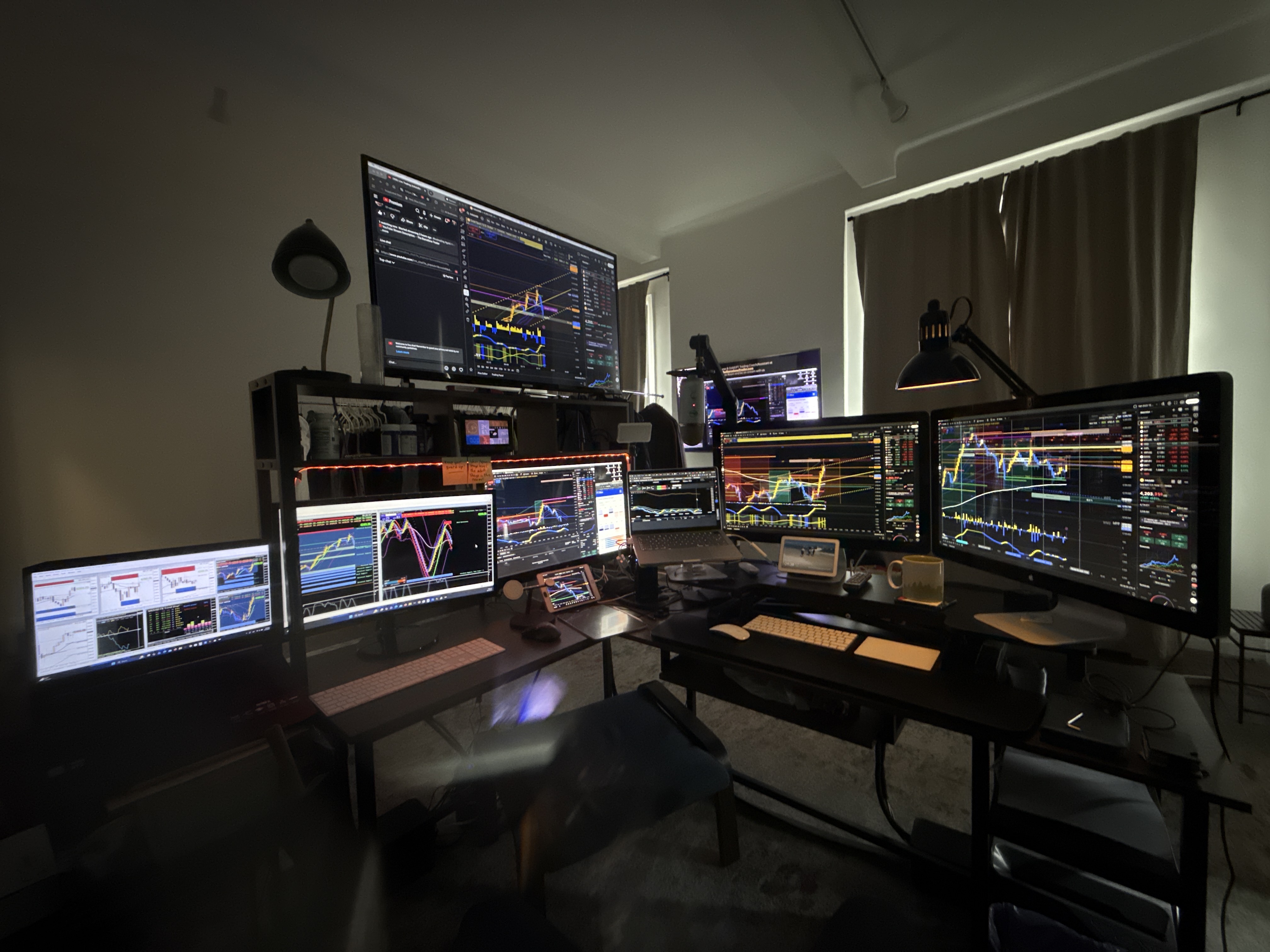
    A room that looks like NASA, NORAD, and the DJ booth at Razzmatazz had a baby, and that baby developed a deeply unhealthy relationship with XAUUSD.

    Welcome to the Barcelona Trader Command Center—where eight monitors stand shoulder-to-shoulder like Catalan castellers, and one tier high, each one dedicated to a very specific purpose that I will absolutely forget when things go sideways.

    Front and center: the charts I actually use.

    Left side: the charts I pretend I use.

    Right side: the charts I swear I’ll use tomorrow.

    Top screen: YouTube chat roasting me in real time.

    Every screen flashes with more data than any one human should consume before 9AM. Pivot levels, liquidity sweeps, delta footprints, volatility bands—basically a live EEG of gold’s nervous system.

    Good luck getting this on your Apple Watch.

    The lighting is dim on purpose.

    Not because I’m dramatic — though let’s be honest, I absolutely am — but because it keeps me calm enough to avoid doing something stupid at 8:31AM.

    The microphone you see?

    That’s for my streams.

    And by “streams,” I mean those moments when I’m pretending to be composed while internally whispering, Please, for the love of God, don’t reverse here.

    There’s a keyboard for every continent.

    A mouse for every mood.

    And enough cable spaghetti behind the desk to qualify for its own infrastructure bill.

    But here’s the truth:

    This setup isn’t about flexing.

    It’s not even about the screens.

    It’s about building an environment where I trade like the best version of myself, not the gremlin who shows up when I’m tired, bored, or convinced I can outsmart a trillion-dollar market using only spite.

    This room is where I’ve learned discipline, restraint, patience, humility — basically all the things gold has beaten into me through brute force.

    It’s where I’ve tilted, recovered, matured, and slowly, painfully, become a professional.

    And now it’s where I’m making the push toward real consistency, real payouts, and a real future in this game.

    So yeah — this is the Command Center.

    A control room for a trader who’s finally done trying to be a hero and is now just trying to be right enough, long enough, to win the war.

    Welcome behind the scenes.

    Mind the cables.

    And whatever you do…

    don’t touch these buttons over here. No wait. Not those. These other ones. No. Wait. Maybe it’s these other ones. Lemme check…

    Oh, sh*t!

  • The Most Dangerous Lie I Ever Believed as a Trader

    The Most Dangerous Lie I Ever Believed as a Trader

    There’s a lie traders tell themselves — and no, I don’t mean the innocent ones like:

    • “My setup is A+.”
    • “Jerome Powell wouldn’t hurt me personally.”
    • “This wick is definitely a liquidity grab and not a sign from God to stop trading.”

    No, I’m talking about the big lie.
    The seductive lie.
    The lie so powerful it should come with a surgeon general’s warning:

    “I can make it back.”

    Every trader knows this lie.
    Every trader has believed this lie.
    And every blown account in the history of humanity can be traced back to this lie.

    Because here’s the messed-up part:
    It’s not even really a lie.

    I can make it back.
    And not in some theoretical, self-help-book, manifest-your-destiny way.
    No — mathematically, psychologically, historically — most of the time, I actually could dig my way out.

    Which is precisely why it almost killed me.

    I wasn’t losing because I was bad at trading.
    Oh no.
    That would’ve been easy.

    I was losing because I was dangerously good at fixing my mistakes — right up until the moment I exploded like a crypto exchange with no risk management desk.

    See, the market gave me a cruel gift:
    Enough talent to believe I could always recover.
    But not enough emotional regulation to know when not to try.

    It’s the trader’s version of being able to fly… but only for short distances, and only before crashing into power lines.

    Let me break this down like a risk manager who’s given up on life:

    • 70% of the time, I make the losses back.
    • 30% of the time, I accidentally sacrifice a small forest of prop firm accounts.

    And that 30%?
    It happens when I’ve sized up, placed the revenge trade and lost again.

    That’s where Evil Mike shows up.
    The one who hyperventilates.
    The one who thinks the best recovery strategy is “what if we just press all the buttons harder?”

    This week, I met that fork in the road again.
    Two Hot Stove Exits losses. –$500 loss across all of my accounts. It hurts BUT my plan accounts for it and allows for it. The loss didn’t even throw my month off track. But it hurts! Did I mention that?
    Old me would’ve said:

    “Let’s get stupid.”

    He would’ve grabbed two more contracts, fired off another vengeance trade, and most likely ended the day either a triumphant war hero… or a cautionary tale in a Discord room.

    But this time?
    I did the unthinkable.

    I stopped.

    I took the boring red day.
    No Rambo trade.
    No “just one more and I’m done.”
    No emotional support chart bags.

    Just… stop.

    It turns out the secret to becoming a black belt trader is not becoming some Zen grandmaster who predicts every candle. No.
    It’s becoming a slightly more responsible adult than you were yesterday.

    It’s realizing that “making it back” is not a trading strategy.
    It’s an emotional impulse disguised as confidence.
    A wolf in sheep’s clothing.
    A wolf that ate all my sheep and then set the barn on fire.

    And yeah — trading is getting boring now.
    Predictable.
    Calm.
    Rule-based.
    Which is apparently what success looks like.

    Wild.

    Somewhere along the line, I traded in the adrenaline-fueled hero fantasy for the sustainable-but-boring habit of not blowing up my life.

    Turns out the market didn’t need fixing.
    The accounts didn’t need fixing.
    The hedge fund gods didn’t need appeasing.

    It was me.
    I was the problem.

    And honestly?
    It’s kind of nice to be fixed.

  • Yes, I Trade $10 Million of Gold With a Mouse Click. No, I’m Not Joking.

    Yes, I Trade $10 Million of Gold With a Mouse Click. No, I’m Not Joking.

    There’s a moment every trader eventually has — usually after a clean session where everything finally feels quiet and professional — when you take a step back and think:

    “I am casually transacting millions of dollars of gold with a mouse click.”

    This isn’t theoretical.

    This isn’t dramatized.

    It’s just the math of trading GC at scale.

    I’ve always known the contract specs — 1 GC contract controls 100 troy ounces — but I don’t think most people ever stop to feel what that actually means.

    Let me show you what it means.

    The Math Behind the Madness

    1 contract = 100 ounces

    I trade 25 accounts simultaneously.

    So…

    1 trade × 25 contracts = 2,500 ounces of gold

    At today’s price of ~$4,065 an ounce:

    2,500 oz × $4,065 = $10,162,500

    Yes, really.

    Every time I enter one position — just one — the notional value is north of ten million dollars.

    This is why:

    • a 1-tick movement is a $250 swing
    • a 10-tick pullback is $2,500
    • a hesitation feels like someone reached into your pocket
    • and a tilt episode becomes a financial reenactment of the Hindenburg

    Gold scalping isn’t “day trading.”

    It’s not “side income.”

    It’s not “just a few ticks.”

    It’s high-velocity risk management on institutional-sized exposure with human-sized psychology.

    Heck, occasionally, I even size-up to two contracts, bringing the notional gold value to over $20m.

    No wonder it takes years to get consistent.

    Why Gold Scalping Is a Psychological Furnace

    Most retail traders think they’re trading:

    • a $4,000 instrument
    • $10 per tick
    • something “manageable”

    But the body doesn’t react to the margin requirement.

    It reacts to the notional exposure.

    Your nervous system knows the stakes are huge.

    Mine did too — long before consistency arrived.

    This is why gold traders:

    • tilt violently
    • overtrade
    • freeze
    • chase
    • capitulate
    • revenge-trade
    • double size
    • spiral
    • blow accounts

    The math is simple.

    The psychology is nuclear.

    You’re controlling millions with a finger.

    Your body feels every ounce of it.

    What Finally Made It Click for Me

    It wasn’t “positive mindset.”

    It wasn’t morning affirmations.

    It wasn’t imagining myself on a yacht like some YouTube guru.

    It was building real structural guardrails:

    • a hard daily stop
    • a master account lock
    • a copier that enforces limits
    • guardrails around dopamine
    • a process that protects me from tilt
    • a cockpit my brain can operate under pressure

    Once the structure was correct, trading millions of dollars of notional gold per session stopped feeling like running into a burning building.

    It became manageable.

    Predictable.

    Even calm.

    The stakes didn’t change.

    I just stopped letting my worst impulses participate.

    The Point of This Post

    It’s this:

    If you’re trading GC, you’re already in the deep end.

    You can pretend you’re not — but your nervous system knows the truth.

    And that truth explains:

    • the learning curve
    • the emotional volatility
    • the blown accounts
    • the dopamine storms
    • the delayed consistency
    • the difficulty
    • the necessity of guardrails
    • the relief when things finally stabilize

    You’re not trading “just one contract.”

    You’re trading leverage on millions of dollars of metal.

    That’s why consistency feels like a multi-year marathon.

    That’s why survival is the first skill.

    Consistency is the second.

    Profitability is the third.

    And if you make it to the third?

    You’re already beating mathematical gravity.

    Final Thought

    I used to beat myself up for how long it took — 2 years and 8 months.

    But now, standing on the other side of the chaos, here’s what I know:

    This timeline isn’t slow.

    This timeline isn’t embarrassing.

    This timeline is exactly what it takes to trade millions of dollars of gold with a nervous system that’s human.

    The game isn’t easy.

    But I built the cockpit.

    And now the plane flies.

    One click.

    Ten million in notional gold.

    And for the first time — peace.