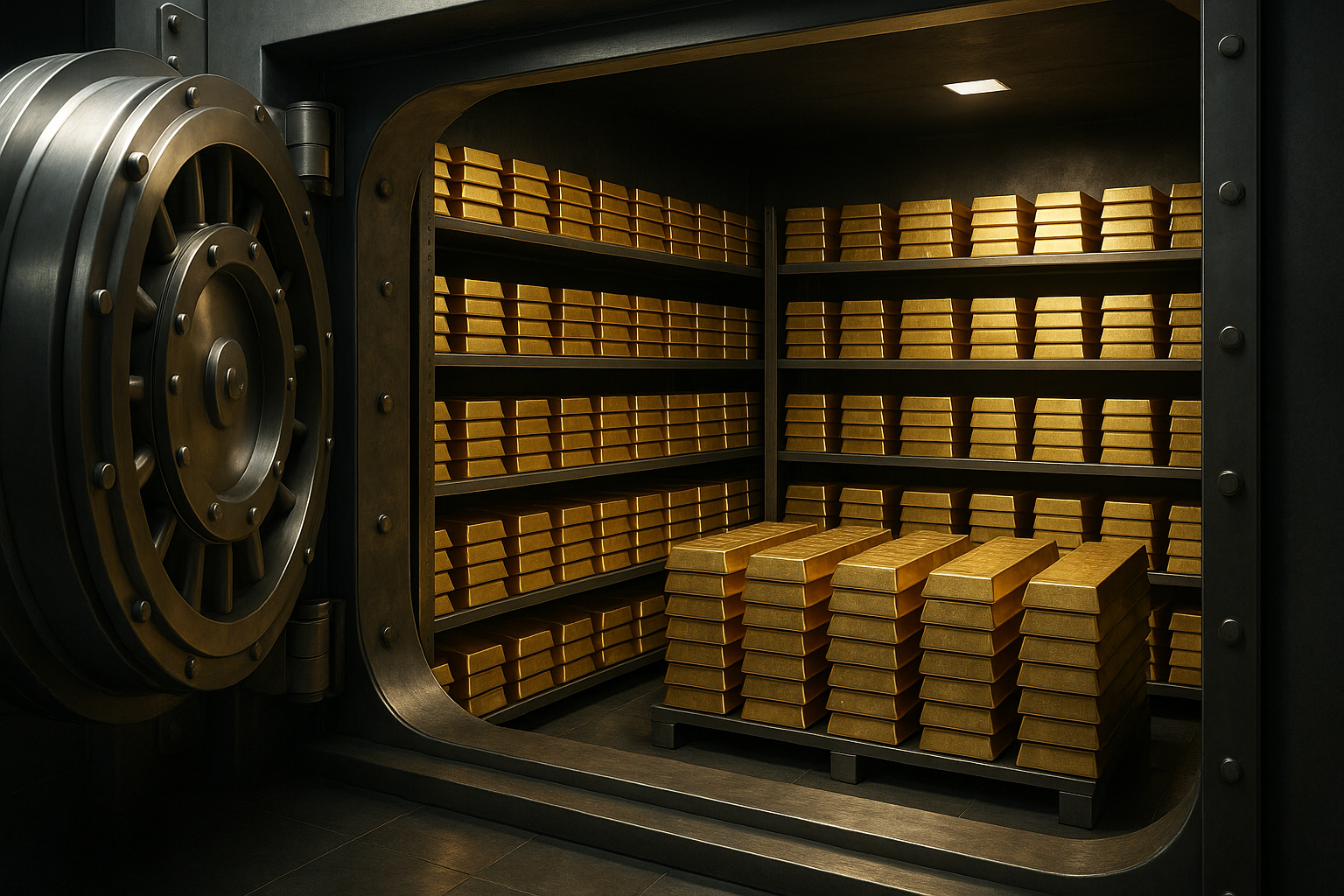
Gold is a funny thing. It has no earnings, no dividends, no quarterly reports. You can’t eat it, and it’s not especially useful for modern industrial processes. But somehow, it still commands the attention of central banks, hedge funds, sovereign wealth managers, and your cousin Dave who owns “a little physical, just in case.”
The reason is simple: gold is trust on a chain. It’s the asset that steps in when fiat feels fragile, when bonds look shaky, or when the geopolitical tea leaves start swirling in unpredictable ways. It doesn’t promise yield — it promises stability. And in a world increasingly short on that, gold gets traded. A lot.
🌍 Global Gold Trading — Bigger Than Most People Realize
Let’s talk scale. Each day, depending on the source and how you count it, roughly $130–$200 billion worth of gold changes hands globally across all markets — futures, spot, ETFs, OTC, and physical. That’s more than the daily volume of the S&P 500.
To break that down:
- Hourly, we’re talking $5–8 billion.
- Per minute, about $100–150 million.
- Per second, you could argue the world blinks and $2 million in gold just moved.
This isn’t just day traders poking at XAUUSD. We’re talking about:
- Central banks quietly adjusting their reserves.
- Algorithmic traders scalping GC1! contracts.
- Physical deliveries being arranged via the LBMA or the Shanghai Gold Exchange.
- Bullion dealers hedging forward contracts through COMEX futures.
And yes — retail traders (like us) taking breakout scalps off key pivots at 7:32 a.m. because we think the DXY’s losing steam.
🧠 Why We Trade Gold
We could trade anything — indices, currencies, soybeans if we felt like it. But we trade gold.
Why?
Because gold moves. It gives us real opportunities every single day. Whether it’s reacting to a Fed comment, a war headline, or just bouncing off a key level, gold offers the kind of intraday volatility that scalpers dream about. Not random chaos — but consistent rhythm. It stretches and contracts in ways you can come to know, if you pay attention long enough.
That’s why our team doesn’t try to be masters of everything. We specialize. Because every instrument has its own personality, and developing instinct — real gut feel — only happens when you commit to learning one market inside and out. For us, that’s gold.
Over time, the setups start to scream instead of whisper. The traps get easier to spot. And edge starts to look a lot like intuition.
So no, we don’t trade everything.
We trade the one thing that rewards mastery.
🧭 Who Sets the Price?
Despite all these trading venues, there’s one main benchmark the world references — COMEX futures. That’s where most of the price discovery happens. Spot gold (XAUUSD) follows it. The Shanghai Gold Exchange reflects it. Even over-the-counter billion-dollar private deals are priced off it.
Central banks may not click the “Buy” button on GC1!, but when they rebalance reserves, they’re staring at that same number you and I are.
And so while gold might feel old-school, the ecosystem around it is anything but. It’s global, fast, liquid, and surprisingly modern — with price feeds pinging from New York to London to Shanghai in milliseconds.
So if you’ve ever wondered how gold really moves — who moves it, when, and why — the following table gives you a cheat sheet to the major players and platforms. From spot to futures to physical, here’s how the world trades gold:
🌐 Gold Price Market Comparison: Who’s Driving What?
| Feature | COMEX (Futures) | SGE (Shanghai Gold Exchange) | OTC Market (e.g., LBMA) | XAUUSD (Spot Gold) |
|---|---|---|---|---|
| Role in Price Discovery | 🏆 Primary benchmark — sets global tone | Secondary — reflects Chinese physical demand | Influences via large private flows | 💡 Follows futures, reflects global sentiment |
| Transparency | High — public, regulated, real-time data | Medium — less real-time depth | Low — private & bilateral | Medium — varies by broker, influenced by liquidity feeds |
| Participants | Hedge funds, banks, asset managers | Chinese institutions, refiners, central bank-affiliates | Central banks, sovereigns, bullion banks | Retail traders, brokers, liquidity providers |
| Currency | USD | CNY (Yuan) | USD | USD |
| Settlement | Mostly cash-settled contracts (GC1!) | Physical delivery only | Physical & forwards, swaps | Cash-settled, no physical delivery |
| Volume & Liquidity | Very high (esp. front-month contracts) | High, domestic to China | Massive but opaque | High — driven by retail + broker-dealer liquidity pools |
| Pricing Influence | 🧭 Global benchmark— base reference for all | Follows COMEX + adds regional premium/discount | Prices referenced to COMEX | Mirrors COMEX/OTC but often leads intraday sentiment |
| Arbitrage Potential | Yes — vs SGE & OTC | Yes — via premium arbitrage | Limited but present | No — derivative of other markets |
| Used by Central Banks? | 🏦 Yes — for reserve benchmarking and hedging | Yes — esp. China | Yes — primary for physical reserve acquisition | No — not directly used by central banks |
| Market Hours | 23 hours/day (CME Globex) | Chinese trading hours (approx. 13 hours/day) | 24/7 (unofficial) | 24/5 (with gaps at rollover and weekends) |
🧠 Key Takeaways
- COMEX: Serves as the primary platform for global gold price discovery, influencing other markets worldwide.
- SGE: Reflects China’s domestic gold market dynamics and often trades at a premium or discount to COMEX.
- OTC Market: Comprises large, private transactions that can influence pricing but lack transparency.
- XAUUSD: Represents the spot price of gold in USD, closely tracking COMEX and OTC prices, and is widely used by retail traders.