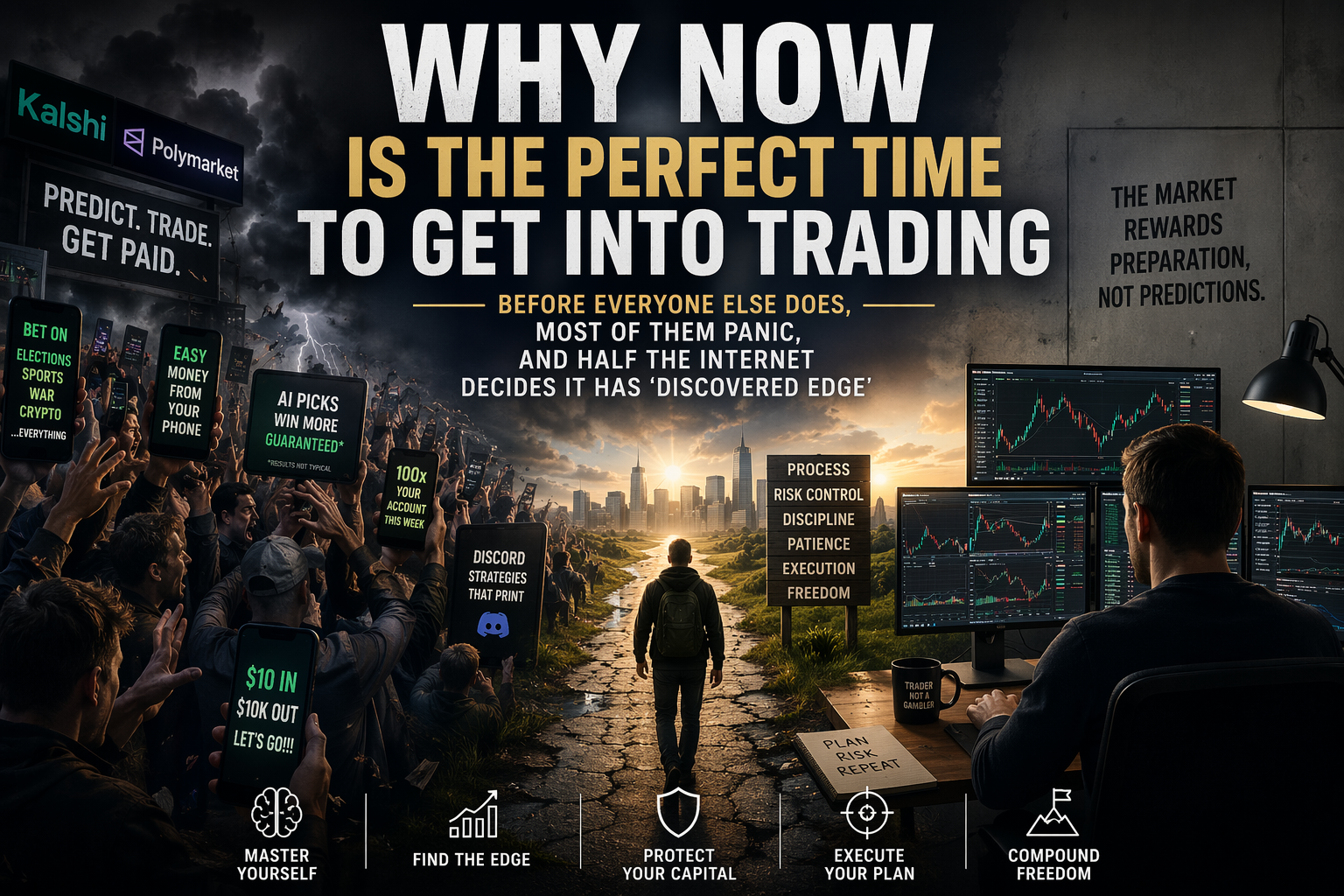
There are moments in history when it pays to be early.
Not just because you beat the rush, but because you have time to become the real thing before the crowd arrives in a cloud of confidence, apps, Discord links, and deeply inspirational self-delusion.
This is one of those moments.
A while back, I made the argument that AI was going to disrupt white-collar work, that many smart and capable people would start looking for alternative ways to earn, and that trading would become one of the obvious places they’d land. That thesis has only gotten stronger.
Because now we’re no longer dealing with a thought experiment. We’re watching the early signs already. The IMF said in January that nearly 40% of global jobs are exposed to AI-driven change, with major implications for the kinds of professional and technical roles many people once thought were relatively safe.
And when people feel their footing slipping, they do what modern people do: they open an app and attempt to negotiate with uncertainty.
Which brings us to a useful preview of what’s coming.
You can already see a version of this impulse in the rise of prediction markets like Kalshi and Polymarket. These platforms have exploded in visibility and volume. Reuters reported in March that global prediction-market trading volume hit $47 billion in 2025, and that the sector was drawing serious interest from traditional finance. Reuters also reported that Intercontinental Exchange, the parent company of the New York Stock Exchange, invested $600 million more into Polymarket in late March as event-based trading keeps growing.
That tells you something important.
More and more people are getting comfortable with the idea that they can supplement income, regain some control, or monetize their judgment by tapping at a glowing rectangle and making wagers on uncertain future outcomes. Politics. Economics. Geopolitics. Sports. The fate of civilization before lunch. Reuters has also reported broader 2026 side-hustle and career-pivot pressures as workers try to assemble a livable financial life from multiple income streams and reinvention strategies.
And I get it.
This economy has a way of making people feel like they should have at least three revenue streams, a newsletter, a consulting lane, a personal brand, and perhaps a tasteful mushroom tincture business just to afford soup.
So people flock to whatever looks like agency.
But prediction markets also illustrate an important distinction.
They can create the illusion that all market-related activity is basically the same. It isn’t.
A lot of prediction-market activity is much closer to gambling with a news addiction than it is to professional trading. At times it starts to resemble a slightly dressed-up version of “who knew what first.” Reuters reported scrutiny over Iran-related prediction bets in March, including concerns about whether these markets can reward unusually early or unusually good information in ways that edge uncomfortably close to insider-style dynamics. And reporting this week on newsroom ethics around prediction markets underscored the same broader problem: when access to information becomes tradable, the line between insight and informational unfairness can get very thin, very fast.
That is not the same thing as learning to trade.
Trading, done seriously, is not just having a take on the future and an app in your hand. It is a craft. A profession. A discipline. It is process, execution, risk management, emotional control, market understanding, and the ability to function under pressure without turning one bad decision into an interpretive dance of financial self-harm.
That difference matters.
Because as more people get used to monetized uncertainty, more of them are going to drift toward actual trading too. Some will come from the world of prediction apps. Some will come from layoffs, career anxiety, or shrinking opportunity in white-collar work. Some will simply be looking for a skill that feels more durable and self-directed than waiting to be reorganized out of existence by software and a cheerful email from Human Resources.
That impulse is understandable.
What is not understandable is how casually many people will be sold the fantasy.
They’ll be told that with the right AI prompt, a few backtests, an indicator pack, and a face that says “I’ve recently discovered conviction,” they can become traders.
They cannot.
Not right away.
Not because they are dumb. Not because they are weak. Not because the gods have singled them out for humiliation near a ring light.
But because trading is not mainly an information problem. It is a judgment-under-pressure problem.
And that is where the suffering starts.
AI can help people learn faster. It can help them organize information, test ideas, summarize concepts, and accelerate the early stages of education. That part is real. The tool is real.
What it cannot do is regulate your nervous system for you when you are in a live trade and your brain has suddenly become a small regional theater staging a production called Maybe It’ll Come Back. It cannot make you patient when price is choppy. It cannot stop you from revenge trading because your last setup failed and now you have decided to challenge the market to a duel over twelve dollars and your remaining dignity.
That part is still human.
And that is exactly why this may be the best time in years to start learning seriously.
Because we are entering the period when more people will come toward trading for valid reasons, but most of them will still underestimate what the craft actually demands.
Phase 1: The Surge
The first thing to understand is that more people are going to explore trading over the next few years, and many of them are going to be perfectly intelligent people.
That is what makes this so interesting.
This is not mainly a story about fools rushing in.
It is a story about smart, stressed, capable, ambitious people walking into a brutally unforgiving domain with the wrong mental model.
They will think access is competence.
They will think software is discipline.
They will think information is edge.
They will think “I understand the setup” is the same thing as “I can execute it repeatedly under pressure with risk under control and my ego in a medically supervised condition.”
It is not.
And because it is not, many of them will have a rough experience.
Not because they deserve one.
Because they are entering a field that is routinely marketed as easier, faster, and more intuitive than it really is.
That is why starting now matters.
If you begin now, you are not getting ahead of some cartoon mob of idiots in clown shoes carrying candlestick charts and motivational podcasts. You are getting ahead of a large incoming wave of underprepared people, many of whom will need years to understand what trading actually requires.
That gives you something incredibly valuable: time.
Time to build process before the noise gets louder.
Time to develop judgment before overconfidence gets industrialized.
Time to become calm and capable while other people are still mistaking enthusiasm for skill.
Phase 2: The Washout
This is the part that sounds harsh, but it is simply reality: most people who try trading will not stay with it long enough, seriously enough, or humbly enough to become consistently good.
Some will lose money and leave.
Some will discover they were attracted to the fantasy more than the craft.
Some will be taught badly.
Some will size badly.
Some will confuse motion with mastery.
Some will explain every loss using a rotating wheel of excuses that includes the algos, the market makers, Jerome Powell, Europe, spread widening, cosmic injustice, and whatever one candle did to them personally at 9:37 a.m.
And some will quit not because they lacked potential, but because the learning curve is steeper and lonelier than they were led to believe.
That last category matters to me.
Because I do not think the coming washout is funny in some gleeful way. I think a lot of people are going to come into this trying earnestly to adapt to a changing world. Many of them will be decent, hardworking, intelligent people. They will simply be trying to learn something difficult under financial and emotional pressure, while being sold a version of trading that looks like freedom and often behaves like a psychological stress position.
That is not mockery-worthy. That is just modern life with better graphics.
But it is also true that a washout will happen.
It always does.
And when it does, the people who remain will not necessarily be the flashiest or the loudest. They will be the ones who built habits, process, emotional control, and respect for risk. The ones who stopped trying to win arguments with the market and started learning how to work.
That is where the real separation begins.
Phase 3: The Thinner Air
Longer term, I still think the environment gets more selective.
More automation.
More machine participation.
Less obvious sloppiness floating around for anyone with a chart, a prayer, and a deeply moving commitment to being early for the wrong reason.
That does not mean there will be no edge for humans.
It means the bar rises.
The edge migrates toward patience, precision, selectivity, self-control, and the ability to execute without flinching, freelancing, or composing an entire constitutional crisis in your own head because one setup failed.
That is a different game than the hype version.
But it is still a real one.
And here is the beautiful part: every cycle still brings new participants. Every cycle produces fresh overconfidence, fresh shortcuts, fresh magical thinking, fresh attempts to turn uncertainty into income with insufficient preparation and a suspiciously expensive microphone.
Human nature is not going anywhere.
Which means opportunity is not going anywhere either.
It just becomes less forgiving about who gets to capture it.
So Why Get In Now?
Because this is the sweet spot.
You are early enough to build skill before the next big rush fully matures.
You are early enough to learn the hard parts before the culture gets even more saturated with AI-assisted confidence and low-friction speculation.
You are early enough to develop real competence while many others are still discovering that trading is not a loophole, not a productivity hack, not a monetized vibe, and not a substitute for emotional regulation.
That is the opportunity.
Not to mock people.
Not to prey on anyone.
To get serious before seriousness becomes unavoidable.
The people who start now, and treat this like a profession, will be in a very different position from the people who arrive later assuming that access to tools means access to edge.
And that gap is likely to widen, not shrink.
There is another reason this matters right now. Reuters reported this week that the SEC approved the removal of the old pattern day trader restriction, which had limited small accounts under $25,000 to three day trades in five business days. Critics warned the change could open the door to more impulsive, higher-risk retail behavior. In plain English, one more barrier has been lowered between undercapitalized enthusiasm and a memorable afternoon.
That does not mean people should not learn trading.
It means they should learn it properly.
Because easier access does not make the profession easier. It just increases the number of people who can discover that fact firsthand.
One More Thing
If you are going to get into trading now, learn from people who respect both the opportunity and the difficulty.
Learn from people who actually trade.
Learn from people who understand that human behavior matters as much as market structure.
Learn from people who are not selling trading as an escape hatch for the desperate, but as a demanding craft for people willing to do the work.
That is what we try to do at The Barcelona Trader.
Real systems.
Real coaching.
Real markets.
Real-time pressure.
If you want to begin before the next wave fully crashes onto the beach with its apps, narratives, side-hustle panic, and brave little delusions, this is a very good time to start.
Maybe the best time in years.
Because the future is likely to contain more uncertainty, more speculation, more people trying to earn from volatility, and more confusion about the difference between clicking on risk and actually knowing how to manage it. The early signs are already here, from AI-driven job anxiety to booming prediction markets to regulatory changes that make active trading easier to access for smaller accounts.
And that is exactly why trading should be treated with more seriousness, not less.
A lot of people are about to come looking for agency.
Some will find gambling.
Some will find noise.
Some will find a temporary obsession and a very educational bruise.
A few will find a craft.
Better to start becoming one of those people now.
Leave a Reply