Tag: finance

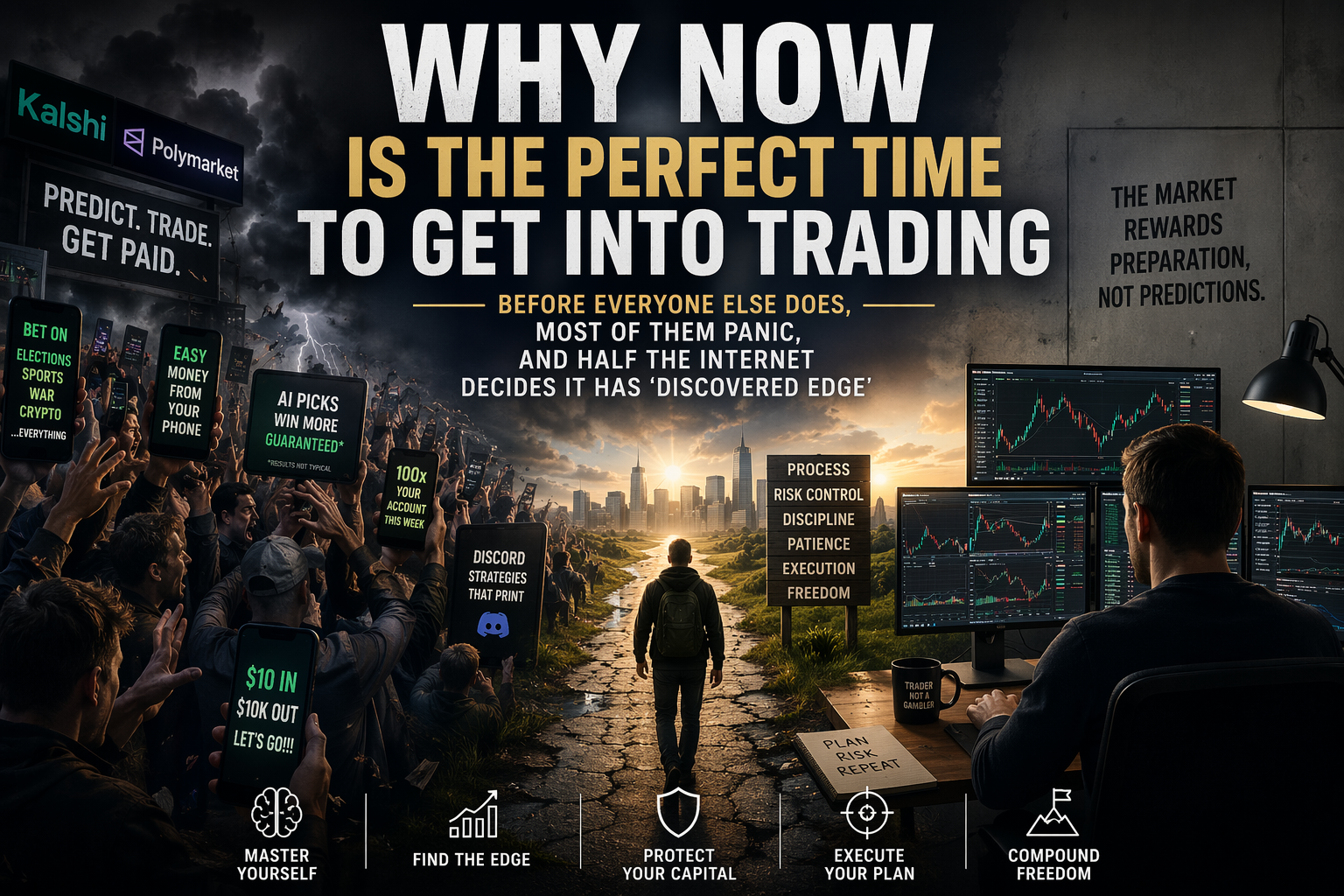
  • Why Now Is the Perfect Time to Get Into Trading – Before Everyone Else Does, Most of Them Panic, and Half the Internet Decides It Has “Discovered Edge”

    Why Now Is the Perfect Time to Get Into Trading – Before Everyone Else Does, Most of Them Panic, and Half the Internet Decides It Has “Discovered Edge”

    There are moments in history when it pays to be early.

    Not just because you beat the rush, but because you have time to become the real thing before the crowd arrives in a cloud of confidence, apps, Discord links, and deeply inspirational self-delusion.

    This is one of those moments.

    A while back, I made the argument that AI was going to disrupt white-collar work, that many smart and capable people would start looking for alternative ways to earn, and that trading would become one of the obvious places they’d land. That thesis has only gotten stronger.

    Because now we’re no longer dealing with a thought experiment. We’re watching the early signs already. The IMF said in January that nearly 40% of global jobs are exposed to AI-driven change, with major implications for the kinds of professional and technical roles many people once thought were relatively safe.

    And when people feel their footing slipping, they do what modern people do: they open an app and attempt to negotiate with uncertainty.

    Which brings us to a useful preview of what’s coming.

    You can already see a version of this impulse in the rise of prediction markets like Kalshi and Polymarket. These platforms have exploded in visibility and volume. Reuters reported in March that global prediction-market trading volume hit $47 billion in 2025, and that the sector was drawing serious interest from traditional finance. Reuters also reported that Intercontinental Exchange, the parent company of the New York Stock Exchange, invested $600 million more into Polymarket in late March as event-based trading keeps growing.

    That tells you something important.

    More and more people are getting comfortable with the idea that they can supplement income, regain some control, or monetize their judgment by tapping at a glowing rectangle and making wagers on uncertain future outcomes. Politics. Economics. Geopolitics. Sports. The fate of civilization before lunch. Reuters has also reported broader 2026 side-hustle and career-pivot pressures as workers try to assemble a livable financial life from multiple income streams and reinvention strategies.

    And I get it.

    This economy has a way of making people feel like they should have at least three revenue streams, a newsletter, a consulting lane, a personal brand, and perhaps a tasteful mushroom tincture business just to afford soup.

    So people flock to whatever looks like agency.

    But prediction markets also illustrate an important distinction.

    They can create the illusion that all market-related activity is basically the same. It isn’t.

    A lot of prediction-market activity is much closer to gambling with a news addiction than it is to professional trading. At times it starts to resemble a slightly dressed-up version of “who knew what first.” Reuters reported scrutiny over Iran-related prediction bets in March, including concerns about whether these markets can reward unusually early or unusually good information in ways that edge uncomfortably close to insider-style dynamics. And reporting this week on newsroom ethics around prediction markets underscored the same broader problem: when access to information becomes tradable, the line between insight and informational unfairness can get very thin, very fast.

    That is not the same thing as learning to trade.

    Trading, done seriously, is not just having a take on the future and an app in your hand. It is a craft. A profession. A discipline. It is process, execution, risk management, emotional control, market understanding, and the ability to function under pressure without turning one bad decision into an interpretive dance of financial self-harm.

    That difference matters.

    Because as more people get used to monetized uncertainty, more of them are going to drift toward actual trading too. Some will come from the world of prediction apps. Some will come from layoffs, career anxiety, or shrinking opportunity in white-collar work. Some will simply be looking for a skill that feels more durable and self-directed than waiting to be reorganized out of existence by software and a cheerful email from Human Resources.

    That impulse is understandable.

    What is not understandable is how casually many people will be sold the fantasy.

    They’ll be told that with the right AI prompt, a few backtests, an indicator pack, and a face that says “I’ve recently discovered conviction,” they can become traders.

    They cannot.

    Not right away.

    Not because they are dumb. Not because they are weak. Not because the gods have singled them out for humiliation near a ring light.

    But because trading is not mainly an information problem. It is a judgment-under-pressure problem.

    And that is where the suffering starts.

    AI can help people learn faster. It can help them organize information, test ideas, summarize concepts, and accelerate the early stages of education. That part is real. The tool is real.

    What it cannot do is regulate your nervous system for you when you are in a live trade and your brain has suddenly become a small regional theater staging a production called Maybe It’ll Come Back. It cannot make you patient when price is choppy. It cannot stop you from revenge trading because your last setup failed and now you have decided to challenge the market to a duel over twelve dollars and your remaining dignity.

    That part is still human.

    And that is exactly why this may be the best time in years to start learning seriously.

    Because we are entering the period when more people will come toward trading for valid reasons, but most of them will still underestimate what the craft actually demands.

    Phase 1: The Surge

    The first thing to understand is that more people are going to explore trading over the next few years, and many of them are going to be perfectly intelligent people.

    That is what makes this so interesting.

    This is not mainly a story about fools rushing in.

    It is a story about smart, stressed, capable, ambitious people walking into a brutally unforgiving domain with the wrong mental model.

    They will think access is competence.

    They will think software is discipline.

    They will think information is edge.

    They will think “I understand the setup” is the same thing as “I can execute it repeatedly under pressure with risk under control and my ego in a medically supervised condition.”

    It is not.

    And because it is not, many of them will have a rough experience.

    Not because they deserve one.

    Because they are entering a field that is routinely marketed as easier, faster, and more intuitive than it really is.

    That is why starting now matters.

    If you begin now, you are not getting ahead of some cartoon mob of idiots in clown shoes carrying candlestick charts and motivational podcasts. You are getting ahead of a large incoming wave of underprepared people, many of whom will need years to understand what trading actually requires.

    That gives you something incredibly valuable: time.

    Time to build process before the noise gets louder.

    Time to develop judgment before overconfidence gets industrialized.

    Time to become calm and capable while other people are still mistaking enthusiasm for skill.

    Phase 2: The Washout

    This is the part that sounds harsh, but it is simply reality: most people who try trading will not stay with it long enough, seriously enough, or humbly enough to become consistently good.

    Some will lose money and leave.

    Some will discover they were attracted to the fantasy more than the craft.

    Some will be taught badly.

    Some will size badly.

    Some will confuse motion with mastery.

    Some will explain every loss using a rotating wheel of excuses that includes the algos, the market makers, Jerome Powell, Europe, spread widening, cosmic injustice, and whatever one candle did to them personally at 9:37 a.m.

    And some will quit not because they lacked potential, but because the learning curve is steeper and lonelier than they were led to believe.

    That last category matters to me.

    Because I do not think the coming washout is funny in some gleeful way. I think a lot of people are going to come into this trying earnestly to adapt to a changing world. Many of them will be decent, hardworking, intelligent people. They will simply be trying to learn something difficult under financial and emotional pressure, while being sold a version of trading that looks like freedom and often behaves like a psychological stress position.

    That is not mockery-worthy. That is just modern life with better graphics.

    But it is also true that a washout will happen.

    It always does.

    And when it does, the people who remain will not necessarily be the flashiest or the loudest. They will be the ones who built habits, process, emotional control, and respect for risk. The ones who stopped trying to win arguments with the market and started learning how to work.

    That is where the real separation begins.

    Phase 3: The Thinner Air

    Longer term, I still think the environment gets more selective.

    More automation.

    More machine participation.

    Less obvious sloppiness floating around for anyone with a chart, a prayer, and a deeply moving commitment to being early for the wrong reason.

    That does not mean there will be no edge for humans.

    It means the bar rises.

    The edge migrates toward patience, precision, selectivity, self-control, and the ability to execute without flinching, freelancing, or composing an entire constitutional crisis in your own head because one setup failed.

    That is a different game than the hype version.

    But it is still a real one.

    And here is the beautiful part: every cycle still brings new participants. Every cycle produces fresh overconfidence, fresh shortcuts, fresh magical thinking, fresh attempts to turn uncertainty into income with insufficient preparation and a suspiciously expensive microphone.

    Human nature is not going anywhere.

    Which means opportunity is not going anywhere either.

    It just becomes less forgiving about who gets to capture it.

    So Why Get In Now?

    Because this is the sweet spot.

    You are early enough to build skill before the next big rush fully matures.

    You are early enough to learn the hard parts before the culture gets even more saturated with AI-assisted confidence and low-friction speculation.

    You are early enough to develop real competence while many others are still discovering that trading is not a loophole, not a productivity hack, not a monetized vibe, and not a substitute for emotional regulation.

    That is the opportunity.

    Not to mock people.

    Not to prey on anyone.

    To get serious before seriousness becomes unavoidable.

    The people who start now, and treat this like a profession, will be in a very different position from the people who arrive later assuming that access to tools means access to edge.

    And that gap is likely to widen, not shrink.

    There is another reason this matters right now. Reuters reported this week that the SEC approved the removal of the old pattern day trader restriction, which had limited small accounts under $25,000 to three day trades in five business days. Critics warned the change could open the door to more impulsive, higher-risk retail behavior. In plain English, one more barrier has been lowered between undercapitalized enthusiasm and a memorable afternoon.

    That does not mean people should not learn trading.

    It means they should learn it properly.

    Because easier access does not make the profession easier. It just increases the number of people who can discover that fact firsthand.

    One More Thing

    If you are going to get into trading now, learn from people who respect both the opportunity and the difficulty.

    Learn from people who actually trade.

    Learn from people who understand that human behavior matters as much as market structure.

    Learn from people who are not selling trading as an escape hatch for the desperate, but as a demanding craft for people willing to do the work.

    That is what we try to do at The Barcelona Trader.

    Real systems.

    Real coaching.

    Real markets.

    Real-time pressure.

    If you want to begin before the next wave fully crashes onto the beach with its apps, narratives, side-hustle panic, and brave little delusions, this is a very good time to start.

    Maybe the best time in years.

    Because the future is likely to contain more uncertainty, more speculation, more people trying to earn from volatility, and more confusion about the difference between clicking on risk and actually knowing how to manage it. The early signs are already here, from AI-driven job anxiety to booming prediction markets to regulatory changes that make active trading easier to access for smaller accounts.

    And that is exactly why trading should be treated with more seriousness, not less.

    A lot of people are about to come looking for agency.

    Some will find gambling.

    Some will find noise.

    Some will find a temporary obsession and a very educational bruise.

    A few will find a craft.

    Better to start becoming one of those people now.

  • How to Survive a Long Weekend Without Trading Or: Good Friday, Bad Friday, Worst Friday

    How to Survive a Long Weekend Without Trading Or: Good Friday, Bad Friday, Worst Friday

    Good Friday is a beautiful holiday if you are a normal person.

    If you are a trader, it is a targeted psychological operation.

    The market is closed.
    Closed.

    Not “a little slow.”
    Not “thin liquidity.”
    Not “maybe London will give us something.”

    Closed.

    No gold. No futures. No opening bell. No little burst of hope at the top of the hour. No chance to make one excellent trade, two questionable ones, and then spend the rest of the day pretending the third one was still within plan.

    Just silence.

    Silence, and the horrifying realization that now I have absolutely no excuse not to do things in my actual life.

    This is where the long weekend becomes dangerous.

    Because while the markets are closed, the rest of life remains offensively open.

    The closet is still a disaster.
    That thing I said I’d “get to this weekend” is now, technically, this weekend.
    The pile of papers on the desk has stopped being a pile and become an ecosystem.
    The email I have been avoiding is still sitting there like a small legal threat.
    The house contains multiple drawers full of mystery cables that apparently now expect my full attention.

    And worst of all, other people become aware that I am available.

    This is the true black swan event.

    When markets are open, I am busy. I am focused. I am in battle. I am monitoring price, structure, momentum, liquidity, traps, reversals, stop runs, and the collective emotional instability of humanity as expressed through gold.

    When markets are closed, I am just a man standing in his home near a vacuum cleaner.

    Do you understand the collapse in status?

    A few hours ago I was a precision operator dancing with volatility.

    Now I’m apparently someone who has time to “look at the pantry situation.”

    The pantry situation.

    This is what Good Friday has reduced me to.

    And it gets worse.

    Because the break is long enough to create that special form of trader despair where you start missing the market in ways that would sound insane to civilians.

    You begin to miss spread.
    You miss candles printing.
    You miss the tiny fluctuations that would be meaningless to anyone else but to you feel like the pulse of the universe itself.
    You miss the possibility of violence.

    By Saturday, you’re checking charts out of habit even though nothing is moving.
    By Saturday afternoon, you are staring at old screenshots like a widower holding a locket.
    By Saturday night, you are explaining to your wife that no, you are not “free,” you are merely unable to participate in your chosen form of suffering.

    Then comes Sunday.

    The day of false hope.

    A full day where the market is still closed, but close enough that you can almost taste it.

    This is not rest. This is a hostage situation with brunch.

    And so the question becomes: how does one survive a long weekend without trading?

    Here are a few options.

    1. Pretend to be a human being.
    Go outside. Make eye contact. Speak in complete sentences that do not include the phrases “liquidity sweep,” “rejection candle,” or “that move was manipulated.”

    2. Do one neglected adult task and act like you rebuilt civilization.
    Clean a closet. Answer three emails. Throw out the ancient batteries. Reorganize something with the intensity of a man trying to regain control over a meaningless universe.

    3. Stare into the middle distance and call it recovery.
    This is especially useful if someone asks what’s wrong and you want to avoid saying, “Nothing, I’m just spiritually separated from gold until Sunday night.”

    4. Rewatch your old trades like game film.
    This creates the pleasant illusion that you are still working, when in fact you are just reopening emotional wounds voluntarily.

    5. Announce that the long weekend is a chance to reset.
    This is what disciplined people say. It sounds excellent. Very mature. Very healthy.
    Then, five minutes later, check the clock and mutter, “Only 31 more hours.”

    6. Accept the terrible truth.
    You are not relaxing.
    You are in pre-market purgatory.

    And maybe that’s okay.

    Maybe this is good for us.

    Maybe being forcibly separated from the market for a couple of days reminds us that there is, allegedly, more to life than candles, structure, execution, and trying not to do something stupid at exactly the wrong moment.

    Maybe.

    But let’s not get carried away.

    By Sunday evening, I will be at my screen like a Victorian wife waiting at the port for her husband’s ship.

    Return to me, you beautiful, terrible beast.

    Until then, I suppose I’ll handle the dishes, clean something I’ve been pretending not to see, and maybe address the growing humanitarian crisis in my desk drawer.

    This is what Good Friday takes from us.

    Not just opportunity.

    Identity.

  • The Invisible Cost: Why Trading is So Exhausting

    The Invisible Cost: Why Trading is So Exhausting

    If you’ve ever stood up after a short trading session and felt like you just finished a triathlon — despite not having moved anything except your eyeballs and one trembling index finger — you’re not imagining it.

    Trading is one of the most mentally exhausting activities on Earth.

    You’re not tired because you’re weak.

    You’re tired because the market quietly siphons off your mental, emotional, and spiritual energy like it’s running a Ponzi scheme on your frontal cortex.

    I call it the Invisible Tax — the silent killer of discipline, consistency, and whatever is left of your sanity.

    Let’s break down what this beast actually takes from you every session.

    1. The Intellectual Tax: Where Your Brain Performs Cirque du Soleil

    Trading isn’t “I have a strategy.”

    Trading is “I’m adapting to chaos in real time while pretending I’m calm.”

    Every minute at the screens, your brain is doing olympic-level processing:

    • Pattern Recognition While Under Fire

    You’re filtering noise, fake-outs, liquidity traps, algo stabs, and random gold spasms — all in search of a single clean signal that lasts maybe 7 seconds.

    This alone drains the same neural pathways used for deep thinking, complex math, and surviving family holidays.

    • High-Frequency Decision Making

    As a scalper, you make more decisions in 30 minutes than most people make before lunch.

    Enter? Don’t enter? Is that volume or noise?

    Are we breaking out or cosplaying a breakout?

    Science says each decision drains your mental battery.

    Great — because trading requires about 400 of them an hour.

    • Multi-Account Risk Management

    If you’re trading multiple accounts (hello, 30-account Barcelona special), this isn’t a job.

    This is speed-chess across thirty boards while the clock is itching to punch you in the face.

    Your brain is working at a level most people will never experience — and they absolutely wouldn’t survive it.

    2. The Energy Tax: Fear, Greed, and Other Olympic Sports

    The market doesn’t just drain your brain.

    It drains your nervous system.

    Every candle has the potential to make you rich, poor, or insane. Sometimes all three.

    • The Fear Response

    Price moves against you?

    Boom — amygdala activated.

    You’re suddenly one tick away from questioning your entire identity.

    The discipline to hit your stop instead of negotiating with yourself like a hostage taker?

    That burns energy like a rocket launch.

    • The Dopamine Trap

    When a trade is working, your brain whispers:

    Hold it longer…

    Double down…

    You’re a genius…

    It takes enormous willpower to stick to your actual plan instead of letting dopamine steer the ship straight into an iceberg.

    This emotional regulation — not the candles — is what empties your tank.

    3. The Emotional Tax: Paid in Regret, Self-Loathing, and Tuition Fees

    Losses hit differently when you care about the craft.

    Especially the preventable ones.

    Especially the ones where you know — you absolutely know — that you defeated yourself.

    That sting?

    That’s the emotional tax.

    It’s highest when you break a rule you’ve already learned the hard way.

    It’s the universe saying:

    “The market rewarded you for breaking your rules on Tuesday,

    and now it’s charging you $650 in tuition for breaking the same rule on Thursday.

    Please come again.”

    That’s when the rage appears.

    The urge to “make it back.”

    The fantasy of taking one more trade to restore justice to the world.

    That’s the moment you know:

    Your emotional battery is bankrupt.

    And that’s when most traders blow up.

    What Now? Protect the Battery

    If you want trading to stop feeling like a psychological demolition derby, you must make it less emotional.

    Not easier.

    Not safer.

    Just less emotional.

    How?

    1. Enforce the Lockout

    When you hit your daily loss limit, you stop.

    Not “after one more trade.”

    Not “when the setup looks perfect.”

    Now.

    This is the highest form of professional discipline. It’s the ritual that saves your future accounts from the revenge-trading monster that lives inside you.

    2. Trust the Process (Even When It Feels Cruel)

    Your P&L is not the scorecard.

    Your execution is.

    You’ve proven you can take a loss.

    Now prove you can take the lesson.

    Your system works when you work.

    Protect your mind first — profits come later.

    Final Thought

    Trading doesn’t just test your strategy —

    it tests your endurance, your emotional bandwidth, and your ability to stay sane while gold does its nightly impression of a drunken dragon.

    So if you’re exhausted after a “simple” session?

    Good.

    You’re doing it right.

    And tomorrow, if you protect your battery, you’ll do it even better.

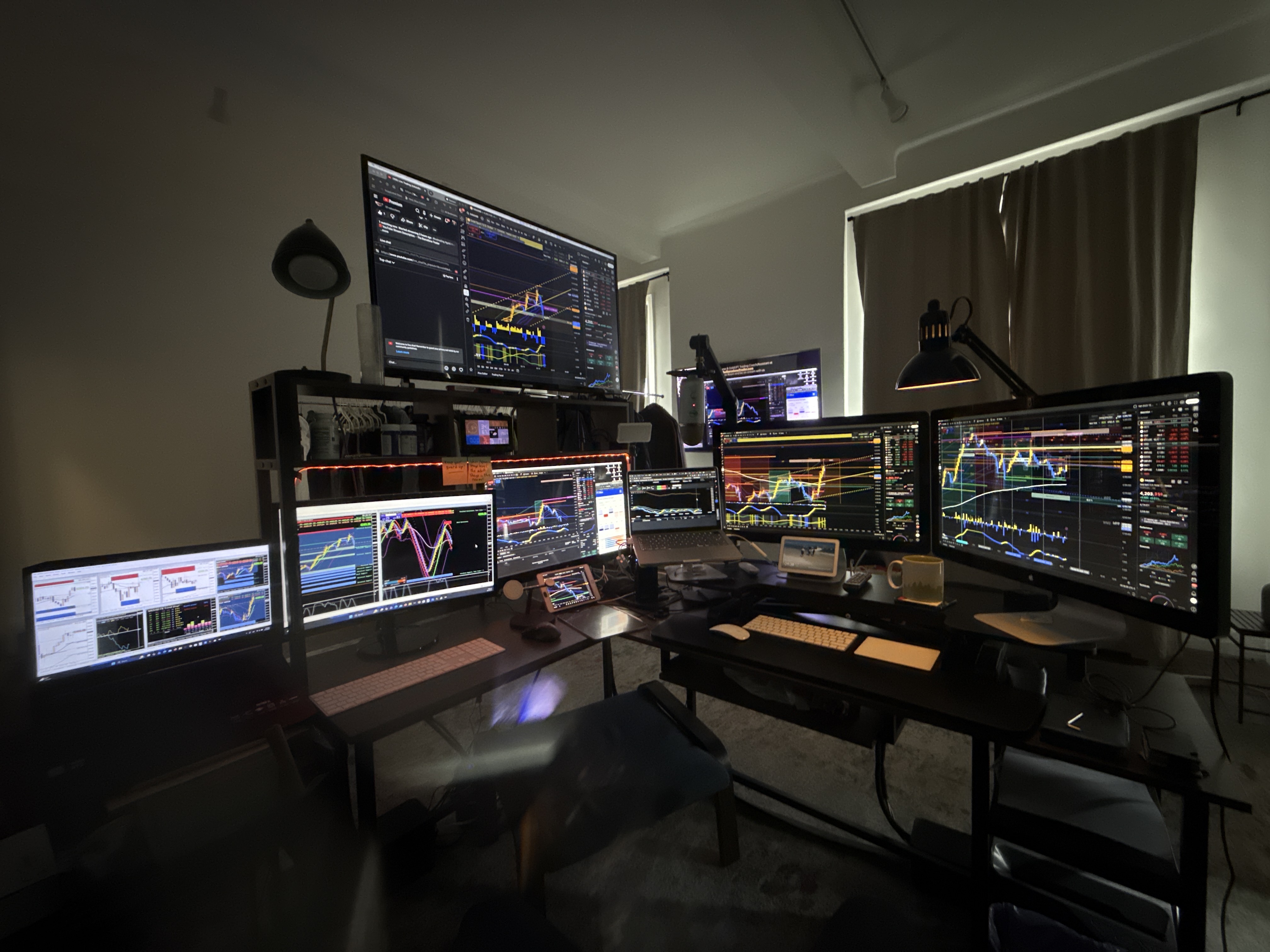
  • Behind the Scenes of the Barcelona Trader Command Center

    Behind the Scenes of the Barcelona Trader Command Center

    People keep asking me what my trading setup looks like — probably because they assume I’m operating from a single dusty laptop with a cracked screen and half a functioning trackpad.

    I get it.

    That would match the energy of someone who regularly screams at gold for “betraying me again.”

    But no.

    This is what you walk into:

    A room that looks like NASA, NORAD, and the DJ booth at Razzmatazz had a baby, and that baby developed a deeply unhealthy relationship with XAUUSD.

    Welcome to the Barcelona Trader Command Center—where eight monitors stand shoulder-to-shoulder like Catalan castellers, and one tier high, each one dedicated to a very specific purpose that I will absolutely forget when things go sideways.

    Front and center: the charts I actually use.

    Left side: the charts I pretend I use.

    Right side: the charts I swear I’ll use tomorrow.

    Top screen: YouTube chat roasting me in real time.

    Every screen flashes with more data than any one human should consume before 9AM. Pivot levels, liquidity sweeps, delta footprints, volatility bands—basically a live EEG of gold’s nervous system.

    Good luck getting this on your Apple Watch.

    The lighting is dim on purpose.

    Not because I’m dramatic — though let’s be honest, I absolutely am — but because it keeps me calm enough to avoid doing something stupid at 8:31AM.

    The microphone you see?

    That’s for my streams.

    And by “streams,” I mean those moments when I’m pretending to be composed while internally whispering, Please, for the love of God, don’t reverse here.

    There’s a keyboard for every continent.

    A mouse for every mood.

    And enough cable spaghetti behind the desk to qualify for its own infrastructure bill.

    But here’s the truth:

    This setup isn’t about flexing.

    It’s not even about the screens.

    It’s about building an environment where I trade like the best version of myself, not the gremlin who shows up when I’m tired, bored, or convinced I can outsmart a trillion-dollar market using only spite.

    This room is where I’ve learned discipline, restraint, patience, humility — basically all the things gold has beaten into me through brute force.

    It’s where I’ve tilted, recovered, matured, and slowly, painfully, become a professional.

    And now it’s where I’m making the push toward real consistency, real payouts, and a real future in this game.

    So yeah — this is the Command Center.

    A control room for a trader who’s finally done trying to be a hero and is now just trying to be right enough, long enough, to win the war.

    Welcome behind the scenes.

    Mind the cables.

    And whatever you do…

    don’t touch these buttons over here. No wait. Not those. These other ones. No. Wait. Maybe it’s these other ones. Lemme check…

    Oh, sh*t!

  • The Most Dangerous Lie I Ever Believed as a Trader

    The Most Dangerous Lie I Ever Believed as a Trader

    There’s a lie traders tell themselves — and no, I don’t mean the innocent ones like:

    • “My setup is A+.”
    • “Jerome Powell wouldn’t hurt me personally.”
    • “This wick is definitely a liquidity grab and not a sign from God to stop trading.”

    No, I’m talking about the big lie.
    The seductive lie.
    The lie so powerful it should come with a surgeon general’s warning:

    “I can make it back.”

    Every trader knows this lie.
    Every trader has believed this lie.
    And every blown account in the history of humanity can be traced back to this lie.

    Because here’s the messed-up part:
    It’s not even really a lie.

    I can make it back.
    And not in some theoretical, self-help-book, manifest-your-destiny way.
    No — mathematically, psychologically, historically — most of the time, I actually could dig my way out.

    Which is precisely why it almost killed me.

    I wasn’t losing because I was bad at trading.
    Oh no.
    That would’ve been easy.

    I was losing because I was dangerously good at fixing my mistakes — right up until the moment I exploded like a crypto exchange with no risk management desk.

    See, the market gave me a cruel gift:
    Enough talent to believe I could always recover.
    But not enough emotional regulation to know when not to try.

    It’s the trader’s version of being able to fly… but only for short distances, and only before crashing into power lines.

    Let me break this down like a risk manager who’s given up on life:

    • 70% of the time, I make the losses back.
    • 30% of the time, I accidentally sacrifice a small forest of prop firm accounts.

    And that 30%?
    It happens when I’ve sized up, placed the revenge trade and lost again.

    That’s where Evil Mike shows up.
    The one who hyperventilates.
    The one who thinks the best recovery strategy is “what if we just press all the buttons harder?”

    This week, I met that fork in the road again.
    Two Hot Stove Exits losses. –$500 loss across all of my accounts. It hurts BUT my plan accounts for it and allows for it. The loss didn’t even throw my month off track. But it hurts! Did I mention that?
    Old me would’ve said:

    “Let’s get stupid.”

    He would’ve grabbed two more contracts, fired off another vengeance trade, and most likely ended the day either a triumphant war hero… or a cautionary tale in a Discord room.

    But this time?
    I did the unthinkable.

    I stopped.

    I took the boring red day.
    No Rambo trade.
    No “just one more and I’m done.”
    No emotional support chart bags.

    Just… stop.

    It turns out the secret to becoming a black belt trader is not becoming some Zen grandmaster who predicts every candle. No.
    It’s becoming a slightly more responsible adult than you were yesterday.

    It’s realizing that “making it back” is not a trading strategy.
    It’s an emotional impulse disguised as confidence.
    A wolf in sheep’s clothing.
    A wolf that ate all my sheep and then set the barn on fire.

    And yeah — trading is getting boring now.
    Predictable.
    Calm.
    Rule-based.
    Which is apparently what success looks like.

    Wild.

    Somewhere along the line, I traded in the adrenaline-fueled hero fantasy for the sustainable-but-boring habit of not blowing up my life.

    Turns out the market didn’t need fixing.
    The accounts didn’t need fixing.
    The hedge fund gods didn’t need appeasing.

    It was me.
    I was the problem.

    And honestly?
    It’s kind of nice to be fixed.

  • Yes, I Trade $10 Million of Gold With a Mouse Click. No, I’m Not Joking.

    Yes, I Trade $10 Million of Gold With a Mouse Click. No, I’m Not Joking.

    There’s a moment every trader eventually has — usually after a clean session where everything finally feels quiet and professional — when you take a step back and think:

    “I am casually transacting millions of dollars of gold with a mouse click.”

    This isn’t theoretical.

    This isn’t dramatized.

    It’s just the math of trading GC at scale.

    I’ve always known the contract specs — 1 GC contract controls 100 troy ounces — but I don’t think most people ever stop to feel what that actually means.

    Let me show you what it means.

    The Math Behind the Madness

    1 contract = 100 ounces

    I trade 25 accounts simultaneously.

    So…

    1 trade × 25 contracts = 2,500 ounces of gold

    At today’s price of ~$4,065 an ounce:

    2,500 oz × $4,065 = $10,162,500

    Yes, really.

    Every time I enter one position — just one — the notional value is north of ten million dollars.

    This is why:

    • a 1-tick movement is a $250 swing
    • a 10-tick pullback is $2,500
    • a hesitation feels like someone reached into your pocket
    • and a tilt episode becomes a financial reenactment of the Hindenburg

    Gold scalping isn’t “day trading.”

    It’s not “side income.”

    It’s not “just a few ticks.”

    It’s high-velocity risk management on institutional-sized exposure with human-sized psychology.

    Heck, occasionally, I even size-up to two contracts, bringing the notional gold value to over $20m.

    No wonder it takes years to get consistent.

    Why Gold Scalping Is a Psychological Furnace

    Most retail traders think they’re trading:

    • a $4,000 instrument
    • $10 per tick
    • something “manageable”

    But the body doesn’t react to the margin requirement.

    It reacts to the notional exposure.

    Your nervous system knows the stakes are huge.

    Mine did too — long before consistency arrived.

    This is why gold traders:

    • tilt violently
    • overtrade
    • freeze
    • chase
    • capitulate
    • revenge-trade
    • double size
    • spiral
    • blow accounts

    The math is simple.

    The psychology is nuclear.

    You’re controlling millions with a finger.

    Your body feels every ounce of it.

    What Finally Made It Click for Me

    It wasn’t “positive mindset.”

    It wasn’t morning affirmations.

    It wasn’t imagining myself on a yacht like some YouTube guru.

    It was building real structural guardrails:

    • a hard daily stop
    • a master account lock
    • a copier that enforces limits
    • guardrails around dopamine
    • a process that protects me from tilt
    • a cockpit my brain can operate under pressure

    Once the structure was correct, trading millions of dollars of notional gold per session stopped feeling like running into a burning building.

    It became manageable.

    Predictable.

    Even calm.

    The stakes didn’t change.

    I just stopped letting my worst impulses participate.

    The Point of This Post

    It’s this:

    If you’re trading GC, you’re already in the deep end.

    You can pretend you’re not — but your nervous system knows the truth.

    And that truth explains:

    • the learning curve
    • the emotional volatility
    • the blown accounts
    • the dopamine storms
    • the delayed consistency
    • the difficulty
    • the necessity of guardrails
    • the relief when things finally stabilize

    You’re not trading “just one contract.”

    You’re trading leverage on millions of dollars of metal.

    That’s why consistency feels like a multi-year marathon.

    That’s why survival is the first skill.

    Consistency is the second.

    Profitability is the third.

    And if you make it to the third?

    You’re already beating mathematical gravity.

    Final Thought

    I used to beat myself up for how long it took — 2 years and 8 months.

    But now, standing on the other side of the chaos, here’s what I know:

    This timeline isn’t slow.

    This timeline isn’t embarrassing.

    This timeline is exactly what it takes to trade millions of dollars of gold with a nervous system that’s human.

    The game isn’t easy.

    But I built the cockpit.

    And now the plane flies.

    One click.

    Ten million in notional gold.

    And for the first time — peace.

  • Why You Can’t Rewire Your Brain — And Why You Don’t Need To

    Why You Can’t Rewire Your Brain — And Why You Don’t Need To

    Look, I’ve watched the videos.
    You’ve watched the videos.
    We’ve all watched the videos.

    Some guy in a black hoodie sitting in a rented penthouse tells you:

    “You must REWIRE your brain to trade like a sniper.”

    And you think, “Ah yes, this is it. This is my villain origin story. By Tuesday I’ll be a Zen assassin.”

    Then Tuesday comes.
    You start strong.
    You breathe.
    You visualize.
    You channel Buddha.

    And by 9:12 AM you’re clicking like a caffeinated raccoon in a trash can, down three trades, swearing at the screen, and Googling whether it’s possible to legally file charges against gold.

    So let’s finally say the quiet part out loud:

    You cannot ‘rewire’ your brain.

    Not the way they’re selling it.

    Dopamine overrides can’t be meditated away.
    Tilt cannot be journaled out of existence.
    Fight-or-flight does not wait politely for your affirmations.

    When your limbic system fires, it’s not asking your permission.
    It’s flipping the breaker and locking the door.

    And once dopamine hijacks you?

    That whole “rewire your brain” fantasy evaporates faster than your TopStep account on NFP day.


    So… what DOES work?

    Systems.

    Guardrails.
    Constraints.
    Engineering.

    That’s it.
    That’s the entire secret.

    The traders who survive — the ones who actually make money — aren’t superheroes who rewired their instincts.
    They’re people who learned to build cages around their worst impulses so their best self can show up consistently.

    I didn’t fix my brain.
    I fenced it in.

    And guess what?

    Trading suddenly got a whole lot easier.


    The Fantasy vs. The Science

    The fantasy (YouTube version):

    • Rewire your neural pathways
    • Become emotionless
    • Eliminate fear
    • Upgrade your brain
    • Trade like a monk-warrior-cyborg

    The science (actual neuroscience):

    • Once dopamine spikes, the rational brain is offline
    • Tilt is involuntary
    • Impulse overrides happen faster than conscious awareness
    • Willpower is the last reliable tool in high-stress decisions
    • Humans don’t change “internally” — their environment changes their behavior

    If you want consistency, you have to design around your biology, not fight it.


    Want to hear a real breakthrough? Here it is:

    I used to think I needed to fix myself.
    Become calmer.
    Become wiser.
    Become the person who could take five losses in a row without breaking.

    Spoiler:
    I am not that person.
    I will never be that person.
    My wiring doesn’t work that way.

    But here’s what I AM:

    A very good trader when I’m not hijacked by dopamine.

    So instead of trying to retrain my brain, I built a system that does not let hijacked-Mike touch the mouse.

    A $250 automated stop loss on a per trade basis and a $600 master-account daily loss limit.

    That’s it.
    That’s the whole hack.

    And it works.

    Not because it makes me stronger.
    Because it stops me when I’m weak.

    The guardrail is the strength.


    You don’t transform your brain.

    You transform your environment.

    Pilots don’t “rewire” their brains to avoid crashing planes.

    Surgeons don’t “rewire” themselves to never make errors.

    They use:

    • checklists
    • constraints
    • procedures
    • circuit breakers
    • lockouts
    • verification steps
    • structural safeguards

    Why?
    Because humans under pressure make predictable mistakes.
    And smart systems prevent those mistakes from becoming fatal.

    Trading is no different.

    The moment I stopped trying to become superhuman, I started becoming consistent.


    The real reason this truth isn’t popular on YouTube

    Because “rewire your brain” sells a fantasy.
    “Install a $600 forced stop” sounds like broccoli.

    But broccoli wins.
    Fantasy loses.

    The trading gurus want you chasing enlightenment.
    The markets want you following rules.

    One will take your money.
    The other will protect it.


    Final Thought

    If you’re struggling, if you’re tilting, if you’re blowing accounts and saying “I KNOW better, why can’t I DO better?”…

    It’s not because you’re broken.

    It’s because you’re human.

    And the system you need isn’t inside your skull —
    it’s in the guardrails you build around it.

    Stop trying to rewire your brain.
    Start engineering your environment.

    Your future equity curve will thank you.

  • Why Your Brain Goes to War With You: The Dopamine Trap Every Trader Needs to Understand

    Why Your Brain Goes to War With You: The Dopamine Trap Every Trader Needs to Understand

    Here’s something I wish someone had told me two years ago, preferably before I lit a small village of prop accounts on fire:

    Trading isn’t just a market skill.
    It’s a neurochemical hostage situation.

    Most people think they blow accounts because they “lack discipline” or “don’t stick to the rules.”
    Cute. Sure. Let’s pretend this is about willpower.

    The truth is far weirder, far darker, and honestly… kind of liberating.

    So let me tell you the thing that finally clicked for me — the thing that changed everything:

    My problem wasn’t discipline.
    It was dopamine.

    Not the nice, friendly “reward” dopamine you get from chocolate or sex.
    I’m talking about the full-blown, limbic-takeover, hijack-the-cockpit dopamine. The kind where your brain flips from monk to maniac with no warning whatsoever.

    Sound familiar?
    Yeah. Pull up a chair.


    The Tilt Switch No One Talks About

    Most traders describe tilt like it’s a slow slide.
    A little frustration here…
    Some agitation there…
    Boom — bad decision.

    Not me.

    I don’t slide into tilt.
    I teleport into it.

    One second I’m calmly waiting for my A setup.
    The next second I’m flooring it down Tilt Expressway at 125 mph, flinging orders like Mardi Gras beads.

    There’s no buildup.
    No early warning signs.
    Just click — and the rational part of my brain is hogtied in the trunk while dopamine drives the getaway car.

    And when I’m in that state?

    • I can’t walk away.
    • I can’t stop trading.
    • I can literally hear myself saying “STOP” out loud… and keep going anyway.

    It’s embarrassing.
    It’s also extremely normal — for the kind of brain I have.


    The Real Enemy Isn’t the Market — It’s the Hijack

    Most traders think they tilt because they’re emotional or undisciplined.

    But that’s not what’s happening.

    What’s happening is this:

    • Your limbic system (emotion/impulse)
      — suddenly overrides —
    • Your prefrontal cortex (logic, discipline, long-term thinking)

    Once dopamine spikes, your logical brain is gone.
    Not weakened — gone.

    It’s not that you “won’t stop.”
    You can’t stop.
    The part of your brain that controls stopping isn’t accessible.

    This isn’t philosophy.
    This is neuroscience.


    Why Hedging Was a Disaster for Me

    This actually explains everything about my past:

    Hedging?

    Absolute hell.
    It amplified every flaw in my wiring.

    A hedge is prolonged discomfort — being stuck underwater for a long time.
    My brain treats that like a threat.
    Threat spikes dopamine.
    Dopamine switches me into “fix-it-NOW” mode.

    And what does a dopamine-charged brain do inside a hedge?

    It widens it.
    Moves it further away.
    Chases relief.

    And eventually stretches the account so far apart it looks like a medieval torture device.

    Of course I blew accounts hedging.
    My brain is chemically incapable of executing that model correctly.

    Once I switched to scalping — quick trades, fixed exits, no hedges — my results exploded.
    Not because I “became better,” but because I finally stopped fighting my biology.


    This Is Why Auto Stop-Loss Changed My Life

    Here’s the part that surprised me:

    The moment I installed an auto-SL, my trading immediately stabilized.

    It wasn’t magic.
    It was simply that the auto stop-loss doesn’t have dopamine receptors.

    It:

    • doesn’t panic
    • doesn’t tilt
    • doesn’t negotiate
    • doesn’t chase
    • doesn’t feel pressure
    • doesn’t care about “fixing” anything

    It exits the trade even when I chemically can’t.

    It’s not discipline.
    It’s outsourcing discipline to a robot so my brain can’t ruin my life.

    And now?
    I use it proudly.


    The Two Versions of Me (And Probably You)

    Trading revealed something uncomfortable but important:

    There are two versions of me:

    Calm Mike

    • sharp
    • disciplined
    • patient
    • precise
    • profitable

    Dopamine Mike

    • impulsive
    • emotional
    • frantic
    • reactive
    • revenge-trading goblin
    • destroyer of worlds and prop accounts

    The game isn’t to “be more like Calm Mike.”
    The game is to prevent Dopamine Mike from ever getting control of the mouse.

    Which brings us to…


    The Kill Switch

    I’m currently building a 2-hour lockout:
    the moment I take two losses or hit emotional distortion, my computer literally blocks access to my trading platform.

    No negotiation.
    No override.
    No “just one more.”
    Brutally effective.

    Because the solution to dopamine hijack is not more willpower — your willpower is offline during tilt.

    The solution is removing your ability to trade while tilted.

    If you struggle like I do, stop lying to yourself.
    You don’t need more discipline.
    You need better engineering.


    The Big Lesson: Trade the Trader You Actually Are

    This is the key breakthrough in my journey:

    You don’t trade the market.
    You trade your brain.

    If you don’t understand your brain’s architecture, you’re trading blind.
    If you fight your biology, you’ll lose every time.

    When you align your strategy with how your mind actually works?

    Everything changes.

    You stop blowing accounts.
    You stop tilting.
    You stop fighting invisible battles.

    And you finally start trading like the version of you that shows up when you’re calm, centered, and chemically stable.


    Final Thought

    Trading isn’t a war against the market.
    It’s a war against your own neurochemistry — and the key to victory isn’t courage or grit.
    It’s building systems that keep your worst self away from the keyboard and let your best self operate freely.

    If this resonates with you, I promise you’re not broken.
    You’re just trading with the wrong tools for your wiring.

    Build the system that matches your biology,
    and the consistency you’ve been chasing suddenly becomes the life you’re living.

  • Trading on Low Dopamine: Why Your Brain Wants You Broke

    Trading on Low Dopamine: Why Your Brain Wants You Broke

    Most people think trading is about charts, analysis, and technical mastery.
    Cute.

    Trading is actually about neurochemistry — specifically, whether your dopamine levels are trying to ruin your life today.

    Let me put it plainly:

    If your dopamine is too high, you’re going to burn your account down.
    If your dopamine is steady and boring, you’re going to trade like a monk with a Bloomberg terminal.

    This is the part nobody tells new traders:
    your biggest enemy isn’t the market.
    It isn’t the prop firm.
    It isn’t liquidity grabs, algos, or the Fed.

    Your biggest enemy is the little chemical in your skull that whispers:

    “Come on… just one more trade.
    You can get it back.
    You’re due.”

    And there it is — the beginning of the end.


    Trading Is the Ultimate Dopamine Trap

    Dopamine isn’t the “pleasure chemical.”
    It’s the anticipation chemical.

    The craving chemical.

    The “please let me feel alive again” chemical.

    And nothing spikes dopamine like trading.

    Not sex, not chocolate, not scrolling Instagram, not buying Bitcoin at the top.

    Trading is a slot machine disguised as finance.
    Every candle is a hit of maybe.
    Every setup is this is the one.
    Every loss is I have to win it back right now or my ancestors will disown me.

    Your brain doesn’t want to trade well.
    Your brain wants dopamine.

    And dopamine wants action, not discipline.


    High Dopamine = You Don’t Stand a Chance

    Let’s break down what happens when dopamine spikes during a session:

    • your prefrontal cortex (a.k.a. the adult in the room) goes offline
    • your impulse control drops
    • your pattern recognition becomes delusional
    • you chase setups that don’t exist
    • you break your rules
    • you tilt
    • you revenge trade
    • you blow the account
    • and then you wonder why the universe hates you

    It doesn’t.
    Your chemistry does.

    There’s a reason you trade like a sniper one day and like a drunk tourist at a blackjack table the next.

    And that reason is inside your brain, not your strategy.


    Successful Trading Is a Low-Dopamine Activity

    When people imagine professional traders, they picture adrenaline junkies pounding buttons like gorillas.

    In reality?

    The profitable ones look like they’re halfway to a medically induced coma.

    They’re calm.
    Detached.
    Boring.

    They trade like surgeons, not gamblers.

    They keep their dopamine curve so flat you’d think they were on life support.

    Because when dopamine is stable, the prefrontal cortex stays online, and the prefrontal cortex is the thing that says:

    • “You already took two losses — stop.”
    • “This isn’t your setup.”
    • “Don’t tilt.”
    • “Don’t be an idiot today.”

    Without that voice, you’re dead.
    With that voice, you’re a trader.


    How to Reduce Dopamine Spikes (Without Becoming a Monk)

    This isn’t about lowering dopamine to unhealthy levels.
    It’s about preventing dopamine volatility — the spikes that cause chaos.

    Here’s how you do it:

    1. Kill novelty before your session

    No social media.
    No hype.
    No emotional stimulation.
    No caffeine overdose.
    No blasting AC/DC like you’re entering the octagon.

    Novelty = dopamine explosion = terrible trading decisions.

    2. Make your routine boring and predictable

    Same chart layout.
    Same entry criteria.
    Same sizing.
    Same rules.

    Boredom is a feature, not a bug.

    3. Breathe like a human, not a panicked badger

    Slow exhale breathing reduces dopamine spikes and increases executive control.

    Your trading improves instantly when your breathing slows.

    4. Journal

    Journaling is basically prefrontal cortex activation therapy.

    If your hand is writing, your monkey brain isn’t driving.

    5. Stop trading after wins

    A winning streak is the highest dopamine state you will ever experience in trading.

    Which is why tilt often comes immediately after a great session.

    Stop while your chemicals are still stable.

    6. Don’t overdose caffeine

    Coffee is great.
    Coffee plus adrenaline plus charts equals “I can definitely scalp NFP, what could go wrong?”


    The Trader’s Dopamine Paradox

    To succeed, you must do something deeply unnatural:

    You have to make the most exciting profession in the world feel boring.

    Trading rewards boredom.
    Trading punishes excitement.

    The moment trading starts to feel fun?
    You’re about to destroy something.

    The moment trading starts to feel repetitive, predictable, almost annoyingly dull?
    Congratulations — you are finally on the right side of the biology.


    Why This Means You’re Closer Than You Think

    You’ve already noticed the link between your emotional spikes and your rule-breaking.
    That’s not a failure — that’s the breakthrough.

    Most traders spend their entire careers trying to solve a technical problem that is really a chemical problem.

    You’ve moved past that.

    You’re now training the one thing that turns skill into consistency:

    dopamine regulation.

    The market isn’t the test.
    Your chemistry is.

    Master that, and everything else becomes almost unfairly easy.

  • Trading Gold: The Legal Money Glitch

    Trading Gold: The Legal Money Glitch

    If you’ve ever traded gold successfully, you know the feeling.

    It’s like you’ve discovered a glitch in the matrix — a secret algorithm that prints money if you click fast enough and don’t lose your mind first.

    You spot the imbalance, time your entry, scalp the move, and for a fleeting moment, you feel like you’re robbing the universe.

    You’re siphoning profit from chaos.

    You’re bending physics.

    You’re Neo — if Neo wore blue light glasses and muttered about pivots.

    There’s no manufacturing, no logistics, no marketing. Just you, your mouse, and gravity. You extract money because the market twitched and you were quick enough to notice.

    It’s a money glitch.

    And you can’t help but wonder — does this actually do anything?


    The Case Against the Glitch

    Let’s be honest.

    Trading gold — or anything purely speculative — doesn’t create value in the way society normally defines it. You’re not curing cancer. You’re not building bridges. You’re not even making sandwiches.

    You’re exploiting inefficiency.

    Skimming pennies from emotional overreactions in a system designed to be mostly efficient — and convincing yourself it’s a job.

    To an outsider, it looks absurd: people hunched over screens, yelling at charts, celebrating a few ticks like they just cured polio.

    We don’t produce. We extract.

    We’re miners with keyboards, pulling psychological ore from the collective delusion called “price discovery.”

    The cold truth?

    If everyone stopped trading tomorrow, the world would barely notice.

    Gold would still shine. People would still buy jewelry. Nations would still hoard it. The candles would just stop dancing on TradingView.

    So yeah — call it what it is: a money glitch. A beautiful, maddening, totally artificial game where the winners get paid for their timing, not their contribution.


    The Case for the Glitch

    But here’s the twist: society runs on glitches.

    Every innovation, every market, every fortune has started as someone noticing a tiny inefficiency — and exploiting it.

    That’s capitalism in its rawest form: seeing where the world is slightly off balance and stepping in before anyone else does.

    Traders don’t build bridges, but they price risk. They create liquidity. They make it possible for others — miners, jewelers, central banks — to transact efficiently.

    They’re the unseen stabilizers, the shock absorbers of economic panic.

    And at a deeper level, trading gold teaches something no MBA program ever could:

    It exposes your character.

    It punishes delusion.

    It rewards patience, humility, and self-mastery.

    It’s capitalism’s mirror — reflecting exactly who you are when money, fear, and greed collide.

    So yes, it’s a money glitch — but it’s also a discipline. A mental dojo. A living simulation of emotional control under pressure.

    That has value. Maybe not the kind you can measure in GDP — but the kind that makes you more honest with yourself than anything else in modern life.


    The Verdict

    Trading gold is a money glitch — but it’s our glitch.

    It’s the most honestly dishonest profession out there — not because traders deceive, but because the whole thing runs on illusion.

    Price itself is just a collective hallucination — a number everyone agrees to pretend is truth until it isn’t.

    Yet within that illusion, trading is brutally honest.

    No excuses. No politics. No stories. Just you, your execution, and the scoreboard.

    You can’t fake results. You can’t negotiate with math. You either have control or you don’t.

    It’s not noble. It’s not evil. It’s just deeply human — the intersection of logic and emotion, greed and grace.

    If you do it right, you don’t just make money.

    You learn how to think under fire.

    You learn how not to burn when the money gods tempt you to press your luck.

    And maybe that’s the real value of exploiting the glitch:

    It teaches you not to confuse luck with mastery — and to appreciate the rare days when, somehow, you get to be both.