Category: Trading Psychology

  • The Part No One Talks About

    The Part No One Talks About

    There’s a part of the trading journey that almost no one warns you about.

    It’s not the beginning—when you’re reckless and euphoric and think you’re going to master the markets in six months.
    It’s not the blow-up phase either—when you burn an account and realize this game isn’t as easy as the YouTubers made it look.

    No, this part is later.
    This part is worse.

    It’s when you’re doing almost everything right… and it still isn’t showing up in your P&L.

    You’re finally sticking to your plan.
    You’re not revenge trading.
    You’re managing risk.
    You’re walking away when the market’s not clean.
    You’re doing all the internal work—but the external results still suck.

    This is the part where it’s darkest before the dawn.

    It’s brutal. Because the dopamine is gone. The chaos is behind you. But the consistency hasn’t paid off yet.

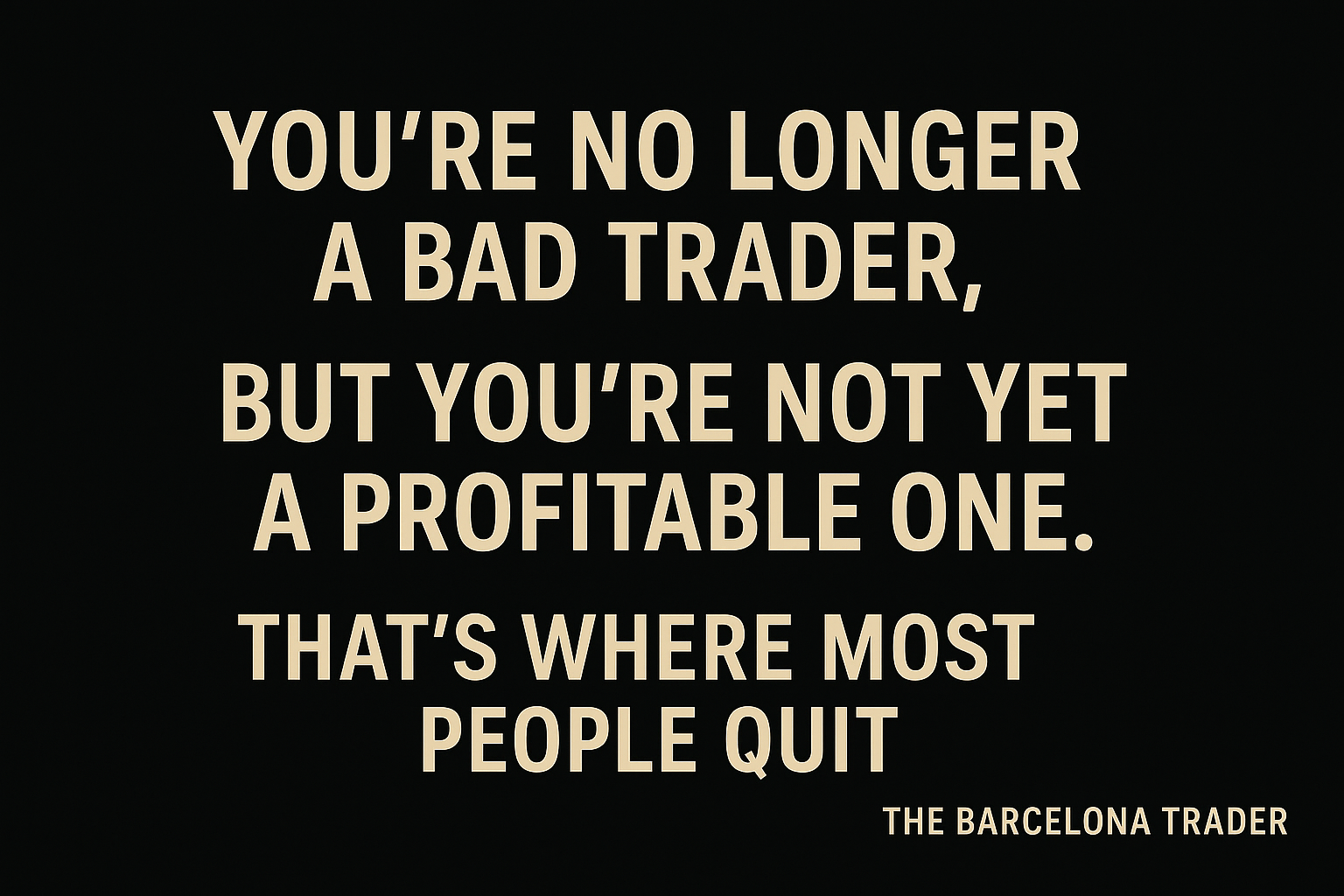
    You’re no longer a bad trader.
    But you’re not yet a profitable one.

    You’re stuck in the hallway between who you were… and who you’re becoming.

    And let me tell you—this is where most traders quit.
    Not because they’re failing. But because they’re improving… and it still feels like failure.

    But here’s the truth:
    This phase isn’t punishment. It’s proof.
    Proof that you’re getting closer.

    You’re not making impulsive trades anymore—so you’re not getting lucky.
    You’re not violating your plan—so there’s no home-run outliers.

    You’re left with the truth.
    The slow, grinding truth of a process that hasn’t finished yet.

    Keep going.

    This is the stretch where all the invisible work starts to compound.
    Where your equity curve feels flat, but your discipline curve is steep.
    Where your P&L is quiet, but your brain is finally rewiring.

    If you’re here, don’t quit.
    Don’t go looking for a new system.
    Don’t start over.
    Just keep showing up.

    Because if you make it through this phase—
    The results come fast.
    And they come from you—not a signal, not a fluke, not a lucky week.

    They come from the foundation you’re laying right now.

    You’re closer than you think.
    Stay in it.

  • Why Traders Get So Intense about Trading

    Why Traders Get So Intense about Trading

    Ever notice how traders become a little much?

    Not just interested. Not just focused.

    But full-blown, charts-in-the-shower, “I’ll be there after London closes” obsessed?

    You start out thinking you’ll learn to make a little money on the side.

    Two years later, you’re ignoring dinner, talking about liquidity sweeps like they’re plot twists in a Scorsese film, and arguing with your own journal.

    What is it about trading that turns normal people into hyper-disciplined, caffeine-fueled, market-monitoring maniacs?

    Here’s my take.

    1. It’s brutally honest.

    In a world full of spin and sugarcoating, trading tells you the truth—daily.

    You’re either right or you’re not.

    You respected your risk or you didn’t.

    There’s no boss to blame. No co-worker to cover for you. Just your decisions, reflected back in numbers. It’s clarity—and it’s addictive.

    2. It promises freedom—but makes you earn it.

    The idea that you can master a skill, deploy it from anywhere, and build your own financial runway? That’s powerful.

    But unlike get-rich-quick schemes, trading doesn’t hand it to you.

    It demands effort. Consistency. Self-awareness.

    The harder it is, the more legit it feels. And when you finally make it through the fog, it changes you.

    3. The game never ends.

    Every day is a new puzzle.

    No two sessions are the same. There’s always something to improve. A better entry. A cleaner exit. A more disciplined mindset.

    It becomes a self-mastery project disguised as a career.

    4. You see progress—and that’s intoxicating.

    Not every day. Not every trade.

    But slowly, you see it. The restraint. The setups you walk away from. The losses you take without spiraling.

    And you start thinking: What else in life could I apply this to?

    That’s when you realize… you’re hooked.

    5. It makes you better. Or it breaks you trying.

    And deep down, we respect that.

    Trading doesn’t care about your résumé. It cares about your resolve.

    It forces you to confront your ego, your habits, your fears—and either fix them or keep paying for them.

    There’s something quietly beautiful about that kind of accountability.


    So yeah—traders can be intense.

    We get weird. We wake up early. We cancel plans. We say things like “price is building energy.”

    But we’re not crazy. We’re just called.

    Because once you taste what it feels like to trade with clarity—to trust yourself under pressure—you don’t want to go back.

    And when that happens?

    You’re not “interested” anymore.

    You’re in.

  • When You Need A Stern Talking-to After Breaking Your Rules

    When You Need A Stern Talking-to After Breaking Your Rules

    Look me in the eye.

    You want to be a trader? Then act like one.

    A trader doesn’t beg the market for mercy. A trader doesn’t hold and hope. A trader doesn’t violate their own rules and call it strategy.

    Every time you ignore your stop, every time you say “just a little more,” you’re not just risking money —you’re proving to yourself that you can’t be trusted when it matters most.

    That’s not a loss. That’s self-betrayal. And it’s worse than red on a chart.

    Your spouse/family etc. is depending on you. You said you’d make this work. So what are you gonna tell them? That you almost had discipline? That you knew better, but clicked anyway? That your plan didn’t fail — you did?

    You don’t get to blame the market. You don’t get to say it was “just one trade.”

    If you can’t follow your own rules, then stop pretending this is a business. Because it’s not. It’s a slot machine with better lighting.

    But if you’re done with that —If today’s the day you build trust one trade at a time —

    Then sit your ass down, trade your plan, and walk away with your self-respect intact.

    You don’t need a win. You need a clean session.

    Be a person of your word. Prove it — to yourself. Right now.

  • DAB: The Hidden Bias That Destroys Profitable Traders

    DAB: The Hidden Bias That Destroys Profitable Traders

    There’s a moment—every trader knows it—when you’ve had a good run. You’re up for the session, maybe even on a streak. The charts have been generous. You’re calm. Confident. Dialed in.

    And then it happens.

    You take one more trade. Maybe it’s not your best setup. Maybe it is. But this time… it turns. Fast. And instead of cutting it when your rules say to, you freeze.

    Why?

    Because it’s not just a losing trade.

    It’s threatening to take back your wins.

    And the pain of giving up $150 of profit feels worse than the risk of losing everything.

    That’s DAB—Drawdown Aversion Bias.

    A psychological trap where the fear of surrendering a small win causes us to abandon the very discipline that earned that win in the first place.


    What DAB Sounds Like:

    • “It’s only a pullback. It’ll bounce.”
    • “I’ll just wait a little longer—then close.”
    • “I’ve had such a good day, I deserve this trade to work.”
    • “I can’t give it all back now…”

    DAB doesn’t scream. It whispers. And its voice sounds a lot like hope.


    Why DAB Is So Dangerous

    Because it doesn’t strike in chaos—it strikes in confidence.

    After you’ve already proven you can win.

    It tricks you into thinking you’ve earned an exception to your rules.

    That you’ve ascended past discipline.

    And before you know it, you’re $600 in drawdown on a trade you never should’ve let go past -$150.

    You’re negotiating with yourself.

    You’re justifying, praying, watching.

    You’re no longer trading.


    How to Defuse DAB

    1. Name It.If you can spot it, you can stop it. When that creeping resistance to cutting a loser shows up, say it out loud: “This is DAB.”
    2. Use a Session Trailing Stop.Decide ahead of time: once I’m up X, I won’t give back more than Y—no exceptions.
    3. Pre-Commit a Max Per-Trade Risk Once Green.E.g. “If I’m up $500, no trade may risk more than $150 of that.”
    4. Journaling the Feeling.Capture what it feels like in the moment DAB kicks in. You’ll start to see the pattern—and build immunity.
    5. Honor the Exit More Than the Outcome.Don’t judge the trade by what happened after you closed it.Judge it by whether you followed the rules that keep you in the game.

    Final Thought:

    Most traders don’t blow their accounts on their worst day.

    They blow it trying to protect their best ones.

    DAB is sneaky. It’s emotional.

    And if you don’t learn to beat it, it will beat you.

    But when you master it?

    You don’t just keep your profits.

    You earn your trust back. Trade by trade.

  • When You Hope There’s Only One More Thing to Fix

    When You Hope There’s Only One More Thing to Fix

    There comes a point in every serious trader’s journey where you start whispering to yourself, “Maybe it’s just this one last thing.” One more dial. One more adjustment. One more rule you finally start obeying like it actually matters.

    It’s not perfectionism exactly. You’re not trying to be flawless. You’re just… tired. Tired of the ups and downs. Tired of knowing you’re close. Tired of watching your system almost work—if only you could stop screwing it up.

    It’s not delusion. It’s hope.

    It’s earned hope backed by thousands of hours of screen time and heartbreak.

    At this stage, you don’t need a new system. You don’t need another coach. You don’t need to watch another damn YouTube video of a dude in a Bugatti explaining risk management while wearing a tank top and gold chain.

    You already know what works.

    You just need to do it.

    Again. And again. And again.

    That’s where I am.

    After years of refining my process, blowing up accounts, clawing my way back, writing rulebooks and ignoring them, building trading AI to keep me sane—I finally believe this may actually be it. The last adjustment. The final behavioral shift that lets everything lock in.

    And I’m writing this not just to remind myself, but to speak to anyone else standing in this same weird psychological hallway:

    You are not asking the wrong question.

    There is a point where you don’t need to fix ten things.

    Just one.

    And it’s the boring one.

    It’s the emotional one.

    It’s the “Can I do this again tomorrow?” one.

    If you’re hoping it’s just one more thing, and you’re showing up with honesty, humility, and self-awareness—you might not be dreaming.

    You might be right.