Category: Trading Psychology

  • Trading With the Hulk

    Trading With the Hulk

    Here’s what I’ve learned the hard way: I am not a rational person who occasionally gets emotional. I’m an emotional animal who manages to have rational experiences.

    Most of the time, I can play the part of the disciplined trader. Cool head, tight rules, clean exits. Bruce Banner at the desk. But the second anger gets triggered — a loss that stings, a stop that feels unfair — Banner is gone and the Hulk takes over.

    And the Hulk doesn’t “trade.” The Hulk smashes buttons. He doubles down on losers, chases reversals, and treats my account like it owes him money. He is not interested in logic, or setups, or risk management. He is interested in destruction — and he’s very, very good at it.

    Here’s the cruel part: you can’t negotiate with the Hulk. Once the adrenaline hits, once the blood pressure spikes, the transformation is already underway. There’s no talking him down. By the time I’m green and raging, the account is already red and bleeding.

    So the only move is prevention. At the very first flicker of anger, at the very first whisper that the Hulk might be coming, I have to walk away. If I don’t, it’s too late.

    Because the first loss never kills my account. The Hulk does.

  • You Are Not Your Thoughts (Thankfully)

    You Are Not Your Thoughts (Thankfully)

    One of the hardest truths in trading is this: you are not your thoughts. You’re the awareness of them. And if you don’t learn that early enough, your account balance will be the one to teach you. Brutally.

    Because here’s what happens. You take a few losses — maybe you followed your rules, maybe you didn’t — and suddenly the brain pipes up like a bad karaoke singer: “Let’s make it back. Double down. The next one’s the big one.”

    That voice isn’t wisdom. It’s desperation in a trench coat. And if you follow it, you’ll end up in a place every trader knows too well: staring at the screen, muttering to yourself about how unfair it all is, while your broker thanks you for the donation.

    Professional traders know this game isn’t about silencing those thoughts. That’s impossible. The brain loves to chatter. The skill is noticing the thoughts, labeling them (“ah, that’s revenge-trading talking”), and then not acting on them. It’s mindfulness, not mute mode.

    And mindfulness in trading isn’t just a five-minute meditation app exercise. Sometimes it means hours of watching the market do nothing and not inventing a setup that isn’t there. Sometimes it’s days. Sometimes it’s an entire week where your only win is that you didn’t throw good money after bad.

    That’s the real discipline: sitting still while your brain screams at you to move.

    It’s learning that a red day doesn’t mean you’re a failure, and a green day doesn’t mean you’re a genius. You’re just the awareness, steadying the ship while the thoughts thrash around below deck.

    Most people quit trading because they can’t separate the two. The pros? They practice it daily. Not perfectly — no one does — but enough to let the setups come to them instead of chasing ghosts.

    So next time the thoughts come barging in after a loss, remember: they’re not you. They’re just noise. Your job is to observe, breathe, and wait.

    Because the market will still be here tomorrow. Your account, on the other hand, might not survive if you keep letting your thoughts take the wheel.

  • Trading Is Psychological Pain Tolerance. The Gym Bros Are Half Right.

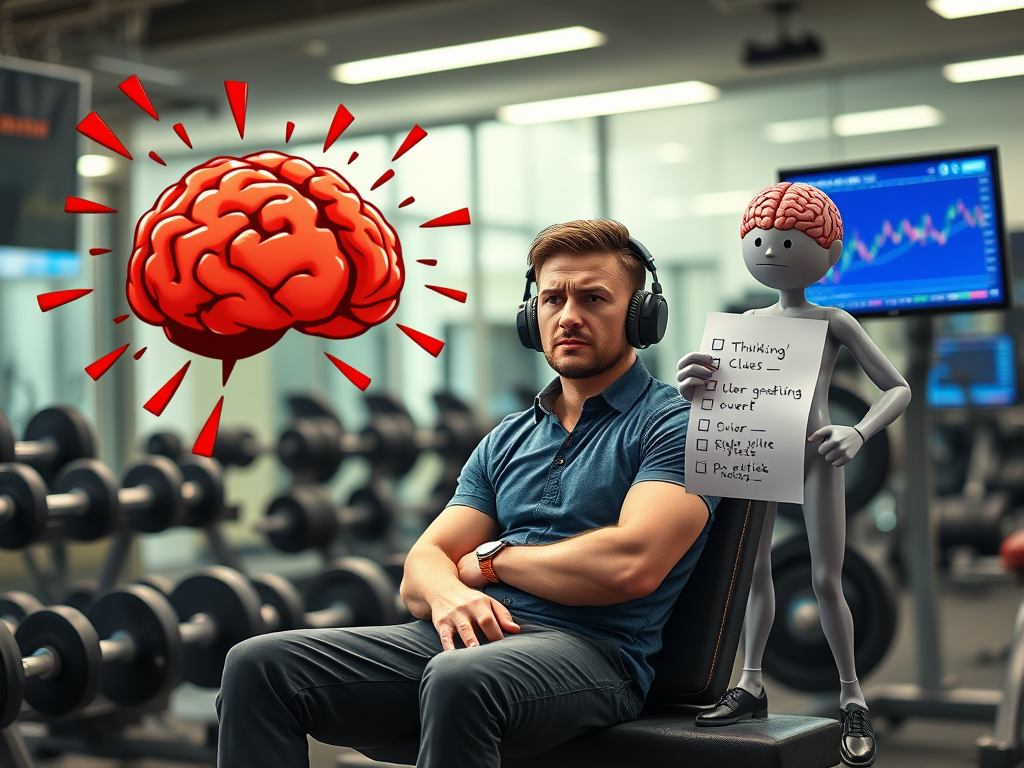
    Trading Is Psychological Pain Tolerance. The Gym Bros Are Half Right.

    There’s a certain flavor of trading guru out there—you’ve seen them.
    Tight T-shirt, protein shake, testosterone-infused motivational posts.
    Discipline starts at 5 AM in the gym, bro. If you can’t do that, you’ll never be a trader.

    And to be fair, they’re not entirely wrong.

    But they’re not entirely right either.


    Trading is a form of psychological athleticism.

    At its core, trading is about doing the correct thing while your brain is screaming at you to do the wrong thing.
    Over.
    And over.
    And over.

    It is pain tolerance, but not physical.
    It’s not about how much you can bench press.
    It’s about how long you can sit inside a trade that’s gone $150 against you and calmly click out exactly where your exit rule tells you to, rather than where your ego wants you to.


    Where the gym analogy works

    When you train physically, you deliberately introduce discomfort to build resilience.
    You force yourself into pain under controlled conditions.

    • You’re sore, but you do the reps.
    • You’re tired, but you finish the workout.
    • You’re tempted to quit, but you don’t.

    That process does strengthen your nervous system.
    It builds tolerance for discomfort.
    It creates evidence that you can act correctly even when uncomfortable.

    That skill absolutely transfers into trading.


    But here’s where the gym bros lose the plot:

    They make it sound like you need to be in peak “Alpha Mode” before every trading session.

    Like if you don’t get 8 hours of sleep, eat salmon and quinoa, meditate for 20 minutes, and hit a personal deadlift record…
    … you’re not “primed” to execute.

    And while yes—healthy routines help—it’s a false expectation that you can or need to be at peak readiness every time you sit at the screens.


    The uncomfortable truth:

    You will trade tired.
    You will trade frustrated.
    You will trade stressed.
    You will trade while your kid is sick, your dog puked on the carpet, and your neighbor’s leaf blower is firing up for the third time that morning.

    And you still have to execute.

    Because the real skill isn’t trading while feeling good.
    It’s trading well while feeling like garbage.


    So does trading become easier?

    Yes — but not because the discomfort goes away.
    It gets easier because you stop fearing the discomfort.

    You stop negotiating with your emotional brain.

    You stop arguing with the voice that says:

    • “This feels bad.”
    • “I want out.”
    • “I can’t take another loss.”

    And instead you calmly say back:

    “Noted.
    But I will still obey my system.”


    Eventually, it becomes muscle memory. Sort of.

    When you start, trading feels like learning a foreign language while someone screams in your ear.
    Every decision feels loaded with pressure.

    But over time, as you consistently act correctly inside discomfort, your brain starts to rewire:

    • The discomfort remains.
    • But your response becomes automatic.
    • You act correctly faster.
    • You spend less time spiraling.

    That’s the true version of “muscle memory” in trading.


    So, should you hit the gym?

    Yes.

    But not because your biceps will make you a better trader.

    You do it because voluntarily enduring discomfort in any domain trains your nervous system for voluntary discomfort everywhere.

    And trading is voluntary discomfort on steroids.


    The real takeaway

    Trading mastery isn’t about achieving perfect emotional neutrality.
    It’s about executing correctly despite imperfect emotions.

    Every rep in the gym, every hard conversation you have in your personal life, every time you face a stressful truth you’d rather avoid —
    —it’s all training for the psychological game you’ll face at the charts.

    Because in the end, trading mastery is nothing more than emotional pain tolerance, skillfully directed.

  • Why Trading Is More Like Pro Sports Than You Think

    Why Trading Is More Like Pro Sports Than You Think

    By The Barcelona Trader

    Let’s kill the myth right now:

    Trading is not about freedom.
    Not at the top level. Not if you’re serious.

    It’s not about beach laptops, passive income, or sipping margaritas while price hits your TP.

    That’s Instagram.
    Real trading?

    It’s elite performance.
    It’s blood, sweat, and drawdown.
    It’s discipline over dopamine—every damn day.


    Think Trading’s Not a Sport? Ask Your Heart Rate.

    You want to know if trading is athletic?

    Check your pulse the next time you’re:

    • Managing a $1,200 unrealized loss
    • Fighting off revenge trade temptation
    • Or staring at a high-probability setup you just know will fake you out the moment you enter

    The stress is real. The emotional stakes are high.
    And if you think pushing buttons isn’t physical, then you’ve never sweated through a T-shirt while scalping NFP.


    Here’s Why It Maps to Athletics

    1. Routine = Results
      Athletes warm up. Review tape. Sleep well. Eat right.Traders?
      You prep levels. Journal sessions. Reset your mindset. Sleep—or don’t—and see what it costs you.
    2. You Train in Silence. You Perform in Public.
      No one sees the work.
      They just see the outcomes: “You made how much this month?”But they didn’t see the losses you walked away from.
      The setups you passed on.
      The months where you played defense, not offense.
    3. You Fight Yourself More Than You Fight the Market
      Ask any fighter what the real battle is.
      It’s not the opponent—it’s themselves.Same in trading.Your edge doesn’t matter if you can’t execute it.
      And most of us aren’t beaten by the chart—we’re beaten by our own impatience, our ego, or our inner 3rd grader who just wants to press the button because it’s shiny.

    The Habits of an Elite Trader (Read: Athlete)

    • You follow the plan even when it’s boring.
      (Welcome to the gym. You’re doing reps.)
    • You take clean setups only.
      (Would you sprint a 400m at full speed during warm-up? No? Then don’t trade chop.)
    • You recover after losses.
      (Traders rest. They study film. They come back stronger. The amateurs rage-click and blow the account.)
    • You train your psychology like a pro.
      (Visualization. Affirmations. Self-talk. You think athletes are the only ones who do this?)

    What Makes Trading Even Harder Than Sports

    Here’s the kicker:

    In sports, you get immediate feedback.
    In trading? Not so much.

    You can do everything right and still lose money.
    You can break every rule and still walk away green.

    That kind of uncertainty doesn’t exist on the field.
    Only here.

    That’s why traders need even more discipline than most athletes.
    We don’t just manage performance. We manage ambiguity.


    The Point

    If you want to trade at a high level, stop looking at it like a shortcut to freedom.

    Start looking at it like training camp.

    • Show up early.
    • Stick to your routine.
    • Track everything.
    • Rest like it matters.
    • Respect the craft.

    Because trading, like sport, rewards the prepared, punishes the sloppy, and makes legends out of the disciplined.


    Trading isn’t a hustle. It’s a performance.
    And the market doesn’t care if you’re tired. It only cares if you’re ready.


  • Why Trading Is One of the Hardest Things You’ll Ever Do (Even If That Dumb Guy You Know Is Somehow Good at It)

    Why Trading Is One of the Hardest Things You’ll Ever Do (Even If That Dumb Guy You Know Is Somehow Good at It)

    Let’s just say it:
    Trading might be the most psychologically demanding, emotionally taxing, and intellectually humbling pursuit you’ll ever take on.

    You’re battling markets that don’t care about your hopes, your charts, or your horoscope. You’re staring down uncertainty with real money on the line, trying to make decisions under pressure that require ice in your veins and steel in your spine.

    It’s brutal.
    It’s lonely.
    It’s a mirror that doesn’t lie.

    But here’s the part that can mess with your head:
    You might know a trader who isn’t exactly a beacon of brilliance. The kind of guy who thinks the moon landing was fake but trusts his cousin’s Forex signals. And somehow… he’s making money.

    How is that possible?

    Because trading success isn’t always a clean reflection of IQ or worldview.
    You don’t need to be a philosopher-king or a Nobel laureate.
    You need to follow your rules.
    You need to manage risk.
    You need to execute—again and again—without letting your ego hijack the wheel.

    The truth is, some people with deeply questionable opinions about life, women, and geopolitics can still be emotionally disciplined in a trade.
    That’s the paradox.
    You can be a narrow thinker and a consistent trader.
    And you can be a brilliant, introspective, highly-evolved human who still blows up their account because they couldn’t click the exit button when it mattered.

    So yes, trading is one of the hardest things you’ll ever do—not because it requires raw intellect, but because it demands mastery over self. And let’s be honest, most people never get there.

    If you’re on the path, if you’re doing the work, if you’re confronting your own behavior with brutal honesty—then you’re already ahead of the curve.

    Welcome to the grind.
    It’s not fair. It’s not easy.
    And it’s definitely not for everyone.

    But for those who can learn to navigate it with discipline and humility… it’s the closest thing we’ve got to alchemy.

  • When My Trading Hydra Found a New Way to Kill Me

    When My Trading Hydra Found a New Way to Kill Me

    I thought I’d finally beaten my worst trading habit with a perfect $120 stop loss. Instead, my brain used the safety net as an excuse to take worse trades, rack up losses, and go full revenge mode — proving the Hydra wasn’t dead, just plotting.

    Yesterday, I wrote about finally out-smarting myself. My biggest trading enemy wasn’t the market, the algos, or even Jerome Powell’s ability to tank gold with a single eyebrow twitch. It was me — specifically, me refusing to take the loss I knew I should take.

    I fixed that by wiring an automatic $120 hot stove exit onto every trade. If it hit, I was out. No debate. No “just one more tick.” No “maybe it’ll come back.” And it worked — instantly. My losses were clean, my head was clear, and I felt like I’d finally caged the beast.

    Victory, right?

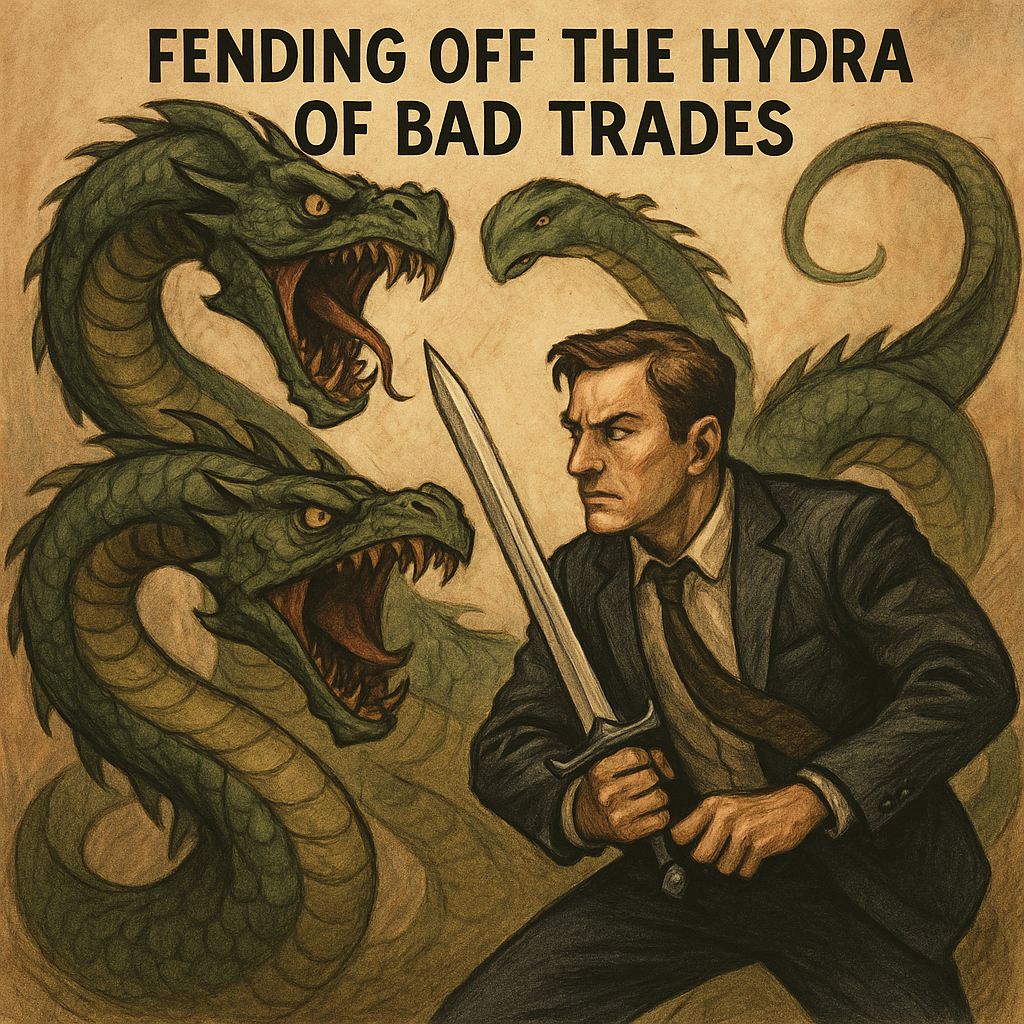
    Not so fast. Anyone who’s read their mythology knows the Hydra doesn’t go quietly. Chop off one head, and another grows back — sometimes uglier.


    The New Head

    Now that my per-trade loss was capped, something shifted in my brain. The fear that used to keep me picky about entries got… lazy. I started taking lower-quality setups. Not garbage, but not my best.

    Here’s how it spiraled:

    1. Take a C+ setup.
    2. Lose. No biggie — the loss is capped.
    3. Take another mediocre setup. Lose again.
    4. By the third or fourth loss, I’m annoyed, so I take a bigger swing to “make it back.”
    5. That swing doesn’t work — and now the Hydra’s laughing while I nuke my day.

    The problem wasn’t my stop loss. It was what the safety net did to my discipline.


    The Kill Shot

    Same fix as last time: remove the choice.

    • $360 max session loss. When I hit it, I’m locked out. Revenge trade impossible.
    • Hard stop times. 11:00 AM ET for the NY Session, 10:00 PM ET for the Asia Session. The clock says stop, I’m done.
    • Back to A+, A, and A- setups only. No “just okay” trades because “what’s the harm?” The harm is right there in my P&L.

    The $120 HSE protects me from one bad trade. The $360 cap protects me from a bad stretch. The strict setup filter protects me from starting the slide in the first place.


    The Next Heads I’m Watching For

    • Setup dilution creeping back in when the market’s slow.
    • Cutting winners early after a losing streak, afraid to “let it come back.”
    • Trading on tilt when outside life distractions bleed into the session.

    Bottom Line

    An elite trader doesn’t beat the Hydra once — they keep sharpening the blade. Every time a new head appears, it gets chopped and the wound gets sealed.

    So yeah, I use crutches. Locks. Kill switches. Call them whatever you want. They work. And the only thing dumber than leaning on a crutch is limping without one.

    The Hydra can keep growing heads. I’ll keep swinging.

  • The Day I Finally Outsmarted Myself

    The Day I Finally Outsmarted Myself

    For a long time now, my biggest enemy in trading hasn’t been the market, the algorithms, or even Jerome Powell’s ability to tank gold with a single eyebrow twitch.
    It’s been me.
    More specifically, me refusing to take the loss I knew I should take — the hot stove exit, or HSE.

    The HSE is simple in theory: the moment a trade is clearly invalidated, you get out. You touch the hot stove, it burns, you pull your hand back.
    Except in my case, I’d leave my hand there a few more seconds, just to “see if maybe it stops hurting.”


    Why I Didn’t Just Automate It Earlier

    If you’re thinking, “Mike, just use a stop loss, problem solved,” you’re both right and wrong.
    My broker, Tradovate, has a group trading feature that lets me execute one trade and mirror it across all my accounts — but it doesn’t allow bracket orders. That means no automatic stop loss when using that setup. And my trades are too short in duration to manually type one in after entry.

    I thought about using a third-party copy trader before, but I talked myself out of it. Too much hassle. Too much potential for lag. Too many stories of things going wrong. And, in true trader fashion, I told myself, “I’ll just fix it with discipline.”
    (Insert laugh track here.)


    Why That Changed

    Fast-forward to this week. I finally reached the point where my manual HSE violations were costing me too much — not just in money, but in mental capital.
    So I set up Tradesyncer, connected it to all my accounts, and now every single trade I take has an automatic $120 stop loss. If it hits, I’m out. No debate. No “just another tick.” No “it’ll come back.”

    And the first day I used it?
    I felt calmer. More focused. More like an operator and less like a gambler negotiating with himself.


    A Crutch? Absolutely. And I’m Proud of It.

    Yes, it’s a crutch. But here’s the thing about crutches: elite athletes use them all the time. Not the wooden kind from the ER — the mental and technological kind that make their performance bulletproof.

    An elite trader doesn’t care whether the edge comes from discipline, experience, technology, or a three-legged goat that predicts FOMC outcomes.
    The only metric that matters is: does it make you money?

    So now I’ve got my crutch, and it’s keeping me from burning my hand on the stove. That’s not weakness — that’s just good risk management.

  • Risk Management vs Emotional Mastery: The Two Dragons You Have to Slay

    Risk Management vs Emotional Mastery: The Two Dragons You Have to Slay

    One of the most misunderstood aspects of trading is the difference between risk management and emotional mastery. They often get lumped together like they’re the same thing.

    They’re not.

    They’re two entirely separate battles you have to win. Two dragons. And if you don’t know which one you’re fighting, you’ll get eaten.


    Dragon #1 — Risk Management

    Risk management is simple.

    It’s math.

    It’s rules.

    It’s your mechanical defense system.

    You put guardrails in place to prevent catastrophic damage:

    • Max loss per trade
    • Max loss per session
    • Max loss per day
    • Max drawdown for the account

    The point of risk management is not to make you a better trader emotionally — it’s to ensure you survive long enough to become one.

    Good risk management keeps you in the game.

    Bad risk management gets you carried out on a stretcher.


    Dragon #2 — Emotional Mastery

    Emotional mastery is different.

    This is the dragon inside your skull.

    It’s the voice that says:

    • “I can’t believe I just lost $300. I need to make it back.”
    • “Maybe if I hold this loser a little longer, it’ll turn.”
    • “I’m due for a win.”
    • “I feel too anxious to click this next trade.”

    Emotional mastery has nothing to do with your risk limits.

    You can have perfect risk management and still sabotage yourself:

    • Hesitate on entries
    • Exit winners too early
    • Hold losers too long
    • Take revenge trades
    • Skip A+ setups because you’re rattled

    That’s not a risk management failure.

    That’s an emotional discipline failure.


    Here’s the critical point:

    Risk management tells you when to stop trading.

    Emotional mastery tells you how to trade cleanly until you get there.


    The Trap That Kills Traders

    Most traders think:

    “If I just tighten my risk management, I’ll stop making mistakes.”

    Nope.

    All that does is shrink the amount of damage your emotional brain can inflict before you get shut down. That’s better than nothing — but it doesn’t build mastery.

    At best, you’re containing your undisciplined self.

    At worst, you’re just kicking the emotional problem down the road, hoping smaller position sizes will protect you from yourself.


    The Real Goal

    The goal is to build emotional mastery so that:

    • Each trade is independent.
    • P&L does not control your behavior.
    • Your exit rules are obeyed whether you’re up or down.
    • You are psychologically flat regardless of recent wins or losses.

    The pros don’t avoid discomfort.

    They operate inside it without flinching.


    A Test You Can Ask Yourself

    After a loss, ask:

    “Is my next trade as clean, objective, and disciplined as my first trade would have been?”

    If the answer is yes — you’re approaching mastery.

    If the answer is no — you still have work to do.

    (Hint: we all still have work to do.)


    In Closing

    You need both dragons slain to be a consistently profitable trader.

    • Risk management keeps you alive.
    • Emotional mastery makes you thrive.

    Most traders only build one.

    Your job is to build both.


  • What If “Giving It My All” Isn’t Good Enough?

    What If “Giving It My All” Isn’t Good Enough?

    Every trader has asked it. Usually in silence. Often in the dark.

    “What if I’m doing everything right… and I still fail?”

    It’s the kind of thought that doesn’t just whisper—it haunts. And it hits hardest when you’ve finally stopped half-assing it and gone all-in. When you’ve sacrificed time, pride, and a chunk of your identity to this pursuit.

    Because if your all isn’t enough—what’s left?


    The Fear That Only the Serious Feel

    Here’s the thing: This fear doesn’t show up for dabblers.

    People who aren’t taking trading seriously don’t ask this question. They’re too busy blaming the market, the broker, the indicator, the moon phase.

    But if you’re feeling this? You’re probably dangerously close to being good.

    That’s the irony. The self-doubt isn’t a sign you’re failing—it’s often a sign you’re leveling up. You’re noticing nuance. You’re battling the inner critic because you actually care.

    That’s not weakness. That’s growth.


    The Myth of the Natural

    Part of what feeds this fear is the myth that great traders are born with it. That some people just “have it”—and if you don’t, you’re doomed.

    That’s crap.

    Elite trading is learned. It’s painful. It’s repetitive. It requires more emotional rewiring than most people can stomach.

    So if you’re in the thick of that? You’re not broken. You’re becoming.


    But What If I Really Do Fail?

    Let’s get uncomfortable. Let’s say you give it your all. And after a year—or a few—you still don’t make it.

    Then you’ll know. And that alone is worth everything.

    Because the worst outcome isn’t failure. It’s not knowing. It’s years spent half-invested, always wondering if you could’ve made it if you’d just committed.

    If you go all-in and fail, you walk away with clarity, emotional toughness, and a better version of yourself. If you half-ass it and fail, you walk away with regret.


    Here’s the Truth

    Your all is already better than you think. Most people never even get to the point where they can recognize their mistakes, let alone articulate them in real time and improve them.

    Hopefully, you’re doing that.

    Maybe you’re stacking clean sessions. You should be managing emotional state. You shouldn’t be chasing, spiraling, or giving in to the noise.

    You’ve probably already passed the “could I do this?” test. Now you’re just in the “how far can I go?” phase.

    And if you keep showing up—clean, focused, honest—you’ll find out.

    You’ve got more in the tank than you think.

  • The Coin Flip Analogy: Trading Success Explained

    The Coin Flip Analogy: Trading Success Explained

    Let’s play a game.

    I flip a coin. Every time it lands on heads, I give you $10. Every time it lands on tails, you give me $5.

    Wanna play?

    You’d be a fool not to. It’s not even close. The longer we play, the more money piles up in your corner.

    Of course, you might lose the first flip. Or the second. Or even three in a row. But if you understand the rules of the game—and if you’re not sabotaged by emotion—you won’t flinch. You’ll keep flipping. Because you know how this story ends.

    Now here’s the twist:

    That’s trading.
    That’s exactly what trading should feel like—if you’re doing it right.

    But what do most people do?

    They lose a trade—or two—and suddenly they’re questioning the whole system. Their palms sweat. Their brain starts writing little horror stories about failure and doom. They tighten up. They hesitate. They stop flipping.

    Or worse—they panic, double down, and blow themselves up.

    All because they don’t understand the nature of the game.

    They want every flip to work. They want every trade to win. They want control in a game built on uncertainty.

    They can’t handle losses—even small, expected, built-into-the-math losses—because they haven’t trained themselves to see the bigger picture. They’re so focused on the last $5 they had to give back, they miss the $10 that was coming next.

    If that’s you—if you’re stuck in that cycle—it’s not your fault. The human brain is wired to hate loss. Loss aversion isn’t a bug in your system. It’s default code.

    But here’s the good news:
    You can reprogram it.

    You just have to play the game long enough—with the odds tilted in your favor—to see that the outcome of any one trade doesn’t matter.

    What matters is that you take the right kinds of trades.
    What matters is that your wins are bigger than your losses.
    What matters is that you keep flipping the damn coin.

    And when it lands on tails?
    Smile. You just paid your edge tax. Now flip again.

    This analogy came via The Duomo Initiative.