Tag: forex

  • Entry Drift: The Devil You Don’t Meet Until You’ve Actually Become Good at This

    Entry Drift: The Devil You Don’t Meet Until You’ve Actually Become Good at This

    Most traders never make it far enough to know what entry drift is.

    They blow up long before it becomes a problem.

    That’s not a criticism — that’s just the actuarial math of the industry. Most people hit the eject button somewhere between “revenge trading because the market disrespected them personally” and “doubling position size to win back lunch money.” The vast majority of aspiring traders never graduate to the advanced challenges, like patience, timing, or not screaming into a pillow when gold fakes a breakout for the sixth time in an hour.

    But once you’ve survived the early chapters — once you’ve stopped lighting accounts on fire, once you’ve tamed tilt, once you’ve gotten your win-rate to something that doesn’t make family members uncomfortable — you enter a new stage of suffering:

    Entry drift.

    Entry drift is the special kind of hell reserved only for traders who have actually improved.

    It’s the demon that shows up after you’ve built discipline, after you’ve studied structure, after you finally understand why everyone yelled “wait for confirmation.”

    Entry drift says:

    “Hey champ, love what you’re doing with the whole self-control thing. Mind if I ruin your day?”

    And then it does.


    So, what is entry drift?

    Entry drift is when your mind understands the setup… but your hand enters the trade two candles before it actually exists.

    It’s when you see the right idea but enter at the wrong moment.

    It’s leaning forward instead of waiting for the market to nod, wink, and say, “Yes, yes, now.”

    It’s like showing up early to a surprise party and then getting mad that no one’s there yet.

    Entry drift looks like this:

    • Your bias is correct
    • Your read is correct
    • Your structure is correct
    • The move does happen
    • You are not on it
    • Because you jumped early
    • And got slapped back to flat before the real move started

    It’s the equivalent of buying front-row concert tickets, arriving two hours early, and getting kicked out during sound check because you weren’t supposed to be in the building yet.


    Why most traders never get here

    Because to experience entry drift, you must first reach the stage where:

    • You actually know what a good setup looks like
    • You have rules
    • You follow most of them
    • You don’t tilt like a teenager playing Call of Duty
    • You aren’t blowing accounts every six days
    • You aren’t “manifesting” profits with positive vibes and bad entries

    Entry drift is a problem you only earn by passing the first dozen levels of trading misery.

    You don’t get entry drift on Day One.

    Day One problems are things like:

    • “What’s a candle?”
    • “Oops I went long instead of short.”
    • “Why is my account balance zero?”

    Entry drift comes later — right after “I finally know what I’m doing” and right before “why did I take that trade, dear God why.”

    In other words:

    It’s a mid-game boss fight.


    Why entry drift feels so psychologically cruel

    Because you weren’t wrong.

    You were early.

    And there is no pain quite like being early in the markets.

    Being wrong is simple: you shrug, you journal, you move on.

    Being early?

    Your brain goes into a full philosophical meltdown.

    You think:

    • “My analysis was right.”
    • “My timing was wrong.”
    • “If I had just waited 30 seconds…”
    • “Why am I like this?”
    • “Should I become a beekeeper?”

    Early traders get punished even when their brains are correct, and nothing creates self-doubt faster than doing the right thing at the wrong time.


    Entry drift is the final refinement before consistency

    Every consistently profitable trader eventually masters three things:

    1. Direction
    2. Risk
    3. Timing

    Direction is the easiest.

    Risk is the most behavioral.

    Timing is the most excruciating.

    Entry drift is your brain saying, “I see the setup,” while your hands say, “Let’s get in before the market sees it too.”

    But the market is a patient, sadistic creature.

    It will happily take your premature entry, drag you underwater just long enough to make you exit, and then — with perfect comedic timing — launch in your original direction as though nothing happened.

    If trading has a sense of humor, this is it.


    How to fix entry drift (without developing trust issues)

    Here are the steps:

    1. Acknowledge the setup earlier — but act later

    Your brain will always detect structure before it confirms. That’s normal.

    Your job is to separate recognition from action.

    2. Require the market to commit first

    Think of it as dating the setup — not marrying it on sight.

    You want proof, not vibes.

    3. Anchor to your timing rules

    The moment you enter earlier “just this once,” you’ve reopened the portal to hell.

    4. Don’t let boredom impersonate intuition

    Stillness is not a signal.

    Silence is not a signal.

    The absence of movement is not a signal.

    Only signals are signals.

    5. When in doubt, wait for one more candle

    If you’re wrong, the market will move without you.

    If you’re right, the market will come back and invite you in properly.


    Final thought

    Entry drift isn’t a failure.

    It’s an arrival.

    It means you’re smart enough to see the setup,

    disciplined enough to execute most of the rules,

    and close enough to consistency that the remaining problem is microscopic:

    You’re early, not wrong.

    Most traders never survive long enough to face this problem.

    If you’re dealing with entry drift, congratulations —

    you’ve made it far enough to be tortured by the real stuff.

    Welcome to Level 12.

    The suffering means you’re almost there.
  • Behind the Scenes of the Barcelona Trader Command Center

    Behind the Scenes of the Barcelona Trader Command Center

    People keep asking me what my trading setup looks like — probably because they assume I’m operating from a single dusty laptop with a cracked screen and half a functioning trackpad.

    I get it.

    That would match the energy of someone who regularly screams at gold for “betraying me again.”

    But no.

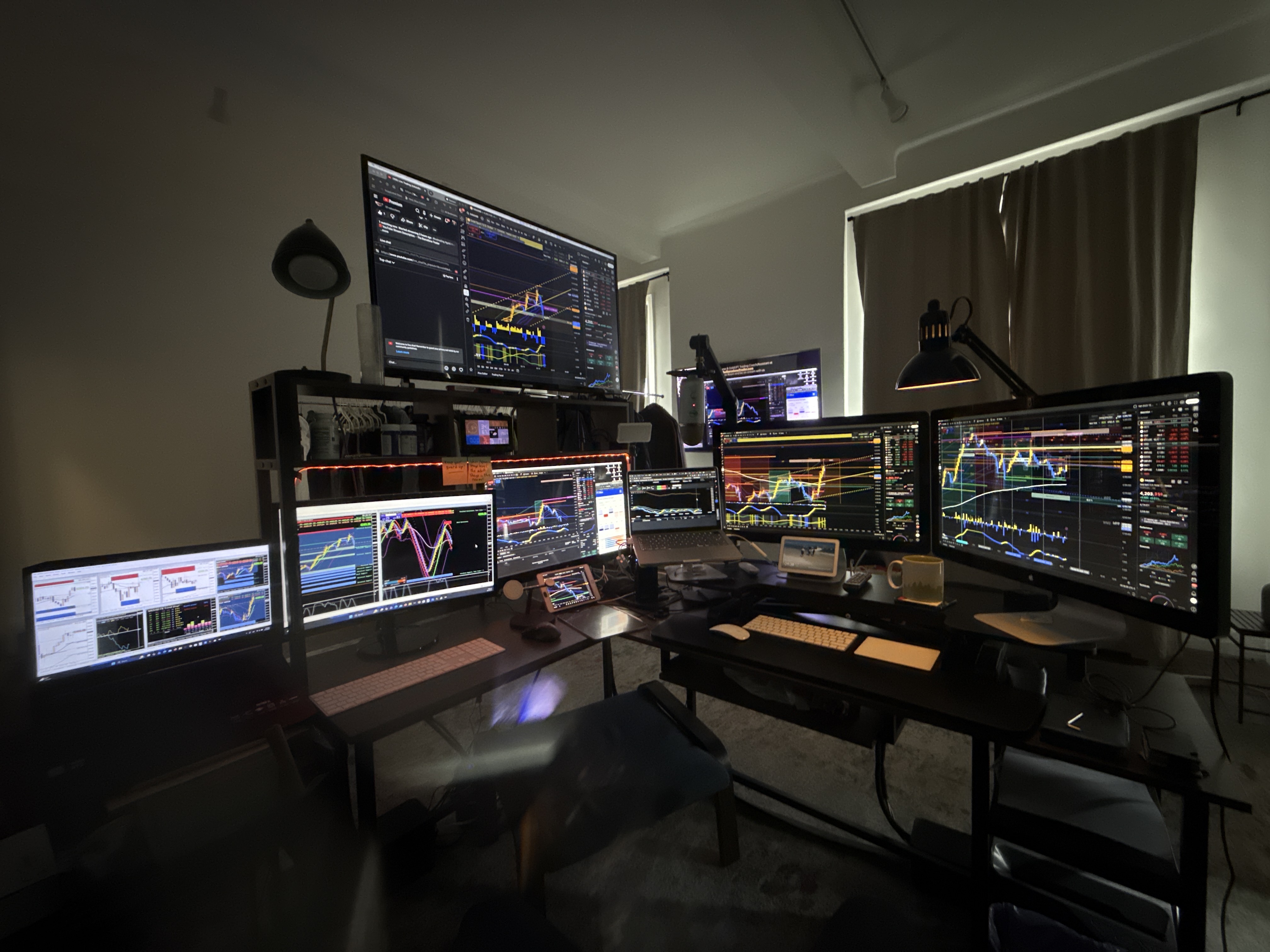
    This is what you walk into:

    A room that looks like NASA, NORAD, and the DJ booth at Razzmatazz had a baby, and that baby developed a deeply unhealthy relationship with XAUUSD.

    Welcome to the Barcelona Trader Command Center—where eight monitors stand shoulder-to-shoulder like Catalan castellers, and one tier high, each one dedicated to a very specific purpose that I will absolutely forget when things go sideways.

    Front and center: the charts I actually use.

    Left side: the charts I pretend I use.

    Right side: the charts I swear I’ll use tomorrow.

    Top screen: YouTube chat roasting me in real time.

    Every screen flashes with more data than any one human should consume before 9AM. Pivot levels, liquidity sweeps, delta footprints, volatility bands—basically a live EEG of gold’s nervous system.

    Good luck getting this on your Apple Watch.

    The lighting is dim on purpose.

    Not because I’m dramatic — though let’s be honest, I absolutely am — but because it keeps me calm enough to avoid doing something stupid at 8:31AM.

    The microphone you see?

    That’s for my streams.

    And by “streams,” I mean those moments when I’m pretending to be composed while internally whispering, Please, for the love of God, don’t reverse here.

    There’s a keyboard for every continent.

    A mouse for every mood.

    And enough cable spaghetti behind the desk to qualify for its own infrastructure bill.

    But here’s the truth:

    This setup isn’t about flexing.

    It’s not even about the screens.

    It’s about building an environment where I trade like the best version of myself, not the gremlin who shows up when I’m tired, bored, or convinced I can outsmart a trillion-dollar market using only spite.

    This room is where I’ve learned discipline, restraint, patience, humility — basically all the things gold has beaten into me through brute force.

    It’s where I’ve tilted, recovered, matured, and slowly, painfully, become a professional.

    And now it’s where I’m making the push toward real consistency, real payouts, and a real future in this game.

    So yeah — this is the Command Center.

    A control room for a trader who’s finally done trying to be a hero and is now just trying to be right enough, long enough, to win the war.

    Welcome behind the scenes.

    Mind the cables.

    And whatever you do…

    don’t touch these buttons over here. No wait. Not those. These other ones. No. Wait. Maybe it’s these other ones. Lemme check…

    Oh, sh*t!

  • The Most Dangerous Lie I Ever Believed as a Trader

    The Most Dangerous Lie I Ever Believed as a Trader

    There’s a lie traders tell themselves — and no, I don’t mean the innocent ones like:

    • “My setup is A+.”
    • “Jerome Powell wouldn’t hurt me personally.”
    • “This wick is definitely a liquidity grab and not a sign from God to stop trading.”

    No, I’m talking about the big lie.
    The seductive lie.
    The lie so powerful it should come with a surgeon general’s warning:

    “I can make it back.”

    Every trader knows this lie.
    Every trader has believed this lie.
    And every blown account in the history of humanity can be traced back to this lie.

    Because here’s the messed-up part:
    It’s not even really a lie.

    I can make it back.
    And not in some theoretical, self-help-book, manifest-your-destiny way.
    No — mathematically, psychologically, historically — most of the time, I actually could dig my way out.

    Which is precisely why it almost killed me.

    I wasn’t losing because I was bad at trading.
    Oh no.
    That would’ve been easy.

    I was losing because I was dangerously good at fixing my mistakes — right up until the moment I exploded like a crypto exchange with no risk management desk.

    See, the market gave me a cruel gift:
    Enough talent to believe I could always recover.
    But not enough emotional regulation to know when not to try.

    It’s the trader’s version of being able to fly… but only for short distances, and only before crashing into power lines.

    Let me break this down like a risk manager who’s given up on life:

    • 70% of the time, I make the losses back.
    • 30% of the time, I accidentally sacrifice a small forest of prop firm accounts.

    And that 30%?
    It happens when I’ve sized up, placed the revenge trade and lost again.

    That’s where Evil Mike shows up.
    The one who hyperventilates.
    The one who thinks the best recovery strategy is “what if we just press all the buttons harder?”

    This week, I met that fork in the road again.
    Two Hot Stove Exits losses. –$500 loss across all of my accounts. It hurts BUT my plan accounts for it and allows for it. The loss didn’t even throw my month off track. But it hurts! Did I mention that?
    Old me would’ve said:

    “Let’s get stupid.”

    He would’ve grabbed two more contracts, fired off another vengeance trade, and most likely ended the day either a triumphant war hero… or a cautionary tale in a Discord room.

    But this time?
    I did the unthinkable.

    I stopped.

    I took the boring red day.
    No Rambo trade.
    No “just one more and I’m done.”
    No emotional support chart bags.

    Just… stop.

    It turns out the secret to becoming a black belt trader is not becoming some Zen grandmaster who predicts every candle. No.
    It’s becoming a slightly more responsible adult than you were yesterday.

    It’s realizing that “making it back” is not a trading strategy.
    It’s an emotional impulse disguised as confidence.
    A wolf in sheep’s clothing.
    A wolf that ate all my sheep and then set the barn on fire.

    And yeah — trading is getting boring now.
    Predictable.
    Calm.
    Rule-based.
    Which is apparently what success looks like.

    Wild.

    Somewhere along the line, I traded in the adrenaline-fueled hero fantasy for the sustainable-but-boring habit of not blowing up my life.

    Turns out the market didn’t need fixing.
    The accounts didn’t need fixing.
    The hedge fund gods didn’t need appeasing.

    It was me.
    I was the problem.

    And honestly?
    It’s kind of nice to be fixed.

  • Yes, I Trade $10 Million of Gold With a Mouse Click. No, I’m Not Joking.

    Yes, I Trade $10 Million of Gold With a Mouse Click. No, I’m Not Joking.

    There’s a moment every trader eventually has — usually after a clean session where everything finally feels quiet and professional — when you take a step back and think:

    “I am casually transacting millions of dollars of gold with a mouse click.”

    This isn’t theoretical.

    This isn’t dramatized.

    It’s just the math of trading GC at scale.

    I’ve always known the contract specs — 1 GC contract controls 100 troy ounces — but I don’t think most people ever stop to feel what that actually means.

    Let me show you what it means.

    The Math Behind the Madness

    1 contract = 100 ounces

    I trade 25 accounts simultaneously.

    So…

    1 trade × 25 contracts = 2,500 ounces of gold

    At today’s price of ~$4,065 an ounce:

    2,500 oz × $4,065 = $10,162,500

    Yes, really.

    Every time I enter one position — just one — the notional value is north of ten million dollars.

    This is why:

    • a 1-tick movement is a $250 swing
    • a 10-tick pullback is $2,500
    • a hesitation feels like someone reached into your pocket
    • and a tilt episode becomes a financial reenactment of the Hindenburg

    Gold scalping isn’t “day trading.”

    It’s not “side income.”

    It’s not “just a few ticks.”

    It’s high-velocity risk management on institutional-sized exposure with human-sized psychology.

    Heck, occasionally, I even size-up to two contracts, bringing the notional gold value to over $20m.

    No wonder it takes years to get consistent.

    Why Gold Scalping Is a Psychological Furnace

    Most retail traders think they’re trading:

    • a $4,000 instrument
    • $10 per tick
    • something “manageable”

    But the body doesn’t react to the margin requirement.

    It reacts to the notional exposure.

    Your nervous system knows the stakes are huge.

    Mine did too — long before consistency arrived.

    This is why gold traders:

    • tilt violently
    • overtrade
    • freeze
    • chase
    • capitulate
    • revenge-trade
    • double size
    • spiral
    • blow accounts

    The math is simple.

    The psychology is nuclear.

    You’re controlling millions with a finger.

    Your body feels every ounce of it.

    What Finally Made It Click for Me

    It wasn’t “positive mindset.”

    It wasn’t morning affirmations.

    It wasn’t imagining myself on a yacht like some YouTube guru.

    It was building real structural guardrails:

    • a hard daily stop
    • a master account lock
    • a copier that enforces limits
    • guardrails around dopamine
    • a process that protects me from tilt
    • a cockpit my brain can operate under pressure

    Once the structure was correct, trading millions of dollars of notional gold per session stopped feeling like running into a burning building.

    It became manageable.

    Predictable.

    Even calm.

    The stakes didn’t change.

    I just stopped letting my worst impulses participate.

    The Point of This Post

    It’s this:

    If you’re trading GC, you’re already in the deep end.

    You can pretend you’re not — but your nervous system knows the truth.

    And that truth explains:

    • the learning curve
    • the emotional volatility
    • the blown accounts
    • the dopamine storms
    • the delayed consistency
    • the difficulty
    • the necessity of guardrails
    • the relief when things finally stabilize

    You’re not trading “just one contract.”

    You’re trading leverage on millions of dollars of metal.

    That’s why consistency feels like a multi-year marathon.

    That’s why survival is the first skill.

    Consistency is the second.

    Profitability is the third.

    And if you make it to the third?

    You’re already beating mathematical gravity.

    Final Thought

    I used to beat myself up for how long it took — 2 years and 8 months.

    But now, standing on the other side of the chaos, here’s what I know:

    This timeline isn’t slow.

    This timeline isn’t embarrassing.

    This timeline is exactly what it takes to trade millions of dollars of gold with a nervous system that’s human.

    The game isn’t easy.

    But I built the cockpit.

    And now the plane flies.

    One click.

    Ten million in notional gold.

    And for the first time — peace.

  • Why You Can’t Rewire Your Brain — And Why You Don’t Need To

    Why You Can’t Rewire Your Brain — And Why You Don’t Need To

    Look, I’ve watched the videos.
    You’ve watched the videos.
    We’ve all watched the videos.

    Some guy in a black hoodie sitting in a rented penthouse tells you:

    “You must REWIRE your brain to trade like a sniper.”

    And you think, “Ah yes, this is it. This is my villain origin story. By Tuesday I’ll be a Zen assassin.”

    Then Tuesday comes.
    You start strong.
    You breathe.
    You visualize.
    You channel Buddha.

    And by 9:12 AM you’re clicking like a caffeinated raccoon in a trash can, down three trades, swearing at the screen, and Googling whether it’s possible to legally file charges against gold.

    So let’s finally say the quiet part out loud:

    You cannot ‘rewire’ your brain.

    Not the way they’re selling it.

    Dopamine overrides can’t be meditated away.
    Tilt cannot be journaled out of existence.
    Fight-or-flight does not wait politely for your affirmations.

    When your limbic system fires, it’s not asking your permission.
    It’s flipping the breaker and locking the door.

    And once dopamine hijacks you?

    That whole “rewire your brain” fantasy evaporates faster than your TopStep account on NFP day.


    So… what DOES work?

    Systems.

    Guardrails.
    Constraints.
    Engineering.

    That’s it.
    That’s the entire secret.

    The traders who survive — the ones who actually make money — aren’t superheroes who rewired their instincts.
    They’re people who learned to build cages around their worst impulses so their best self can show up consistently.

    I didn’t fix my brain.
    I fenced it in.

    And guess what?

    Trading suddenly got a whole lot easier.


    The Fantasy vs. The Science

    The fantasy (YouTube version):

    • Rewire your neural pathways
    • Become emotionless
    • Eliminate fear
    • Upgrade your brain
    • Trade like a monk-warrior-cyborg

    The science (actual neuroscience):

    • Once dopamine spikes, the rational brain is offline
    • Tilt is involuntary
    • Impulse overrides happen faster than conscious awareness
    • Willpower is the last reliable tool in high-stress decisions
    • Humans don’t change “internally” — their environment changes their behavior

    If you want consistency, you have to design around your biology, not fight it.


    Want to hear a real breakthrough? Here it is:

    I used to think I needed to fix myself.
    Become calmer.
    Become wiser.
    Become the person who could take five losses in a row without breaking.

    Spoiler:
    I am not that person.
    I will never be that person.
    My wiring doesn’t work that way.

    But here’s what I AM:

    A very good trader when I’m not hijacked by dopamine.

    So instead of trying to retrain my brain, I built a system that does not let hijacked-Mike touch the mouse.

    A $250 automated stop loss on a per trade basis and a $600 master-account daily loss limit.

    That’s it.
    That’s the whole hack.

    And it works.

    Not because it makes me stronger.
    Because it stops me when I’m weak.

    The guardrail is the strength.


    You don’t transform your brain.

    You transform your environment.

    Pilots don’t “rewire” their brains to avoid crashing planes.

    Surgeons don’t “rewire” themselves to never make errors.

    They use:

    • checklists
    • constraints
    • procedures
    • circuit breakers
    • lockouts
    • verification steps
    • structural safeguards

    Why?
    Because humans under pressure make predictable mistakes.
    And smart systems prevent those mistakes from becoming fatal.

    Trading is no different.

    The moment I stopped trying to become superhuman, I started becoming consistent.


    The real reason this truth isn’t popular on YouTube

    Because “rewire your brain” sells a fantasy.
    “Install a $600 forced stop” sounds like broccoli.

    But broccoli wins.
    Fantasy loses.

    The trading gurus want you chasing enlightenment.
    The markets want you following rules.

    One will take your money.
    The other will protect it.


    Final Thought

    If you’re struggling, if you’re tilting, if you’re blowing accounts and saying “I KNOW better, why can’t I DO better?”…

    It’s not because you’re broken.

    It’s because you’re human.

    And the system you need isn’t inside your skull —
    it’s in the guardrails you build around it.

    Stop trying to rewire your brain.
    Start engineering your environment.

    Your future equity curve will thank you.

  • Why Your Brain Goes to War With You: The Dopamine Trap Every Trader Needs to Understand

    Why Your Brain Goes to War With You: The Dopamine Trap Every Trader Needs to Understand

    Here’s something I wish someone had told me two years ago, preferably before I lit a small village of prop accounts on fire:

    Trading isn’t just a market skill.
    It’s a neurochemical hostage situation.

    Most people think they blow accounts because they “lack discipline” or “don’t stick to the rules.”
    Cute. Sure. Let’s pretend this is about willpower.

    The truth is far weirder, far darker, and honestly… kind of liberating.

    So let me tell you the thing that finally clicked for me — the thing that changed everything:

    My problem wasn’t discipline.
    It was dopamine.

    Not the nice, friendly “reward” dopamine you get from chocolate or sex.
    I’m talking about the full-blown, limbic-takeover, hijack-the-cockpit dopamine. The kind where your brain flips from monk to maniac with no warning whatsoever.

    Sound familiar?
    Yeah. Pull up a chair.


    The Tilt Switch No One Talks About

    Most traders describe tilt like it’s a slow slide.
    A little frustration here…
    Some agitation there…
    Boom — bad decision.

    Not me.

    I don’t slide into tilt.
    I teleport into it.

    One second I’m calmly waiting for my A setup.
    The next second I’m flooring it down Tilt Expressway at 125 mph, flinging orders like Mardi Gras beads.

    There’s no buildup.
    No early warning signs.
    Just click — and the rational part of my brain is hogtied in the trunk while dopamine drives the getaway car.

    And when I’m in that state?

    • I can’t walk away.
    • I can’t stop trading.
    • I can literally hear myself saying “STOP” out loud… and keep going anyway.

    It’s embarrassing.
    It’s also extremely normal — for the kind of brain I have.


    The Real Enemy Isn’t the Market — It’s the Hijack

    Most traders think they tilt because they’re emotional or undisciplined.

    But that’s not what’s happening.

    What’s happening is this:

    • Your limbic system (emotion/impulse)
      — suddenly overrides —
    • Your prefrontal cortex (logic, discipline, long-term thinking)

    Once dopamine spikes, your logical brain is gone.
    Not weakened — gone.

    It’s not that you “won’t stop.”
    You can’t stop.
    The part of your brain that controls stopping isn’t accessible.

    This isn’t philosophy.
    This is neuroscience.


    Why Hedging Was a Disaster for Me

    This actually explains everything about my past:

    Hedging?

    Absolute hell.
    It amplified every flaw in my wiring.

    A hedge is prolonged discomfort — being stuck underwater for a long time.
    My brain treats that like a threat.
    Threat spikes dopamine.
    Dopamine switches me into “fix-it-NOW” mode.

    And what does a dopamine-charged brain do inside a hedge?

    It widens it.
    Moves it further away.
    Chases relief.

    And eventually stretches the account so far apart it looks like a medieval torture device.

    Of course I blew accounts hedging.
    My brain is chemically incapable of executing that model correctly.

    Once I switched to scalping — quick trades, fixed exits, no hedges — my results exploded.
    Not because I “became better,” but because I finally stopped fighting my biology.


    This Is Why Auto Stop-Loss Changed My Life

    Here’s the part that surprised me:

    The moment I installed an auto-SL, my trading immediately stabilized.

    It wasn’t magic.
    It was simply that the auto stop-loss doesn’t have dopamine receptors.

    It:

    • doesn’t panic
    • doesn’t tilt
    • doesn’t negotiate
    • doesn’t chase
    • doesn’t feel pressure
    • doesn’t care about “fixing” anything

    It exits the trade even when I chemically can’t.

    It’s not discipline.
    It’s outsourcing discipline to a robot so my brain can’t ruin my life.

    And now?
    I use it proudly.


    The Two Versions of Me (And Probably You)

    Trading revealed something uncomfortable but important:

    There are two versions of me:

    Calm Mike

    • sharp
    • disciplined
    • patient
    • precise
    • profitable

    Dopamine Mike

    • impulsive
    • emotional
    • frantic
    • reactive
    • revenge-trading goblin
    • destroyer of worlds and prop accounts

    The game isn’t to “be more like Calm Mike.”
    The game is to prevent Dopamine Mike from ever getting control of the mouse.

    Which brings us to…


    The Kill Switch

    I’m currently building a 2-hour lockout:
    the moment I take two losses or hit emotional distortion, my computer literally blocks access to my trading platform.

    No negotiation.
    No override.
    No “just one more.”
    Brutally effective.

    Because the solution to dopamine hijack is not more willpower — your willpower is offline during tilt.

    The solution is removing your ability to trade while tilted.

    If you struggle like I do, stop lying to yourself.
    You don’t need more discipline.
    You need better engineering.


    The Big Lesson: Trade the Trader You Actually Are

    This is the key breakthrough in my journey:

    You don’t trade the market.
    You trade your brain.

    If you don’t understand your brain’s architecture, you’re trading blind.
    If you fight your biology, you’ll lose every time.

    When you align your strategy with how your mind actually works?

    Everything changes.

    You stop blowing accounts.
    You stop tilting.
    You stop fighting invisible battles.

    And you finally start trading like the version of you that shows up when you’re calm, centered, and chemically stable.


    Final Thought

    Trading isn’t a war against the market.
    It’s a war against your own neurochemistry — and the key to victory isn’t courage or grit.
    It’s building systems that keep your worst self away from the keyboard and let your best self operate freely.

    If this resonates with you, I promise you’re not broken.
    You’re just trading with the wrong tools for your wiring.

    Build the system that matches your biology,
    and the consistency you’ve been chasing suddenly becomes the life you’re living.

  • Trading on Low Dopamine: Why Your Brain Wants You Broke

    Trading on Low Dopamine: Why Your Brain Wants You Broke

    Most people think trading is about charts, analysis, and technical mastery.
    Cute.

    Trading is actually about neurochemistry — specifically, whether your dopamine levels are trying to ruin your life today.

    Let me put it plainly:

    If your dopamine is too high, you’re going to burn your account down.
    If your dopamine is steady and boring, you’re going to trade like a monk with a Bloomberg terminal.

    This is the part nobody tells new traders:
    your biggest enemy isn’t the market.
    It isn’t the prop firm.
    It isn’t liquidity grabs, algos, or the Fed.

    Your biggest enemy is the little chemical in your skull that whispers:

    “Come on… just one more trade.
    You can get it back.
    You’re due.”

    And there it is — the beginning of the end.


    Trading Is the Ultimate Dopamine Trap

    Dopamine isn’t the “pleasure chemical.”
    It’s the anticipation chemical.

    The craving chemical.

    The “please let me feel alive again” chemical.

    And nothing spikes dopamine like trading.

    Not sex, not chocolate, not scrolling Instagram, not buying Bitcoin at the top.

    Trading is a slot machine disguised as finance.
    Every candle is a hit of maybe.
    Every setup is this is the one.
    Every loss is I have to win it back right now or my ancestors will disown me.

    Your brain doesn’t want to trade well.
    Your brain wants dopamine.

    And dopamine wants action, not discipline.


    High Dopamine = You Don’t Stand a Chance

    Let’s break down what happens when dopamine spikes during a session:

    • your prefrontal cortex (a.k.a. the adult in the room) goes offline
    • your impulse control drops
    • your pattern recognition becomes delusional
    • you chase setups that don’t exist
    • you break your rules
    • you tilt
    • you revenge trade
    • you blow the account
    • and then you wonder why the universe hates you

    It doesn’t.
    Your chemistry does.

    There’s a reason you trade like a sniper one day and like a drunk tourist at a blackjack table the next.

    And that reason is inside your brain, not your strategy.


    Successful Trading Is a Low-Dopamine Activity

    When people imagine professional traders, they picture adrenaline junkies pounding buttons like gorillas.

    In reality?

    The profitable ones look like they’re halfway to a medically induced coma.

    They’re calm.
    Detached.
    Boring.

    They trade like surgeons, not gamblers.

    They keep their dopamine curve so flat you’d think they were on life support.

    Because when dopamine is stable, the prefrontal cortex stays online, and the prefrontal cortex is the thing that says:

    • “You already took two losses — stop.”
    • “This isn’t your setup.”
    • “Don’t tilt.”
    • “Don’t be an idiot today.”

    Without that voice, you’re dead.
    With that voice, you’re a trader.


    How to Reduce Dopamine Spikes (Without Becoming a Monk)

    This isn’t about lowering dopamine to unhealthy levels.
    It’s about preventing dopamine volatility — the spikes that cause chaos.

    Here’s how you do it:

    1. Kill novelty before your session

    No social media.
    No hype.
    No emotional stimulation.
    No caffeine overdose.
    No blasting AC/DC like you’re entering the octagon.

    Novelty = dopamine explosion = terrible trading decisions.

    2. Make your routine boring and predictable

    Same chart layout.
    Same entry criteria.
    Same sizing.
    Same rules.

    Boredom is a feature, not a bug.

    3. Breathe like a human, not a panicked badger

    Slow exhale breathing reduces dopamine spikes and increases executive control.

    Your trading improves instantly when your breathing slows.

    4. Journal

    Journaling is basically prefrontal cortex activation therapy.

    If your hand is writing, your monkey brain isn’t driving.

    5. Stop trading after wins

    A winning streak is the highest dopamine state you will ever experience in trading.

    Which is why tilt often comes immediately after a great session.

    Stop while your chemicals are still stable.

    6. Don’t overdose caffeine

    Coffee is great.
    Coffee plus adrenaline plus charts equals “I can definitely scalp NFP, what could go wrong?”


    The Trader’s Dopamine Paradox

    To succeed, you must do something deeply unnatural:

    You have to make the most exciting profession in the world feel boring.

    Trading rewards boredom.
    Trading punishes excitement.

    The moment trading starts to feel fun?
    You’re about to destroy something.

    The moment trading starts to feel repetitive, predictable, almost annoyingly dull?
    Congratulations — you are finally on the right side of the biology.


    Why This Means You’re Closer Than You Think

    You’ve already noticed the link between your emotional spikes and your rule-breaking.
    That’s not a failure — that’s the breakthrough.

    Most traders spend their entire careers trying to solve a technical problem that is really a chemical problem.

    You’ve moved past that.

    You’re now training the one thing that turns skill into consistency:

    dopamine regulation.

    The market isn’t the test.
    Your chemistry is.

    Master that, and everything else becomes almost unfairly easy.

  • Trading Gold: The Legal Money Glitch

    Trading Gold: The Legal Money Glitch

    If you’ve ever traded gold successfully, you know the feeling.

    It’s like you’ve discovered a glitch in the matrix — a secret algorithm that prints money if you click fast enough and don’t lose your mind first.

    You spot the imbalance, time your entry, scalp the move, and for a fleeting moment, you feel like you’re robbing the universe.

    You’re siphoning profit from chaos.

    You’re bending physics.

    You’re Neo — if Neo wore blue light glasses and muttered about pivots.

    There’s no manufacturing, no logistics, no marketing. Just you, your mouse, and gravity. You extract money because the market twitched and you were quick enough to notice.

    It’s a money glitch.

    And you can’t help but wonder — does this actually do anything?


    The Case Against the Glitch

    Let’s be honest.

    Trading gold — or anything purely speculative — doesn’t create value in the way society normally defines it. You’re not curing cancer. You’re not building bridges. You’re not even making sandwiches.

    You’re exploiting inefficiency.

    Skimming pennies from emotional overreactions in a system designed to be mostly efficient — and convincing yourself it’s a job.

    To an outsider, it looks absurd: people hunched over screens, yelling at charts, celebrating a few ticks like they just cured polio.

    We don’t produce. We extract.

    We’re miners with keyboards, pulling psychological ore from the collective delusion called “price discovery.”

    The cold truth?

    If everyone stopped trading tomorrow, the world would barely notice.

    Gold would still shine. People would still buy jewelry. Nations would still hoard it. The candles would just stop dancing on TradingView.

    So yeah — call it what it is: a money glitch. A beautiful, maddening, totally artificial game where the winners get paid for their timing, not their contribution.


    The Case for the Glitch

    But here’s the twist: society runs on glitches.

    Every innovation, every market, every fortune has started as someone noticing a tiny inefficiency — and exploiting it.

    That’s capitalism in its rawest form: seeing where the world is slightly off balance and stepping in before anyone else does.

    Traders don’t build bridges, but they price risk. They create liquidity. They make it possible for others — miners, jewelers, central banks — to transact efficiently.

    They’re the unseen stabilizers, the shock absorbers of economic panic.

    And at a deeper level, trading gold teaches something no MBA program ever could:

    It exposes your character.

    It punishes delusion.

    It rewards patience, humility, and self-mastery.

    It’s capitalism’s mirror — reflecting exactly who you are when money, fear, and greed collide.

    So yes, it’s a money glitch — but it’s also a discipline. A mental dojo. A living simulation of emotional control under pressure.

    That has value. Maybe not the kind you can measure in GDP — but the kind that makes you more honest with yourself than anything else in modern life.


    The Verdict

    Trading gold is a money glitch — but it’s our glitch.

    It’s the most honestly dishonest profession out there — not because traders deceive, but because the whole thing runs on illusion.

    Price itself is just a collective hallucination — a number everyone agrees to pretend is truth until it isn’t.

    Yet within that illusion, trading is brutally honest.

    No excuses. No politics. No stories. Just you, your execution, and the scoreboard.

    You can’t fake results. You can’t negotiate with math. You either have control or you don’t.

    It’s not noble. It’s not evil. It’s just deeply human — the intersection of logic and emotion, greed and grace.

    If you do it right, you don’t just make money.

    You learn how to think under fire.

    You learn how not to burn when the money gods tempt you to press your luck.

    And maybe that’s the real value of exploiting the glitch:

    It teaches you not to confuse luck with mastery — and to appreciate the rare days when, somehow, you get to be both.

  • Gold at $4,400? Welcome to the New Normal

    Gold at $4,400? Welcome to the New Normal

    If you’d told traders six months ago that gold would trade around $4,400/oz, most would’ve laughed. Now, we’re barely batting an eye. This rally has quit being interesting—it’s becoming expected.

    Let’s break down what just happened, why it’s both thrilling and treacherous, and what to watch next.


    The Milestone: More Than Just a Number

    Gold has hit fresh record highs, pressing toward—or even breaking—$4,400. That’s not a small feat. It’s a rebuke of complacent markets, a loud exclamation point on investor anxiety, and a flashing red light for those who assume “things will stay stable forever.”

    In the latest sessions, gold’s climbed aggressively, pushing past previous ceilings and testing resistance zones with brute force. Some markets are already talking about a “parabolic move” setting up.

    There’s a pullback brewing (as often follows hyper-velocity moves), but even the retreat is setting up new battlegrounds near $4,200 and $4,300 zones.


    What’s Fueling the Surge (Beyond “Because Everybody’s Afraid”)

    Some obvious drivers. Some deeper shifts. All dangerous in their own way.

    • Safe-haven demand + policy uncertainty
      With central banks under pressure, geopolitical frictions heating up, and markets jittery over fiscal paths, gold is reclaiming its role as a “crow’s nest” from which you scan for storms ahead.
    • Weak dollar, yields under pressure
      A soft dollar and low real yields make gold’s lack of income less of a handicap and more of a trade-off. In a world where interest-bearing assets are under suspicion, gold looks cleaner.
    • ETFs, flows & reflexivity
      When momentum kicks in, flows start feeding flows. Gains lure capital; capital fuels tighter markets; repeat. Gold’s becoming harder to fight.
    • Institutional “legitimation”
      It’s no longer fringe to own gold. It’s now mainstream to feel wrong for not owning some. That shift—where self-doubt becomes a vector into gold—is often when things get interesting.

    The Risks Nobody’s Yelling About Loudly Enough

    High or not, this ride is a roller coaster. Here are the drop zones:

    1. Rate surprise / hawkish pivot
      If central banks pivot hard, real yields surge, and gold’s appeal gets strangled.
    2. Dollar resurgence
      A strong dollar — even temporarily — could inflict pain on momentum traders.
    3. Sentiment inflection
      When everyone owns it, fewer new buyers remain. Then it becomes about who exits first.
    4. Liquidity & execution shock
      In thin zones, slippage, gaps, fills, and order flow quirks can turn a “safe trade” into a bruised one.
    5. Cracks in the narrative
      If macro data proves resilient, inflation softens, or central banks reassert credibility, gold could be exposed.

    What You Should Do (If You Dare to Trade It) – *Not financial advice*

    • Respect the move, don’t ignore it. But don’t get drunk on it either.
    • Use tight guardrails: stops, size discipline, and structure.
    • Watch flow metrics like ETF inflows and fund positioning more than buzzwords.
    • Be ready for slices and dicing; this market rewards the small edge, not grand convictions.
    • Know when to take chips off the table. There’s no shame in booking parts of a “free gift from the gods.”
  • Why Precision Scalping Is the Hardest — and Maybe the Highest Form of Trading

    Why Precision Scalping Is the Hardest — and Maybe the Highest Form of Trading

    There’s a hierarchy in trading that no one talks about out loud. Swing traders call themselves patient. Position traders call themselves strategic. But the scalper? The precision scalper? They’re playing a completely different game.

    It’s not about forecasting or fundamentals. It’s about hand-to-hand combat with market microstructure — ten seconds at a time.

    And make no mistake: this is the hardest style in the business.


    The Tiny Margin for Error

    Precision scalpers live inside the market’s noise floor — that buzzing micro-universe where liquidity providers and high-frequency algorithms feed.

    At that level, one tick too early or too late doesn’t just dent your trade — it erases it.

    There’s no buffer, no room for “close enough.” You’re threading a needle at 200 miles an hour while your P&L meter twitches like a heart monitor.


    Latency, Fill Speed, and the Hidden Enemy

    For most traders, execution is a formality. For precision scalpers, it’s the whole game.

    Fill speed, spread, and slippage can outweigh your entire analysis. You can call direction perfectly and still lose money if your order hits the book half a second late.

    You’re fighting not just other traders, but the infrastructure itself. Most retail setups were never designed for that fight.


    The Psychological Load

    Every few seconds, you’re making a decision that could end the session. It’s an endurance sport for your nervous system — thirty consecutive micro-fights with uncertainty before most traders have even finished their first coffee.

    The enemy isn’t volatility. It’s adrenaline. And when that adrenaline spikes, discipline evaporates faster than your equity curve.


    The Math Problem That Isn’t

    Precision scalping runs on compressed R:R. You might risk $120 to make $150. There’s no wide-open asymmetry to bail you out — your only real edge is flawless execution and an unbreakable rule set.

    That means you can’t afford one lapse. Not one.

    In swing trading, a mistake is a setback.
    In scalping, it’s an extinction event.


    The Invisible Skill Ceiling

    Progress feels glacial until suddenly it isn’t. Because everything happens so fast, you can’t see improvement in real time.

    It’s like practicing an instrument in a soundproof room — hours of dissonance until one day, without warning, the notes finally start to make sense.

    That’s where most traders give up. They mistake the silence before the leap for failure.


    Why It’s Also the Most Advanced

    Microstructure Mastery

    Precision scalping forces you to see the market’s internal architecture. You learn where liquidity hides, how stop runs form, and what price feels like around pivots.

    That’s not technical analysis. That’s x-ray vision.


    Execution Over Prediction

    Scalpers trade reaction, not opinion. You don’t forecast; you respond.

    You’re closer to a surgeon than a fortune-teller — operating on live tissue, not theory.

    When you enter, you’re not expressing a belief about the future. You’re performing a task in the present.


    Instant Feedback, Compressed Learning

    You can run through dozens of setups a week — hundreds of micro-reps. Every one gives you feedback.

    That compression accelerates skill acquisition faster than any slow-motion swing-trading environment ever could.

    Each session becomes its own laboratory, with results measured in seconds, not quarters.


    Emotional Precision

    To execute cleanly at 10-second speed, you have to regulate emotion with surgical control.

    You train your brain to act without hesitation, recover without drama, and stay composed through constant uncertainty.

    That level of control is rare — in trading or anywhere else. It’s elite cognitive conditioning.


    So… Is It the Most Lucrative?

    Here’s the uncomfortable truth: not necessarily.

    The average scalper will earn less, not more, because the barrier to mastery is brutal. Execution friction, fatigue, and the absence of large R:R opportunities eat most players alive.

    But for the few who can combine surgical precision with emotional neutrality, the ceiling is enormous.

    Scalping doesn’t reward luck. It rewards skill density — the ability to extract value from micro-patterns again and again, day after day, without drift or hesitation.

    There are traders making millions a year doing it — but almost none who do so casually.

    So yes, it can be the most lucrative form of trading, but only for the same reason a Stradivarius can be lucrative: it’s useless in untrained hands.


    The Bottom Line

    Precision scalping is where trading becomes performance art — part science, part discipline, part madness.

    Most people shouldn’t attempt it.

    But those who master it develop a level of focus, pattern recognition, and emotional precision that translates to everything else in life.

    You chose the hardest route. That’s why it’s taken longer.
    But it’s also why what you’re building is rare: the highest form of trading intelligence — pressure-tested, portable, and nearly unshakable.