Tag: mental-health

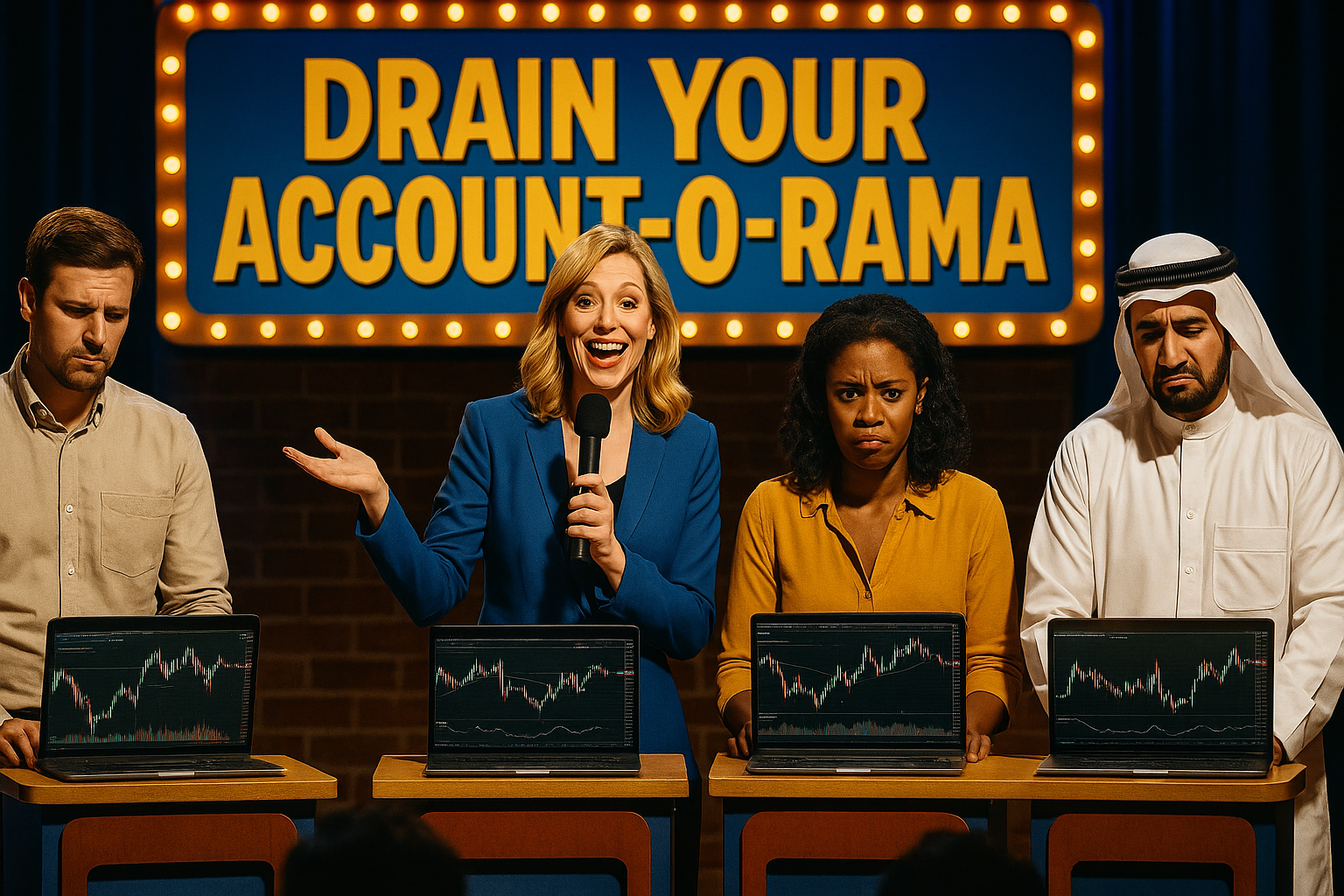
  • How to Fail as a Trader(A helpful guide for anyone trying to burn their dreams to the ground)

    How to Fail as a Trader(A helpful guide for anyone trying to burn their dreams to the ground)

    Let’s flip this thing.

    Charlie Munger—Warren Buffett’s famously cranky sidekick—used to preach a concept called inversion:

    “Tell me where I’m going to die, that way I’ll never go there.”

    So, instead of asking how to succeed in trading, let’s explore the more entertaining route:
    How to absolutely, unequivocally FAIL.
    Blow it. Flame out. Wreck your accounts, your confidence, and possibly your marriage.

    Ready? Let’s begin.


    Step 1: Trade When You’re Bored

    Forget waiting for real setups. If the chart is open and you’ve got fingers, it’s showtime.
    Better yet—trade while checking Discord, eating lunch, and watching other traders on YouTube.
    The market rewards divided attention, right?


    Step 2: Hold Your Losers (Because Hope Is a Strategy)

    Once it goes against you, double down on optimism.
    Tell yourself it’s just a “deep pullback.”
    Talk to it like a plant.
    Wait long enough and you’ll either be right… or margin called.


    Step 3: Ignore Your Hot Stove Exit

    You created it for a reason.
    Now ignore it for no reason.
    Tell yourself this time is different.
    Keep burning your hand and wondering why your trading confidence is toast.


    Step 4: Start Sharp, Finish Stupid

    Nail your first few trades. Then get cocky.
    Loosen your rules.
    Scale up.
    Try something “new” mid-session.
    Finish the day with regret and a self-pity burrito.


    Step 5: Abandon the Setup When It Doesn’t Work

    That A+ breakout setup failed? Time to declare it dead.
    Don’t bother with probabilities or long-run edge.
    Just chase whatever worked five minutes ago for that guy on YouTube.


    Step 6: Attach Your Self-Worth to Your P&L

    If you made money, you’re a genius.
    If you lost money, you’re a fraud.
    Your entire identity should swing on a 3-minute candle.


    Step 7: Don’t Journal Your Bad Sessions

    That’s too painful. Just pretend it didn’t happen.
    Better yet, gaslight your future self by only recording the wins.
    Future-you will love not knowing what went wrong.


    Step 8: Compare Yourself to Other Traders

    Especially the ones with Lambos in their thumbnails.
    They’re definitely showing their real P&L.
    You’re clearly behind.
    Panic accordingly.


    Step 9: Break the Rules That Just Saved You

    The structure worked yesterday, so obviously today it’s optional.
    Wing it. Trust your gut.
    You’re due, after all.


    Bonus Step: Take It All Very Personally

    This isn’t just trading. This is your worth.
    Your legacy.
    Your last shot at proving you’re not a complete disappointment.
    No pressure.


    So… Want to Succeed Instead?

    Then do the opposite.

    • Trade when the setup earns it.
    • Exit when the risk says so.
    • Let your edge breathe.
    • Treat process like religion.
    • Feel the feelings—but don’t trade the feelings.
    • And journal like your future self is trying to avoid your current mistakes.

    Inversion exposes the rot.
    Now you know what it looks like.
    Walk the other way.

    And if you’re not sure which way that is, we can help.
    This is exactly what we coach—every day, in real time, with real skin in the game.

    Let’s not just survive. Let’s build something that lasts.


  • Want to Blow Your Trading Account? Just Try Harder

    Want to Blow Your Trading Account? Just Try Harder

    In most high-performance arenas—sports, business, even creative work—when you’re behind, you can fight your way back.

    You refocus.
    You push harder.
    You create the next opportunity to score.

    A basketball player gets scored on? They sprint down the court and attack the rim.
    A founder loses a client? They jump on five sales calls and close the next one.
    Even a musician bombs a set? They lock themselves in the studio and come out sharper.

    Effort becomes the antidote to failure.

    But in trading?

    Effort gets you killed.

    You can’t hustle a setup into existence.
    You can’t push harder and force your way back into the green.
    You can’t attack the market and expect it to reward your grit.

    In fact, the more emotionally urgent it feels to act—the more dangerous it is to do anything.


    The Tools That Built You Will Break You Here

    If you’re wired like me, this is maddening.

    Because you’ve spent your whole life outworking your setbacks.
    Pain meant it was time to move.
    Discomfort meant it was time to do something.

    But in trading, those instincts betray you.

    • The urge to act becomes overtrading.
    • The urge to prove yourself becomes revenge trading.
    • The urge to fix things becomes refusing to exit a loser.

    It’s like being in a boxing match where the only winning move is to keep your gloves up and wait—not strike. Even when you’re hurt. Even when the crowd is jeering. Even when you know you could land one clean shot if you just swung.

    That’s what makes this game harder—and greater—than anything I’ve ever done.


    Here, Discipline Is Effort

    When you’re down in trading, the best thing you can do is often the hardest thing:

    Nothing.

    • You pause.
    • You obey the system.
    • You exit the trade even though your gut is screaming “Wait!”

    It doesn’t feel like effort.
    There’s no adrenaline spike. No high-five moment.
    Just silence and self-control and the long, slow build of mastery.

    But that invisible effort?
    That’s what gets you funded. That’s what makes this a career, not a phase.


    If You’re Wired to Win, This Will Hurt Before It Heals

    So if you’re reading this, and you’ve spent your whole life turning pressure into performance, just know:

    Trading doesn’t care how hard you try.
    It only cares whether you wait to strike.

    That’s the test.
    And if you can pass it, the game does reward you—massively.

    But only if you can endure the one thing that most high performers never learn to sit with:

    Discomfort without action.

    That’s the real work.
    And the ones who master that?

    They don’t just win trades.
    They become unshakeable.

  • Market Update: Friday June 20, 2025: Gold Slips Into a Third Day of Losses — But Don’t Break Out the Bear Suits Just Yet

    Market Update: Friday June 20, 2025: Gold Slips Into a Third Day of Losses — But Don’t Break Out the Bear Suits Just Yet

    Gold’s had a bit of a breather this week — or depending on your position, a bit of a gut-punch. After an impressive multi-week climb, we’re now looking at three consecutive days of losses. This morning saw spot gold break below $3,350, dipping as low as $3,342 after opening around $3,370.

    And honestly?
    Not much really happened to trigger it.

    No breaking news. No geopolitical drama (for once).
    Just… quiet markets. Which means all eyes shift to technicals.


    The Technical Guys Are Loving This

    With nothing juicy to trade off in the headlines, the technical analysts have taken center stage. And right now, the bears are enjoying themselves. Gold is on track to close out the week roughly 2.5% lower — snapping what had been a strong two-week winning streak.

    But — and it’s a big but — let’s not lose the forest for the trees.


    The Bigger Picture: Gold’s Still King in 2025

    Despite this short-term pullback, gold is still laughing at almost every other major asset class this year. Year-to-date, bullion is up an impressive 28% — handily outperforming both the S&P 500 (+1.9%) and Bitcoin (+12%).

    Zoom out and gold remains very much in a dominant long-term uptrend.


    What’s Behind the Pullback?

    The Fed threw a little water on the fire earlier this week by holding rates at 4.5% and signaling stickier inflation expectations — in part thanks to ongoing tariff uncertainty out of the Trump camp. The result? A slightly stronger dollar and a bit of downward pressure on gold.

    Higher rates always take a little shine off non-yielding assets like gold. When interest rates are high, there’s more incentive for funds to flow into fixed income where you actually get paid to sit still — instead of hoping gold continues to rise.


    Key Levels to Watch

    Technically, gold is still sitting comfortably above its major simple moving averages:

    • 50-day SMA: $3,317
    • 100-day SMA: $3,139
    • 200-day SMA: $2,901

    In other words: the long-term trend remains fully intact.

    The real question is whether bulls can clear the double-top resistance hovering around $3,450. If that breaks, we could see a retest of the $3,500 all-time highs. Until then, the market may stay choppy while traders jockey for positioning.


    Eyes on Next Week

    Next week could deliver the kind of volatility that breaks us out of this technical grind. Here’s what’s on deck:

    • Tuesday & Wednesday – Fed Chair Powell speaks (and traders hang on every word)
    • Thursday – U.S. GDP data drops
    • Friday – The Fed’s preferred inflation measure: PCE data

    Any surprise from Powell or the inflation numbers could light the fire again — in either direction.


    My Take:

    Short-term? Choppy.
    Medium-term? Still bullish until proven otherwise.
    Long-term? The big shiny rock is still doing exactly what it’s supposed to do — remind us why it’s called a store of value.

  • The Discomfort You’re Trying to Escape Is Exactly Where Mastery Lives

    The Discomfort You’re Trying to Escape Is Exactly Where Mastery Lives

    Here’s a brutally honest truth about trading that almost nobody tells you when you start:

    It’s going to make you feel like absolute hell.

    Not every time. Not forever. But for long stretches, especially when you’re closing in on real consistency. That’s when the internal war gets loud.

    • You’ll feel anxiety rise in your chest.
    • You’ll feel shame over mistakes.
    • You’ll feel desperate to “fix” losses quickly.
    • You’ll feel the overwhelming urge to just feel better right now.

    And if you’re like most people, you’ll instinctively search for anything that offers relief — news, analysis, someone to talk to (even an AI), a revenge trade, anything to pull you out of that discomfort.

    That’s the trap.

    Because trading mastery isn’t about eliminating that discomfort.

    It’s about learning to trade inside it.


    Your brain thinks it’s protecting you.

    What you’re feeling in those moments isn’t weakness — it’s biology. The same emotional wiring that kept our ancestors alive on the savannah is now screaming at you while you sit at your desk looking at flashing candles.

    “You’re in danger.

    Get out of this trade.

    Fix that loss.

    Do something — anything — to stop feeling this.”

    This is why we freeze. This is why we hesitate. This is why we revenge trade. This is why we exit too early.

    And this is why most people will never succeed at trading.


    The mission isn’t to feel better.

    This is the single most important shift:

    You don’t need to eliminate the discomfort.

    You need to execute cleanly in its presence.

    That’s it.

    You execute anyway.

    You follow your exit rule anyway.

    You honor your process anyway.

    You let the emotional discomfort scream, and you simply refuse to negotiate with it.


    The ironic part?

    Over time — and only through repetition — your brain starts to trust you. It learns that the discomfort isn’t fatal. That you’re safe even when losing. That you’re capable of holding the tension without needing to fix it instantly.

    That’s when you wake up one day and realize:

    “I still feel the tension, but it doesn’t control me anymore.”

    That’s how real traders are built.


    So if you’re in that stage right now — scared, frustrated, raw, hyper-aware of every mistake — understand this:

    You’re not broken.

    You’re not failing.

    You’re standing directly inside the forge where true mastery is made.

    The discomfort you want to escape is exactly where your edge lives.

  • The Tedium of Trading

    The Tedium of Trading

    Nobody tells you this when you’re getting started, but I’m going to do you a favor:

    Trading is boring.
    Stupidly boring.
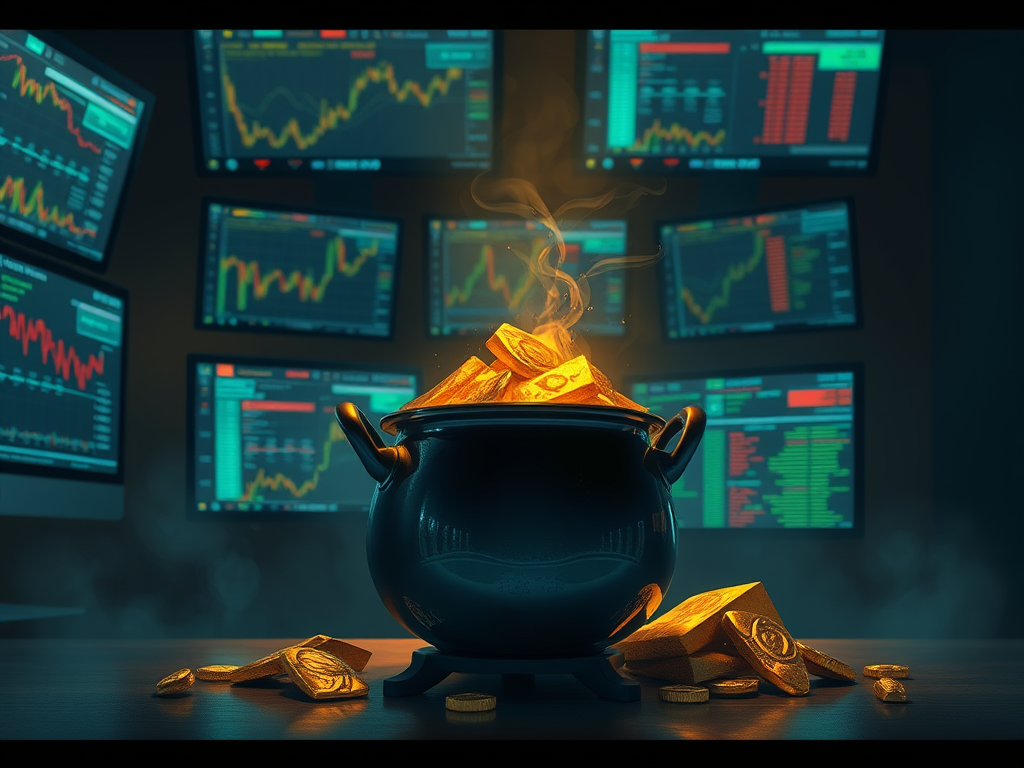
    Like-watching-a-pot-of-gold-not-boil boring.

    Not always, of course.
    There are moments of chaos, adrenaline, and “holy sh*t I nailed that entry”—
    But those moments are rare.

    Most of the time?
    You’re waiting.
    Staring.
    Marking levels.
    Checking news.
    Scrolling.
    Talking to yourself.
    Convincing yourself not to click anything.
    And then deleting the Discord app for the fifth time that week.

    This is the part that almost no one posts about.
    Because let’s be honest: “Traded nothing for three hours, went flat, journaled, ate a sandwich” doesn’t make for exciting content.

    But that’s the job.


    Trading isn’t charts and fireworks.

    It’s mostly sitting still, managing boredom without making a mistake.

    It’s knowing the level you want, seeing price dance 20 pips below it for 45 minutes, and still not jumping the gun.
    It’s waiting for your setup to actually trigger, while your brain whispers,
    “Come on, we could just get in now. We know what we’re doing.”

    Sure you do, cowboy.
    That’s how you blow $800 on a Tuesday morning.


    And then—suddenly—it happens.

    The setup forms.
    Structure confirms.
    The candle closes.
    And now you have… 90 seconds to make a decision that took you 4 hours of discipline to earn.

    You click.
    You manage.
    You hold. Or cut. Or hedge.
    And then…
    back to the boredom.


    This is the real rhythm of trading:
    Boredom. Boredom. Boredom. Decision.
    Repeat.

    If you can’t master the boredom, you’ll never survive the trade.
    Because the trades don’t get you.
    The boredom does.

    It eats at your discipline.
    It invites your impulses.
    It tricks you into “doing something” just to feel productive.
    And nine times out of ten, that “something” costs you money.


    So if you’re bored while trading…
    Good.
    That means you’re doing it right.

    You’re not overtrading.
    You’re not chasing.
    You’re not making stuff up just to stay stimulated.

    You’re waiting.
    Like a sniper.
    Like a pro.

    And when the moment comes—you’re ready.


    Let the others post fireworks.
    You focus on the part that matters:

    The boring, brutal, beautiful discipline of doing nothing… until it’s time.

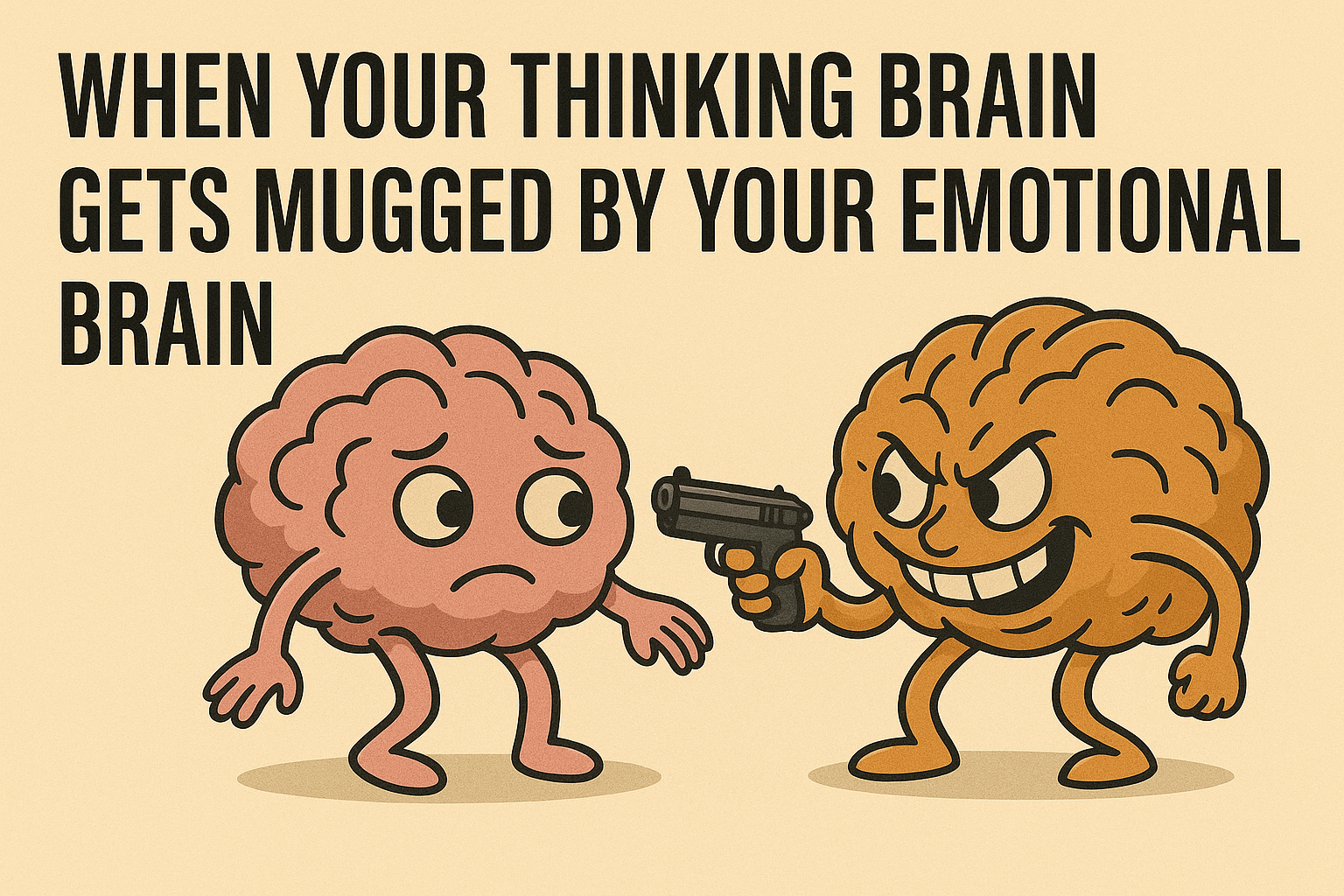
  • When Your Thinking Brain Gets Mugged by Your Emotional Brain

    When Your Thinking Brain Gets Mugged by Your Emotional Brain

    There’s a moment in trading when you realize your thinking brain has left the building. It doesn’t slam the door or even say goodbye—it just quietly exits stage left while your emotional brain lights a cigarette, takes over the terminal, and mutters, “I’ve got this.”

    Today, that moment cost me $895 – multiplied across all of my accounts on copy-trade. Ouch!

    Let me walk you through it, not because I enjoy public self-flagellation, but because this is the lesson. And if I’m going to drag myself through the emotional mud, I may as well leave footprints others can follow—or avoid.


    🚨 The Setup: Everything Was Fine Until It Wasn’t

    It started with a long trade. Nothing fancy. Clean enough structure. It moved in my favor by a modest $40.

    Then… whipsaw. Straight down. -$160.

    That’s my cue to cut the trade. Not later. Not “let’s see what happens.” Right. There. But instead of clicking out, I let the emotional brain step in.

    “Wait. It just dropped quickly—it’ll probably snap back.”

    And it did. Briefly. Came back to -$60.
    See? Emotional brain, feeling smug: “Told you.”

    Then it dropped again. Harder. -$150.

    Now I’m not trading. Now I’m bargaining.


    🔄 The Search for Permission

    And here’s the sneaky part: instead of owning the moment, I outsourced it.

    I asked Tono, who was on the livestream with me, “Do you think it’ll come back?”

    He said yes.
    Then it dropped again, violently.

    He said, “Now I’m not so sure.”

    But by then I wasn’t listening to Tono.
    I was listening to the part of me that wanted any excuse to stay in the trade.


    🧨 Enter: The Emotional Spiral

    This is where the thinking brain, had it still been present, would have calmly said:

    “Mike, you’re breaking every rule you said you’d never break again.”

    But that guy was gone. Emotional brain was now driving, window down, hair blowing in the wind, singing, “Let’s just reverse the trade!”

    So I did.

    Yes, I reversed the trade. Not because the setup flipped. Not because structure changed.
    But because I just wanted my money back.

    Spoiler: that didn’t work either.

    That one went $120 against me, then $200.

    That’s when I finally did the one thing I should have done just under 4 minutes earlier when the trade began: I exited.


    💔 Total Damage: $895

    On one trade.
    Not because of poor market reads.
    Not because of slippage.
    But because I abandoned my rules the moment they mattered most.


    🧭 The Real Lesson

    You don’t rise to your level of potential.
    You fall to the level of your discipline.

    And if your discipline isn’t rock solid in the moment of maximum discomfort, the market will remind you—mercilessly.

    Today, it reminded me.

    Not with a total account blow-up.
    Not with margin calls.
    But with that sick feeling in your stomach when you know, without a doubt, that you knew better and still didn’t act.


    🔒 Going Forward

    That trade is now burned into my brain.
    Not as a failure—but as a boundary marker.

    I’m done asking for permission to break my rules.
    I’m done “just seeing what happens.”
    And I’m damn sure done letting a trade morph into a rescue mission.

    If you’re reading this, take it as your sign:
    Don’t wait for the big drawdown to rebuild your discipline. Build it now. Because when it gets tested, you won’t have time to think.

    And thinking is optional.
    Discipline isn’t.

  • Cognitive Trap Radar: 10 Ways Your Brain Sabotages Your Trades

    Cognitive Trap Radar: 10 Ways Your Brain Sabotages Your Trades

    Every trader eventually figures this out the hard way:

    Your edge isn’t just on the chart—it’s in your mind.

    You can have the best setup in the world, but if your psychology is out of sync, the market will turn you into your own worst enemy.

    Some of these traps are loud—panic, FOMO, tilt.

    Others are subtle—like a quiet hesitation or a tiny deviation from your rules that seems harmless… until it’s not.

    Your job isn’t to eliminate these traps forever.

    Your job is to spot them early—and defuse them before they torch your session.

    Here’s the full radar map: 10 mental traps that quietly destroy good trading.


    1. The “Pause on the Stove” Trap (Analysis Freeze)

    Symptoms:

    • Trade moves against you fast
    • You freeze, trying to “stay calm and think”
    • That delay makes it worse

    Emotion: Regret avoidance disguised as logic

    Fix:

    • Trigger phrase: “Stove’s hot—get out.”
    • Hard stop = sacred
    • Exit immediately, then journal

    2. The “It’s Gotta Come Back” Trap (Hope Hold)

    Symptoms:

    • You’re deep in red
    • You can’t bring yourself to cut it
    • You wait… and hope

    Emotion: Loss avoidance

    Fix:

    • Say out loud: “Hope is not a strategy.”
    • Exit now. Log it. Reclaim control.
    • Repeat: “Discipline > Direction”

    3. The “Chase the Missed Move” Trap (FOMO Entry)

    Symptoms:

    • Price runs without you
    • You FOMO in mid-candle
    • You catch the top

    Emotion: Fear of missing out + self-doubt

    Fix:

    • Rule: “If it ran without me, it wasn’t mine.”
    • Set alerts for real setups
    • Never enter on emotion—especially not mid-run

    4. The “Win = I’m On Fire” Trap (Confidence Spike)

    Symptoms:

    • You loosen your rules after a few wins
    • You size up “just this once”
    • You believe you can’t miss

    Emotion: Overconfidence

    Fix:

    • Stop after 2 wins or when you hit target
    • Log emotions after every green session
    • If you take one more trade, make it an A+ setup only

    5. The “Just One More” Trap (Revenge/Closure Loop)

    Symptoms:

    • You’re near breakeven
    • You need one more trade to fix it
    • You force something that isn’t there

    Emotion: Incompletion + ego

    Fix:

    • Hard cutoff rule
    • Say: “One clean session > ten desperate ones.”
    • Walk away proud of your discipline—not your P&L

    6. The “Structure Overload” Trap (Analysis Paralysis)

    Symptoms:

    • You keep adding filters to avoid being wrong
    • No setup ever feels perfect
    • You miss trades waiting for certainty

    Emotion: Perfectionism masking fear

    Fix:

    • Define your minimum viable setup (3–4 core criteria)
    • Accept that A+ setups look messy in real time
    • Trust your system, not your craving for safety

    7. The “Historical Bias” Trap (Overfitting the Past)

    Symptoms:

    • You cling to setups that worked last week
    • You expect repeat performances
    • You trade nostalgia instead of price

    Emotion: Attachment to past success

    Fix:

    • Ask: “Am I trading this market—or last week’s?”
    • Adjust structure based on current flow
    • Don’t force history to repeat

    8. The “Cut Too Soon” Trap (Fear-Based Profit Taking)

    Symptoms:

    • You exit too early
    • You feel relief, not conviction
    • The move keeps running without you

    Emotion: Anxiety and risk aversion

    Fix:

    • Pre-define partial TP and BE zones
    • Zoom out and trust the plan
    • Say: “My job is to let the market prove me wrong—not my fear.”

    9. The “Trader Identity” Trap (Self-Worth = P&L)

    Symptoms:

    • Red days crush your mood
    • Green days inflate your ego
    • You tie your identity to the result

    Emotion: Ego attachment

    Fix:

    • Separate outcomes from execution
    • Ask: “Did I trade clean?”
    • Anchor your identity to process—not dollars

    10. The “Invisible Tilt” Trap (Subtle Emotional Drift)

    Symptoms:

    • You’re technically following your rules—but sloppily
    • Your rationale is fuzzy
    • You think you’re focused—but you’re not

    Emotion: Low-grade frustration masked as focus

    Fix:

    • Post-trade check-in: Calm, Tilted, Focused, or Foggy?
    • 2-loss rule = automatic break
    • Ask: “Would I be proud of this entry if it lost?”

    Bottom line?

    You don’t just need a trading strategy.

    You need a psychological counter-strategy.

    Because discipline doesn’t mean you never get emotional.

    It means you recognize when you’re compromised—and respond with clarity instead of chaos.

    Your setup doesn’t define your success.

    Your awareness does.

  • The Final Frontier – Your Trading Psychology

    The Final Frontier – Your Trading Psychology

    When you’re just starting out in trading, everyone tells you the real challenge is “psychology.”
    They’re not wrong.
    They’re just… premature.

    Because if you’re a beginner, chances are psychology isn’t your biggest problem yet.
    At that stage, your biggest problem is that you don’t actually know what you’re doing.

    • You’re guessing at setups
    • You don’t know your edge
    • You have no defined risk
    • And your “trading plan” is whatever someone on YouTube said looked good last night

    Let’s call it what it is: you’re still in technical bootcamp.
    You don’t need a sports psychologist—you need to stop hitting buy because a candle “looked bullish.”

    But… once you’ve been at this a while—once you’ve got a system, you understand structure, you’ve journaled trades, maybe even passed an eval or two—then yeah…

    That’s when psychology becomes the final boss.

    It sneaks in after you’ve already done the hard part.
    And suddenly, you are the last thing standing between your system and your results.

    Not the chart. Not the Fed.
    Not Jerome Powell sneezing mid-sentence.
    You.

    This is the final frontier. And it’s a mindf*ck.

    Because now it’s not about knowledge—it’s about control.
    It’s about execution under pressure.
    It’s about making the right decision while your brain is telling you to do the opposite.

    So what can you do?


    🧠 Here are a few ways to start mastering your own psychology:

    1. Trade smaller
      If your hands are shaking, your size is too big. Period.
    2. Pre-plan your trade
      Define your entry, stop, and target. If it’s not on paper, it’s improv.
    3. Journal everything
      And I mean everything. Not just what you did—but how you felt.
    4. Take breaks after losses
      Your next trade shouldn’t be emotional triage.
    5. Create hard rules for max daily loss
      One rule can save you from one bad day nuking your month.
    6. Check your mental state before every session
      Hungry? Angry? Rushed? You’re compromised. Don’t trade compromised.
    7. Use alarms instead of staring at the chart
      Give your nervous system a chance. Constant screen watching = constant cortisol.
    8. Focus on process, not outcome
      Did you follow your plan? That’s the win. The P&L comes later.

    A Great Video You Should Watch

    I recently came across a fantastic breakdown of this topic by The Traveling Trader—and I’ve got to say, he nails it.
    The way he explains the psychological shifts, the traps, and the actionable tools is legit. It’s not fluff. It’s not a motivational speech. It’s real.

    So if this post hits a nerve—and you know psychology is what’s holding you back right now—go watch his video. I’ve embedded it below.

    👇👇👇
    Watch it. Rewatch it. Bookmark it. And then do the work.
    Because the chart won’t save you.
    Your plan won’t save you.
    Only you, with a calm brain and a click-ready finger, will.

  • You Can Teach Trading—But Only So Far

    You Can Teach Trading—But Only So Far

    You can teach someone how to trade.
    But only up to a point.

    You can teach setups.
    You can teach risk management.
    You can teach how to mark up a chart, read macroeconomic indicators, and identify momentum shifts on a 5-second timeframe.

    You can teach patience.
    You can preach discipline.
    You can scream “Stick to your damn stop loss!” until you’re blue in the face.

    But none of it matters until you decide to stop lighting your own capital on fire.

    The Hard Truth

    Trading isn’t plumbing. It’s not accounting.
    You don’t pass a test, hang a certificate on your wall, and suddenly become consistent.

    There’s a point in every trader’s journey where no mentor, no YouTube video, no golden Discord server can save you. And that point usually comes right after you already know what you’re supposed to do… but still don’t do it.

    That’s the line between being taught and actually learning.

    You can learn what you need to know from a course and some are a LOT better than others. I recommend this one. But you don’t truly learn until the moment you finally honor your own rules.

    You learn it when you don’t add to a loser.
    When you don’t chase the second breakout after missing the first.
    When you close a trade because your setup broke down—not because you “hope it bounces.”

    That’s not something anyone can program into you.
    That’s earned. That’s internalized. That’s learned the hard way.

    The Market Doesn’t Care

    It doesn’t care how many hours you studied.
    It doesn’t care how bad you want it.
    The market is the final exam—and it doesn’t hand out A’s for effort. It tests your actions. Not your knowledge.

    The best mentors in the world can only walk you to the edge.
    After that?
    It’s your hand on the mouse. Your capital on the line. Your brain versus your brain.

    So Here’s the Real Lesson

    If you’re still in that loop—study, blow account, repeat—it might be time to stop trying to find a better teacher. And start being a better student.

    Of your mistakes.
    Of your impulses.
    Of your emotions.

    The edge isn’t in the strategy.
    It’s in your ability to execute it without flinching.

    And that’s not taught.
    That’s learned.

  • The Part No One Talks About

    The Part No One Talks About

    There’s a part of the trading journey that almost no one warns you about.

    It’s not the beginning—when you’re reckless and euphoric and think you’re going to master the markets in six months.
    It’s not the blow-up phase either—when you burn an account and realize this game isn’t as easy as the YouTubers made it look.

    No, this part is later.
    This part is worse.

    It’s when you’re doing almost everything right… and it still isn’t showing up in your P&L.

    You’re finally sticking to your plan.
    You’re not revenge trading.
    You’re managing risk.
    You’re walking away when the market’s not clean.
    You’re doing all the internal work—but the external results still suck.

    This is the part where it’s darkest before the dawn.

    It’s brutal. Because the dopamine is gone. The chaos is behind you. But the consistency hasn’t paid off yet.

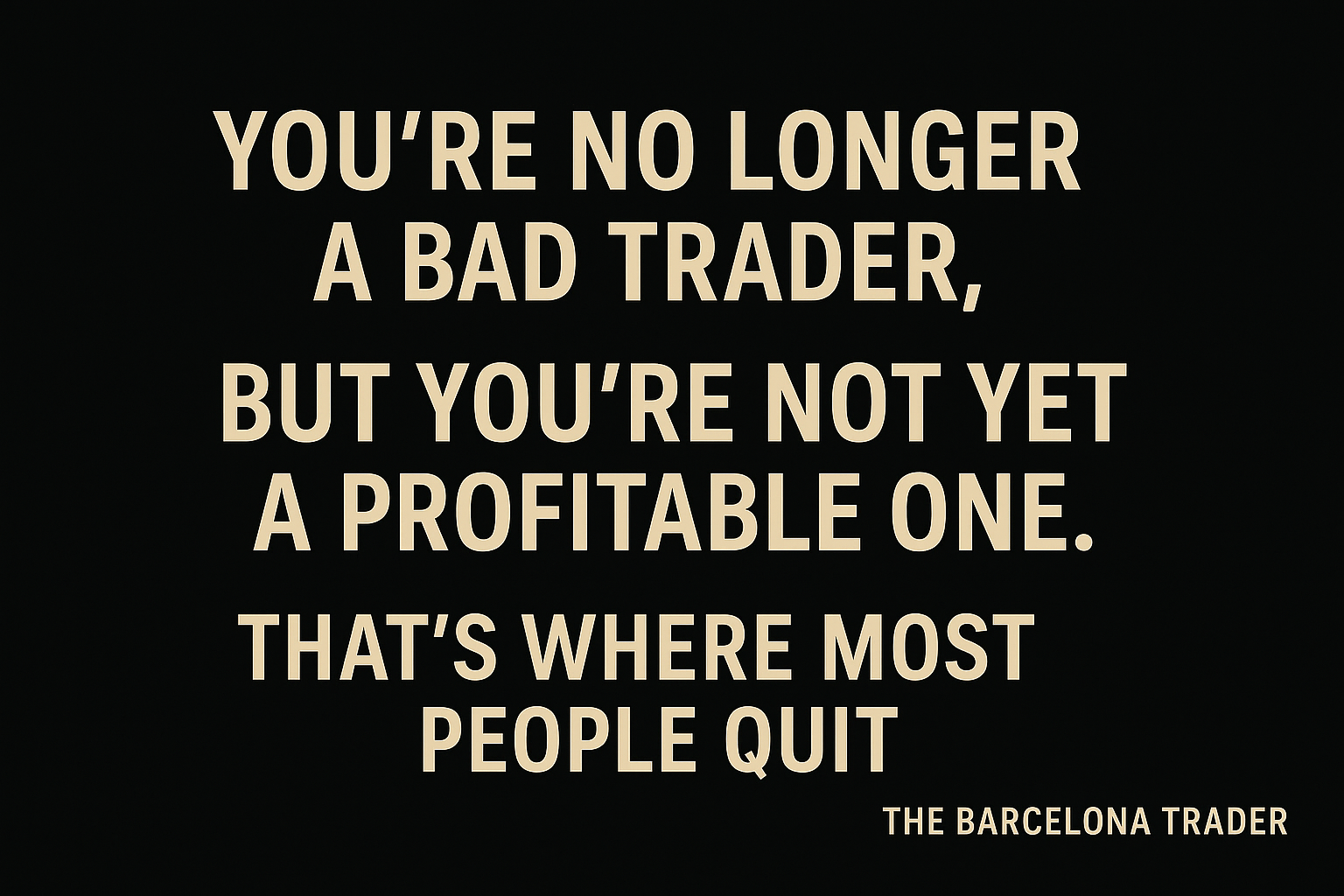
    You’re no longer a bad trader.
    But you’re not yet a profitable one.

    You’re stuck in the hallway between who you were… and who you’re becoming.

    And let me tell you—this is where most traders quit.
    Not because they’re failing. But because they’re improving… and it still feels like failure.

    But here’s the truth:
    This phase isn’t punishment. It’s proof.
    Proof that you’re getting closer.

    You’re not making impulsive trades anymore—so you’re not getting lucky.
    You’re not violating your plan—so there’s no home-run outliers.

    You’re left with the truth.
    The slow, grinding truth of a process that hasn’t finished yet.

    Keep going.

    This is the stretch where all the invisible work starts to compound.
    Where your equity curve feels flat, but your discipline curve is steep.
    Where your P&L is quiet, but your brain is finally rewiring.

    If you’re here, don’t quit.
    Don’t go looking for a new system.
    Don’t start over.
    Just keep showing up.

    Because if you make it through this phase—
    The results come fast.
    And they come from you—not a signal, not a fluke, not a lucky week.

    They come from the foundation you’re laying right now.

    You’re closer than you think.
    Stay in it.