Tag: mental-health

  • How to Survive a Long Weekend Without Trading Or: Good Friday, Bad Friday, Worst Friday

    How to Survive a Long Weekend Without Trading Or: Good Friday, Bad Friday, Worst Friday

    Good Friday is a beautiful holiday if you are a normal person.

    If you are a trader, it is a targeted psychological operation.

    The market is closed.
    Closed.

    Not “a little slow.”
    Not “thin liquidity.”
    Not “maybe London will give us something.”

    Closed.

    No gold. No futures. No opening bell. No little burst of hope at the top of the hour. No chance to make one excellent trade, two questionable ones, and then spend the rest of the day pretending the third one was still within plan.

    Just silence.

    Silence, and the horrifying realization that now I have absolutely no excuse not to do things in my actual life.

    This is where the long weekend becomes dangerous.

    Because while the markets are closed, the rest of life remains offensively open.

    The closet is still a disaster.
    That thing I said I’d “get to this weekend” is now, technically, this weekend.
    The pile of papers on the desk has stopped being a pile and become an ecosystem.
    The email I have been avoiding is still sitting there like a small legal threat.
    The house contains multiple drawers full of mystery cables that apparently now expect my full attention.

    And worst of all, other people become aware that I am available.

    This is the true black swan event.

    When markets are open, I am busy. I am focused. I am in battle. I am monitoring price, structure, momentum, liquidity, traps, reversals, stop runs, and the collective emotional instability of humanity as expressed through gold.

    When markets are closed, I am just a man standing in his home near a vacuum cleaner.

    Do you understand the collapse in status?

    A few hours ago I was a precision operator dancing with volatility.

    Now I’m apparently someone who has time to “look at the pantry situation.”

    The pantry situation.

    This is what Good Friday has reduced me to.

    And it gets worse.

    Because the break is long enough to create that special form of trader despair where you start missing the market in ways that would sound insane to civilians.

    You begin to miss spread.
    You miss candles printing.
    You miss the tiny fluctuations that would be meaningless to anyone else but to you feel like the pulse of the universe itself.
    You miss the possibility of violence.

    By Saturday, you’re checking charts out of habit even though nothing is moving.
    By Saturday afternoon, you are staring at old screenshots like a widower holding a locket.
    By Saturday night, you are explaining to your wife that no, you are not “free,” you are merely unable to participate in your chosen form of suffering.

    Then comes Sunday.

    The day of false hope.

    A full day where the market is still closed, but close enough that you can almost taste it.

    This is not rest. This is a hostage situation with brunch.

    And so the question becomes: how does one survive a long weekend without trading?

    Here are a few options.

    1. Pretend to be a human being.
    Go outside. Make eye contact. Speak in complete sentences that do not include the phrases “liquidity sweep,” “rejection candle,” or “that move was manipulated.”

    2. Do one neglected adult task and act like you rebuilt civilization.
    Clean a closet. Answer three emails. Throw out the ancient batteries. Reorganize something with the intensity of a man trying to regain control over a meaningless universe.

    3. Stare into the middle distance and call it recovery.
    This is especially useful if someone asks what’s wrong and you want to avoid saying, “Nothing, I’m just spiritually separated from gold until Sunday night.”

    4. Rewatch your old trades like game film.
    This creates the pleasant illusion that you are still working, when in fact you are just reopening emotional wounds voluntarily.

    5. Announce that the long weekend is a chance to reset.
    This is what disciplined people say. It sounds excellent. Very mature. Very healthy.
    Then, five minutes later, check the clock and mutter, “Only 31 more hours.”

    6. Accept the terrible truth.
    You are not relaxing.
    You are in pre-market purgatory.

    And maybe that’s okay.

    Maybe this is good for us.

    Maybe being forcibly separated from the market for a couple of days reminds us that there is, allegedly, more to life than candles, structure, execution, and trying not to do something stupid at exactly the wrong moment.

    Maybe.

    But let’s not get carried away.

    By Sunday evening, I will be at my screen like a Victorian wife waiting at the port for her husband’s ship.

    Return to me, you beautiful, terrible beast.

    Until then, I suppose I’ll handle the dishes, clean something I’ve been pretending not to see, and maybe address the growing humanitarian crisis in my desk drawer.

    This is what Good Friday takes from us.

    Not just opportunity.

    Identity.
  • Why You Can’t Rewire Your Brain — And Why You Don’t Need To

    Why You Can’t Rewire Your Brain — And Why You Don’t Need To

    Look, I’ve watched the videos.
    You’ve watched the videos.
    We’ve all watched the videos.

    Some guy in a black hoodie sitting in a rented penthouse tells you:

    “You must REWIRE your brain to trade like a sniper.”

    And you think, “Ah yes, this is it. This is my villain origin story. By Tuesday I’ll be a Zen assassin.”

    Then Tuesday comes.
    You start strong.
    You breathe.
    You visualize.
    You channel Buddha.

    And by 9:12 AM you’re clicking like a caffeinated raccoon in a trash can, down three trades, swearing at the screen, and Googling whether it’s possible to legally file charges against gold.

    So let’s finally say the quiet part out loud:

    You cannot ‘rewire’ your brain.

    Not the way they’re selling it.

    Dopamine overrides can’t be meditated away.
    Tilt cannot be journaled out of existence.
    Fight-or-flight does not wait politely for your affirmations.

    When your limbic system fires, it’s not asking your permission.
    It’s flipping the breaker and locking the door.

    And once dopamine hijacks you?

    That whole “rewire your brain” fantasy evaporates faster than your TopStep account on NFP day.


    So… what DOES work?

    Systems.

    Guardrails.
    Constraints.
    Engineering.

    That’s it.
    That’s the entire secret.

    The traders who survive — the ones who actually make money — aren’t superheroes who rewired their instincts.
    They’re people who learned to build cages around their worst impulses so their best self can show up consistently.

    I didn’t fix my brain.
    I fenced it in.

    And guess what?

    Trading suddenly got a whole lot easier.


    The Fantasy vs. The Science

    The fantasy (YouTube version):

    • Rewire your neural pathways
    • Become emotionless
    • Eliminate fear
    • Upgrade your brain
    • Trade like a monk-warrior-cyborg

    The science (actual neuroscience):

    • Once dopamine spikes, the rational brain is offline
    • Tilt is involuntary
    • Impulse overrides happen faster than conscious awareness
    • Willpower is the last reliable tool in high-stress decisions
    • Humans don’t change “internally” — their environment changes their behavior

    If you want consistency, you have to design around your biology, not fight it.


    Want to hear a real breakthrough? Here it is:

    I used to think I needed to fix myself.
    Become calmer.
    Become wiser.
    Become the person who could take five losses in a row without breaking.

    Spoiler:
    I am not that person.
    I will never be that person.
    My wiring doesn’t work that way.

    But here’s what I AM:

    A very good trader when I’m not hijacked by dopamine.

    So instead of trying to retrain my brain, I built a system that does not let hijacked-Mike touch the mouse.

    A $250 automated stop loss on a per trade basis and a $600 master-account daily loss limit.

    That’s it.
    That’s the whole hack.

    And it works.

    Not because it makes me stronger.
    Because it stops me when I’m weak.

    The guardrail is the strength.


    You don’t transform your brain.

    You transform your environment.

    Pilots don’t “rewire” their brains to avoid crashing planes.

    Surgeons don’t “rewire” themselves to never make errors.

    They use:

    • checklists
    • constraints
    • procedures
    • circuit breakers
    • lockouts
    • verification steps
    • structural safeguards

    Why?
    Because humans under pressure make predictable mistakes.
    And smart systems prevent those mistakes from becoming fatal.

    Trading is no different.

    The moment I stopped trying to become superhuman, I started becoming consistent.


    The real reason this truth isn’t popular on YouTube

    Because “rewire your brain” sells a fantasy.
    “Install a $600 forced stop” sounds like broccoli.

    But broccoli wins.
    Fantasy loses.

    The trading gurus want you chasing enlightenment.
    The markets want you following rules.

    One will take your money.
    The other will protect it.


    Final Thought

    If you’re struggling, if you’re tilting, if you’re blowing accounts and saying “I KNOW better, why can’t I DO better?”…

    It’s not because you’re broken.

    It’s because you’re human.

    And the system you need isn’t inside your skull —
    it’s in the guardrails you build around it.

    Stop trying to rewire your brain.
    Start engineering your environment.

    Your future equity curve will thank you.

  • Why Your Brain Goes to War With You: The Dopamine Trap Every Trader Needs to Understand

    Why Your Brain Goes to War With You: The Dopamine Trap Every Trader Needs to Understand

    Here’s something I wish someone had told me two years ago, preferably before I lit a small village of prop accounts on fire:

    Trading isn’t just a market skill.
    It’s a neurochemical hostage situation.

    Most people think they blow accounts because they “lack discipline” or “don’t stick to the rules.”
    Cute. Sure. Let’s pretend this is about willpower.

    The truth is far weirder, far darker, and honestly… kind of liberating.

    So let me tell you the thing that finally clicked for me — the thing that changed everything:

    My problem wasn’t discipline.
    It was dopamine.

    Not the nice, friendly “reward” dopamine you get from chocolate or sex.
    I’m talking about the full-blown, limbic-takeover, hijack-the-cockpit dopamine. The kind where your brain flips from monk to maniac with no warning whatsoever.

    Sound familiar?
    Yeah. Pull up a chair.


    The Tilt Switch No One Talks About

    Most traders describe tilt like it’s a slow slide.
    A little frustration here…
    Some agitation there…
    Boom — bad decision.

    Not me.

    I don’t slide into tilt.
    I teleport into it.

    One second I’m calmly waiting for my A setup.
    The next second I’m flooring it down Tilt Expressway at 125 mph, flinging orders like Mardi Gras beads.

    There’s no buildup.
    No early warning signs.
    Just click — and the rational part of my brain is hogtied in the trunk while dopamine drives the getaway car.

    And when I’m in that state?

    • I can’t walk away.
    • I can’t stop trading.
    • I can literally hear myself saying “STOP” out loud… and keep going anyway.

    It’s embarrassing.
    It’s also extremely normal — for the kind of brain I have.


    The Real Enemy Isn’t the Market — It’s the Hijack

    Most traders think they tilt because they’re emotional or undisciplined.

    But that’s not what’s happening.

    What’s happening is this:

    • Your limbic system (emotion/impulse)
      — suddenly overrides —
    • Your prefrontal cortex (logic, discipline, long-term thinking)

    Once dopamine spikes, your logical brain is gone.
    Not weakened — gone.

    It’s not that you “won’t stop.”
    You can’t stop.
    The part of your brain that controls stopping isn’t accessible.

    This isn’t philosophy.
    This is neuroscience.


    Why Hedging Was a Disaster for Me

    This actually explains everything about my past:

    Hedging?

    Absolute hell.
    It amplified every flaw in my wiring.

    A hedge is prolonged discomfort — being stuck underwater for a long time.
    My brain treats that like a threat.
    Threat spikes dopamine.
    Dopamine switches me into “fix-it-NOW” mode.

    And what does a dopamine-charged brain do inside a hedge?

    It widens it.
    Moves it further away.
    Chases relief.

    And eventually stretches the account so far apart it looks like a medieval torture device.

    Of course I blew accounts hedging.
    My brain is chemically incapable of executing that model correctly.

    Once I switched to scalping — quick trades, fixed exits, no hedges — my results exploded.
    Not because I “became better,” but because I finally stopped fighting my biology.


    This Is Why Auto Stop-Loss Changed My Life

    Here’s the part that surprised me:

    The moment I installed an auto-SL, my trading immediately stabilized.

    It wasn’t magic.
    It was simply that the auto stop-loss doesn’t have dopamine receptors.

    It:

    • doesn’t panic
    • doesn’t tilt
    • doesn’t negotiate
    • doesn’t chase
    • doesn’t feel pressure
    • doesn’t care about “fixing” anything

    It exits the trade even when I chemically can’t.

    It’s not discipline.
    It’s outsourcing discipline to a robot so my brain can’t ruin my life.

    And now?
    I use it proudly.


    The Two Versions of Me (And Probably You)

    Trading revealed something uncomfortable but important:

    There are two versions of me:

    Calm Mike

    • sharp
    • disciplined
    • patient
    • precise
    • profitable

    Dopamine Mike

    • impulsive
    • emotional
    • frantic
    • reactive
    • revenge-trading goblin
    • destroyer of worlds and prop accounts

    The game isn’t to “be more like Calm Mike.”
    The game is to prevent Dopamine Mike from ever getting control of the mouse.

    Which brings us to…


    The Kill Switch

    I’m currently building a 2-hour lockout:
    the moment I take two losses or hit emotional distortion, my computer literally blocks access to my trading platform.

    No negotiation.
    No override.
    No “just one more.”
    Brutally effective.

    Because the solution to dopamine hijack is not more willpower — your willpower is offline during tilt.

    The solution is removing your ability to trade while tilted.

    If you struggle like I do, stop lying to yourself.
    You don’t need more discipline.
    You need better engineering.


    The Big Lesson: Trade the Trader You Actually Are

    This is the key breakthrough in my journey:

    You don’t trade the market.
    You trade your brain.

    If you don’t understand your brain’s architecture, you’re trading blind.
    If you fight your biology, you’ll lose every time.

    When you align your strategy with how your mind actually works?

    Everything changes.

    You stop blowing accounts.
    You stop tilting.
    You stop fighting invisible battles.

    And you finally start trading like the version of you that shows up when you’re calm, centered, and chemically stable.


    Final Thought

    Trading isn’t a war against the market.
    It’s a war against your own neurochemistry — and the key to victory isn’t courage or grit.
    It’s building systems that keep your worst self away from the keyboard and let your best self operate freely.

    If this resonates with you, I promise you’re not broken.
    You’re just trading with the wrong tools for your wiring.

    Build the system that matches your biology,
    and the consistency you’ve been chasing suddenly becomes the life you’re living.

  • The Dirty Secret About Trading Discipline (It’s Not About Willpower)

    The Dirty Secret About Trading Discipline (It’s Not About Willpower)

    Let’s get this out of the way: trading discipline is not about being a badass with nerves of steel. If that were true, Navy SEALs would all be fund managers and monks would be crushing the futures market between meditation sessions. But they’re not.

    Discipline in trading has almost nothing to do with raw willpower. That’s the dirty secret.

    Willpower is like a battery — it runs out, usually right when you need it most. And if your entire plan for success relies on your brain saying no to temptation a hundred times a day, then congratulations: you’ve already lost.


    Why Grit Alone Fails

    We’ve all been there. You swear you won’t revenge trade. You tell yourself you’ll cut the loser at minus one hundred and twenty-five. And then the candle spikes, your pulse jumps, and suddenly you’re in a position twice as big as you meant to take.

    What happened? Did your inner warrior take the night off? No. You tried to fight chaos with nothing but personal grit — and chaos always wins.


    Systems Beat Willpower

    The traders who survive (and thrive) don’t rely on moment-to-moment strength. They build systems that do the heavy lifting for them.

    • Rules: Pre-defined exits, entries, and hot stove limits. Clear, simple, enforceable.
    • Structure: Trading sessions you treat like a job — not like a late-night casino run.
    • Processes: Journals, checklists, and reviews that make you painfully honest with yourself.

    Systems don’t care if you’re tired. They don’t care if you’re emotional. They don’t care if you just had three losing trades in a row. They only care about execution.


    Think Guardrails, Not Heroics

    Picture a highway with no guardrails. Most drivers would eventually drift off the edge. It’s not because they’re bad drivers; it’s because we’re human. Guardrails exist so that when you inevitably swerve, you don’t go over the cliff.

    Trading rules are those guardrails. They’re not there to make you a better person. They’re there to keep you alive.


    The Paradox of Freedom

    Here’s the funny part: the more structure you build, the freer you actually become. Without it, every trade feels like life or death. With it, you know exactly where you stand.

    When you trust your system, you can shut down the self-talk, the bargaining, the “just one more” spiral. You don’t need to be Superman — you just need to show up and follow the map.


    Final Word

    So stop worshiping willpower. It’s a fragile, fleeting thing. Build rules. Build structure. Build systems that are stronger than you on your worst day.

    Because in trading, your worst day will come. The question is: will your framework hold, or will you bet it all on being superhuman in the moment?

    Spoiler: the market doesn’t care.

  • How to Handle the Weekend After a Bad Trading Week

    How to Handle the Weekend After a Bad Trading Week

    There’s a very specific kind of pain that only traders know.

    You’ve had a rough week.

    You’re sitting in drawdown.

    You’re disappointed, angry, frustrated.

    And worst of all?

    The markets are closed.

    You can’t fix it.

    You can’t take action.

    You just sit there.

    Marinating in your own bad decisions.


    The trader’s weekend dilemma:

    When you’re in a losing streak, the weekends feel longer.

    Because unlike most normal people, weekends aren’t rest for traders — they’re emotional purgatory.

    • Your brain obsesses over charts that aren’t moving.
    • You replay trades you should’ve exited earlier.
    • You run fantasy simulations of what would’ve happened “if only.”

    The urge to make the pain stop starts to build.


    Here’s where it gets dangerous:

    The natural instinct is to reach for a dopamine hit to alleviate the discomfort:

    • Binge Netflix.
    • Scroll social media endlessly.
    • Overeat.
    • Numb yourself with alcohol.
    • Start planning “big” trading adjustments.
    • Fantasize about how you’ll make it all back Monday morning.

    Anything to make the emotional sting feel less sharp.


    But here’s the truth nobody wants to hear:

    Every time you seek relief, you train your brain to seek immediate comfort instead of long-term discipline.

    And that’s the exact dynamic that shows up when:

    • You revenge trade to erase losses.
    • You overtrade trying to feel “back in control.”
    • You hold losing trades beyond your stop because “it might come back.”

    Seeking relief becomes your default trading behavior.


    The real work is done in this weekend pain.

    This is your training ground.

    Not the charts.

    Not the trades.

    Right here. Inside this discomfort.

    Because trading success isn’t about feeling great while you trade.

    It’s about executing correctly while you feel like absolute garbage.


    What to do instead:

    1️⃣ Sit in the pain.

    Feel it. Let it wash over you without trying to numb it.

    This is the currency you’re paying for your growth.

    2️⃣ Reflect with brutal honesty.

    • What actually happened this week?
    • What rule did you break?
    • Where did your emotional brain hijack you?

    3️⃣ Journal with purpose, not fantasy.

    • Write down what you’ll do differently.
    • Write out your process for catching yourself next time.
    • Don’t write “how you’ll make it back.” That’s poison.

    4️⃣ Respect Monday.

    Monday is not your redemption day.

    It’s just another session. Another opportunity to execute cleanly.

    If you try to erase last week’s losses emotionally, you’ll just compound them.


    In truth:

    This weekend pain is exactly why most people never make it as traders.

    They’re not willing to sit in the discomfort long enough to retrain their nervous system.

    But if you can build the muscle to act correctly inside discomfort,

    You’re doing the real work most traders will never do.


    Final thought:

    The pain you feel this weekend is the tuition.

    How you process it determines whether you’re building mastery or simply running laps around your same old cycle.

    If you want comfort, there are easier careers.

    If you want mastery, lean into the pain.


  • Trading With the Hulk

    Trading With the Hulk

    Here’s what I’ve learned the hard way: I am not a rational person who occasionally gets emotional. I’m an emotional animal who manages to have rational experiences.

    Most of the time, I can play the part of the disciplined trader. Cool head, tight rules, clean exits. Bruce Banner at the desk. But the second anger gets triggered — a loss that stings, a stop that feels unfair — Banner is gone and the Hulk takes over.

    And the Hulk doesn’t “trade.” The Hulk smashes buttons. He doubles down on losers, chases reversals, and treats my account like it owes him money. He is not interested in logic, or setups, or risk management. He is interested in destruction — and he’s very, very good at it.

    Here’s the cruel part: you can’t negotiate with the Hulk. Once the adrenaline hits, once the blood pressure spikes, the transformation is already underway. There’s no talking him down. By the time I’m green and raging, the account is already red and bleeding.

    So the only move is prevention. At the very first flicker of anger, at the very first whisper that the Hulk might be coming, I have to walk away. If I don’t, it’s too late.

    Because the first loss never kills my account. The Hulk does.

  • You Are Not Your Thoughts (Thankfully)

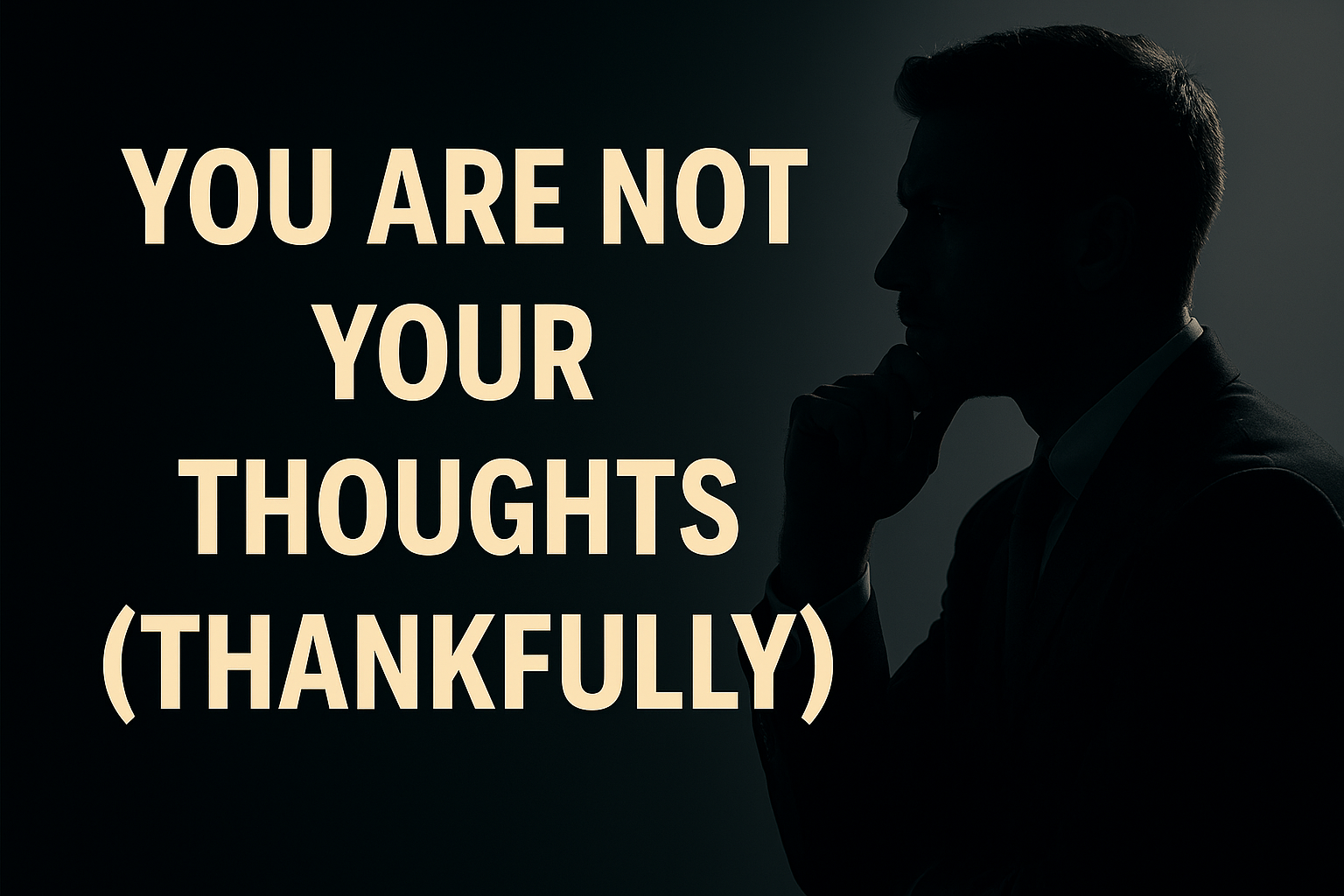
    You Are Not Your Thoughts (Thankfully)

    One of the hardest truths in trading is this: you are not your thoughts. You’re the awareness of them. And if you don’t learn that early enough, your account balance will be the one to teach you. Brutally.

    Because here’s what happens. You take a few losses — maybe you followed your rules, maybe you didn’t — and suddenly the brain pipes up like a bad karaoke singer: “Let’s make it back. Double down. The next one’s the big one.”

    That voice isn’t wisdom. It’s desperation in a trench coat. And if you follow it, you’ll end up in a place every trader knows too well: staring at the screen, muttering to yourself about how unfair it all is, while your broker thanks you for the donation.

    Professional traders know this game isn’t about silencing those thoughts. That’s impossible. The brain loves to chatter. The skill is noticing the thoughts, labeling them (“ah, that’s revenge-trading talking”), and then not acting on them. It’s mindfulness, not mute mode.

    And mindfulness in trading isn’t just a five-minute meditation app exercise. Sometimes it means hours of watching the market do nothing and not inventing a setup that isn’t there. Sometimes it’s days. Sometimes it’s an entire week where your only win is that you didn’t throw good money after bad.

    That’s the real discipline: sitting still while your brain screams at you to move.

    It’s learning that a red day doesn’t mean you’re a failure, and a green day doesn’t mean you’re a genius. You’re just the awareness, steadying the ship while the thoughts thrash around below deck.

    Most people quit trading because they can’t separate the two. The pros? They practice it daily. Not perfectly — no one does — but enough to let the setups come to them instead of chasing ghosts.

    So next time the thoughts come barging in after a loss, remember: they’re not you. They’re just noise. Your job is to observe, breathe, and wait.

    Because the market will still be here tomorrow. Your account, on the other hand, might not survive if you keep letting your thoughts take the wheel.

  • Trading Is Psychological Pain Tolerance. The Gym Bros Are Half Right.

    Trading Is Psychological Pain Tolerance. The Gym Bros Are Half Right.

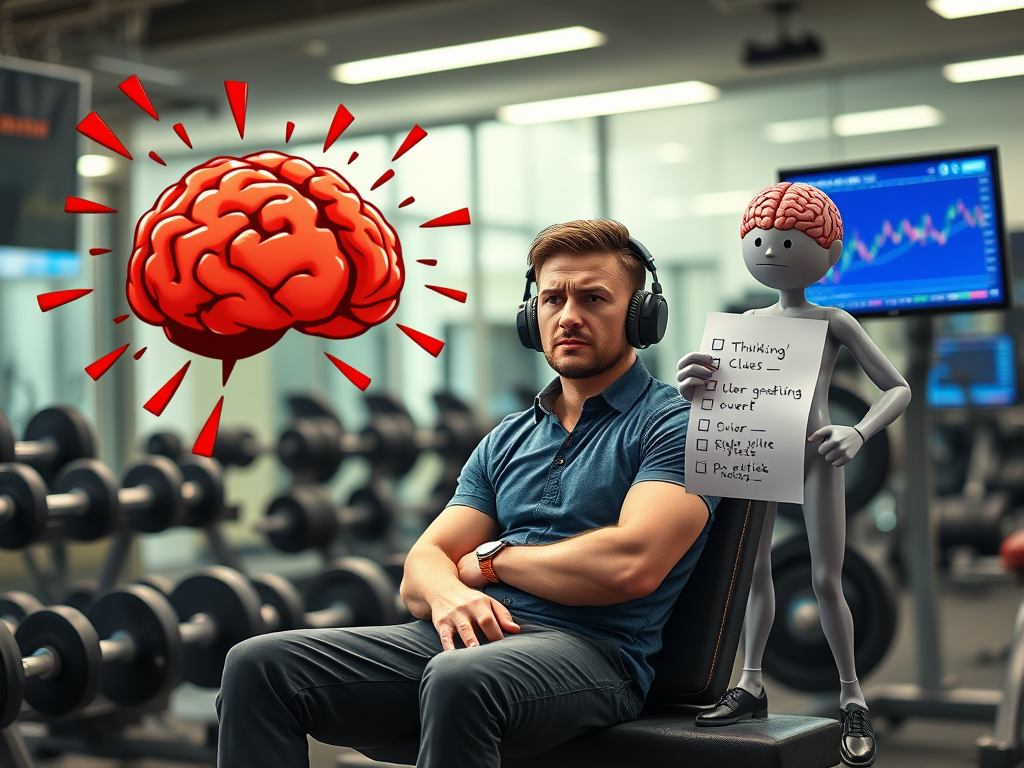
    There’s a certain flavor of trading guru out there—you’ve seen them.
    Tight T-shirt, protein shake, testosterone-infused motivational posts.
    Discipline starts at 5 AM in the gym, bro. If you can’t do that, you’ll never be a trader.

    And to be fair, they’re not entirely wrong.

    But they’re not entirely right either.


    Trading is a form of psychological athleticism.

    At its core, trading is about doing the correct thing while your brain is screaming at you to do the wrong thing.
    Over.
    And over.
    And over.

    It is pain tolerance, but not physical.
    It’s not about how much you can bench press.
    It’s about how long you can sit inside a trade that’s gone $150 against you and calmly click out exactly where your exit rule tells you to, rather than where your ego wants you to.


    Where the gym analogy works

    When you train physically, you deliberately introduce discomfort to build resilience.
    You force yourself into pain under controlled conditions.

    • You’re sore, but you do the reps.
    • You’re tired, but you finish the workout.
    • You’re tempted to quit, but you don’t.

    That process does strengthen your nervous system.
    It builds tolerance for discomfort.
    It creates evidence that you can act correctly even when uncomfortable.

    That skill absolutely transfers into trading.


    But here’s where the gym bros lose the plot:

    They make it sound like you need to be in peak “Alpha Mode” before every trading session.

    Like if you don’t get 8 hours of sleep, eat salmon and quinoa, meditate for 20 minutes, and hit a personal deadlift record…
    … you’re not “primed” to execute.

    And while yes—healthy routines help—it’s a false expectation that you can or need to be at peak readiness every time you sit at the screens.


    The uncomfortable truth:

    You will trade tired.
    You will trade frustrated.
    You will trade stressed.
    You will trade while your kid is sick, your dog puked on the carpet, and your neighbor’s leaf blower is firing up for the third time that morning.

    And you still have to execute.

    Because the real skill isn’t trading while feeling good.
    It’s trading well while feeling like garbage.


    So does trading become easier?

    Yes — but not because the discomfort goes away.
    It gets easier because you stop fearing the discomfort.

    You stop negotiating with your emotional brain.

    You stop arguing with the voice that says:

    • “This feels bad.”
    • “I want out.”
    • “I can’t take another loss.”

    And instead you calmly say back:

    “Noted.
    But I will still obey my system.”


    Eventually, it becomes muscle memory. Sort of.

    When you start, trading feels like learning a foreign language while someone screams in your ear.
    Every decision feels loaded with pressure.

    But over time, as you consistently act correctly inside discomfort, your brain starts to rewire:

    • The discomfort remains.
    • But your response becomes automatic.
    • You act correctly faster.
    • You spend less time spiraling.

    That’s the true version of “muscle memory” in trading.


    So, should you hit the gym?

    Yes.

    But not because your biceps will make you a better trader.

    You do it because voluntarily enduring discomfort in any domain trains your nervous system for voluntary discomfort everywhere.

    And trading is voluntary discomfort on steroids.


    The real takeaway

    Trading mastery isn’t about achieving perfect emotional neutrality.
    It’s about executing correctly despite imperfect emotions.

    Every rep in the gym, every hard conversation you have in your personal life, every time you face a stressful truth you’d rather avoid —
    —it’s all training for the psychological game you’ll face at the charts.

    Because in the end, trading mastery is nothing more than emotional pain tolerance, skillfully directed.

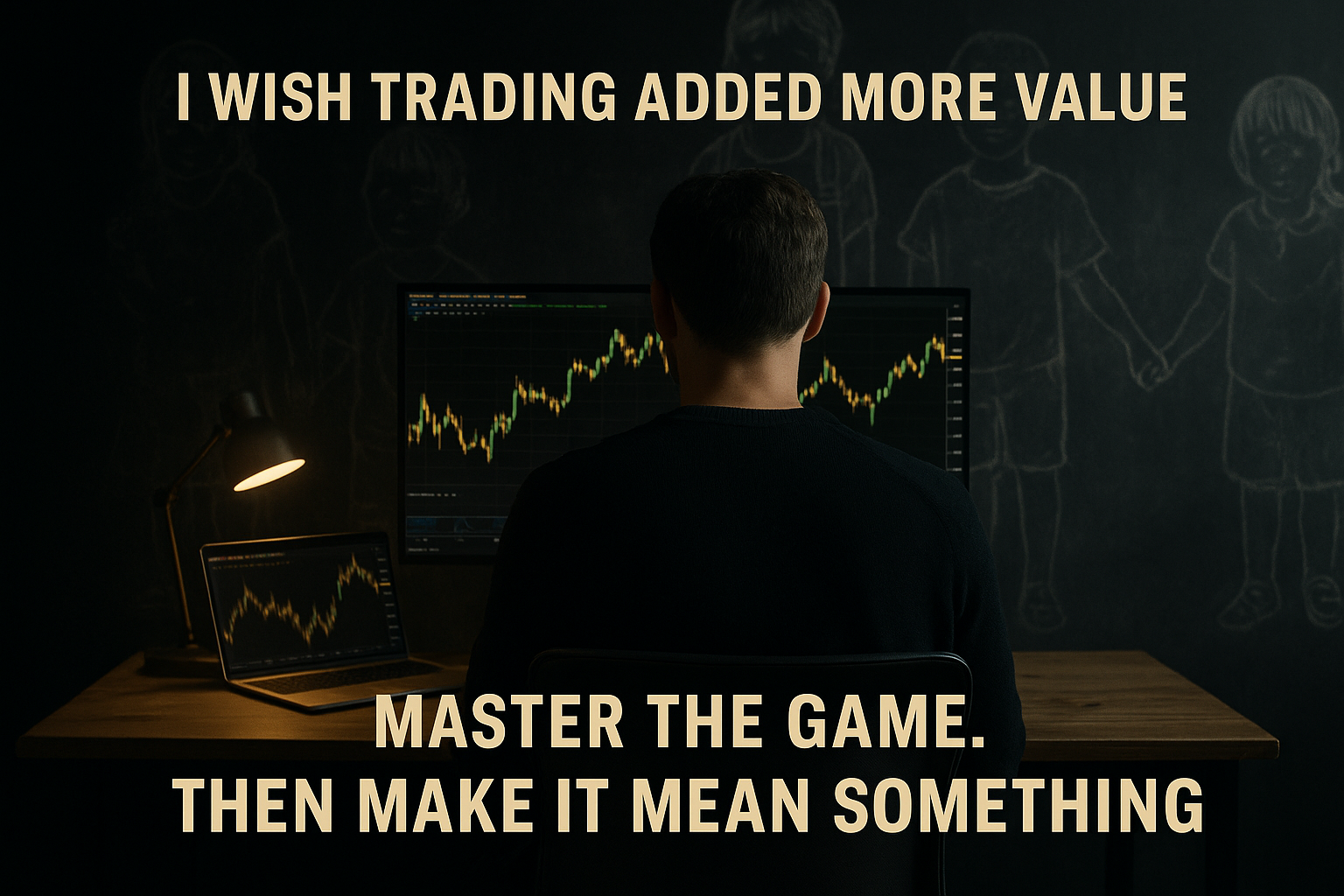
  • I Wish Trading Added More Value

    I Wish Trading Added More Value

    By The Barcelona Trader

    There’s a lot of content out there comparing traders to elite athletes.

    And sure—we train like them. We review tape. We build routines.

    We talk about discipline, precision, mindset, and performance.

    I just wrote a post about it.

    (It was good. You should read it.)

    But if I’m being honest?

    I wish it mattered more.

    Because here’s the truth I don’t see many traders say out loud:

    We don’t fix anything.

    We don’t build anything.

    We don’t make anything better.


    We Exploit a Money Glitch

    What we do is find inefficiencies.

    Tiny moments of imbalance in a system that was designed—poorly, beautifully, and sometimes accidentally—to let us take advantage of price movement for profit.

    It’s a glitch.

    A repeatable, learnable glitch.

    It feels like a game.

    But the money’s real.

    And every dollar we make?

    Someone else loses.

    Usually a beginner.

    Often someone overleveraged.

    Sometimes someone who can’t afford to be wrong.

    We tell ourselves we’re “competing with institutions,” and sometimes that’s true.

    But a lot of the time?

    We’re just better at the game than the people on the other side of our trades.


    The Internal Conflict

    I’m not writing this because I’m ashamed to be a trader. I’m not.

    I’ve worked damn hard to be good at this.

    But I do feel the contradiction.

    There’s a quiet dissonance that comes from knowing that I’ve built a skill that:

    • Creates freedom for me
    • Offers precision, structure, and mastery
    • …but doesn’t really give anything back

    Not like a teacher.

    Not like a doctor.

    Not even like a coder or a builder or a writer.

    We don’t leave anything behind.

    We don’t plant anything that grows.


    So Why Do It?

    Because it’s honest.

    That may sound strange. But there’s something clean—stripped down—about trading.

    • It doesn’t lie to you.
    • It doesn’t pretend to be noble.
    • It rewards clarity, discipline, and execution. Nothing else.

    And maybe, just maybe…

    If we can master this thing that rewards nothing but control and commitment, we can free ourselves up to do something that does matter.

    Trading doesn’t have to be our legacy.

    But it can fund one.


    I don’t pretend trading is saving the world.

    But I do think it can give us the time, the focus, and the freedom to try.

    And maybe that’s enough—for now.

  • What Being a Good Trader Probably Says About You (Spoiler: It’s Not All Pretty)

    What Being a Good Trader Probably Says About You (Spoiler: It’s Not All Pretty)

    If you’re a good trader—or becoming one—there are probably some things it says about your character. Some flattering. Some… less so.

    Let’s start with the good stuff.

    You’ve got grit.

    Most people would rather eat a box of thumbtacks than sit through the psychological beatdown that trading hands out. But you? You stuck around after the first slap in the face. And the second. And the fifth. That means you’ve got a high pain tolerance and probably a dark sense of humor. Which is good, because the market thinks it’s hilarious.

    You’re self-aware—painfully so.

    Trading forces you to look in the mirror. Not a flattering, Instagram-filtered mirror, but one of those magnifying mirrors that shows every pore and mistake in 4K. You’ve faced your emotional impulses, your ego, your dopamine addiction—and you’ve named them. That’s rare. Most people go their whole lives blaming the market, their ex, or gluten.

    You’re patient… with a hair trigger.

    You’ve learned to wait. For your setup. For confirmation. For the trade to come to you. But once it’s there, you strike like a cobra who drinks espresso. That combo—slow hands, fast execution—isn’t natural. You trained it. You bled for it. And now it’s part of you.

    You’ve become a master of emotional containment.

    Outwardly calm, inwardly screaming is a fair description of 80% of your trades. But here you are, clicking exit instead of throwing your monitor through a window. That’s growth. That’s character. Or at least damage harnessed for good.


    But let’s be honest…

    Being a good trader might also mean:

    You trust yourself more than most people—and that can make you hard to live with.
    You’ve learned that only your judgment matters in the trade. That’s great in the market. At home? It can make you slightly unbearable when choosing restaurants, watching sports, or discussing politics.

    You’ve got control issues.
    You don’t just want to win trades. You want to understand every move, every wick, every pullback like it’s a personal message from God. You might say you’re just “data-driven.” Your spouse might say you’re impossible.

    You isolate when things go wrong.
    Because trading doesn’t just test your discipline—it tests your worth. When you mess up, you don’t want a hug. You want silence, charts, and maybe a whiskey. That’s not always the healthiest—but it’s real.

    You’re not a joiner.
    Good traders don’t do well in groupthink. You’ve learned to think alone, decide alone, and win or lose on your own terms. That independence is a superpower. But it can also make you the quiet one at the party who’s checking gold price on their phone while someone explains cryptocurrency “for real this time.”


    So what does being a good trader say about you?

    It says you’re battle-tested.
    It says you’re dangerous when focused.
    It says you’ve wrestled with your worst instincts—and sometimes even won.

    And it says that while you might still be a work in progress,
    you’re the kind of person who doesn’t flinch when the stakes are real.

    Not a bad character sketch. Especially in a world full of people chasing dopamine and blaming the Fed.

    You? You’re just here, clicking clean. One trade at a time.