When you first start trading, you probably imagine yourself mastering price action, calmly executing, and steadily growing your account like a seasoned assassin.
And then reality hits: You spend the first month just figuring out how the hell to arrange your monitors. You install indicators you don’t understand. You hear terms like RSI, VWAP, MACD, Renko, EMAs—and suddenly it feels like you’re trying to fly a 747 in the dark… with the cockpit manual written in a different language.
Welcome to the real beginning.
The truth is, trading is a bit like flying on instruments.
The market isn’t something you can physically see. It’s not a mountain you can climb or a ball you can chase. It’s a data stream. A shifting emotional tide. A multi-billion-dollar organism that’s alive, but invisible.
And your indicators? They’re the cockpit instruments telling you where you are—relative to structure, trend, momentum, liquidity. You’re not seeing the market. You’re reading it. Feeling it through dials, lines, and flashing lights.
And guess what? Learning to trust those instruments takes time.
Because indicators don’t always agree. Sometimes they lag. Sometimes they lead. Sometimes they lie. You have to watch what they say when the market does X, Y, or Z. You have to get a feel for how they behave in motion. That means repetition. Observation. Context.
Yes, your mentor will help.
They’ll give you a starting setup. Maybe introduce you to the indicators that work for them. But over time, you’ll figure out which ones speak to you. Which ones give you confidence. Which ones let you breathe.
And that discovery? That’s not the “advanced stage.” That’s the actual learning curve.
It’s the quiet work that makes the difference between “following a system” and owning your process.
My setup didn’t happen overnight.
I tweaked. I replaced. I threw half of it out and started over. Eventually, I stopped asking, “What indicator is best?” and started asking: “Which one helps me see more clearly—and act more confidently?”
That’s when it clicks. That’s when your station becomes yours. That’s when you stop flying blind—and start flying on feel, with instruments that were built around your brain.
So yeah—don’t rush it. Your mentor’s system is your launchpad. But your real edge? That gets built dial by dial, over time, by you.
Update: I have written a follow-up to this piece here.
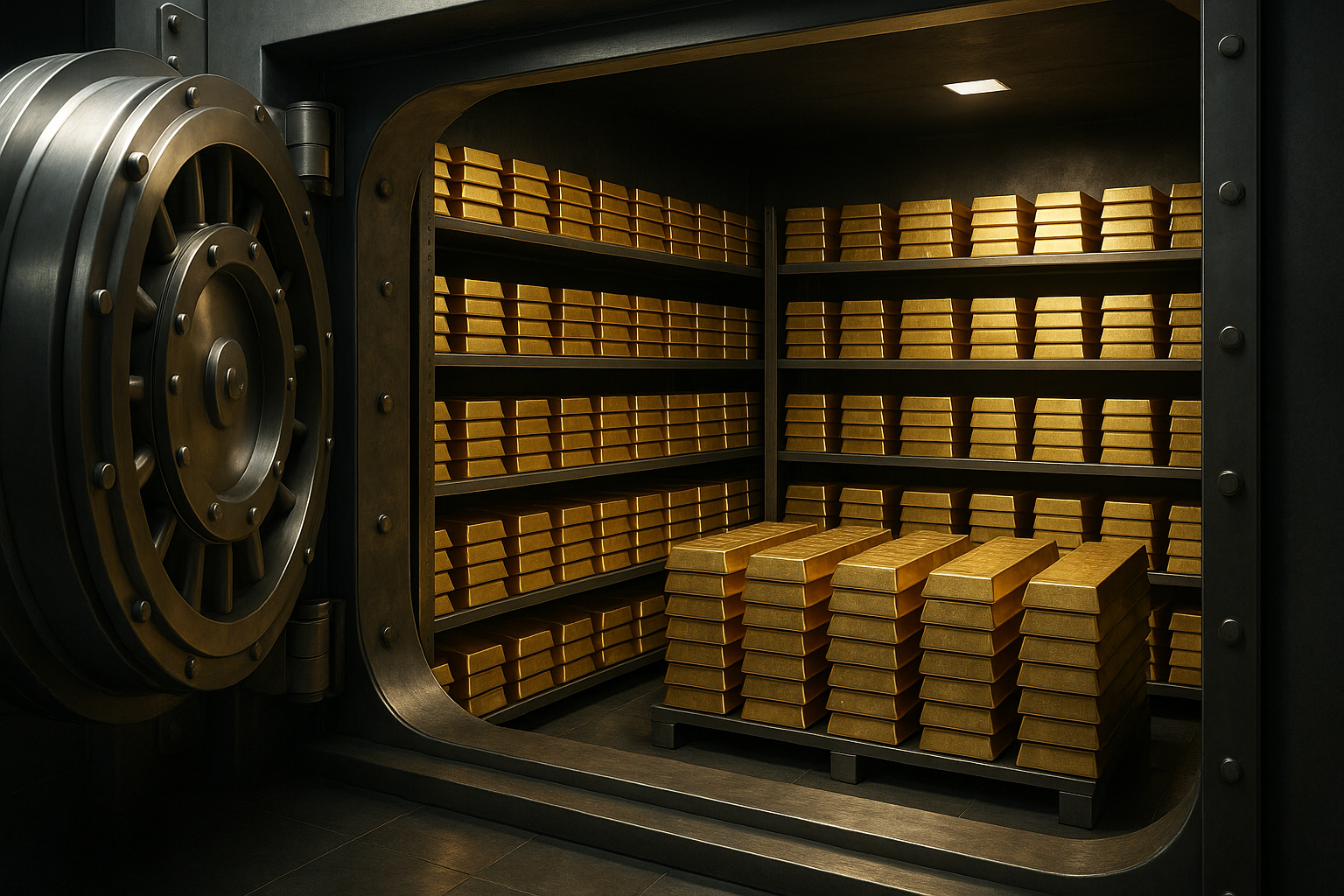
Gold is a funny thing. It has no earnings, no dividends, no quarterly reports. You can’t eat it, and it’s not especially useful for modern industrial processes. But somehow, it still commands the attention of central banks, hedge funds, sovereign wealth managers, and your cousin Dave who owns “a little physical, just in case.”
The reason is simple: gold is trust on a chain. It’s the asset that steps in when fiat feels fragile, when bonds look shaky, or when the geopolitical tea leaves start swirling in unpredictable ways. It doesn’t promise yield — it promises stability. And in a world increasingly short on that, gold gets traded. A lot.
🌍 Global Gold Trading — Bigger Than Most People Realize
Let’s talk scale. Each day, depending on the source and how you count it, roughly $130–$200 billion worth of gold changes hands globally across all markets — futures, spot, ETFs, OTC, and physical. That’s more than the daily volume of the S&P 500.
To break that down:
Hourly, we’re talking $5–8 billion.
Per minute, about $100–150 million.
Per second, you could argue the world blinks and $2 million in gold just moved.
This isn’t just day traders poking at XAUUSD. We’re talking about:
Central banks quietly adjusting their reserves.
Algorithmic traders scalping GC1! contracts.
Physical deliveries being arranged via the LBMA or the Shanghai Gold Exchange.
Bullion dealers hedging forward contracts through COMEX futures.
And yes — retail traders (like us) taking breakout scalps off key pivots at 7:32 a.m. because we think the DXY’s losing steam.
🧠 Why We Trade Gold
We could trade anything — indices, currencies, soybeans if we felt like it. But we trade gold.
Why?
Because gold moves. It gives us real opportunities every single day. Whether it’s reacting to a Fed comment, a war headline, or just bouncing off a key level, gold offers the kind of intraday volatility that scalpers dream about. Not random chaos — but consistent rhythm. It stretches and contracts in ways you can come to know, if you pay attention long enough.
That’s why our team doesn’t try to be masters of everything. We specialize. Because every instrument has its own personality, and developing instinct — real gut feel — only happens when you commit to learning one market inside and out. For us, that’s gold.
Over time, the setups start to scream instead of whisper. The traps get easier to spot. And edge starts to look a lot like intuition.
So no, we don’t trade everything.
We trade the one thing that rewards mastery.
🧭 Who Sets the Price?
Despite all these trading venues, there’s one main benchmark the world references — COMEX futures. That’s where most of the price discovery happens. Spot gold (XAUUSD) follows it. The Shanghai Gold Exchange reflects it. Even over-the-counter billion-dollar private deals are priced off it.
Central banks may not click the “Buy” button on GC1!, but when they rebalance reserves, they’re staring at that same number you and I are.
And so while gold might feel old-school, the ecosystem around it is anything but. It’s global, fast, liquid, and surprisingly modern — with price feeds pinging from New York to London to Shanghai in milliseconds.
So if you’ve ever wondered how gold really moves — who moves it, when, and why — the following table gives you a cheat sheet to the major players and platforms. From spot to futures to physical, here’s how the world trades gold:
There comes a point in every serious trader’s journey where you start whispering to yourself, “Maybe it’s just this one last thing.” One more dial. One more adjustment. One more rule you finally start obeying like it actually matters.
It’s not perfectionism exactly. You’re not trying to be flawless. You’re just… tired. Tired of the ups and downs. Tired of knowing you’re close. Tired of watching your system almost work—if only you could stop screwing it up.
It’s not delusion. It’s hope.
It’s earned hope backed by thousands of hours of screen time and heartbreak.
At this stage, you don’t need a new system. You don’t need another coach. You don’t need to watch another damn YouTube video of a dude in a Bugatti explaining risk management while wearing a tank top and gold chain.
You already know what works.
You just need to do it.
Again. And again. And again.
That’s where I am.
After years of refining my process, blowing up accounts, clawing my way back, writing rulebooks and ignoring them, building trading AI to keep me sane—I finally believe this may actually be it. The last adjustment. The final behavioral shift that lets everything lock in.
And I’m writing this not just to remind myself, but to speak to anyone else standing in this same weird psychological hallway:
You are not asking the wrong question.
There is a point where you don’t need to fix ten things.
Just one.
And it’s the boring one.
It’s the emotional one.
It’s the “Can I do this again tomorrow?” one.
If you’re hoping it’s just one more thing, and you’re showing up with honesty, humility, and self-awareness—you might not be dreaming.
You can read every book ever written on how to ride a bike. You can study the mechanics, watch slow-motion videos, break down the physics of balance and torque… But the first time you actually get on a bike?
You’re going to fall.
Trading is exactly like that.
You think, “I’ve got this. I’ve been watching charts for weeks. I understand support and resistance. I even know what a fair value gap is.”
Then you place a real trade. You watch it turn red. And suddenly— You realize you don’t know anything about balance.
Because just like a bike, trading requires feel. Micro-adjustments. Confidence through wobbles. A relationship with risk that can’t be taught—only lived.
Enter: The Training Wheels
For most of us, that means a mentor. Someone who’s been through the crashes and can help you stay upright long enough to build some muscle memory.
They’ll tell you when to brake, when to pedal, when to coast, and when to get the hell off the sidewalk. They’ll show you what not to do. And if they’re good, they won’t just hand you a strategy—they’ll help you build your own balance.
But even with training wheels, you’re going to tip over. Your stops will get hit. You’ll fumble an entry. You’ll panic, hold too long, exit too early. That’s not failure. That’s learning to ride.
The Most Dangerous Phase?
When the training wheels come off, and you think you’ve got it figured out. You get overconfident. You start taking corners too fast. You forget the market is still the pavement—and it doesn’t care how good you felt yesterday.
You’re still building reflexes. Still calibrating judgment. Still earning the ability to stay upright without thinking about every tiny move.
But eventually—if you stick with it—you stop wobbling. You ride clean. You navigate with confidence. You feel when something’s off. You even start to enjoy the ride.
And that’s when you know:
You’re not trying to learn trading anymore. You’re just… trading.