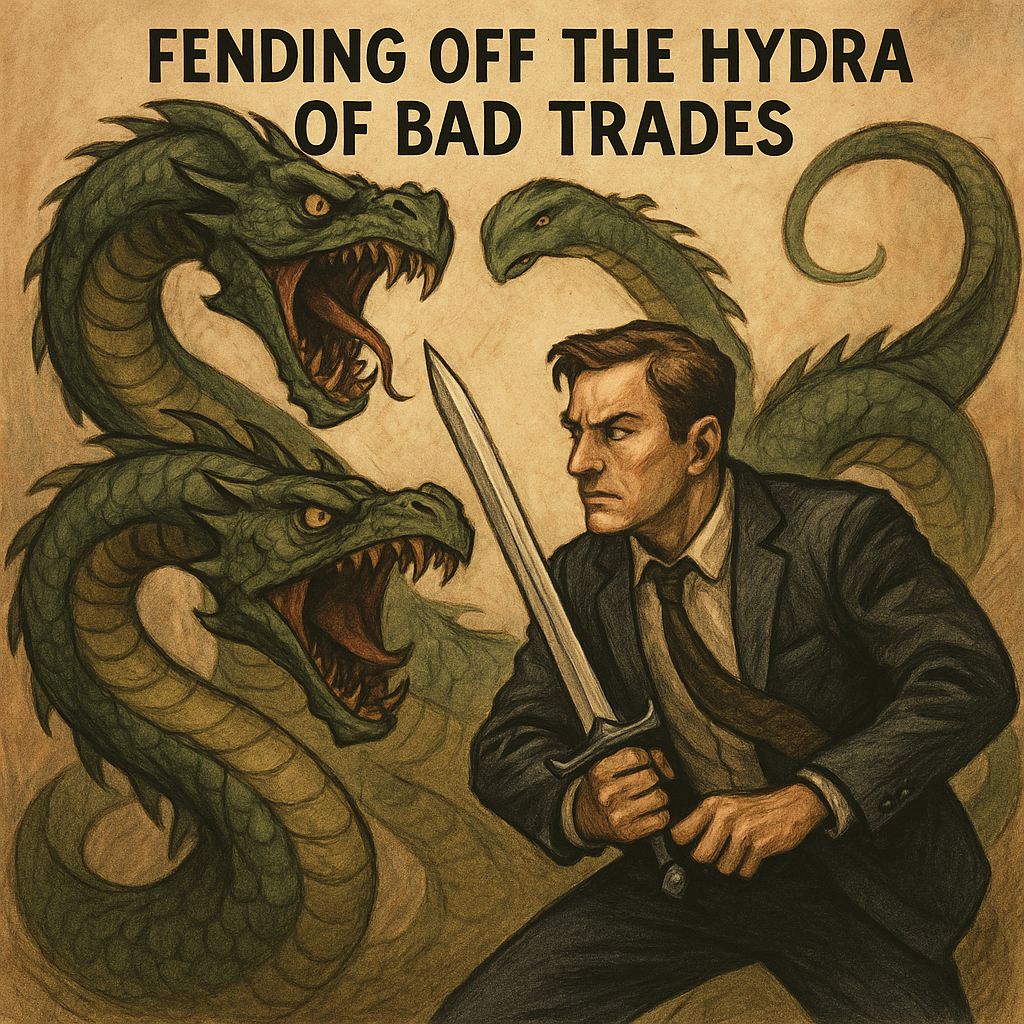
I thought I’d finally beaten my worst trading habit with a perfect $120 stop loss. Instead, my brain used the safety net as an excuse to take worse trades, rack up losses, and go full revenge mode — proving the Hydra wasn’t dead, just plotting.
Yesterday, I wrote about finally out-smarting myself. My biggest trading enemy wasn’t the market, the algos, or even Jerome Powell’s ability to tank gold with a single eyebrow twitch. It was me — specifically, me refusing to take the loss I knew I should take.
I fixed that by wiring an automatic $120 hot stove exit onto every trade. If it hit, I was out. No debate. No “just one more tick.” No “maybe it’ll come back.” And it worked — instantly. My losses were clean, my head was clear, and I felt like I’d finally caged the beast.
Victory, right?
Not so fast. Anyone who’s read their mythology knows the Hydra doesn’t go quietly. Chop off one head, and another grows back — sometimes uglier.
The New Head
Now that my per-trade loss was capped, something shifted in my brain. The fear that used to keep me picky about entries got… lazy. I started taking lower-quality setups. Not garbage, but not my best.
Here’s how it spiraled:
Take a C+ setup.
Lose. No biggie — the loss is capped.
Take another mediocre setup. Lose again.
By the third or fourth loss, I’m annoyed, so I take a bigger swing to “make it back.”
That swing doesn’t work — and now the Hydra’s laughing while I nuke my day.
The problem wasn’t my stop loss. It was what the safety net did to my discipline.
The Kill Shot
Same fix as last time: remove the choice.
$360 max session loss. When I hit it, I’m locked out. Revenge trade impossible.
Hard stop times. 11:00 AM ET for the NY Session, 10:00 PM ET for the Asia Session. The clock says stop, I’m done.
Back to A+, A, and A- setups only. No “just okay” trades because “what’s the harm?” The harm is right there in my P&L.
The $120 HSE protects me from one bad trade. The $360 cap protects me from a bad stretch. The strict setup filter protects me from starting the slide in the first place.
The Next Heads I’m Watching For
Setup dilution creeping back in when the market’s slow.
Cutting winners early after a losing streak, afraid to “let it come back.”
Trading on tilt when outside life distractions bleed into the session.
Bottom Line
An elite trader doesn’t beat the Hydra once — they keep sharpening the blade. Every time a new head appears, it gets chopped and the wound gets sealed.
So yeah, I use crutches. Locks. Kill switches. Call them whatever you want. They work. And the only thing dumber than leaning on a crutch is limping without one.
The Hydra can keep growing heads. I’ll keep swinging.
For a long time now, my biggest enemy in trading hasn’t been the market, the algorithms, or even Jerome Powell’s ability to tank gold with a single eyebrow twitch. It’s been me. More specifically, me refusing to take the loss I knew I should take — the hot stove exit, or HSE.
The HSE is simple in theory: the moment a trade is clearly invalidated, you get out. You touch the hot stove, it burns, you pull your hand back. Except in my case, I’d leave my hand there a few more seconds, just to “see if maybe it stops hurting.”
Why I Didn’t Just Automate It Earlier
If you’re thinking, “Mike, just use a stop loss, problem solved,” you’re both right and wrong. My broker, Tradovate, has a group trading feature that lets me execute one trade and mirror it across all my accounts — but it doesn’t allow bracket orders. That means no automatic stop loss when using that setup. And my trades are too short in duration to manually type one in after entry.
I thought about using a third-party copy trader before, but I talked myself out of it. Too much hassle. Too much potential for lag. Too many stories of things going wrong. And, in true trader fashion, I told myself, “I’ll just fix it with discipline.” (Insert laugh track here.)
Why That Changed
Fast-forward to this week. I finally reached the point where my manual HSE violations were costing me too much — not just in money, but in mental capital. So I set up Tradesyncer, connected it to all my accounts, and now every single trade I take has an automatic $120 stop loss. If it hits, I’m out. No debate. No “just another tick.” No “it’ll come back.”
And the first day I used it? I felt calmer. More focused. More like an operator and less like a gambler negotiating with himself.
A Crutch? Absolutely. And I’m Proud of It.
Yes, it’s a crutch. But here’s the thing about crutches: elite athletes use them all the time. Not the wooden kind from the ER — the mental and technological kind that make their performance bulletproof.
An elite trader doesn’t care whether the edge comes from discipline, experience, technology, or a three-legged goat that predicts FOMC outcomes. The only metric that matters is: does it make you money?
So now I’ve got my crutch, and it’s keeping me from burning my hand on the stove. That’s not weakness — that’s just good risk management.
One of the most misunderstood aspects of trading is the difference between risk management and emotional mastery. They often get lumped together like they’re the same thing.
They’re not.
They’re two entirely separate battles you have to win. Two dragons. And if you don’t know which one you’re fighting, you’ll get eaten.
Dragon #1 — Risk Management
Risk management is simple.
It’s math.
It’s rules.
It’s your mechanical defense system.
You put guardrails in place to prevent catastrophic damage:
Max loss per trade
Max loss per session
Max loss per day
Max drawdown for the account
The point of risk management is not to make you a better trader emotionally — it’s to ensure you survive long enough to become one.
Good risk management keeps you in the game.
Bad risk management gets you carried out on a stretcher.
Dragon #2 — Emotional Mastery
Emotional mastery is different.
This is the dragon inside your skull.
It’s the voice that says:
“I can’t believe I just lost $300. I need to make it back.”
“Maybe if I hold this loser a little longer, it’ll turn.”
“I’m due for a win.”
“I feel too anxious to click this next trade.”
Emotional mastery has nothing to do with your risk limits.
You can have perfect risk management and still sabotage yourself:
Hesitate on entries
Exit winners too early
Hold losers too long
Take revenge trades
Skip A+ setups because you’re rattled
That’s not a risk management failure.
That’s an emotional discipline failure.
Here’s the critical point:
Risk management tells you when to stop trading.
Emotional mastery tells you how to trade cleanly until you get there.
The Trap That Kills Traders
Most traders think:
“If I just tighten my risk management, I’ll stop making mistakes.”
Nope.
All that does is shrink the amount of damage your emotional brain can inflict before you get shut down. That’s better than nothing — but it doesn’t build mastery.
At best, you’re containing your undisciplined self.
At worst, you’re just kicking the emotional problem down the road, hoping smaller position sizes will protect you from yourself.
The Real Goal
The goal is to build emotional mastery so that:
Each trade is independent.
P&L does not control your behavior.
Your exit rules are obeyed whether you’re up or down.
You are psychologically flat regardless of recent wins or losses.
The pros don’t avoid discomfort.
They operate inside it without flinching.
A Test You Can Ask Yourself
After a loss, ask:
“Is my next trade as clean, objective, and disciplined as my first trade would have been?”
If the answer is yes — you’re approaching mastery.
If the answer is no — you still have work to do.
(Hint: we all still have work to do.)
In Closing
You need both dragons slain to be a consistently profitable trader.
Every trader has asked it. Usually in silence. Often in the dark.
“What if I’m doing everything right… and I still fail?”
It’s the kind of thought that doesn’t just whisper—it haunts. And it hits hardest when you’ve finally stopped half-assing it and gone all-in. When you’ve sacrificed time, pride, and a chunk of your identity to this pursuit.
Because if your all isn’t enough—what’s left?
The Fear That Only the Serious Feel
Here’s the thing: This fear doesn’t show up for dabblers.
People who aren’t taking trading seriously don’t ask this question. They’re too busy blaming the market, the broker, the indicator, the moon phase.
But if you’re feeling this? You’re probably dangerously close to being good.
That’s the irony. The self-doubt isn’t a sign you’re failing—it’s often a sign you’re leveling up. You’re noticing nuance. You’re battling the inner critic because you actually care.
That’s not weakness. That’s growth.
The Myth of the Natural
Part of what feeds this fear is the myth that great traders are born with it. That some people just “have it”—and if you don’t, you’re doomed.
That’s crap.
Elite trading is learned. It’s painful. It’s repetitive. It requires more emotional rewiring than most people can stomach.
So if you’re in the thick of that? You’re not broken. You’re becoming.
But What If I Really Do Fail?
Let’s get uncomfortable. Let’s say you give it your all. And after a year—or a few—you still don’t make it.
Then you’ll know. And that alone is worth everything.
Because the worst outcome isn’t failure. It’s not knowing. It’s years spent half-invested, always wondering if you could’ve made it if you’d just committed.
If you go all-in and fail, you walk away with clarity, emotional toughness, and a better version of yourself. If you half-ass it and fail, you walk away with regret.
Here’s the Truth
Your all is already better than you think. Most people never even get to the point where they can recognize their mistakes, let alone articulate them in real time and improve them.
Hopefully, you’re doing that.
Maybe you’re stacking clean sessions. You should be managing emotional state. You shouldn’t be chasing, spiraling, or giving in to the noise.
You’ve probably already passed the “could I do this?” test. Now you’re just in the “how far can I go?” phase.
And if you keep showing up—clean, focused, honest—you’ll find out.
When I first started learning to trade, all I wanted to do was… well, trade.
I didn’t want to read more theory. I didn’t want to wait for the “right market conditions.” I didn’t want to do visualization exercises or light a scented candle to regulate my nervous system.
I just wanted to get in there and throw some punches.
But the kind of trading we do—scalping gold using a mash-up of indicators from multiple platforms—has one tiny inconvenience:
You can’t really backtest it.
Not properly. Not cleanly. Not the way the backtesting bros on YouTube tell you to.
Because some of our indicators are on TradingView… Some are on Meta Trader 4… One’s from EliteAlgo… A couple come from Tono’s vault of secrets… And the whole system is designed to be lived in, not simulated.
There’s no drag-and-drop environment where you can recreate the pace, pressure, and psychodrama of a real session on a real market with real capital.
So that left me with only one option: Learn by trading. Live. In session.
And that’s when the rulebook came out.
“You shouldn’t trade unless market conditions are ideal.” “You shouldn’t trade if you’re tired, emotional, or distracted.” “You shouldn’t trade unless you’re in flow state with a green smoothie and a low resting heart rate.”
Great. So basically, don’t trade.
Because in the early days? I was always a little emotional. The market was never ideal. And my “flow state” was somewhere between caffeinated rage and quiet despair.
But I was determined. Determined to be the one trader who could rise above it all. The one who could power through less-than-perfect conditions.
“Those rules are for weak-minded traders. I will train myself to ignore them. I will transcend.”
Spoiler: I did not transcend.
Turns out, I was just doing what new traders do:
I overestimated my resilience.
I underestimated the market’s indifference.
And I thought “rules” were optional for people with vision.
I wasn’t training to become resilient. I was training to become delusional.
The joke was on me.
Because here’s what I learned the hard way:
If the market conditions aren’t right, your edge isn’t there.
If your emotional state is off, your execution will suffer.
If your ego says “I’ve got this” while your account says otherwise… guess who’s right?
There is no shortcut. There is no version of you that becomes immune to conditions.
There is only the version of you that respects the craft—or blows up trying to shortcut it.
But here’s the good news.
Eventually, I stopped fighting the guardrails. I stopped chasing every chart flicker as a “learning opportunity.” I stopped thinking I was the exception.
And ironically, that’s when I actually started learning.
Not just how to trade… But how to show up like a trader.
Final thought:
If you’re in that phase—desperate to trade, frustrated by rules, convinced that you’re built different…
You’re not broken. You’re just at the beginning.
But take it from someone who tried to brute force his way through the mountain:
The rules aren’t your enemy. They’re the rope that keeps you from falling off the cliff.
You can either learn that by listening… Or by learning the way I did.
Let’s be honest—most people who get into trading won’t make it. Not because they’re dumb. Most are actually pretty sharp. But they’re either impatient, overconfident, allergic to discipline—or some glorious cocktail of all three. So they flame out. They blame the markets. And they go back to their regularly scheduled life.
But a few… a very few… make it.
If you’re one of the lunatics who refuses to quit, here’s what that journey usually looks like. Think of it as your roadmap—or your obituary, depending on how the next few months go.
🟤 Stage 1: The Novice
Mindset: Hopeful. Clueless. Occasionally euphoric. Favorite quote: “I think I’ve figured this out.” Behavior: Trading like you’re in a casino, but with worse odds. Clicking buttons. Chasing trends. Watching YouTube videos with thumbnails that say “$5K in 5 Minutes.” Your job: Don’t blow up your life. Learn what a setup actually looks like. Understand risk. Get humbled. That’s the door you have to walk through.
Milestone to escape: Your first real, gut-punch moment of clarity where you go, “Oh… this is going to take actual work.”
🟡 Stage 2: The Aspiring Trader
Mindset: Obsessed. Bouncing between hope and despair. Favorite quote: “Maybe this new strategy will work.” Behavior: You try 37 different approaches in a week. You change your rules hourly. You blame the market, your broker, or the moon phase when it doesn’t work. Your job: Pick a damn lane. Pick one approach. Learn its nuances. Build skill, not fantasy.
Milestone to escape: You stop hunting for unicorn indicators and start learning to read price like it’s your job. Because it is.
🟠 Stage 3: The System Student
Mindset: Focused. Fragile. Easily spooked. Favorite quote: “I just need more data.” Behavior: You’ve chosen a system. Congrats. Now you hesitate when it shows up. You miss trades. You second-guess exits. You have moments of brilliance—and moments of sheer, uncut panic. Your job: Trade the setups. Log the trades. Watch your own patterns. Start developing emotional muscle memory. That’s where consistency is born.
Milestone to escape: You complete a stretch of clean, rules-following sessions—regardless of profit. You’re showing discipline even when it sucks. That’s big.
🔵 Stage 4: The Disciplined Operator
Mindset: Calm. Still slightly dead inside. Favorite quote: “I don’t care what gold should do. I care what it is doing.” Behavior: You show up. You follow your rules. You protect capital. You take your losses like a grown-up. You journal. You review. You actually learn. Your job: Stack clean sessions. Refine execution. Tighten up your exits. Start to separate your thoughts from your actions. This is where you become dangerous.
Milestone to escape: A solid streak of A-grade sessions with no drama. You’re now a real operator. Most never get here.
🟣 Stage 5: The Funded Professional
Mindset: Strategic. Accountable. Mildly paranoid. Favorite quote: “I protect capital above all.” Behavior: You trade prop firm capital or real size with confidence. You understand your edge. You don’t need to be right. You just need to not be stupid. Your job: Execute under pressure. Avoid overtrading. Don’t blow up when your edge is on break. Withdraw your winnings. Take yourself seriously.
Milestone to escape: You pass challenges and get your first real payout. This isn’t a hobby anymore.
🟢 Stage 6: The Consistent Money-Maker
Mindset: Detached. In control. Zero theatrics. Favorite quote: “I’d rather be flat than forced.” Behavior: You withdraw money monthly. You let the good days ride and survive the boring ones. You don’t need the market to entertain you. You just need it to offer something once. Your job: Maintain rhythm. Don’t get greedy. Don’t get lazy. Just hit singles. The home runs show up on their own.
Milestone to escape: 12 consecutive green weeks. Clean trades. No rule-breaking. You’re now printing.
🟠 Stage 7: The Adaptive Technician
Mindset: Dynamic. Quietly elite. Favorite quote: “The market’s always changing. So am I.” Behavior: You notice subtle shifts in volatility and liquidity. You evolve your tactics without changing your core. You take what’s there—and only what’s there. Your job: Be water. Flow around obstacles. Keep your edge sharp without losing what made it work in the first place.
Milestone to escape: You outperform in tough markets while the herd is complaining. You didn’t adapt—you evolved.
🔴 Stage 8: The Elite Trader
Mindset: Zen warlord. You trade. You don’t talk about it. Favorite quote: “That was a good loss.” Behavior: You size up with precision. You take trades no one else sees. You stop trying to be right and just play your game. You’re scaling multiple accounts, compounding monthly, and—if you feel like it—mentoring the next generation. Your job: Protect peace. Manage growth. Maintain dominance. And for god’s sake, don’t get cocky.
Milestone: Consistent six-figure withdrawals, low drawdown, complete emotional detachment. Your trading is boring. Your results are not.
Optional Final Stage: The Architect You don’t just trade. You build. You teach. You systematize. You leave a mark. You create something that helps others win—without selling your soul or your strategy.
Wherever you are on this journey, the rules are the same:
Don’t overtrade.
Protect capital.
Obey your exits.
Observe your mind.
Don’t quit right before it gets good.
Most won’t make it. But someone will. Might as well be you.
I flip a coin. Every time it lands on heads, I give you $10. Every time it lands on tails, you give me $5.
Wanna play?
You’d be a fool not to. It’s not even close. The longer we play, the more money piles up in your corner.
Of course, you might lose the first flip. Or the second. Or even three in a row. But if you understand the rules of the game—and if you’re not sabotaged by emotion—you won’t flinch. You’ll keep flipping. Because you know how this story ends.
Now here’s the twist:
That’s trading. That’s exactly what trading should feel like—if you’re doing it right.
But what do most people do?
They lose a trade—or two—and suddenly they’re questioning the whole system. Their palms sweat. Their brain starts writing little horror stories about failure and doom. They tighten up. They hesitate. They stop flipping.
Or worse—they panic, double down, and blow themselves up.
All because they don’t understand the nature of the game.
They want every flip to work. They want every trade to win. They want control in a game built on uncertainty.
They can’t handle losses—even small, expected, built-into-the-math losses—because they haven’t trained themselves to see the bigger picture. They’re so focused on the last $5 they had to give back, they miss the $10 that was coming next.
If that’s you—if you’re stuck in that cycle—it’s not your fault. The human brain is wired to hate loss. Loss aversion isn’t a bug in your system. It’s default code.
But here’s the good news: You can reprogram it.
You just have to play the game long enough—with the odds tilted in your favor—to see that the outcome of any one trade doesn’t matter.
What matters is that you take the right kinds of trades. What matters is that your wins are bigger than your losses. What matters is that you keep flipping the damn coin.
And when it lands on tails? Smile. You just paid your edge tax. Now flip again.
The world is changing—and not in a way that’s super friendly to creatives.
You’ve probably felt it already.
The commissions are thinner. The gigs are drier. The royalties? Let’s just say Spotify isn’t exactly making sure your kids eat.
And then there’s AI.
It’s not coming for your job. It’s already sitting in your chair, pretending it wrote that song you spent a month crafting.
Images. Videos. Music. Lyrics. Even entire branding packages—generated in 30 seconds by some kid who doesn’t know what a compressor is.
So Now What?
You can complain. (I’ve done it. Cathartic.) You can double down on passion. (Necessary. But won’t pay rent.)
Or—you can build a new skill that doesn’t replace your creativity, but funds it.
I’m talking about trading.
Wait, What? Creatives? Trading?
Yeah, I get it. It sounds absurd.
But hear me out.
Trading is pattern recognition.
Trading is emotional management.
Trading is flow state under pressure.
Trading is knowing when to improvise—and when to hit the damn note exactly as written.
Sound familiar?
If you’ve ever played a solo in front of a crowd, released music to a silent room, or said yes to a freelance project that paid in “exposure,” then you already have more mental toughness than most retail traders walking in with a hoodie and a dream.
Creatives are uniquely wired for trading. They just need a system.
Why Now? Because It Takes Time.
Here’s the truth they don’t put on the sales page:
Trading is not a side hustle. It’s a second profession.
It takes time. It takes reps. It takes failure, frustration, and coming back anyway.
So if you’re looking at the state of the world and thinking, “I need to create a safety net for my future,” then now is the time to start. Because it’s going to take you a year or two before you’re really cooking.
Start today, and future-you might just thank you by not panicking the next time the algorithm changes.
Who Are We? We’re You—Just a Few Years Ahead
I’m Mike McCready, also known as The Barcelona Trader (ok, I just made up a trading name for myself).
I spent the first half of my life in the music business:
I had hit songs in Catalunya.
Brought Springsteen, Prince, and U2 to town.
Ran companies – Polyhonic HMI, Music Xray.
Achieved international media coverage for my companies and our products and services.
Even had the honor of being turned into a Harvard Business School case study.
And now?
I trade gold. Full-time. Clean sessions, funded accounts, and a whole new stage.
My partner in this madness is Tono Miakoda—another music industry veteran turned elite gold scalper. Tono’s been trading for nearly 20 years, mentoring quietly behind the scenes, and developing one of the most precise gold trading models I’ve ever seen.
The Mission: Creatives Who Trade
We’ve launched a new initiative just for people like us—creatives who are ready to learn the skill that funds freedom.
We’re building:
A free trading education stream on YouTube
A precision-based system specifically suited to disciplined, artistic minds
A paid Zoom Room for serious students who want real-time mentorship
And a custom-built GoldGPT AI coach trained on our exact methods, for when we’re not live
We don’t promise Lambos. We don’t push crypto pumps. We teach real traders how to trade with real rules—using a system that works.
Final Note
If you’ve ever said:
“I just need a second income stream that doesn’t destroy my soul,” or “I want to be self-reliant without giving up who I am,”
then this is your moment.
Because trading won’t replace your art. It will protect it.
And in a world that increasingly values content over craft? That might just be the most creative thing you can do.
Charlie Munger—Warren Buffett’s famously cranky sidekick—used to preach a concept called inversion:
“Tell me where I’m going to die, that way I’ll never go there.”
So, instead of asking how to succeed in trading, let’s explore the more entertaining route: How to absolutely, unequivocally FAIL. Blow it. Flame out. Wreck your accounts, your confidence, and possibly your marriage.
Ready? Let’s begin.
Step 1: Trade When You’re Bored
Forget waiting for real setups. If the chart is open and you’ve got fingers, it’s showtime. Better yet—trade while checking Discord, eating lunch, and watching other traders on YouTube. The market rewards divided attention, right?
Step 2: Hold Your Losers (Because Hope Is a Strategy)
Once it goes against you, double down on optimism. Tell yourself it’s just a “deep pullback.” Talk to it like a plant. Wait long enough and you’ll either be right… or margin called.
Step 3: Ignore Your Hot Stove Exit
You created it for a reason. Now ignore it for no reason. Tell yourself this time is different. Keep burning your hand and wondering why your trading confidence is toast.
Step 4: Start Sharp, Finish Stupid
Nail your first few trades. Then get cocky. Loosen your rules. Scale up. Try something “new” mid-session. Finish the day with regret and a self-pity burrito.
Step 5: Abandon the Setup When It Doesn’t Work
That A+ breakout setup failed? Time to declare it dead. Don’t bother with probabilities or long-run edge. Just chase whatever worked five minutes ago for that guy on YouTube.
Step 6: Attach Your Self-Worth to Your P&L
If you made money, you’re a genius. If you lost money, you’re a fraud. Your entire identity should swing on a 3-minute candle.
Step 7: Don’t Journal Your Bad Sessions
That’s too painful. Just pretend it didn’t happen. Better yet, gaslight your future self by only recording the wins. Future-you will love not knowing what went wrong.
Step 8: Compare Yourself to Other Traders
Especially the ones with Lambos in their thumbnails. They’re definitely showing their real P&L. You’re clearly behind. Panic accordingly.
Step 9: Break the Rules That Just Saved You
The structure worked yesterday, so obviously today it’s optional. Wing it. Trust your gut. You’re due, after all.
Bonus Step: Take It All Very Personally
This isn’t just trading. This is your worth. Your legacy. Your last shot at proving you’re not a complete disappointment. No pressure.
So… Want to Succeed Instead?
Then do the opposite.
Trade when the setup earns it.
Exit when the risk says so.
Let your edge breathe.
Treat process like religion.
Feel the feelings—but don’t trade the feelings.
And journal like your future self is trying to avoid your current mistakes.
Inversion exposes the rot. Now you know what it looks like. Walk the other way.
And if you’re not sure which way that is, we can help. This is exactly what we coach—every day, in real time, with real skin in the game.
Let’s not just survive. Let’s build something that lasts.
If you’re serious about trading gold, you’ve probably heard that liquidity is king. But liquidity doesn’t come in one-size-fits-all—especially when it comes to trading spot gold or futures across different global sessions. Each brings its own flavor, tempo, and tradable quirks. Let’s break it down, session by session.
The Asia Session: The Calm Before the Storm
Think of Asia as the quiet before the chaos—or sometimes, just quiet. Volume is lowest during this session, especially in the early Tokyo hours. But don’t mistake that for irrelevance. This is when institutional positioning quietly begins, and if you’re a scalper, the clean, slower price action can actually be a gift. Less noise, less whip—but also fewer explosive moves.
Spot gold tends to drift during Asia, with occasional spikes triggered by macro headlines or yen volatility. Futures trading thins out a bit here, though it still offers scalping opportunities on Globex. If you’re patient, Asia can be a place to warm up, prep, and catch a stealth setup or two. Just don’t expect the fireworks show to start until later.
The London Session: Where the Game Begins
Now we’re in prime time. London isn’t just a financial hub—it’s the hub for physical gold. The LBMA (London Bullion Market Association) sets the benchmark price, and institutional gold traders often anchor their decisions around this session.
This is where liquidity deepens, volatility kicks up, and breakouts often begin. Spot and futures prices both respond sharply to economic news out of Europe and early positioning for the U.S. open. You’ll often see the highs and lows of the day get established here—especially if the market has been coiling during Asia.
If you trade both spot and futures, this is where you’ll see the rhythm diverge slightly, as the futures contract begins to show its hand with more volume. This is also when you start to feel the effects of the contract roll—that moment every couple months when traders move from the current futures contract (e.g., August delivery) to the next one. The new contract often trades at a premium early on, but as we near expiry, it converges with spot—a behavior that’s part arbitrage, part psychology, and all math.
The New York Session: Fireworks and Futures
The New York open is when things can go full throttle. The U.S. Comex futures market dominates gold volumes during this session, especially from 8:20 a.m. ET onward when the pit officially opens. If London is where the fuse is lit, New York is where it burns fast and hot.
This is when spot and futures prices usually move in tandem—although, as we recently saw after the Israel-Iran conflict broke out, futures sometimes spike harder and faster. That divergence? Often the result of speculative leverage, algos sniffing momentum, and differences in how market participants are positioned.
It’s also worth noting that while both London and New York offer deep liquidity, the nature of that liquidity changes. London is where institutions adjust broader positions. New York is where traders react—to data, news, or each other. If you like volatility, this is your hour.
So Which Session is Best?
The real answer? It depends on you.
If you’re a disciplined scalper who wants fewer distractions and tighter price action: Asia might be your playground.
If you like trend initiation, breakout levels, and range-to-trend transitions: London will give you room to run.
If you thrive on volatility, news reactions, and high-volume momentum: New York is where you’ll make (or lose) your gold.
Just remember: each session passes the baton to the next. And the truly elite traders? They know how to read the tape across the sessions—not just during their favorite one.