Category: Coaching

  • Don’t Be a Me: How I Got Suckered by a Telegram Signals Group

    Don’t Be a Me: How I Got Suckered by a Telegram Signals Group

    Early in my trading journey, I was starving for information. Hungry. Obsessed. I had a mentor, but I didn’t want to become a nuisance with my constant stream of rookie questions. So I did what every ambitious but impatient new trader does: I went looking for answers everywhere.

    YouTube? Check.

    Discord and Telegram? Check.

    Trading “gurus” with live streams and promises of secret sauce? Sadly, check.

    That’s how I ended up in a Telegram signals group.


    The Allure of Easy Trades

    This group was pumping out “signals” all day long. Every ping was like a dopamine hit. “Sell gold slowly,” the message would say. Then came the entry signal. Then, barely minutes later, the exit signal.

    Sometimes the move in my favor was so tiny it didn’t even cover the spread. Yet the provider would declare victory like they’d just nailed the trade of the year. I’d still be sitting in drawdown wondering what I was missing.

    Occasionally, yes, the trades made a little money. But just as often, the group would call it a “win” on a whisper of movement before the reversal took me under. And when the market really went against them? That’s when the stop loss magically got “adjusted” or the trade just got memory-holed. Rarely, and I mean rarely, would they flat-out admit they were wrong.

    Meanwhile, I was bleeding — financially and mentally. I thought I was the idiot. I thought I was the one who couldn’t execute what these “pros” were handing me on a platter.


    The Punchline: They Weren’t Even Traders

    Here’s the part that still makes me shake my head. Eventually, I discovered that the group I’d joined wasn’t even run by real traders. They weren’t analyzing charts, managing risk, or trading live accounts. They were simply copy-pasting signals from another group — which, surprise, turned out to be another scam.

    So not only was I paying for bad signals, I was paying for recycled bad signals. Think about that: I was losing money on knockoff trades from a knockoff provider. That’s like buying a fake Rolex and finding out it’s just a knockoff of another fake Rolex.

    At that point, the lesson became clear: if someone can churn out dozens of “winning” trades a day in a Telegram channel, they’re not traders — they’re marketers. And the only thing they’re trading is your subscription money for their lifestyle.


    The Hard Truth

    It took me longer than I’d like to admit to realize what was going on. The entire point of that signals group wasn’t to help me trade. It was to look successful enough to hook the free-trial crowd into paying full freight. I paid. I traded. I lost. They “won.”

    I wasn’t just taken for the subscription fee. I was taken for every dollar of drawdown those false victories left me holding.

    And here’s the kicker: the most damaging part wasn’t even the money. It was the false belief it planted — the idea that a “real trader” is in a trade all the time. That there’s always a setup. That more trades = more opportunities. That’s poison.


    What I Learned the Hard Way

    Yes, I eventually absorbed useful knowledge from various sources. But in the early days, I didn’t know how to filter it. I didn’t know how to separate good context from bad advice. And I sure as hell didn’t know that a Telegram channel blasting out trades like a firehose was closer to a carnival hustle than a trading plan.

    Trading isn’t about signals. It’s about discipline, structure, and patience. It’s about knowing when not to click as much as when to click. And no $50-a-month signal group is going to hand that to you.


    Don’t Be a Me

    So here’s the warning I wish someone had tattooed on my forehead when I was new:

    If you’re in a Telegram group that declares victory when the market barely sneezes, you’re not learning how to trade. You’re paying tuition to scammers whose business model depends on making you think you’re the problem.

    Don’t be a me. Save your cash. Save your mental health. Find a real mentor, build your own system, and understand that no one is going to sell you a shortcut to mastery.

  • How to Handle the Weekend After a Bad Trading Week

    How to Handle the Weekend After a Bad Trading Week

    There’s a very specific kind of pain that only traders know.

    You’ve had a rough week.

    You’re sitting in drawdown.

    You’re disappointed, angry, frustrated.

    And worst of all?

    The markets are closed.

    You can’t fix it.

    You can’t take action.

    You just sit there.

    Marinating in your own bad decisions.


    The trader’s weekend dilemma:

    When you’re in a losing streak, the weekends feel longer.

    Because unlike most normal people, weekends aren’t rest for traders — they’re emotional purgatory.

    • Your brain obsesses over charts that aren’t moving.
    • You replay trades you should’ve exited earlier.
    • You run fantasy simulations of what would’ve happened “if only.”

    The urge to make the pain stop starts to build.


    Here’s where it gets dangerous:

    The natural instinct is to reach for a dopamine hit to alleviate the discomfort:

    • Binge Netflix.
    • Scroll social media endlessly.
    • Overeat.
    • Numb yourself with alcohol.
    • Start planning “big” trading adjustments.
    • Fantasize about how you’ll make it all back Monday morning.

    Anything to make the emotional sting feel less sharp.


    But here’s the truth nobody wants to hear:

    Every time you seek relief, you train your brain to seek immediate comfort instead of long-term discipline.

    And that’s the exact dynamic that shows up when:

    • You revenge trade to erase losses.
    • You overtrade trying to feel “back in control.”
    • You hold losing trades beyond your stop because “it might come back.”

    Seeking relief becomes your default trading behavior.


    The real work is done in this weekend pain.

    This is your training ground.

    Not the charts.

    Not the trades.

    Right here. Inside this discomfort.

    Because trading success isn’t about feeling great while you trade.

    It’s about executing correctly while you feel like absolute garbage.


    What to do instead:

    1️⃣ Sit in the pain.

    Feel it. Let it wash over you without trying to numb it.

    This is the currency you’re paying for your growth.

    2️⃣ Reflect with brutal honesty.

    • What actually happened this week?
    • What rule did you break?
    • Where did your emotional brain hijack you?

    3️⃣ Journal with purpose, not fantasy.

    • Write down what you’ll do differently.
    • Write out your process for catching yourself next time.
    • Don’t write “how you’ll make it back.” That’s poison.

    4️⃣ Respect Monday.

    Monday is not your redemption day.

    It’s just another session. Another opportunity to execute cleanly.

    If you try to erase last week’s losses emotionally, you’ll just compound them.


    In truth:

    This weekend pain is exactly why most people never make it as traders.

    They’re not willing to sit in the discomfort long enough to retrain their nervous system.

    But if you can build the muscle to act correctly inside discomfort,

    You’re doing the real work most traders will never do.


    Final thought:

    The pain you feel this weekend is the tuition.

    How you process it determines whether you’re building mastery or simply running laps around your same old cycle.

    If you want comfort, there are easier careers.

    If you want mastery, lean into the pain.


  • Gold — NY Open Briefing (Thu, Sept 4, 2025 — 7:00 AM ET)

    Gold — NY Open Briefing (Thu, Sept 4, 2025 — 7:00 AM ET)

    Quick vibe: Gold is coming off a record print and a mild pullback. The dollar is meandering, yields are easing, volume’s elevated, and the calendar is stacked. Translation: there’s fuel — pick your spots or the tape will pick you apart.


    Watch Our Live Streams on YouTube

    Be Part of Our Live Streams in our Zoom Room

    Free Trading Course

    GoldGPT AI Trading Assistant

    Indicators I use

    Why Learning To Trade Is So Hard

    How To Use Pivot Points

    Why We Chart Gold on Spot Even When We Trade Futures

    Risk Management vs Emotional Mastery

    FAQs


    Fundamentals & Sentiment (what actually matters this morning)

    • Fed odds: Markets are heavily priced for a September cut. That keeps a floor under gold unless today’s data go “too hot.”
    • Jobs & services day: ADP (8:15 ET), Jobless Claims + Trade Balance + Productivity/Unit Labor Costs (8:30), S&P Global Services PMI (9:45), ISM Services (10:00). These are your landmines.
    • Oil drift: OPEC+ chatter about further output hikes has leaned oil lower this week. Lower oil → softer inflation impulse → modest headwind for “panic gold,” but supportive for “rate-cut gold.” Net: mixed, headline-dependent.
    • Tape context: Gold tapped an all-time high yesterday and eased on profit-taking. Still a bullish regime, but breakouts must stick—chasing the first spike is how wallets disappear.

    Market Snapshot

    • XAUUSD: 3538.8 (range 3511.75 – 3564.15).
    • GC1!: 3598.8 (range 3573.7 – 3621.6).
    • DXY: Sideways last few hours and on 15-min.
    • UST 10-yr: Falling on both the 2–3h and 15-min look.
    • Volume: High. VIX: 16.26 and falling.
    • FXBlue RCS: USD +0.7, XAU –0.3 (mild headwind unless yields keep sliding).

    Levels That Matter (acceptance or nothing)

    Spot XAUUSD

    • Top of box: 3564.15 — sustained trade above turns continuation longs into a job, not a wish.
    • Bottom of box: 3511.75 — sustained trade below opens the trapdoor.
    • Mid: ~3538 — right where we sit; mid-box is for patience, not heroics.

    GC1! Futures

    • 3621.6 (top) / 3573.7 (bottom) — use as confirmation for spot. If one breaks and the other shrugs, you wait.

    10-second breakout tells

    • 3–5 consecutive closes beyond the edge,
    • 60–120 seconds holding outside the prior range,
    • Pullback respects the level (body closes stay outside),
    • Tick/delta/footprint show follow-through, not a one-and-done lunge.

    If you don’t get those? It’s a fake. Fade back into the box only if USD and yields aren’t screaming against you.


    Scenarios (tie them to the calendar)

    1) Soft labor + soft services

    • ADP < consensus, Claims up, ISM Services sub-51 vibe → yields down, USD drifts → gold gets a continuation-long tailwind.
    • Plan: Wait for acceptance over 3564.15 (or 3621.6 on GC). Buy first clean pullback that holds the line.

    2) Surprise strength

    • Hot ADP/ISM, firmer productivity, claims benign → yields bounce, USD perks → gold tests the downside.
    • Plan: Acceptance below 3511.75/3573.7 = momentum shorts. If the break stuffs and snaps back inside, take the A-grade fade to mid-box—then leave it alone.

    3) Mixed tape / whipsaw day

    • One report hot, next cold → ranges rule.
    • Plan: No-man’s-land discipline. If you must trade, it’s failed breaks only with quick hands.

    Trade Plan (keep it surgical)

    • Continuation Long (A/A- only):
      1. Acceptance above 3564.15.
      2. First pullback holds above; enter.
      3. HSE = 12-tick hard stop (Hot Stove Exit: you yank your hand away instantly—no adds, no “one more tick”).
      4. If the level fails on closes, exit. No speeches.
    • Continuation Short (A/A- only):
      1. Acceptance below 3511.75.
      2. First pullback fails beneath; enter.
      3. Same 12-tick HSE.
      4. If the level’s reclaimed, eject.
    • Failed-Break Fade: Only after a real stick attempt. If price knifes back inside and holds, fade to mid-box with the same 12-tick HSE. One and done.

    Risk & Execution Notes (because future-you will thank you)

    • One contract until the data dust settles. You can always add on confirmed structure; you can’t un-tilt a bad fill.
    • First break after 8:15–10:00 releases is the “noise test.” If it looks manic, wait for the retest.
    • Green early? Permission to be boring. The market will open again tomorrow.

    Session Landmines — ET (set your alarms)

    • 8:15 — ADP Employment (Aug)
    • 8:30 — Initial Jobless Claims; Trade Balance (Jul); Productivity/Unit Labor Costs (Q2 rev.)
    • 9:45 — S&P Global US Services PMI (final, Aug)
    • 10:00 — ISM Services (Aug)
    • 12:00 — EIA Weekly Petroleum Status (holiday timing today)

    Bottom Line

    Gold’s perched mid-box with a calendar loaded for movement. Don’t predict the headline — tax the reaction. Acceptance or pass. Breakouts that hold are your paycheck; everything else is cardio.

  • You Are Not Your Thoughts (Thankfully)

    You Are Not Your Thoughts (Thankfully)

    One of the hardest truths in trading is this: you are not your thoughts. You’re the awareness of them. And if you don’t learn that early enough, your account balance will be the one to teach you. Brutally.

    Because here’s what happens. You take a few losses — maybe you followed your rules, maybe you didn’t — and suddenly the brain pipes up like a bad karaoke singer: “Let’s make it back. Double down. The next one’s the big one.”

    That voice isn’t wisdom. It’s desperation in a trench coat. And if you follow it, you’ll end up in a place every trader knows too well: staring at the screen, muttering to yourself about how unfair it all is, while your broker thanks you for the donation.

    Professional traders know this game isn’t about silencing those thoughts. That’s impossible. The brain loves to chatter. The skill is noticing the thoughts, labeling them (“ah, that’s revenge-trading talking”), and then not acting on them. It’s mindfulness, not mute mode.

    And mindfulness in trading isn’t just a five-minute meditation app exercise. Sometimes it means hours of watching the market do nothing and not inventing a setup that isn’t there. Sometimes it’s days. Sometimes it’s an entire week where your only win is that you didn’t throw good money after bad.

    That’s the real discipline: sitting still while your brain screams at you to move.

    It’s learning that a red day doesn’t mean you’re a failure, and a green day doesn’t mean you’re a genius. You’re just the awareness, steadying the ship while the thoughts thrash around below deck.

    Most people quit trading because they can’t separate the two. The pros? They practice it daily. Not perfectly — no one does — but enough to let the setups come to them instead of chasing ghosts.

    So next time the thoughts come barging in after a loss, remember: they’re not you. They’re just noise. Your job is to observe, breathe, and wait.

    Because the market will still be here tomorrow. Your account, on the other hand, might not survive if you keep letting your thoughts take the wheel.

  • Pivot Points: The Trader’s Map of Mayhem

    Pivot Points: The Trader’s Map of Mayhem

    If you’ve ever sat there staring at your chart thinking, “Where the hell is this thing going?” — welcome to the club. That’s why traders lean on pivot points. They’re not crystal balls. They’re not insider tips from some guy who “knows a guy.” They’re just math.

    But here’s the thing: math works. Pivots give you a framework for where the market might slam on the brakes, do a U-turn, or gun it like a teenager in dad’s Camaro. They’re not guarantees. They’re guideposts. And if you’re trading without them, you’re basically running through a minefield in flip-flops.


    The Mother Pivot

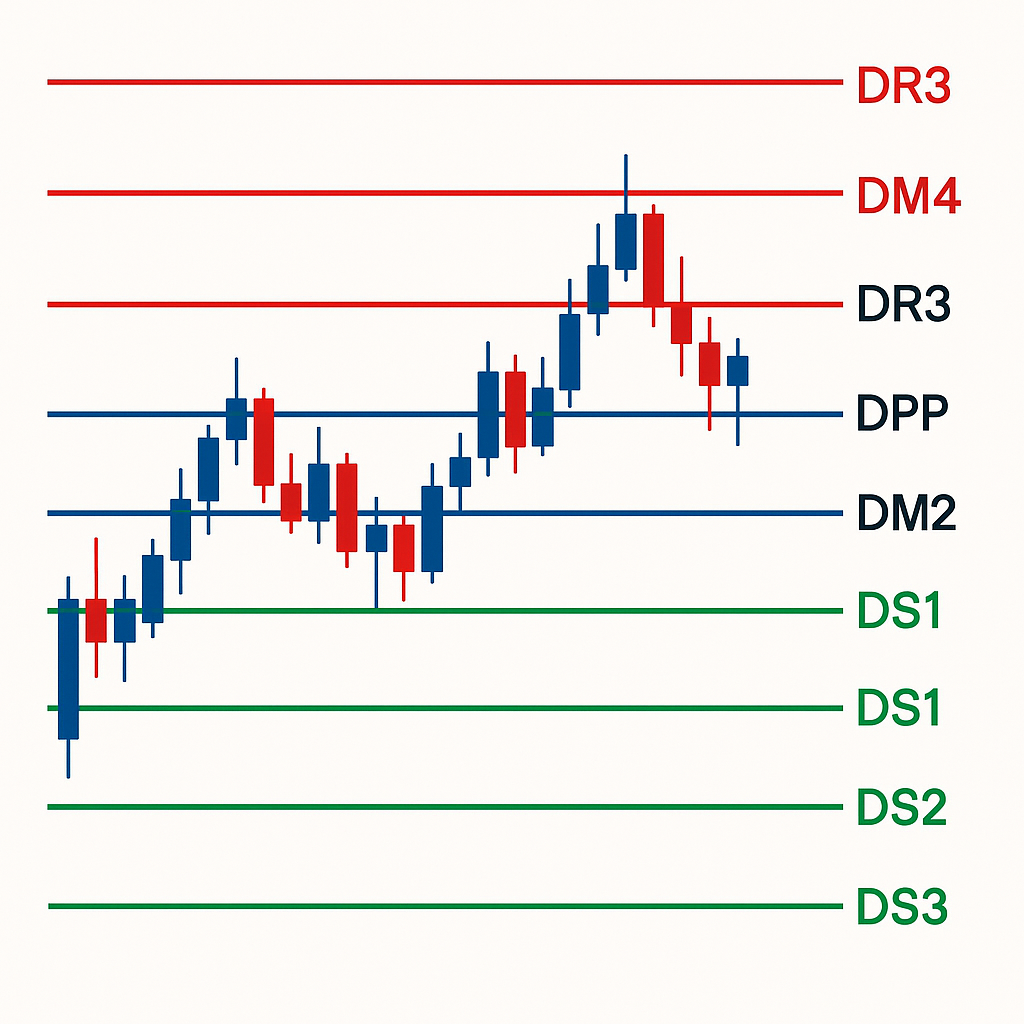
    Everything starts with the Pivot Point (PP) itself. Think of it as the gravitational center of yesterday’s chaos:PP=High+Low+Close3PP=3High+Low+Close​

    That’s it. No secret sauce. Just the average of the high, low, and close. The market’s way of saying, “Here’s the middle ground — now let’s fight about it.”


    The Resistance & Support Gang

    Once you’ve got your pivot, you spin off the levels that traders live and die by:

    • R1 (Resistance 1):

    R1=(2×PP)−LowR1=(2×PP)−Low

    • S1 (Support 1):

    S1=(2×PP)−HighS1=(2×PP)−High

    • R2:

    R2=PP+(High−Low)R2=PP+(High−Low)

    • S2:

    S2=PP−(High−Low)S2=PP−(High−Low)

    • R3:

    R3=High+2×(PP−Low)R3=High+2×(PP−Low)

    • S3:

    S3=Low−2×(High−PP)S3=Low−2×(High−PP)

    Call them “levels,” call them “lines in the sand.” I call them the places you’ll regret ignoring when price slaps you in the face.


    The Midpoints — Because Humans Hate Waiting

    Traders are impatient. That’s why I also plot the midpoints — the halfway houses between the big levels:

    • M1: Between S1 and S2
    • M2: Between S1 and PP
    • M3: Between PP and R1
    • M4: Between R2 and R3

    They don’t get as much hype, but they matter. Markets often pause there, like they’re catching their breath before the next sprint.


    Same Formula, Different Flavor

    Here’s the beauty (or the horror, depending on how you see it): the formulas don’t change. Only the timeframe does.

    • Daily pivots (DPP, DR1, DS1, etc.) → previous day’s OHLC
    • Weekly pivots (WPP, WR1, WS1, etc.) → previous week’s OHLC
    • Monthly pivots (MPP, MR1, MS1, etc.) → previous month’s OHLC

    That’s it. Pivots are universal. Same math, different battlefield.


    Or Skip the Math (Because Life Is Short)

    If you’d rather not do the arithmetic every night like some medieval accountant, I’ve got you covered. I built a simple spreadsheet where you just plug in the open, high, low, and close. It spits out all the pivots for you — daily, weekly, monthly.

    👉 Grab it here and make a copy

    Use it. Abuse it. Just don’t blame me if you ignore the levels and get steamrolled.


    The Bottom Line

    Pivot points won’t make you a genius. They won’t turn your $500 account into a Lambo. But they will give you a reliable map — one that the market respects often enough to keep them on my charts every single session.

    Trading without pivots? That’s like skydiving without checking the parachute. Sure, you might be fine… until you’re not.

    See you in the streams. Bring your helmet.

  • Trading Is Psychological Pain Tolerance. The Gym Bros Are Half Right.

    Trading Is Psychological Pain Tolerance. The Gym Bros Are Half Right.

    There’s a certain flavor of trading guru out there—you’ve seen them.
    Tight T-shirt, protein shake, testosterone-infused motivational posts.
    Discipline starts at 5 AM in the gym, bro. If you can’t do that, you’ll never be a trader.

    And to be fair, they’re not entirely wrong.

    But they’re not entirely right either.


    Trading is a form of psychological athleticism.

    At its core, trading is about doing the correct thing while your brain is screaming at you to do the wrong thing.
    Over.
    And over.
    And over.

    It is pain tolerance, but not physical.
    It’s not about how much you can bench press.
    It’s about how long you can sit inside a trade that’s gone $150 against you and calmly click out exactly where your exit rule tells you to, rather than where your ego wants you to.


    Where the gym analogy works

    When you train physically, you deliberately introduce discomfort to build resilience.
    You force yourself into pain under controlled conditions.

    • You’re sore, but you do the reps.
    • You’re tired, but you finish the workout.
    • You’re tempted to quit, but you don’t.

    That process does strengthen your nervous system.
    It builds tolerance for discomfort.
    It creates evidence that you can act correctly even when uncomfortable.

    That skill absolutely transfers into trading.


    But here’s where the gym bros lose the plot:

    They make it sound like you need to be in peak “Alpha Mode” before every trading session.

    Like if you don’t get 8 hours of sleep, eat salmon and quinoa, meditate for 20 minutes, and hit a personal deadlift record…
    … you’re not “primed” to execute.

    And while yes—healthy routines help—it’s a false expectation that you can or need to be at peak readiness every time you sit at the screens.


    The uncomfortable truth:

    You will trade tired.
    You will trade frustrated.
    You will trade stressed.
    You will trade while your kid is sick, your dog puked on the carpet, and your neighbor’s leaf blower is firing up for the third time that morning.

    And you still have to execute.

    Because the real skill isn’t trading while feeling good.
    It’s trading well while feeling like garbage.


    So does trading become easier?

    Yes — but not because the discomfort goes away.
    It gets easier because you stop fearing the discomfort.

    You stop negotiating with your emotional brain.

    You stop arguing with the voice that says:

    • “This feels bad.”
    • “I want out.”
    • “I can’t take another loss.”

    And instead you calmly say back:

    “Noted.
    But I will still obey my system.”


    Eventually, it becomes muscle memory. Sort of.

    When you start, trading feels like learning a foreign language while someone screams in your ear.
    Every decision feels loaded with pressure.

    But over time, as you consistently act correctly inside discomfort, your brain starts to rewire:

    • The discomfort remains.
    • But your response becomes automatic.
    • You act correctly faster.
    • You spend less time spiraling.

    That’s the true version of “muscle memory” in trading.


    So, should you hit the gym?

    Yes.

    But not because your biceps will make you a better trader.

    You do it because voluntarily enduring discomfort in any domain trains your nervous system for voluntary discomfort everywhere.

    And trading is voluntary discomfort on steroids.


    The real takeaway

    Trading mastery isn’t about achieving perfect emotional neutrality.
    It’s about executing correctly despite imperfect emotions.

    Every rep in the gym, every hard conversation you have in your personal life, every time you face a stressful truth you’d rather avoid —
    —it’s all training for the psychological game you’ll face at the charts.

    Because in the end, trading mastery is nothing more than emotional pain tolerance, skillfully directed.

  • Why Chart Gold on Spot If Futures Drive the Market? Here’s Why.

    Why Chart Gold on Spot If Futures Drive the Market? Here’s Why.

    If you’ve been in the game long enough, you’ve probably noticed something weird:

    Everyone says the big money is trading gold futures—and they’re right.
    But when it’s time to map your pivots, chart your structure, or draw that sweet, sweet trendline, what do most pro traders use?

    Spot gold.

    So what gives?

    Let’s unpack why charting on spot (XAUUSD) is still the move—even if futures (GC1!) are setting the tempo.


    🧭 Spot Is the Anchor

    Spot gold is the market’s baseline consensus price—the global “now” price for an ounce of gold. It trades nearly 24/5, doesn’t expire, doesn’t roll, and doesn’t jump 30 bucks because of a contract change.

    If you’re looking for smooth continuity, spot gives you a chart that behaves like a sane adult. No weird gaps, no surprises at expiration. Just pure price history and structure.

    It’s the equivalent of using a ruler that’s actually straight.


    📉 Futures Drive Flow—But Mirror Spot

    Yes—gold futures dominate volume, especially during the New York session. COMEX is where the whales play. Central banks, hedge funds, algos, the “I moved the market by accident” crowd—they’re doing business in futures.

    But here’s the secret: futures and spot are glued together by arbitrage. If they diverge too far, high-frequency traders pounce. They long one, short the other, and lock in free money until the gap closes.

    Which means your levels on spot still matter, because everyone knows price can’t drift too far from the real-world gold value. And when it does? Smart money just brings it back.


    🧮 Why We Calculate Pivots on Spot

    Pivot formulas—classic, Camarilla, Woodie’s—are almost always built off daily high/low/close values. And on a spot chart, those values are stable, smooth, and globally agreed upon.

    But if you try to run those same calculations on futures during contract roll (when traders shift from one month’s contract to the next), you’ll often get:

    • Confusing price gaps
    • Shrinking or expanding ranges
    • A pivot level that means nothing on the new contract

    Spot gives you clean data. You don’t have to wonder if your S1 is off because COMEX just switched from June to August delivery.


    💡 Real-World Application: What Smart Traders Do

    • Chart on spot. Identify your structure, your supply and demand zones, and your pivots with confidence. It’s cleaner, smoother, and doesn’t play games.
    • Watch futures. That’s where the order flow shows its hand. Especially in the NY session, when GC1! volume spikes, use it to gauge momentum, volatility, and where the institutions are stepping in.

    Think of it like this:

    Futures light the match. Spot shows where the fire will spread.

    And if you understand both? You’re not just playing the game. You’re reading the rulebook while the others are still looking for the board.

  • Why Trading Is More Like Pro Sports Than You Think

    Why Trading Is More Like Pro Sports Than You Think

    By The Barcelona Trader

    Let’s kill the myth right now:

    Trading is not about freedom.
    Not at the top level. Not if you’re serious.

    It’s not about beach laptops, passive income, or sipping margaritas while price hits your TP.

    That’s Instagram.
    Real trading?

    It’s elite performance.
    It’s blood, sweat, and drawdown.
    It’s discipline over dopamine—every damn day.


    Think Trading’s Not a Sport? Ask Your Heart Rate.

    You want to know if trading is athletic?

    Check your pulse the next time you’re:

    • Managing a $1,200 unrealized loss
    • Fighting off revenge trade temptation
    • Or staring at a high-probability setup you just know will fake you out the moment you enter

    The stress is real. The emotional stakes are high.
    And if you think pushing buttons isn’t physical, then you’ve never sweated through a T-shirt while scalping NFP.


    Here’s Why It Maps to Athletics

    1. Routine = Results
      Athletes warm up. Review tape. Sleep well. Eat right.Traders?
      You prep levels. Journal sessions. Reset your mindset. Sleep—or don’t—and see what it costs you.
    2. You Train in Silence. You Perform in Public.
      No one sees the work.
      They just see the outcomes: “You made how much this month?”But they didn’t see the losses you walked away from.
      The setups you passed on.
      The months where you played defense, not offense.
    3. You Fight Yourself More Than You Fight the Market
      Ask any fighter what the real battle is.
      It’s not the opponent—it’s themselves.Same in trading.Your edge doesn’t matter if you can’t execute it.
      And most of us aren’t beaten by the chart—we’re beaten by our own impatience, our ego, or our inner 3rd grader who just wants to press the button because it’s shiny.

    The Habits of an Elite Trader (Read: Athlete)

    • You follow the plan even when it’s boring.
      (Welcome to the gym. You’re doing reps.)
    • You take clean setups only.
      (Would you sprint a 400m at full speed during warm-up? No? Then don’t trade chop.)
    • You recover after losses.
      (Traders rest. They study film. They come back stronger. The amateurs rage-click and blow the account.)
    • You train your psychology like a pro.
      (Visualization. Affirmations. Self-talk. You think athletes are the only ones who do this?)

    What Makes Trading Even Harder Than Sports

    Here’s the kicker:

    In sports, you get immediate feedback.
    In trading? Not so much.

    You can do everything right and still lose money.
    You can break every rule and still walk away green.

    That kind of uncertainty doesn’t exist on the field.
    Only here.

    That’s why traders need even more discipline than most athletes.
    We don’t just manage performance. We manage ambiguity.


    The Point

    If you want to trade at a high level, stop looking at it like a shortcut to freedom.

    Start looking at it like training camp.

    • Show up early.
    • Stick to your routine.
    • Track everything.
    • Rest like it matters.
    • Respect the craft.

    Because trading, like sport, rewards the prepared, punishes the sloppy, and makes legends out of the disciplined.


    Trading isn’t a hustle. It’s a performance.
    And the market doesn’t care if you’re tired. It only cares if you’re ready.


  • Candlesticks: Your Window Into the Market’s Mood Swings

    Candlesticks: Your Window Into the Market’s Mood Swings

    If you’re new to trading, you’ve probably already been told you “just need to learn candlestick patterns.”
    And sure — just like you “just need to go to the gym” to get ripped.
    In reality, candlesticks are less about predicting the future and more about reading the emotional wreckage of the recent past.


    The Anatomy of a Candlestick

    Every candlestick is basically four price points wearing a costume:

    1. Open – Where price started when that candle began.
    2. Close – Where price ended when the candle wrapped up.
    3. High – The highest point price reached during that candle’s life.
    4. Low – The lowest point price reached.

    The body of the candle is the space between the open and close.
    The wicks (also called shadows) are the little sticks poking out the top and bottom, showing where price traveled but didn’t stay.
    Think of the wicks as “emotional outbursts” — moments when the market got dramatic, then quickly changed its mind.

    Green (or white) candles usually mean price went up from open to close.
    Red (or black) means price went down.
    That’s it. No magic — just a price diary.


    Timeframes: Same Story, Different Zoom Level

    Candles can be set to almost any timeframe.
    This changes what each candle represents:

    • 10-second candles: Trading on these is like listening to a gossipy friend live-tweet a breakup. You get every emotional micro-spasm — great for scalping, dangerous for your sanity.
    • 1-minute candles: Still fast, but you start to see small swings take shape. The trading equivalent of speed dating.
    • 5-minute candles: Popular for intraday traders. Big enough to filter noise, small enough to still get multiple entries in a session.
    • 15-minute candles: Now you’re watching the market from a slight distance. Less twitchy, but still tradable. Imagine hearing about the fight after the dust has settled, not during the yelling.

    The smaller the timeframe, the more noise you’ll see — and the more discipline you’ll need not to chase every wiggle.


    Japanese Candlesticks vs. Heiken Ashi

    Both are just ways of drawing price action, but they tell the story differently.

    Japanese Candlesticks (Regular)

    • Each candle reflects the actual open, high, low, and close for that time period.
    • They’re brutally honest — no smoothing, no sugarcoating.
    • Great for traders who want raw data and can handle mood swings.

    Heiken Ashi

    • Uses an average of current and previous candles to smooth out the noise.
    • A Heiken Ashi candle’s “open” and “close” aren’t the real open and close — they’re calculated.
    • Upside: Trends look cleaner, you won’t freak out at every blip.
    • Downside: There’s a delay in showing reversals — kind of like a slow friend who only realizes the party’s over after everyone’s gone home.

    So Which Should You Use?

    • If you’re scalping on a 10-second or 1-minute chart and need every tick of truth? Japanese candlesticks.
    • If you want to stay in trends longer and not get whipsawed to death? Heiken Ashi.
    • If you’re trying to decide which one’s better overall? That’s like asking whether you should use chopsticks or a fork — depends on what’s on your plate.

    Final Word

    Candlesticks aren’t magic spells. They’re just the market’s mood swings painted green and red.
    If you understand how they work across timeframes — and the difference between raw truth (Japanese) and smoothed story (Heiken Ashi) — you’ve already got an edge over the people still treating them like tarot cards.

  • Margin: The Silent Killer (and the Friend You Keep Ignoring)

    Margin: The Silent Killer (and the Friend You Keep Ignoring)

    If you’re serious about trading, you need to understand margin.

    Not vaguely.

    Not “Yeah yeah, I know what margin is.”

    You need to understand it precisely.

    Because margin is one of those things that quietly sits in the background of your trading account…

    … until one day it punches you right in the teeth.


    Let’s start simple: What is margin?

    Margin is collateral.

    It’s the money your broker holds aside while you have an open position.

    Think of it like a security deposit on an apartment.

    You don’t “spend” it — but you can’t use it for anything else while you’re in the trade.

    The bigger your trade size?

    The bigger your margin requirement.


    Margin lets you control large positions with relatively small capital.

    That’s the entire point of leveraged trading.

    Without margin, you’d need hundreds of thousands of dollars to trade even a modest position on gold.

    With margin, you can control huge positions with a much smaller account.

    But here’s the part most new traders don’t fully grasp:

    Margin works both ways.

    It lets you make big trades…

    But it also exposes you to account-crushing losses if you aren’t watching it closely.


    Let’s build a real-world example with XAUUSD.

    Suppose you’re trading XAUUSD (spot gold) with your offshore CFD broker.

    Let’s say they offer you 1:100 leverage (pretty common).

    The current price of gold is $2,400/oz.

    You decide to open a trade for 0.50 lots — that’s a $50 lot size (because on gold, 1 lot = $100 per pip).

    What does that mean in actual notional value?

    0.50 lots = 50 ounces.

    At $2,400 per ounce:

    50 oz × $2,400 = $120,000 notional position size.


    Now, what’s the margin requirement?

    With 1:100 leverage:

    $120,000 ÷ 100 = $1,200 margin required.

    So you need $1,200 of available margin just to open that trade.


    But wait, it doesn’t stop there.

    1️⃣ 

    If price goes higher while you’re in the trade (and you’re short), your margin usage grows indirectly:

    • Your margin requirement stays the same based on position size.
    • But your free margin shrinks as unrealized losses mount.

    2️⃣ 

    If you open multiple trades, each new trade eats up margin:

    • You stack trades, you stack margin requirements.
    • Margin compounds fast if you’re hedging or scaling into positions.

    3️⃣ 

    If your broker changes margin requirements (during news events, weekends, or volatility), you can get hit with sudden margin adjustments.


    Now let’s talk about margin calls — the part that ruins careers.

    A margin call happens when your free margin (your available cushion) gets too low.

    • If your open losses eat up your account balance to the point where you don’t have enough to support the required margin…
    • Your broker steps in and starts automatically closing your trades to protect themselves.

    Yes — the broker protects themselves first.

    You may be thinking, “I’d never let that happen because I manage my drawdown well.”

    But ask anyone who’s blown an account —

    margin calls happen faster than your nervous system can react when you’re emotionally compromised.


    Here’s why you absolutely must monitor margin levels constantly:

    • Because it’s not just price movement that matters.
    • It’s how much capacity you have left to absorb that movement.

    You can be completely “safe” one minute, then two bad candles later you’re in margin call territory — especially with leveraged instruments like gold.


    The higher gold’s price rises, the higher margin costs climb too.

    Let’s say gold moves from $2,400 to $2,500.

    Now that same 0.50 lot trade (50 oz) is controlling:

    50 oz × $2,500 = $125,000 notional position.

    Your new margin requirement at 1:100 leverage:

    $125,000 ÷ 100 = $1,250 margin required.

    Same lot size. Same broker.

    But you need more margin simply because the price moved.

    This is why experienced traders keep track not just of price, but also of notional exposure and how margin demand shifts as prices move.


    Margin isn’t just “some number in the corner of your screen.”

    It’s your breathing room.

    When that breathing room gets tight, so does your ability to:

    • Think clearly
    • Manage trades
    • Avoid desperate revenge trading

    Many traders don’t blow accounts because their trades were wrong —

    they blow accounts because their margin management left them no room to stay alive long enough for trades to resolve.


    The bottom line:

    • Margin is your security deposit on risk.
    • Leverage makes it dangerous fast.
    • Ignoring it is how traders blow accounts even when they think they’re being “disciplined.”

    The traders who survive?

    They keep their eyes glued to margin just as much as to price.

    Your margin level is the lifeboat. Never sail past your lifeboat.