Category: Market Update

  • Gold — NY Open Briefing (Thu, Sept 4, 2025 — 7:00 AM ET)

    Gold — NY Open Briefing (Thu, Sept 4, 2025 — 7:00 AM ET)

    Quick vibe: Gold is coming off a record print and a mild pullback. The dollar is meandering, yields are easing, volume’s elevated, and the calendar is stacked. Translation: there’s fuel — pick your spots or the tape will pick you apart.


    Watch Our Live Streams on YouTube

    Be Part of Our Live Streams in our Zoom Room

    Free Trading Course

    GoldGPT AI Trading Assistant

    Indicators I use

    Why Learning To Trade Is So Hard

    How To Use Pivot Points

    Why We Chart Gold on Spot Even When We Trade Futures

    Risk Management vs Emotional Mastery

    FAQs


    Fundamentals & Sentiment (what actually matters this morning)

    • Fed odds: Markets are heavily priced for a September cut. That keeps a floor under gold unless today’s data go “too hot.”
    • Jobs & services day: ADP (8:15 ET), Jobless Claims + Trade Balance + Productivity/Unit Labor Costs (8:30), S&P Global Services PMI (9:45), ISM Services (10:00). These are your landmines.
    • Oil drift: OPEC+ chatter about further output hikes has leaned oil lower this week. Lower oil → softer inflation impulse → modest headwind for “panic gold,” but supportive for “rate-cut gold.” Net: mixed, headline-dependent.
    • Tape context: Gold tapped an all-time high yesterday and eased on profit-taking. Still a bullish regime, but breakouts must stick—chasing the first spike is how wallets disappear.

    Market Snapshot

    • XAUUSD: 3538.8 (range 3511.75 – 3564.15).
    • GC1!: 3598.8 (range 3573.7 – 3621.6).
    • DXY: Sideways last few hours and on 15-min.
    • UST 10-yr: Falling on both the 2–3h and 15-min look.
    • Volume: High. VIX: 16.26 and falling.
    • FXBlue RCS: USD +0.7, XAU –0.3 (mild headwind unless yields keep sliding).

    Levels That Matter (acceptance or nothing)

    Spot XAUUSD

    • Top of box: 3564.15 — sustained trade above turns continuation longs into a job, not a wish.
    • Bottom of box: 3511.75 — sustained trade below opens the trapdoor.
    • Mid: ~3538 — right where we sit; mid-box is for patience, not heroics.

    GC1! Futures

    • 3621.6 (top) / 3573.7 (bottom) — use as confirmation for spot. If one breaks and the other shrugs, you wait.

    10-second breakout tells

    • 3–5 consecutive closes beyond the edge,
    • 60–120 seconds holding outside the prior range,
    • Pullback respects the level (body closes stay outside),
    • Tick/delta/footprint show follow-through, not a one-and-done lunge.

    If you don’t get those? It’s a fake. Fade back into the box only if USD and yields aren’t screaming against you.


    Scenarios (tie them to the calendar)

    1) Soft labor + soft services

    • ADP < consensus, Claims up, ISM Services sub-51 vibe → yields down, USD drifts → gold gets a continuation-long tailwind.
    • Plan: Wait for acceptance over 3564.15 (or 3621.6 on GC). Buy first clean pullback that holds the line.

    2) Surprise strength

    • Hot ADP/ISM, firmer productivity, claims benign → yields bounce, USD perks → gold tests the downside.
    • Plan: Acceptance below 3511.75/3573.7 = momentum shorts. If the break stuffs and snaps back inside, take the A-grade fade to mid-box—then leave it alone.

    3) Mixed tape / whipsaw day

    • One report hot, next cold → ranges rule.
    • Plan: No-man’s-land discipline. If you must trade, it’s failed breaks only with quick hands.

    Trade Plan (keep it surgical)

    • Continuation Long (A/A- only):
      1. Acceptance above 3564.15.
      2. First pullback holds above; enter.
      3. HSE = 12-tick hard stop (Hot Stove Exit: you yank your hand away instantly—no adds, no “one more tick”).
      4. If the level fails on closes, exit. No speeches.
    • Continuation Short (A/A- only):
      1. Acceptance below 3511.75.
      2. First pullback fails beneath; enter.
      3. Same 12-tick HSE.
      4. If the level’s reclaimed, eject.
    • Failed-Break Fade: Only after a real stick attempt. If price knifes back inside and holds, fade to mid-box with the same 12-tick HSE. One and done.

    Risk & Execution Notes (because future-you will thank you)

    • One contract until the data dust settles. You can always add on confirmed structure; you can’t un-tilt a bad fill.
    • First break after 8:15–10:00 releases is the “noise test.” If it looks manic, wait for the retest.
    • Green early? Permission to be boring. The market will open again tomorrow.

    Session Landmines — ET (set your alarms)

    • 8:15 — ADP Employment (Aug)
    • 8:30 — Initial Jobless Claims; Trade Balance (Jul); Productivity/Unit Labor Costs (Q2 rev.)
    • 9:45 — S&P Global US Services PMI (final, Aug)
    • 10:00 — ISM Services (Aug)
    • 12:00 — EIA Weekly Petroleum Status (holiday timing today)

    Bottom Line

    Gold’s perched mid-box with a calendar loaded for movement. Don’t predict the headline — tax the reaction. Acceptance or pass. Breakouts that hold are your paycheck; everything else is cardio.


  • Will the U.S. Actually Go to War with Venezuela? And What That Would Do to Gold

    Will the U.S. Actually Go to War with Venezuela? And What That Would Do to Gold

    Let’s talk about the elephant in the room — or rather, the seven U.S. Navy warships and 4,500 personnel currently floating in the Caribbean. Officially, they’re there to fight cartels. Unofficially, they’re parked uncomfortably close to Venezuela, and Caracas is not amused.

    So here’s the question: are we actually on the brink of a U.S.–Venezuela war, and more importantly, what does it mean for gold?


    The Setup

    On one side, Washington is flexing hard. Ships, Marines, even a fast-attack submarine — all parked within striking distance. They say it’s about stopping drug smuggling, but everyone knows it doubles as a pressure campaign on Nicolás Maduro’s regime.

    On the other side, Caracas is puffing its chest out. They’re mobilizing militias, yelling about sovereignty, and reminding anyone who’ll listen that most cocaine doesn’t even come from Venezuela. Classic playbook: rally nationalism, make noise, and hope the home crowd eats it up.


    The Odds of War

    Now, is this about to turn into Iraq 2.0? No. The current U.S. presence is way too small for a full invasion. Think gunboat diplomacy with a bit of “don’t test us” energy.

    The most likely scenario is limited action: tighter maritime patrols, maybe a precision strike or two, or a small special forces raid framed as “anti-cartel” rather than “anti-Caracas.” In other words: fireworks, not full-scale war.

    But here’s the thing — even a few fireworks are enough to light up the gold market.


    Gold’s Reaction if Shots Get Fired

    If the first missiles fly, gold’s first instinct is always the same: sprint higher. That’s the headline shock. Traders don’t wait to analyze, they just pile in.

    But sustaining those gains depends on the second-order effects:

    • Does the dollar surge as a safe haven, blunting gold’s rise?
    • Does oil spike, stoking inflation fears and giving gold extra fuel?
    • Do bond yields collapse on a flight to safety, doubling the tailwind for gold?

    Gold’s job is simple: respond to fear. Your job is not to chase the first vertical candle like it’s the last train out of Caracas. Wait for structure. Wait for confirmation. Then clip it clean.


    Why the U.S. and Venezuela Are Even in This Dance

    America’s goals: squeeze Maduro, protect U.S. oil interests in nearby Guyana, and send a message without owning the aftermath.
    Venezuela’s goals: rally nationalism, buy time, and make the cost of U.S. pressure high enough that Washington hesitates.

    Both sides want leverage more than they want war. But in geopolitics, accidents happen. A skirmish at sea, a strike gone wrong, a misstep in disputed oil waters — that’s all it takes to turn a standoff into a gold catalyst.


    What It Means for You as a Trader

    Don’t confuse low probability with low risk. Full war is unlikely, but even a hint of conflict is enough to move gold hard and fast. The pros won’t try to predict the screenplay — they’ll wait, watch, and pounce on the setups the market hands them.

    Your job is the same:

    • Stick to your rules.
    • Don’t trade the headline, trade the structure.
    • Remember: clean sessions beat hot takes.

    Because the only thing worse than being wrong about war is being right about war and still blowing your account.


    Final word: Gold doesn’t care about the politics, it cares about the fear. If Washington decides to play Top Gun: Caracas, the only thing that matters is whether you’re trading like a pro — or torching yourself chasing the noise.

  • Market Update: When LLMs Aren’t the Path to AGI — And Why Nvidia’s Earnings Call Matters to Gold Traders

    Market Update: When LLMs Aren’t the Path to AGI — And Why Nvidia’s Earnings Call Matters to Gold Traders

    Even though we’re gold traders, it pays to keep an eye on the broader market. Gold doesn’t exist in a vacuum. Sentiment, risk appetite, and tech euphoria (or panic) spill into every corner of the financial system. And right now, all eyes are on Nvidia’s earnings call.

    Tomorrow, Nvidia reports. The stock has been the darling of the AI revolution, the poster child for “chips to infinity.” The hype is so thick you could spread it on toast. But with that hype comes a dangerous cocktail: greed on one side, fear on the other. The market’s pricing in a huge move either way. Think ravenous bulls or bloodied bears. No middle ground.

    Fear, Greed, and the Nvidia Narrative

    Wall Street expects Nvidia to post monstrous numbers — revenues that look like they were dreamed up in a fever. If they deliver, greed will roar. The stock could gap higher, dragging tech and risk appetite along for the ride. Traders everywhere will feel braver. Gold may dip as capital rushes back into “risk on.”

    But if Nvidia stumbles? If guidance falters, or if investors sniff that the AI boom isn’t paying the bills yet? Fear takes over. We’re not just talking about one stock missing earnings. We’re talking about an existential wobble in the narrative that’s powered the market for two years: the idea that large language models are marching us toward artificial general intelligence.


    The Jitters: What If LLMs Aren’t AGI?

    Here’s the unspoken fear: what if all this LLM hype doesn’t get us to AGI at all? What if we’ve built bigger and bigger parrots, but not actual intelligence? That thought terrifies investors because if the story cracks, so does the justification for the trillions poured into chips, data centers, and every stock riding Nvidia’s coattails.

    And it’s not a crazy thought. LLMs are brilliant mimics — dazzling at text prediction — but lousy at real reasoning. They’re great at “System 1” style thinking: fast, intuitive, fuzzy. But they stumble on “System 2” reasoning: logic, planning, genuine problem-solving. That’s why some fear the whole AGI narrative is sitting on wobbly stilts.


    If Not LLMs, Then What?

    If LLMs hit a wall, the race for AGI won’t end. It will just pivot. Here are the most credible alternatives:

    1. Neuromorphic & Brain-Inspired Computing
      Chips designed like brains, using spiking neurons and in-memory computing. More efficiency, less brute force.
    2. Hybrid & Symbolic AI
      Marrying neural nets with logic-based reasoning — fast intuition plus deliberate thought. It’s a way to get real structure into the chaos.
    3. Embodied AI
      Intelligence grounded in the physical world. Think robots that actually learn by doing, not just predicting words on a screen.
    4. Whole-Brain Emulation
      Scan and simulate an actual brain neuron by neuron. It sounds like science fiction, but it has serious believers.
    5. Cognitive Architectures
      Building AI with modular systems — memory, planning, reasoning — stitched together in a way that more closely resembles human thought.

    Who’s Out in Front?

    • Intel and DARPA-backed labs are making progress in neuromorphic chips.
    • IBM and academic groups are leading in neuro-symbolic AI.
    • DeepMind and robotics outfits are pushing embodied intelligence.
    • Brain emulation projects are still fringe, but they’re not dead.

    In other words, if the market stops worshipping at the altar of LLMs, there are plenty of other temples waiting.


    Why This Matters for Traders Like Us

    Here’s why we should care as gold traders: the outcome of Nvidia’s call will ripple across everything.

    • If they smash expectations, risk-on explodes, equities pump, and gold might sag as money chases tech.
    • If they falter, doubt spreads like wildfire, risk-off dominates, and gold benefits as capital looks for a safe haven.

    This isn’t just about Nvidia’s revenue. It’s about whether the market still believes the LLM-to-AGI story — or whether fear drives a pivot to other AGI narratives. Either way, tomorrow’s call is a moment of truth.


    Final Thought

    So yes, we’re gold traders. But don’t kid yourself: what happens on that earnings call can shape our tape tomorrow. Nvidia’s numbers aren’t just numbers. They’re a Rorschach test for the greed and fear driving this market.

    And remember — the real joke is on us, believing AGI will come from the next quarterly guidance.


  • When a Truth Social Post Moves Gold $30: What Trump’s Fed Salvo Really Means

    When a Truth Social Post Moves Gold $30: What Trump’s Fed Salvo Really Means

    Well, that escalated quickly.

    Minutes after Donald Trump blasted out a Truth Social broadside about the Federal Reserve, gold ripped higher on our screens—about thirty bucks in twenty minutes. That’s not astrology. That’s policy risk hitting the tape.

    What just happened (the facts)

    • Trump says he’s removing Fed Governor Lisa Cook, posting the letter publicly. It’s an extraordinary move aimed right at the Board of Governors. The Financial Times and Reuters both confirmed the action and the posture behind it. 
    • This follows a month of pressure campaigns—Trump has urged the Fed’s Board to sideline Chair Jerome Powell and “assume control” if he doesn’t cut rates, an open challenge to the central bank’s independence. 
    • Global central bankers (yes, at Jackson Hole) are openly worried about the precedent: politicizing the Fed risks financial stability and credibility. Translation: higher risk premia, more volatility. 

    Can a president actually fire Fed governors?

    Sort of—if there’s legal cause.

    By law, governors serve 14-year terms and may be removed “for cause” (think misconduct or neglect of duty), not just policy disagreements. That’s been the consistent view of mainstream legal analysis for years. Any attempt to stretch “cause” into “I don’t like your dot plot” heads straight to court. 

    Why would Trump want this?

    Let’s drop the euphemisms. Installing loyalists at the Fed can:

    1. Force a faster, deeper rate-cut path (or at least jawbone it), which would juice risk assets in the short run and weaken real yields—classic bullish gold fuel.
    2. Consolidate control of the policy narrative heading into a choppy macro stretch: deficits, tariffs, dollar politics.
    3. Create a chilling effect inside the Fed: even if courts swat removals down, the message lands—vote with the White House or get lawyered up.

    None of that guarantees prosperity. It guarantees uncertainty—and gold loves uncertainty.

    Why gold spiked (and why it might keep a bid)

    • Fed independence risk = risk premium. Markets price in the chance of policy mistakes and credibility damage. That pushes safe-haven demand higher. (Central bankers literally flagged this risk today.) 
    • Lower real yields narrative. If the market believes cuts get pulled forward or are larger than the data would justify, real yields drift down. Gold doesn’t pay a coupon; it thrives when the opportunity cost falls.
    • Institutional optics. Firing a sitting governor—publicly—signals more battles to come (Powell’s term ends next year). The process story alone can keep volatility elevated. 

    The irony file

    While we’re on “governance and credibility,” a reminder: Trump is already a convicted felon in New York for falsifying business records (he received an unconditional discharge in January; the conviction stands). That doesn’t make him wrong about monetary policy, but it does make the “restore integrity” sermon a tough sell. 

    (Separately, a New York appeals court just threw out the half-billion-dollar civil fraud penalty, even as it left core liability findings intact—so expect both sides to wave that around as proof of everything. Markets care less about the spin and more about how the power struggle bleeds into policy.) 

    The opposing view (and why it matters)

    Opposition: The White House can’t lawfully purge the Fed for policy reasons; attempts will be enjoined; the institution will hold.

    Our take: Courts may ultimately check removals—but the process risk (letters, threats, litigation, vacancies) is enough to move markets now. The message to investors is: brace for political volatility embedded in monetary policy. That’s supportive of gold until the governance path is clear.

    How I’m thinking about it as a trader

    • Treat Fed-headlines as catalysts, not trends. Expect gap-y moves, then digestion.
    • Watch real yields and DXY—if either rolls over on the narrative, gold’s dips will be shallow.
    • Respect levels. Policy drama doesn’t repeal technicals; it amplifies them. Confluence > bravado.

    Bottom line: Even if the legal bid trips Trump up, the uncertainty premium is real. As long as the market believes the Fed could get bent out of shape by politics, gold will keep a safety bid—and every spicy post will keep the tinder dry.

  • Market Update: August 8, 2025: When Gold Tariffs Mess with Prices: Spot vs Futures Chaos

    Market Update: August 8, 2025: When Gold Tariffs Mess with Prices: Spot vs Futures Chaos

    Alright traders, buckle up—because gold just got another plot twist.

    In the past 24–48 hours, the U.S. slapped tariffs on one-kilo and 100-ounce gold bars, blindsiding the market where these were previously exempt. Big flashpoint: these bars come largely from Switzerland—the global refining mecca. The result? Futures and spot prices went haywire—practically shouting at each other. Let’s break down what’s happening and how to trade through it.


    The Headlines You Couldn’t Ignore

    • Tariffs land: According to Reuters, U.S. Customs reclassified one-kilo bars under a tariff-able code, triggering Comex futures to surge to a record high of $3,534.10, while spot gold held around $3,386—creating a freakish $100+ gap.
    • Market reactionKitco and Bloomberg report a jittery bullion market—futures racing while spot hangs back, driven by disrupted supply chains and rising uncertainty. This is messy—and exactly the kind of chaos we trade with intent . Although, for me, it’s better to hang back because I like a market with a bit more predictability.

    Why Futures and Spot Prices Diverged Like Two Ships in the Night

    Trading gold is already a game of timing. Tariffs just turned it into a water-skiing rodeo.

    1. Swiss supply disruption: Switzerland refines a massive chunk of one-kilo bars used in COMEX deliveries. The tariffs make that route expensive or legally dicey, throwing futures supply into disarray.
    2. Backwardation madness: Futures popped because traders are betting supply will stay tight. Spot, however, reflects what’s actually trading in London—and that market isn’t reacting as sharply—or as soon—because the gold hasn’t moved yet.
    3. Arbitrage block: This crushes flush-your-wallet opportunities. Where traders once profited from shipping gold from London to New York, the $100+ gap now makes that path untenable.

    What This Means for Traders (That’s You)

    • Take prices one market at a time. Futures are crazy right now. Spot may feel calmer. Your edge? Use both them as signals.
    • Watch futures expirations. If October or December futures prices keep climbing without physical supply backing it, you could get trapped in a squeeze faster than a margin call.
    • Lean on structure, not chaos. Use your existing levels—pivots, trend lines—and observe how spot and futures each respect them differently for clues.
    • Expect volatility. This divergence won’t close neatly. Think bang-bang moves, not smooth transitions.

    Your One-Page Recap:

    FactorSpot BehaviorFutures Behavior
    Swiss Refining TariffHolding, slow to moveRocketing higher
    Arbitrage AbilityBlocked or closedN/A – futures detach
    Opportunity CostNoneHigher risk / reward
    Trading MoveWait for spot structureBe ready to fade futures rip

    Final Thought

    Gold isn’t broken. It’s acting perfectly in a market that’s just been yanked off normal rails.

    Don’t panic. Just trade—knowing that price action isn’t random, just chaotic. And chaos is where we earn edge.

  • Market Update: Aug. 1, 2025: Trump Fired the BLS Commissioner. The Gold Market Noticed.

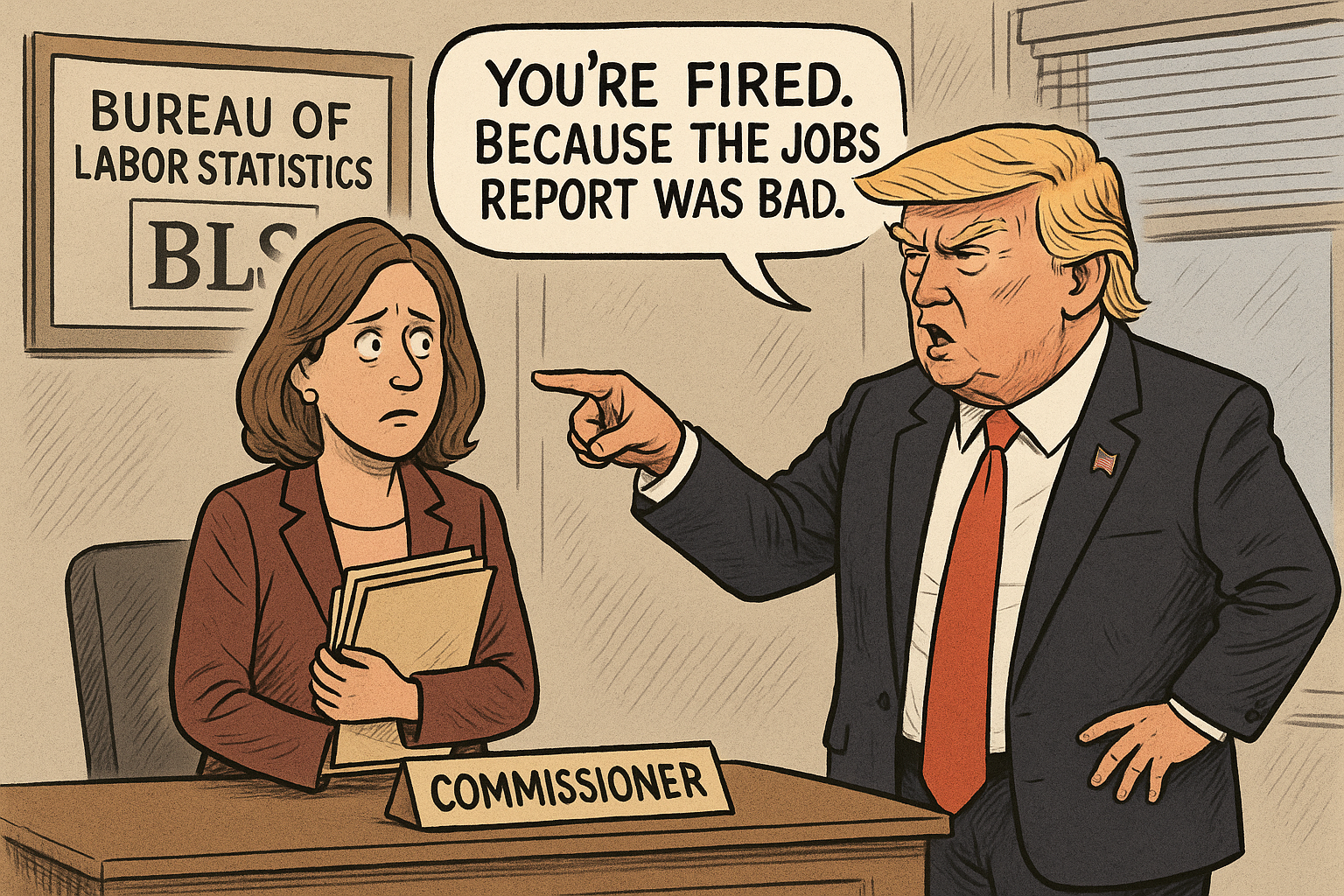
    Market Update: Aug. 1, 2025: Trump Fired the BLS Commissioner. The Gold Market Noticed.

    The Bureau of Labor Statistics has one job: tell the truth about the economy, even when it’s ugly.

    On Friday, it did just that. The July jobs report came in soft—only seventy-three thousand jobs added—and previous months were revised sharply downward. Nothing unusual there. The BLS releases initial estimates and then revises them as more data comes in. This is normal. Boring, even. Just how statistics work.

    But “boring” doesn’t play well in politics.

    Within hours, Donald Trump fired the BLS Commissioner, Erika McEntarfer. Not for breaking rules. Not for falsifying data. But for reporting a jobs number that made him look bad.

    And if you think this is just political drama with no market impact, think again. The gold market is already sniffing out what this kind of behavior signals—and it doesn’t smell like confidence.

    Let’s connect the dots.

    Markets don’t just care about jobs numbers. They care about whether the numbers are real. When you fire the referee because you don’t like the score, investors start asking: what’s next? Will future reports be massaged? Will we stop trusting U.S. data entirely? Will Fed policy decisions be distorted by manipulated inputs?

    This hits gold in two ways:

    1. Institutional Trust = Dollar Stability

    The U.S. dollar is the world’s reserve currency in large part because the world trusts U.S. institutions. If that trust wavers—even a little—gold becomes more attractive as a hedge. You don’t need hyperinflation for gold to rally. A few cracks in the wall of confidence will do just fine.

    2. Policy Uncertainty = Flight to Safety

    If economic reports are politically engineered, markets lose faith in the Fed’s ability to respond accurately. That drives volatility. And when volatility goes up, so does demand for gold. Fast.

    This isn’t hypothetical. The gold market ticked higher after the jobs report—not just because it missed expectations, but because the reaction from the White House was so extreme, it validated gold’s role as an insurance policy against institutional decay.

    And here’s the part no one wants to say out loud: if the numbers suddenly start improving next month, will anyone trust them?

    In the short term, the damage may be muted. But longer term, this kind of political interference puts a question mark next to every U.S. economic release. That’s not good for the bond market. It’s not good for the dollar. But it’s exactly the kind of slow-burning chaos that gold loves.

    So if you’re wondering why gold hasn’t broken down yet despite tightening policy and a cooling labor market—this is part of the answer.

    Trust is hard to build. Easy to destroy. And when it gets shaken? Traders buy insurance.

    And in case you forgot: insurance is spelled G-O-L-D.

  • Market Update: July 17, 2025: What If Trump Fires Powell? Why It Matters for Gold Traders

    Market Update: July 17, 2025: What If Trump Fires Powell? Why It Matters for Gold Traders

    Can the President Even Do That?

    First things first: The short answer is probably no—but that hasn’t stopped Trump from testing the boundaries.

    Under the Federal Reserve Act, the President appoints the Fed Chair—but can only remove them “for cause”, meaning misconduct, inefficiency, or malfeasance. Disagreements over policy (like rate levels) don’t qualify.

    Plus, a recent Supreme Court ruling confirmed that the Fed Chair is protected from removal on political grounds . Some legal voices say it’s still an open question—but any attempt by Trump would almost certainly lead to a landmark court fight .


    Why Trump Wants Someone Else in the Chair

    Trump’s pressure on Powell isn’t random. He’s publicly criticized the Fed for not cutting rates fast enough, arguing that high rates stifle economic growth.

    And now—he’s found a new angle. He’s accusing Powell of overseeing a $2.5 billion Fed building renovation gone wild, potentially justifying a “for cause” removal.

    If Trump could replace Powell with someone who’ll slash rates, it might boost short-term sentiment—but at what cost?


    How Markets Would React (Especially Gold)

    Let’s break it down:

    MarketLikely Reaction
    Stock Markets & DollarInitial shock, a rally in stocks fueled by rate-cut optimism—but sentiment could crater if confidence in Fed independence collapses. Dollar weakness likely as markets angle for looser policy .
    Treasury BondsVolatility spikes. If independence erodes, bond yields might rise regardless of intended rate cuts—due to uncertainty .
    GoldBoom time. Gold shot up ~1.6% immediately after Powell-firing rumors surfaced . If markets begin to fear politicization of Fed, that rally could deepen. But the reverse—Trump standing down—can send gold lower.

    So What Would This Mean for Our Trading?

    1. Volatility spikes.— Emotional trades follow. This is your edge if you can stay calm.
    2. Watch correlation shifts. Dollar down = gold up—except when bonds mess with the mix.
    3. Trade structure, not rumor. Price will move fast after headlines—but obey structure, not hype.
    4. Stay nimble. These headlines could ignite short-lived freak-rallies that reverse fast.

    The Big Picture

    • Trump can’t legally fire Powell—for now. But he’s testing the boundaries, and that alone rattles markets.
    • A successful removal would be cataclysmic for market confidence, and gold would likely rally hard.
    • But even the rumor mill has already moved gold 1–2%—and then reversed on denials.
    • As scalpers, we don’t make macro predictions. We trade the liquidity pulses—this sort of drama can create ideal entry points.

    Final Thought:

    Whatever happens next—to Powell, or the Fed’s structure—just remember:

    Our job isn’t to guess who’s tweeting or suing.
    It’s to read the response: what the market actually does—right now.

    Stay aware. Stay calm. Stay grid-ready.

    Because in the end, political showdowns make the stage… but price action writes the play.

  • Market Update: When Wall Street’s Models Fail—Your Moment to Trade Smarter

    Market Update: When Wall Street’s Models Fail—Your Moment to Trade Smarter

    July 7, 2025 – Let’s talk about the Bloomberg headline today that made retail traders everywhere sit up a little straighter:

    Misfiring Models Leave Wall Street Currency Traders Flying Blind.”

    Translation:
    The big guys have no idea what’s going on. Their models are failing.
    Their predictive edges—built on rate differentials, macro correlations, and years of backtested elegance—have stopped working.

    If you trade gold, FX, or really any market with real-time volatility, this is very good news.
    Because when the quants can’t see straight, the market opens up for traders who can actually feel it.


    This Is Not a Drill: Institutional Edges Are Failing

    The Bloomberg piece reads like a postmortem on macro logic. Traders who once relied on pristine models are now getting chopped to pieces. The reason?

    Because the world changed.

    • Geopolitics are volatile.
    • Central banks are improvising.
    • AI-generated noise is flooding the system.
    • Sentiment swings harder than a Reddit short squeeze.

    And the models?
    They’re still trying to find alpha in a spreadsheet while gold is over here doing interpretive dance on the 10-second chart.


    Why This Matters for Retail Traders

    When Wall Street is flying blind, here’s what happens:

    1. They React Late. You React Fast.
      Their models don’t update mid-candle. Yours do.
      Because you are the model.
    2. They Need Logic. You Trade Structure.
      Institutions hate irrationality. But for the price-action scalper?
      Irrational = juicy.
      Clean breakout. Clear failure. One bar confirmation. We don’t care why—it just has to move.
    3. They Hesitate. You Execute.
      Their internal risk checks, team consensus, and model recalibrations mean they wait.
      You’re a one-person navy seal team with trigger discipline and a mouse.
    4. Their Confidence Is Shaken. Yours Is Building.
      If you’ve been drilling clean sessions, managing exits, respecting your Hot Stove, and journaling like your funding depends on it (because it does), then your edge is sharpening while theirs is glitching.

    The Human Trader Strikes Back

    This is the cycle:

    • First, the machines outperform.
    • Then the market adjusts.
    • Then the machines misfire.
    • Then the humans who survived the first wave start printing.

    The next 12–18 months could be your sweet spot.

    Because while everyone else is either:

    • Just now waking up to trading, or
    • Running back to corporate after getting slapped around, you’re already in the arena.

    So What Now?

    If you’re going to get into this game—or stay in it—you need to:

    1. Train with people who understand this landscape.
      Not YouTube bros showing you how to slap indicators on a chart.
      Not someone promising 10% a month with no heat.
    2. Learn a system that works in chaotic, real-world conditions.
      One that doesn’t require perfect correlation.
      One that works because of the madness, not in spite of it.

    That’s what we’re doing here.
    This isn’t casual trading.
    It’s not a side hustle.

    It’s combat math for degenerates with discipline.
    And right now, while Wall Street’s flying blind…
    you’ve never had a better shot.

  • Gold at $3,400: Mania, Momentum, or Just the End of the World?

    Gold at $3,400: Mania, Momentum, or Just the End of the World?

    Gold’s doing what gold does when the world looks like a powder keg with a matchbook addiction: it’s going up. Not politely. Not steadily. I mean up—like it overheard Jerome Powell whispering “rate cuts” and decided it was 2008 with a vengeance.

    We’re nearly 30% higher on the year. That’s right: Gold has outperformed stocks, bonds, crypto, and probably your therapist’s investment portfolio. Even Bitcoin’s having to take a back seat in the Fear Trade limo. The yellow metal has swagger again—pirate-level swagger.

    So what’s driving this Gold Rush, 2025 edition?

    Spoiler: It’s not euphoria. It’s dread.

    Geopolitical Chaos: Gold’s Favorite Playlist

    At the top of the fear list is the simmering pot of Middle East tensions—Israel and Iran are doing that thing where markets pretend not to panic… and then panic. The worry is that the conflict will spread and disrupt oil supplies. Less oil = higher prices = more inflation anxiety = more central bank constipation.

    The logic is pretty simple: If you think the world might be going to hell, gold is your emergency go-bag. No counterparty risk. No default. No real yield, either—but let’s not get picky when the house might be on fire.

    Have We Hit Peak Panic?

    Some experts think yes.

    Jim Paulsen—ex-Wells Fargo, now a Substack guy with time to think—says gold has basically become the solution to whatever keeps you up at night. Debt, war, inflation, weak leaders, strongmen, climate chaos, TikTok bans—you name it, gold’s your safe word.

    But Paulsen warns: when fear hits a fever pitch, the trade often hits its peak. Consumer confidence, for example, is sitting near post-WWII lows. That’s not bullish for humanity—but ironically, it might mean gold has already priced in the apocalypse.

    And here’s where it gets weird: the VIX is under 20. In English: Wall Street’s fear-o-meter is chilling out. We’re not exactly calm, but we’re not screaming anymore either. Stocks are clawing back toward all-time highs. Labor’s cooling gently, inflation isn’t spiraling, and the Fed’s flirting with rate cuts again like it’s prom season.

    So… is gold about to run out of steam?

    The Dissenters: Gold Isn’t a God

    Enter the skeptics.

    Mona Mahajan at Edward Jones says gold’s been riding momentum and may soon burn out like every other meme-fueled trade that forgot to check the fundamentals.

    Chris Brightman of Research Affiliates doesn’t mince words: “Gold is not a store of value. It’s a speculative asset.”

    Translation: If you think of gold as some quiet, reliable Swiss banker in your portfolio, you’re mistaking it for the wrong metal. Gold is more like a drama queen with trust issues—it might protect you from currency collapse, or it might leave you stranded in a $300 drawdown wondering why you didn’t buy T-bills like a grown-up.

    But Then There’s Yardeni…

    Of course, no gold debate would be complete without a bullish oracle. Ed Yardeni predicts gold will hit $4,000 by New Year’s Eve, and $5,000 by the end of 2026—if, you know, things keep unraveling.

    That’s a big “if” with a lot of fireworks behind it. But hey, if anyone knows how to draw up a doomsday rally chart, it’s Yardeni.

    So What Do We Actually Know?

    • We know gold has momentum.
    • We know fear fuels gold.
    • We know fear is high, but maybe no longer rising.
    • We know oil markets are one bad headline away from a coronary.
    • And we know that if the world keeps wobbling, gold still has room to run.

    But we also know this: gold doesn’t pay rent. And when the fear fades (or just pauses), that shiny yellow rock can drop faster than a TikTok influencer’s crypto coin.

    So what do you do?

    Simple: Diversify. (Yes, it’s boring. Yes, it’s correct.)


    TL;DR

    Gold is up. So is anxiety. Maybe the fear rally has more legs. Maybe it’s cooked. Either way, gold isn’t your religion—it’s just one part of the plan. Stay nimble. Stay hedged. And maybe don’t bet the farm on a rock, no matter how shiny.

  • Gold Just Dethroned the Euro—And Central Banks Are Hoarding It Like It’s the Last Can of Beans in a Fallout Shelter

    Gold Just Dethroned the Euro—And Central Banks Are Hoarding It Like It’s the Last Can of Beans in a Fallout Shelter

    Something strange is happening behind the curtain of global finance. And it’s not a magician pulling rabbits—it’s central banks pulling bullion.

    According to a new report by the European Central Bank, gold has leapfrogged the euro to become the second-most important reserve asset in the world. That’s right—second only to the almighty (and increasingly wobbly) U.S. dollar.

    Gold now makes up 20% of global central bank reserves, while the euro trails behind at 16%. It’s the kind of headline that makes you wonder if Bretton Woods is about to rise from the dead wearing a “Told You So” T-shirt.

    And this isn’t some fluke driven by one country going full pirate and burying treasure under their central bank. We’re talking about a record-shattering accumulation spree: over 1,000 tonnes of gold bought by central banks for the third year in a row. That’s one-fifth of all the gold dug up worldwide in 2024—and twice the average haul from the entire 2010s.

    What’s going on? Well, it turns out when geopolitics start looking like the Season 9 finale of Game of Thrones, central banks stop trusting IOUs and start reaching for things that can’t be frozen, sanctioned, or inflated into confetti.

    Let’s talk numbers.

    • Gold reserves held by central banks are at 36,000 tonnes—just a whisker shy of the 1965 peak during the Bretton Woods era, when the world ran on a gold-backed dollar and haircuts were flatter than interest rates.
    • Buyers leading the charge? India, China, Turkey, and Poland. Yes, Poland is stacking bars like it’s 1938 and the neighbors are getting twitchy again.
    • Gold hit $3,500/oz in 2024, up 30% last year and another 27% since January. Not bad for a rock that does absolutely nothing except not go to zero.

    Why Now?

    The usual objections—gold doesn’t pay interest, costs money to store, and can’t be emailed—are getting drowned out by louder concerns:

    • U.S. debt is ballooning.
    • The dollar is still dominant but increasingly weaponized.
    • If you’re a central bank in a country that might tick off Washington, you don’t want your reserves held in dollars or euros that can be frozen with a single press conference.

    In fact, the ECB found a correlation worth raising an eyebrow over: five of the ten biggest gold-hoarding years since 1999 came from countries that were sanctioned that year or the year before. Coincidence? Nope. This is about sanction-proofing.

    A recent survey of 57 central banks backed it up. The big motivators?

    • Fear of sanctions.
    • Anticipation of a shift in the global monetary order.
    • A growing need to diversify away from the dollar—without jumping into the arms of the euro or renminbi.

    Oh, and remember how gold used to move opposite to real yields? Not anymore. That classic inverse relationship snapped in 2022. Now, gold isn’t trading as a hedge against inflation—it’s trading as a hedge against everything.

    What This Means

    • For traders like me: The gold market’s no longer just about Fed whispers and CPI prints. There’s a geopolitical undercurrent that’s turning this market into a molten blend of macro chess and fear management.
    • For the world: The dollar’s still king, but its crown is tarnishing. Gold is back in the conversation—not as a relic, but as the silent asset that can’t be hacked, sanctioned, or reprinted by a politician with a reelection campaign to fund.

    Final Thought

    The euro just got demoted, gold is flexing like it’s 1965, and central banks are hoarding metal like they know something we don’t. You don’t need to be a conspiracy theorist to see the writing on the vault wall.

    So, next time someone tells you gold is a boomer asset, just smile and tell them: “So are central banks.”