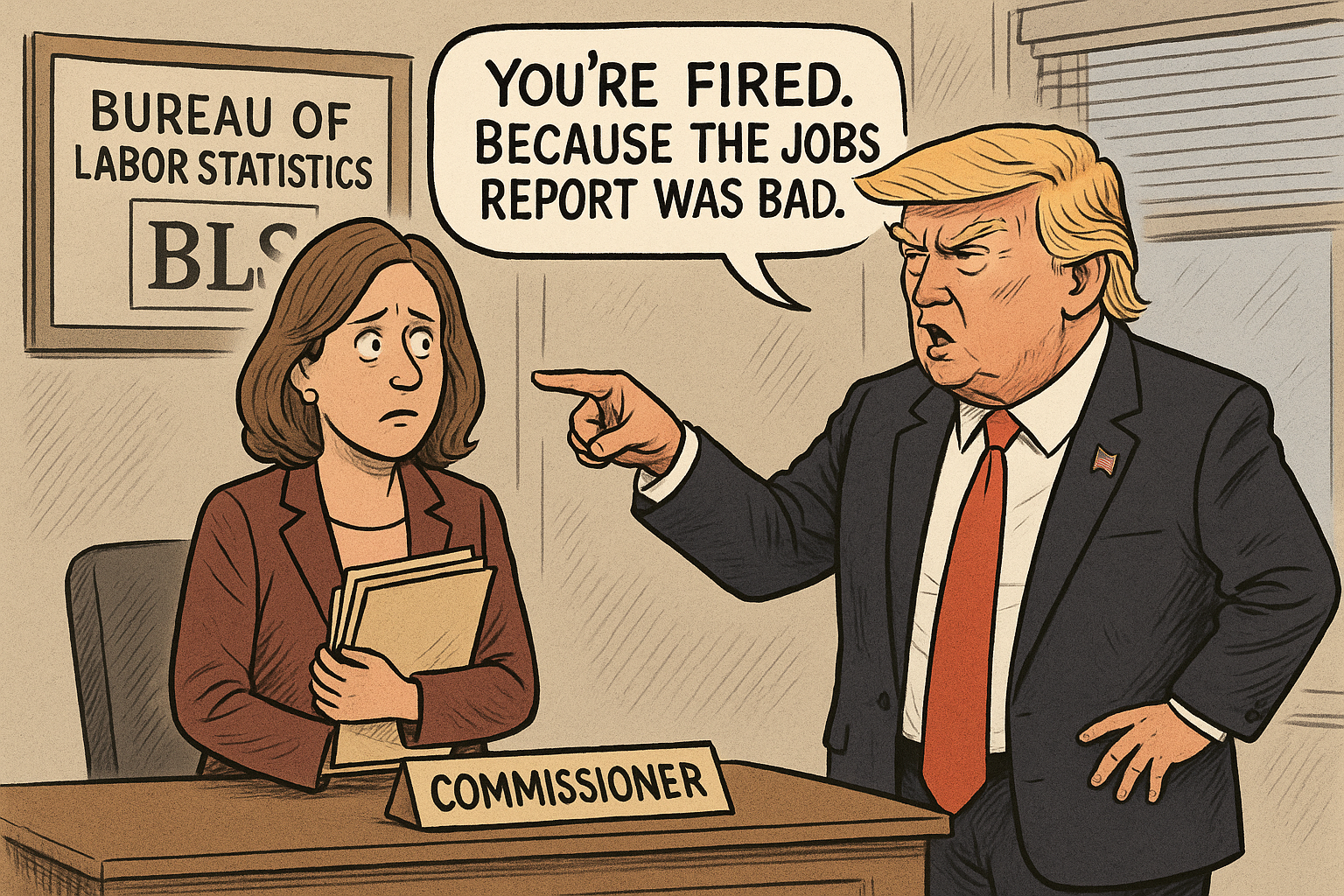
The Bureau of Labor Statistics has one job: tell the truth about the economy, even when it’s ugly.
On Friday, it did just that. The July jobs report came in soft—only seventy-three thousand jobs added—and previous months were revised sharply downward. Nothing unusual there. The BLS releases initial estimates and then revises them as more data comes in. This is normal. Boring, even. Just how statistics work.
But “boring” doesn’t play well in politics.
Within hours, Donald Trump fired the BLS Commissioner, Erika McEntarfer. Not for breaking rules. Not for falsifying data. But for reporting a jobs number that made him look bad.
And if you think this is just political drama with no market impact, think again. The gold market is already sniffing out what this kind of behavior signals—and it doesn’t smell like confidence.
Let’s connect the dots.
Markets don’t just care about jobs numbers. They care about whether the numbers are real. When you fire the referee because you don’t like the score, investors start asking: what’s next? Will future reports be massaged? Will we stop trusting U.S. data entirely? Will Fed policy decisions be distorted by manipulated inputs?
This hits gold in two ways:
1. Institutional Trust = Dollar Stability
The U.S. dollar is the world’s reserve currency in large part because the world trusts U.S. institutions. If that trust wavers—even a little—gold becomes more attractive as a hedge. You don’t need hyperinflation for gold to rally. A few cracks in the wall of confidence will do just fine.
2. Policy Uncertainty = Flight to Safety
If economic reports are politically engineered, markets lose faith in the Fed’s ability to respond accurately. That drives volatility. And when volatility goes up, so does demand for gold. Fast.
This isn’t hypothetical. The gold market ticked higher after the jobs report—not just because it missed expectations, but because the reaction from the White House was so extreme, it validated gold’s role as an insurance policy against institutional decay.
And here’s the part no one wants to say out loud: if the numbers suddenly start improving next month, will anyone trust them?
In the short term, the damage may be muted. But longer term, this kind of political interference puts a question mark next to every U.S. economic release. That’s not good for the bond market. It’s not good for the dollar. But it’s exactly the kind of slow-burning chaos that gold loves.
So if you’re wondering why gold hasn’t broken down yet despite tightening policy and a cooling labor market—this is part of the answer.
Trust is hard to build. Easy to destroy. And when it gets shaken? Traders buy insurance.
And in case you forgot: insurance is spelled G-O-L-D.
Leave a Reply