Category: Strategies

  • Charts & Indicators – Spring/Summer 2026

    Charts & Indicators – Spring/Summer 2026

    Charts and Indicators: Spring 2026 Edition

    Welcome, disciples of the candle. If you’ve found your way here from the livestream, you’re likely tired of staring at a chaotic mess of flickering red and green lights that looks less like a financial instrument and more like a malfunctioning Christmas tree in a dive bar.

    Setting up your TradingView correctly isn’t just a “good idea”—it is a moral imperative. To trade on a default chart is to invite psychological ruin and quite possibly the collapse of the Republic. Here is how I structure my digital sanctuary.


    The Aesthetic: Gold and Blue (The Only Way to Live)

    First, we use Heiken Ashi candles. Why? Because standard Japanese candlesticks are a jagged, anxiety-inducing assault on the human spirit. Heiken Ashi smooths out the noise, allowing us to see the trend with the clarity of a mountain spring.

    As for the colors, I’ve moved past the pedestrian “red vs. green” paradigm.

    • Bullish candles are Gold: Because it’s XAU, and I have a refined sense of irony.
    • Bearish candles are Blue: To represent the deep, chilling ocean of tears shed by those who didn’t follow the trend.

    Temporal Boundaries: The 6PM Line in the Sand

    A chart without vertical lines is a lawless wasteland where time has no meaning and anarchy reigns. I draw vertical lines to separate the days, with each new session commencing at 6PM ET. If your chart doesn’t clearly delineate where Tuesday’s failures end and Wednesday’s hopes begin, you are essentially wandering through a dark forest without a compass or a soul.

    To further categorize our daily suffering, I use Session Markers for Asia, London, and New York. If you aren’t tracking exactly when the London volatility arrives to punch you in the throat, you aren’t really trading; you’re just gambling with extra steps.

    The Sacred Pivots and Sunday Rituals

    To find our bearings in the 2026 markets, I overlay the Monthly, Weekly, and Daily pivot lines. If you don’t know what a pivot is or how to set them up, please tune into the livestream; I cannot be expected to explain the foundational geometry of the universe in a single blog post without suffering a minor stroke.

    I also mark the Sunday Open and the Previous Sunday Open with an Orange Line. This is a non-negotiable ritual. Additionally, I draw orange lines for:

    • Previous Day Point of Control (PDPOC)
    • Previous Day Value Area High (PD VAH)
    • Previous Day Value Area Low (PD VAL)

    I use the Fixed Range Volume Profile tool for these. It is the only way to accurately measure where the “smart money” spent its time before they decided to ruin our collective afternoon.


    The Indicators: The Council of Truth

    Let’s talk TradingView indicators.

    1. EMA 9 Close: Because if you don’t know where the 9-period moving average is, you are essentially trading with a blindfold on in the middle of a freeway.
    2. Support/Resistance with Breaks & Bounces [V1]: A vital tool for identifying where the price will inevitably stall and mock our expectations.
    3. S/R (Standard Support & Resistance): The foundational pillars of reality. Without these, the chart is just a series of meaningless squiggles.
    4. Linear Regression Channel: To give us a mathematical boundary for our delusions of grandeur.
    5. Swing Ranges [ChartPrime]: Crucial for identifying the high and low water marks of our psychological endurance during a trend.
    6. TDFI v2: Because we need a trend direction force index that actually understands the gravity of our situation.
    7. CVD 1D & Volume Delta: This allows me to see the Cumulative Volume Delta—essentially the raw, unbridled aggression of buyers versus sellers. If you aren’t watching the Delta, you are ignoring the heartbeat of the market.

    The Command Center: Multiple Screens of Destiny

    I don’t just watch one chart; I oversee an empire. My workspace is a precision-engineered grid of XAU (Gold) charts: 1h, 15m, 5m, 1m, 10sec, and Renko. I also keep the MGC 10-second chart open, because most of the time, even though we do our charting on spot gold, we’re trading futures. In a sense, that’s my main focus whenever I’m in the middle of a trade.

    To maintain my sanity, I keep the 1m DXY (US Dollar Index) chart in front of me at all times—one must always keep an eye on the enemy. Finally, I have the FXBlue Relative Currency Strength indicator active, filtered exclusively to show the XAU/USD relationship. It is the only relationship in my life that I can accurately quantify using a percentage-based oscillating histogram.

    Set your charts up this way, or continue to live in a state of primitive, unoptimized darkness. The choice is yours.

    The Command Center: Big Boy Work on a MacBook Pro

    Now, let’s talk hardware. If you’ve seen the screenshots of my setup, you might assume I’m running this operation from a server room in a high-frequency trading firm or perhaps a repurposed NASA control center. In reality, the heart of this beast is a 14-inch 2021 MacBook Pro.

    Yes, you read that correctly. While others use their MacBooks to write coffee-shop screenplays or scroll through TikTok, mine is currently performing what I like to call “Big Boy Work.” We are talking about a machine with an M1 Max chip and 64GB of RAM that is being pushed to the absolute edge of its digital existence.

    The Screen Galaxy: 8 Screens of Absolute Overkill

    To trade XAU with the precision I demand, I have surrounded myself with a literal wall of glass. My station consists of:

    • The MacBook Pro Built-in Display: The brain of the operation.
    • Three 27-inch Apple Thunderbolt Displays: For that vintage “I’ve been doing this since the music tech days” aesthetic.
    • One 43-inch Samsung 4K TV: Because sometimes you need to see a 10-second candle the size of a baguette.
    • Two PC Screens: Running MT4 and a “slew” of charts dedicated specifically to support and resistance zones.
    • The iPad: My digital journal for real-time notes. If it isn’t written down, the trade didn’t happen.
    • There is a TV on the wall in front of my station. It is usually just playing the YouTube livestream of the broadcast so I can make sure it’s working.

    This brings the total to seven main screens plus an iPad. Two of the Thunderbolts serve as the “Command Center” for my longer time frames, while the three screens to my left are my “Execution Zone.” The main execution screen is the one you see on the livestreams—the one where the magic (or the occasional heartbreak) happens.

    The Digital Load: A Constitutional Crisis for CPUs

    It’s not just the screens; it’s the sheer weight of the data. At any given moment, this MacBook is simultaneously:

    • Running TradingView (obviously).
    • Managing 20+ Chrome tabs containing brokers, prop firms, and trade copiers.
    • Consulting with Gemini and ChatGPT (my AI brain trust).
    • Organizing my life in Evernote.
    • Streaming music from Spotify.
    • Hosting a Zoom Room.
    • Encoding a high-definition stream to YouTube via OBS.

    Most computers would have burst into flames and filed a grievance with the labor board by now. Mine just keeps humming along, processing the gold markets while I try to maintain my composure.

    A trading setup featuring multiple high-resolution monitors displaying financial charts and data, set in a dimly lit room with a laptop and desk accessories.

    A Note for the Sane

    Here is the truth: You do not need this much firepower to trade effectively. If you are starting out, two screens are perfectly fine. You can reach profitability without looking like you’re trying to hack into the mainframe in a 90s action movie.

    I have this setup because I am a deeply specialized individual who finds comfort in “tricking out” my station to soothe the existential dread that comes with scalping gold. It’s a hobby, an obsession, and a cry for help, all wrapped into one glorious 4K resolution.

    Get two screens. You’ll be fine. I’ll be here, surrounded by monitors, trying to remember what sunlight looks like.

    See you on the stream.

  • The Barcelona Playbook – Gold Scalping, One Landmark at a Time

    The Barcelona Playbook – Gold Scalping, One Landmark at a Time

    In trading, most people name their setups after animals, numbers, or Greek letters.

    But that’s not how we do it in Barcelona.

    Here, we name our plays after our city’s landmarks—each one an iconic, personality-packed representation of the type of market behavior we’re trading.

    These setups were developed by Tono Miakoda, a master of the XAUUSD battlefield. I’ve merely had the honor of naming and articulating them. What follows is our working playbook—from least risky to most risky—each defined by entry conditions, exit strategy, and now: the early invalidation signal.

    Because if you’re waiting for the Hot Stove Exit to tell you a trade is broken, you’re already late.

    These plays work. I know, because they’ve helped me dig out of drawdowns, recover from mistakes, and start stacking serious green days. They’re the setups I use every day when scalping gold on the 10-second chart—both Spot (XAUUSD) and Futures (GC1!).

    But for clarity, this guide is written specifically for Gold Futures.

    That means:

    • No hedging. None. Not even a little. The brokers don’t allow it. Thank Dodd Frank (look it up).
    • We rely on invalidation signals and, when all else fails, the Hot Stove Exit (HSE)—a hard stop rule when the trade goes $125 against me on a one contract size trade.

    If this were a Spot playbook, we’d talk about hedge distances, ideal recovery zones, and how to manage multiple positions. But futures demand precision and finality. And that’s what this guide delivers.

    So now—let’s hit the streets.


    🟢 1. Montjuïc – The Fade at the Fortress

    Concept: Price taps a resistance level and retreats. It couldn’t get through, so we fade it—sell at resistance or buy at support—expecting rejection.

    Think: Montjuïc is that fortress on the hill. Price runs up and get smacked down. Not today, senyor! Of course this can happen in the downward direction too and we’d call it a Reverse Montjuïc.

    • A+: Price taps the level and immediately rejects with a wick and strength reversal.
    • A: Rejection is slower, but it’s happening.
    • A-: Price lingers indecisively. You’re still fading it, but it’s less clear.

    Invalidation: Price closes above/below the level with momentum and volume. It’s no longer a rejection—it’s a breakout.

    Risk Level: 🟢 Low — You’re betting on hesitation, not momentum. Clean and reactive.


    🟢 2. Aragó – The Clean Continuation

    Concept: Price breaks through a minor support/resistance level and flows. Nothing in the way.

    Think: You stop at a traffic light on Carrer Aragó. The light turns green and it you might not have to stop again till you reach Parc Miró. Green lights all the way!

    • A+: Clean break. Renko confirms. 10s candle confirms. No nearby hazards. Relative strength agrees.
    • A: Mostly clean, but there’s a swing high or pivot a few pips ahead.
    • A-: Break is sloppy or early. Momentum exists but entry timing is tight.

    Invalidation: Price returns to the old range and starts to base. Continuation is canceled.

    Risk Level: 🟢 Low — Your bread-and-butter trade. Just don’t run that first light.


    🟡 3. Barceloneta – The Pullback Push

    Concept: Price pulls back during a trend, finds support, and continues.

    Think: A surfer rides a wave into shore (or maybe missed it). The wave pulls out, gathers steam and the surfer rides it again right back to the beach – maybe even beyond the beach right into a nice little café. This play is that second wave, independent of whether or not you caught the first one; which may have been an Aragó or a Montjuïc .

    • A+: Pullback stops exactly at a known support level. Strength resumes. Reversal candle confirms.
    • A: Bounces slightly lower or slower. Still trend-valid.
    • A-: Pullback is vague or lands in no-man’s-land.

    Invalidation: Price breaks the support zone and doesn’t reclaim it quickly. The trend is no longer intact.

    Risk Level: 🟡 Medium — Great R:R, but entry precision is everything.


    🟠 4. Diagonal (pronounced dee-agg-oh-NAHL)– The Dangerous Breakout

    Concept: Price breaks a major support/resistance level. Big move expected—but only if it really breaks. This is just like the Aragó play but instead of breaking a minor level, price breaks a major level.

    Think: Barrelling down Diagonal Avenue trying to take the roundabout at Plaça Francesc Macià at full speed on a moto, never mind the cars and busses… and La Guardia Urbana (aka cops). If you make it, you feel like a genius. If not, call an ambulància.

    • A+: Momentum builds under the level. Clean break. Strength confirms. No resistance ahead.
    • A: Still a break, but there’s hesitation and volume dip.
    • A-: You’re late. Price has already moved and might fake out.

    Invalidation: Price fails to close beyond the major level or snaps back after a wick-through. Danger zone.

    Risk Level: 🟠 Elevated — It’s a big level, so there’s big risk if it fakes.


    🔴 5. Tibidabo – The Failed Breakout Reversal

    Concept: Price breaks a major level, but fails and reverses. You’re fading the fakeout.

    Think: It races up the mountain like it’s going to conquer the world. It rushes through the gates and then suddenly realizes no one is following. It takes a quick selfie and then runs back out the same door it smashed through without even saying adeu-siau! (Bye y’all!)

    • A+: Big breakout candle. Reversal candle follows immediately. Volume shift and strength flip.
    • A: Reversal takes two candles. Still confirms.
    • A-: You’re guessing the fake before confirmation. Dicey.

    Invalidation: Price starts to base at the new level instead of rejecting it. You’re no longer fading momentum—you’re holding against it.

    Risk Level: 🔴 High — You’re betting against breakout momentum. Never increase position size. Best not to try during news events or times of increasing volume.


    🚫 6. Raval – The No-Trade Filter

    Risk Level: Only if you’re foolish enough to click

    Named after: El Raval neighborhood—chaotic, beautiful, but not somewhere you want to stop and do legitimate business.

    What it is: A filter, not a play.

    How it works: When the market is choppy, overlapping candles, no clear structure. Recognize it. Step away.

    Mantra: If it feels like a trap, it probably is.
    When in doubt, shout: “Raval!” and walk away.


    🎁 Bonus Play: La Sagrada Família – The Eternal Trade

    Concept: Any of the above plays can devolve into this one. You’re not winning. You’re not losing. You’re just… waiting.

    Think: You entered a trade. Then the trade entered you. That’s right, you got screwed! Three years later, you’re still in it, and Gaudí’s ghost is watching over your PnL.

    • A+: Doesn’t exist.
    • A: Doesn’t matter.
    • A-: They’re all A- once they turn into a Sagrada Familia.

    Invalidation: If your trade has moved less than 5 ticks in 8 minutes and hasn’t hit target, you’re in purgatory. Exit before it takes your soul.

    Risk Level: 🟪 Existential — This is where joy goes to die. Cut it loose before it becomes a Hot Stove Exit.


    Final Word

    Every one of these plays is tradable on Spot or Futures. But the risk management tools differ. In Spot, we have hedging. In Futures, we don’t.

    That means your survival depends on:

    1. Clean execution
    2. Setup discrimination
    3. Graceful exits

    Tono gave me the structure. Barcelona gave me the flavor. I’m just trying to trade clean, one Aragó at a time.

    Trade like you’ve got rent to pay and a Catalan sunset to catch.

    —The Barcelona Trader

    (Recovering from yesterday’s Montjuïc misread. With honor.)


    Bonus Content: Notes I write to myself when I take these trades

    🎯 The Discretion Filter Framework

    (A.K.A. “When to Pass, When to Press”)

    This is my overlay for already qualified setups. I use it to decide whether to take, skip, reduce size, or pass altogether.


    🟢 Take the Trade (Full Size)

    Only proceed when all of these are true:

    • ✅ Play is clean – meets my A+ or A setup criteria with clarity.
    • ✅ Tape & volume support direction – no lag, no hesitation.
    • ✅ Room to run – nothing obvious on the chart that would stall momentum (e.g. major s/r, VWAP, recent pivot).
    • ✅ Market context confirms – DXY and XAU strength agree with direction.
    • ✅ I feel focused, not rushed – no adrenaline spike or tilt from prior trades.

    📝 Optional green light: When I’m aligned with Tono or it’s a shared conviction play, I can have increased confidence.


    🟡 Reduce Size or Wait (Hesitation Zone)

    Stay out when one or more of these apply:

    • ⚠️ Setup is borderline – technically valid but feels forced.
    • ⚠️ Volume is drying up or order flow looks fake/thin.
    • ⚠️ Upcoming news event or Comex open within next 5 minutes.
    • ⚠️ Price action is sluggish – wicks, wobbles, or inconsistent behavior.
    • ⚠️ My mindset is off – stress, sleep-deprivation, or impulse-driven.

    📝 Pro tip: When in doubt, skip the first break. Let it test, let it breathe. Often the retest gives the cleaner play.


    🔴 Do Not Trade (Hard Pass Zone)

    Skip the trade immediately if any of these are true:

    • ❌ Price already moved – I missed it. Don’t chase.
    • ❌ Market is choppy AF – Fake breaks, no follow-through.
    • ❌ Price action is showing signs of reversal – counter-momentum printing as you enter.
    • ❌ I’m trying to “make back” a prior loss or force an Active Trading Day in a prop firm challenge.
    • ❌ I’m using intuition to invalidate the invalidation (e.g. “I think it’ll come back”).

    🚨 This is the zone where discretion becomes sabotage. Exit the arena.


    🔧 Implementation Tip

    Keep this framework on a sticky note or desk screen beside your setup playbook.

    Use it as a final filter before clicking “Buy” or “Sell.”

  • Don’t Be a Me: How I Got Suckered by a Telegram Signals Group

    Don’t Be a Me: How I Got Suckered by a Telegram Signals Group

    Early in my trading journey, I was starving for information. Hungry. Obsessed. I had a mentor, but I didn’t want to become a nuisance with my constant stream of rookie questions. So I did what every ambitious but impatient new trader does: I went looking for answers everywhere.

    YouTube? Check.

    Discord and Telegram? Check.

    Trading “gurus” with live streams and promises of secret sauce? Sadly, check.

    That’s how I ended up in a Telegram signals group.


    The Allure of Easy Trades

    This group was pumping out “signals” all day long. Every ping was like a dopamine hit. “Sell gold slowly,” the message would say. Then came the entry signal. Then, barely minutes later, the exit signal.

    Sometimes the move in my favor was so tiny it didn’t even cover the spread. Yet the provider would declare victory like they’d just nailed the trade of the year. I’d still be sitting in drawdown wondering what I was missing.

    Occasionally, yes, the trades made a little money. But just as often, the group would call it a “win” on a whisper of movement before the reversal took me under. And when the market really went against them? That’s when the stop loss magically got “adjusted” or the trade just got memory-holed. Rarely, and I mean rarely, would they flat-out admit they were wrong.

    Meanwhile, I was bleeding — financially and mentally. I thought I was the idiot. I thought I was the one who couldn’t execute what these “pros” were handing me on a platter.


    The Punchline: They Weren’t Even Traders

    Here’s the part that still makes me shake my head. Eventually, I discovered that the group I’d joined wasn’t even run by real traders. They weren’t analyzing charts, managing risk, or trading live accounts. They were simply copy-pasting signals from another group — which, surprise, turned out to be another scam.

    So not only was I paying for bad signals, I was paying for recycled bad signals. Think about that: I was losing money on knockoff trades from a knockoff provider. That’s like buying a fake Rolex and finding out it’s just a knockoff of another fake Rolex.

    At that point, the lesson became clear: if someone can churn out dozens of “winning” trades a day in a Telegram channel, they’re not traders — they’re marketers. And the only thing they’re trading is your subscription money for their lifestyle.


    The Hard Truth

    It took me longer than I’d like to admit to realize what was going on. The entire point of that signals group wasn’t to help me trade. It was to look successful enough to hook the free-trial crowd into paying full freight. I paid. I traded. I lost. They “won.”

    I wasn’t just taken for the subscription fee. I was taken for every dollar of drawdown those false victories left me holding.

    And here’s the kicker: the most damaging part wasn’t even the money. It was the false belief it planted — the idea that a “real trader” is in a trade all the time. That there’s always a setup. That more trades = more opportunities. That’s poison.


    What I Learned the Hard Way

    Yes, I eventually absorbed useful knowledge from various sources. But in the early days, I didn’t know how to filter it. I didn’t know how to separate good context from bad advice. And I sure as hell didn’t know that a Telegram channel blasting out trades like a firehose was closer to a carnival hustle than a trading plan.

    Trading isn’t about signals. It’s about discipline, structure, and patience. It’s about knowing when not to click as much as when to click. And no $50-a-month signal group is going to hand that to you.


    Don’t Be a Me

    So here’s the warning I wish someone had tattooed on my forehead when I was new:

    If you’re in a Telegram group that declares victory when the market barely sneezes, you’re not learning how to trade. You’re paying tuition to scammers whose business model depends on making you think you’re the problem.

    Don’t be a me. Save your cash. Save your mental health. Find a real mentor, build your own system, and understand that no one is going to sell you a shortcut to mastery.

  • The Monthly Withdrawal Strategy We Teach But Almost No One Else Does (Because They Can’t Do It Themselves)

    The Monthly Withdrawal Strategy We Teach But Almost No One Else Does (Because They Can’t Do It Themselves)

    by The Barcelona Trader

    Let’s talk about a trading strategy that’s so sharp, so disciplined, and so mentally demanding that almost no one teaches it—because the gurus can’t stick with it themselves:

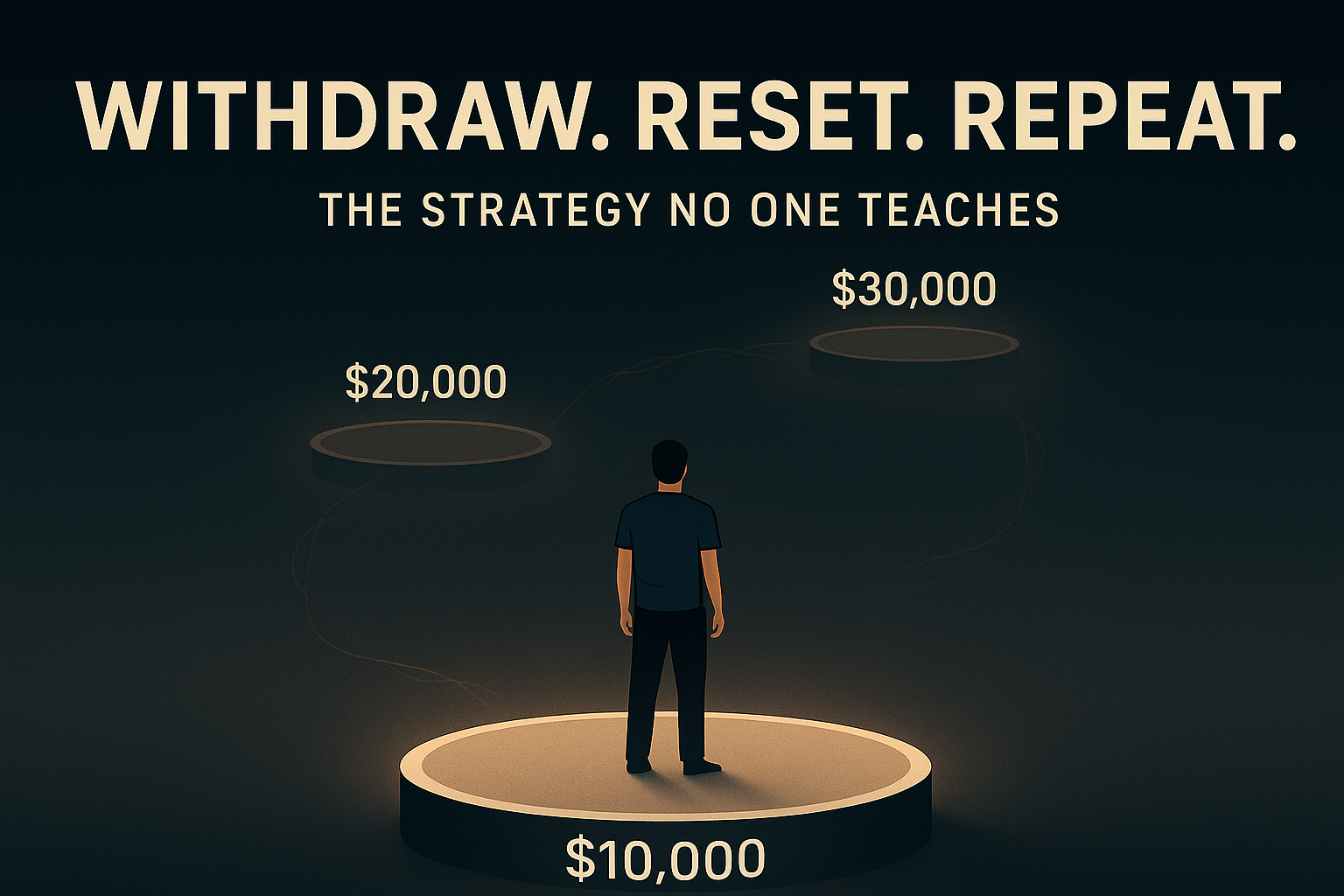
    Making up to 100% of your entire account size—in profits—every single month and withdrawing it.

    I’m talking about making back your whole account balance in gains, taking it all out, and starting over at the baseline the next month.

    Start with $10,000. Finish with $20,000. You withdraw $10,000.
    Every. Single. Month.

    Scale it across multiple accounts.

    Sounds like a dream?
    That’s because it is—until you try to live inside it.


    💡 The Core of the Strategy:

    • Fixed lot size. No scaling. (Say, 0.5 lots on XAUUSD = $50/pip.)
    • A clean, proven edge.
    • Hedging if necessary—but always with discipline and a tight recovery window.
    • Monthly withdrawals that zero out your profits back to the starting capital.

    So if you start with $10K, your job is to make $10K in profit, extract it, and reset.

    No compounding. No adding contracts. No reward for ego.
    Just: execute clean setups, manage risk like a machine, and pay yourself like clockwork.


    🧠 Why No One Teaches This

    Because it’s:

    • Not sexy.
    • Not flexible.
    • And very easy to screw up.

    It doesn’t work unless you:

    • Respect risk more than reward.
    • Exit losers before they rot.
    • Never chase, stretch, or improvise.

    And that’s where most traders fall apart—they need the hope of “just one big month” to justify the pain of drawdown. This strategy doesn’t allow that kind of emotional leak.


    🧱 Why It Works (If You Do)

    • Every month, you reduce risk of ruin by withdrawing capital, not building exposure.
    • You avoid the psychological drift that comes with account growth (“Well, I can afford this loss…”)
    • You build consistency—and predictability—in your income stream.

    It’s trading as a profession, not a personality test.


    🚫 Why It’s Rare

    Because to do it, you need:

    • Emotional immunity to greed.
    • Trust in the math of your edge, not the dopamine of a bigger position size.
    • A flawless exit strategy.
    • A level of discipline that feels, at times, superhuman.

    📌 Bottom Line:

    This is a strategy for people who would rather make $10K a month consistently across 10 accounts than risk blowing one $100K account chasing the high.

    It’s not about getting rich fast.
    It’s about getting rich forever—slowly, precisely, boringly.

    Most traders will never be taught to do this.

    But if you master it?
    You’ve cracked the game.


    TL;DR:

    Withdraw every dime above your starting balance each month. Start over. Do it again.
    The hard part isn’t the market.
    It’s you.

  • Pivot Points: The Trader’s Map of Mayhem

    Pivot Points: The Trader’s Map of Mayhem

    If you’ve ever sat there staring at your chart thinking, “Where the hell is this thing going?” — welcome to the club. That’s why traders lean on pivot points. They’re not crystal balls. They’re not insider tips from some guy who “knows a guy.” They’re just math.

    But here’s the thing: math works. Pivots give you a framework for where the market might slam on the brakes, do a U-turn, or gun it like a teenager in dad’s Camaro. They’re not guarantees. They’re guideposts. And if you’re trading without them, you’re basically running through a minefield in flip-flops.


    The Mother Pivot

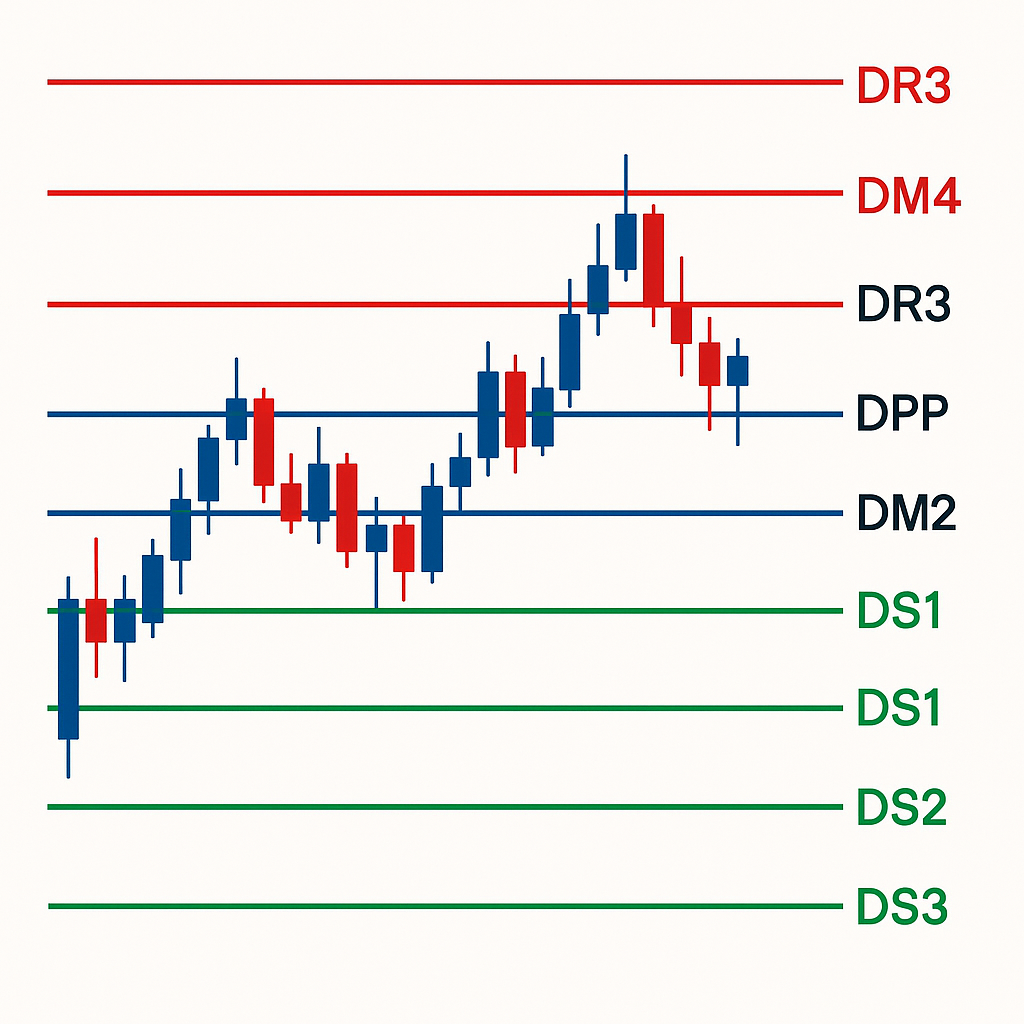
    Everything starts with the Pivot Point (PP) itself. Think of it as the gravitational center of yesterday’s chaos:PP=High+Low+Close3PP=3High+Low+Close​

    That’s it. No secret sauce. Just the average of the high, low, and close. The market’s way of saying, “Here’s the middle ground — now let’s fight about it.”


    The Resistance & Support Gang

    Once you’ve got your pivot, you spin off the levels that traders live and die by:

    • R1 (Resistance 1):

    R1=(2×PP)−LowR1=(2×PP)−Low

    • S1 (Support 1):

    S1=(2×PP)−HighS1=(2×PP)−High

    • R2:

    R2=PP+(High−Low)R2=PP+(High−Low)

    • S2:

    S2=PP−(High−Low)S2=PP−(High−Low)

    • R3:

    R3=High+2×(PP−Low)R3=High+2×(PP−Low)

    • S3:

    S3=Low−2×(High−PP)S3=Low−2×(High−PP)

    Call them “levels,” call them “lines in the sand.” I call them the places you’ll regret ignoring when price slaps you in the face.


    The Midpoints — Because Humans Hate Waiting

    Traders are impatient. That’s why I also plot the midpoints — the halfway houses between the big levels:

    • M1: Between S1 and S2
    • M2: Between S1 and PP
    • M3: Between PP and R1
    • M4: Between R2 and R3

    They don’t get as much hype, but they matter. Markets often pause there, like they’re catching their breath before the next sprint.


    Same Formula, Different Flavor

    Here’s the beauty (or the horror, depending on how you see it): the formulas don’t change. Only the timeframe does.

    • Daily pivots (DPP, DR1, DS1, etc.) → previous day’s OHLC
    • Weekly pivots (WPP, WR1, WS1, etc.) → previous week’s OHLC
    • Monthly pivots (MPP, MR1, MS1, etc.) → previous month’s OHLC

    That’s it. Pivots are universal. Same math, different battlefield.


    Or Skip the Math (Because Life Is Short)

    If you’d rather not do the arithmetic every night like some medieval accountant, I’ve got you covered. I built a simple spreadsheet where you just plug in the open, high, low, and close. It spits out all the pivots for you — daily, weekly, monthly.

    👉 Grab it here and make a copy

    Use it. Abuse it. Just don’t blame me if you ignore the levels and get steamrolled.


    The Bottom Line

    Pivot points won’t make you a genius. They won’t turn your $500 account into a Lambo. But they will give you a reliable map — one that the market respects often enough to keep them on my charts every single session.

    Trading without pivots? That’s like skydiving without checking the parachute. Sure, you might be fine… until you’re not.

    See you in the streams. Bring your helmet.

  • The Day I Finally Outsmarted Myself

    The Day I Finally Outsmarted Myself

    For a long time now, my biggest enemy in trading hasn’t been the market, the algorithms, or even Jerome Powell’s ability to tank gold with a single eyebrow twitch.
    It’s been me.
    More specifically, me refusing to take the loss I knew I should take — the hot stove exit, or HSE.

    The HSE is simple in theory: the moment a trade is clearly invalidated, you get out. You touch the hot stove, it burns, you pull your hand back.
    Except in my case, I’d leave my hand there a few more seconds, just to “see if maybe it stops hurting.”


    Why I Didn’t Just Automate It Earlier

    If you’re thinking, “Mike, just use a stop loss, problem solved,” you’re both right and wrong.
    My broker, Tradovate, has a group trading feature that lets me execute one trade and mirror it across all my accounts — but it doesn’t allow bracket orders. That means no automatic stop loss when using that setup. And my trades are too short in duration to manually type one in after entry.

    I thought about using a third-party copy trader before, but I talked myself out of it. Too much hassle. Too much potential for lag. Too many stories of things going wrong. And, in true trader fashion, I told myself, “I’ll just fix it with discipline.”
    (Insert laugh track here.)


    Why That Changed

    Fast-forward to this week. I finally reached the point where my manual HSE violations were costing me too much — not just in money, but in mental capital.
    So I set up Tradesyncer, connected it to all my accounts, and now every single trade I take has an automatic $120 stop loss. If it hits, I’m out. No debate. No “just another tick.” No “it’ll come back.”

    And the first day I used it?
    I felt calmer. More focused. More like an operator and less like a gambler negotiating with himself.


    A Crutch? Absolutely. And I’m Proud of It.

    Yes, it’s a crutch. But here’s the thing about crutches: elite athletes use them all the time. Not the wooden kind from the ER — the mental and technological kind that make their performance bulletproof.

    An elite trader doesn’t care whether the edge comes from discipline, experience, technology, or a three-legged goat that predicts FOMC outcomes.
    The only metric that matters is: does it make you money?

    So now I’ve got my crutch, and it’s keeping me from burning my hand on the stove. That’s not weakness — that’s just good risk management.

  • Why Now Is the Perfect Time to Get Into Trading (Before Everyone Else Does, and Most of Them Quit)

    Why Now Is the Perfect Time to Get Into Trading (Before Everyone Else Does, and Most of Them Quit)

    There are moments in history when it pays to be early. Not just because you beat the rush, but because you’re already built for what comes next, long after the crowd burns out. This is one of those moments.

    As AI begins sweeping across white-collar industries, displacing analysts, marketers, consultants, and managers, a massive shift is coming: millions of people are going to try trading. Some already are. The pandemic was just the preview. What’s coming is bigger, more chaotic, and ultimately—more survivable for those who start now.


    Phase 1 (Now – 2026): The Flood

    AI is coming for jobs. Smart, ambitious people are about to be made redundant in record numbers. They’ll look for new income sources, and guess what keeps popping up on YouTube?

    “Trade from home!”

    “Make money in the markets!”

    “Prop firms will fund you!”

    Combine that with AI tools giving people a false sense of confidence, and you’ll get an explosion of new traders armed with:

    • A ChatGPT script
    • A few backtests
    • A dangerously inflated ego

    These traders will pile into the markets—and promptly get smoked.

    Because trading isn’t about having tools. It’s about having judgment under pressure. And that doesn’t come from TikTok. It comes from screen time, structure, and elite coaching.

    If you start now, you’ll be learning while the crowd is still overconfident. By the time they realize how hard this game really is, you’ll be calm, capable, and eating their exits.


    Phase 2 (2026 – 2028): The Great Washout

    As fast as they come in, they’ll start dropping like flies:

    • Failed prop firm challenges
    • Blown accounts
    • Social media silence
    • Regulation tightening

    Discords die. Reddit gets quiet. Influencers pivot to crypto mining or real estate. Everyone’s burned out or bitter.

    But not you.

    Because you’ve already:

    • Built your process
    • Learned real risk control
    • Tuned your emotional regulation

    You’re not chasing hype—you’re sharpening edge. You’re one of the few left standing, and it shows in your P&L.


    Phase 3 (2028 – 2032): The Thin Air

    By now, most humans have either quit, automated themselves out of trading, or become too afraid to click.

    AI is trading against itself. The market becomes faster, cleaner, colder. Behavioral mistakes are rarer—but when they happen, they’re massive.

    That’s your game now:

    • Fewer trades
    • Bigger size
    • Cleaner reads
    • Precision sniping

    There’s still money—serious money—but only for those who can wait, stalk, and strike without hesitation. Everyone else? Gone.

    And here’s the best part:

    New retail traders will still come in every cycle. Dumb money never dies. It just gets rebranded.


    So Why Get In Now?

    Because if you wait until everyone else floods in, you’ll be learning while they’re flailing.

    If you wait until they all leave, it’ll be too hard to learn.

    But if you start now, you get the best of both worlds:

    • You build competence while volatility is still rich with opportunity
    • You develop confidence while others are developing bad habits
    • You outlast the exodus and rise into the rare air where real traders live

    You won’t win by being faster than the bots. You’ll win by being better than the humans who think they can out-bot the bots.

    That takes a process. A system. And coaching that doesn’t sell you hype.


    One More Thing:

    If you’re going to get into trading right now, make sure you’re learning from people who:

    • Actually trade (not just teach)
    • Understand both human behavior and machine logic
    • Know what it takes to survive the phases ahead

    That’s what we do at The Barcelona Trader. We teach real systems. We coach real traders. And we’re doing it in real time—on Zoom, on stream, in the markets every day.

    If you’re ready to start before the flood and stay long after it recedes, you’re in the right place.

    Let’s build something that lasts.

  • In The Beginning, I Just Wanted to Trade, Dammit

    In The Beginning, I Just Wanted to Trade, Dammit

    When I first started learning to trade, all I wanted to do was… well, trade.

    I didn’t want to read more theory.
    I didn’t want to wait for the “right market conditions.”
    I didn’t want to do visualization exercises or light a scented candle to regulate my nervous system.

    I just wanted to get in there and throw some punches.

    But the kind of trading we do—scalping gold using a mash-up of indicators from multiple platforms—has one tiny inconvenience:

    You can’t really backtest it.

    Not properly. Not cleanly. Not the way the backtesting bros on YouTube tell you to.

    Because some of our indicators are on TradingView…
    Some are on Meta Trader 4…
    One’s from EliteAlgo…
    A couple come from Tono’s vault of secrets…
    And the whole system is designed to be lived in, not simulated.

    There’s no drag-and-drop environment where you can recreate the pace, pressure, and psychodrama of a real session on a real market with real capital.

    So that left me with only one option:
    Learn by trading. Live. In session.


    And that’s when the rulebook came out.

    “You shouldn’t trade unless market conditions are ideal.”
    “You shouldn’t trade if you’re tired, emotional, or distracted.”
    “You shouldn’t trade unless you’re in flow state with a green smoothie and a low resting heart rate.”

    Great.
    So basically, don’t trade.

    Because in the early days?
    I was always a little emotional.
    The market was never ideal.
    And my “flow state” was somewhere between caffeinated rage and quiet despair.

    But I was determined.
    Determined to be the one trader who could rise above it all.
    The one who could power through less-than-perfect conditions.

    “Those rules are for weak-minded traders. I will train myself to ignore them. I will transcend.”

    Spoiler:
    I did not transcend.


    Turns out, I was just doing what new traders do:

    • I overestimated my resilience.
    • I underestimated the market’s indifference.
    • And I thought “rules” were optional for people with vision.

    I wasn’t training to become resilient.
    I was training to become delusional.


    The joke was on me.

    Because here’s what I learned the hard way:

    • If the market conditions aren’t right, your edge isn’t there.
    • If your emotional state is off, your execution will suffer.
    • If your ego says “I’ve got this” while your account says otherwise… guess who’s right?

    There is no shortcut.
    There is no version of you that becomes immune to conditions.

    There is only the version of you that respects the craft—or blows up trying to shortcut it.


    But here’s the good news.

    Eventually, I stopped fighting the guardrails.
    I stopped chasing every chart flicker as a “learning opportunity.”
    I stopped thinking I was the exception.

    And ironically, that’s when I actually started learning.

    Not just how to trade…
    But how to show up like a trader.


    Final thought:

    If you’re in that phase—desperate to trade, frustrated by rules, convinced that you’re built different…

    You’re not broken.
    You’re just at the beginning.

    But take it from someone who tried to brute force his way through the mountain:

    The rules aren’t your enemy.
    They’re the rope that keeps you from falling off the cliff.

    You can either learn that by listening…
    Or by learning the way I did.

    One red session at a time.

  • How to Fail as a Trader(A helpful guide for anyone trying to burn their dreams to the ground)

    How to Fail as a Trader(A helpful guide for anyone trying to burn their dreams to the ground)

    Let’s flip this thing.

    Charlie Munger—Warren Buffett’s famously cranky sidekick—used to preach a concept called inversion:

    “Tell me where I’m going to die, that way I’ll never go there.”

    So, instead of asking how to succeed in trading, let’s explore the more entertaining route:
    How to absolutely, unequivocally FAIL.
    Blow it. Flame out. Wreck your accounts, your confidence, and possibly your marriage.

    Ready? Let’s begin.


    Step 1: Trade When You’re Bored

    Forget waiting for real setups. If the chart is open and you’ve got fingers, it’s showtime.
    Better yet—trade while checking Discord, eating lunch, and watching other traders on YouTube.
    The market rewards divided attention, right?


    Step 2: Hold Your Losers (Because Hope Is a Strategy)

    Once it goes against you, double down on optimism.
    Tell yourself it’s just a “deep pullback.”
    Talk to it like a plant.
    Wait long enough and you’ll either be right… or margin called.


    Step 3: Ignore Your Hot Stove Exit

    You created it for a reason.
    Now ignore it for no reason.
    Tell yourself this time is different.
    Keep burning your hand and wondering why your trading confidence is toast.


    Step 4: Start Sharp, Finish Stupid

    Nail your first few trades. Then get cocky.
    Loosen your rules.
    Scale up.
    Try something “new” mid-session.
    Finish the day with regret and a self-pity burrito.


    Step 5: Abandon the Setup When It Doesn’t Work

    That A+ breakout setup failed? Time to declare it dead.
    Don’t bother with probabilities or long-run edge.
    Just chase whatever worked five minutes ago for that guy on YouTube.


    Step 6: Attach Your Self-Worth to Your P&L

    If you made money, you’re a genius.
    If you lost money, you’re a fraud.
    Your entire identity should swing on a 3-minute candle.


    Step 7: Don’t Journal Your Bad Sessions

    That’s too painful. Just pretend it didn’t happen.
    Better yet, gaslight your future self by only recording the wins.
    Future-you will love not knowing what went wrong.


    Step 8: Compare Yourself to Other Traders

    Especially the ones with Lambos in their thumbnails.
    They’re definitely showing their real P&L.
    You’re clearly behind.
    Panic accordingly.


    Step 9: Break the Rules That Just Saved You

    The structure worked yesterday, so obviously today it’s optional.
    Wing it. Trust your gut.
    You’re due, after all.


    Bonus Step: Take It All Very Personally

    This isn’t just trading. This is your worth.
    Your legacy.
    Your last shot at proving you’re not a complete disappointment.
    No pressure.


    So… Want to Succeed Instead?

    Then do the opposite.

    • Trade when the setup earns it.
    • Exit when the risk says so.
    • Let your edge breathe.
    • Treat process like religion.
    • Feel the feelings—but don’t trade the feelings.
    • And journal like your future self is trying to avoid your current mistakes.

    Inversion exposes the rot.
    Now you know what it looks like.
    Walk the other way.

    And if you’re not sure which way that is, we can help.
    This is exactly what we coach—every day, in real time, with real skin in the game.

    Let’s not just survive. Let’s build something that lasts.


  • Best Time to Trade Gold? A Session-by-Session Primer on Asia, London, and New York

    Best Time to Trade Gold? A Session-by-Session Primer on Asia, London, and New York

    If you’re serious about trading gold, you’ve probably heard that liquidity is king. But liquidity doesn’t come in one-size-fits-all—especially when it comes to trading spot gold or futures across different global sessions. Each brings its own flavor, tempo, and tradable quirks. Let’s break it down, session by session.


    The Asia Session: The Calm Before the Storm

    Think of Asia as the quiet before the chaos—or sometimes, just quiet. Volume is lowest during this session, especially in the early Tokyo hours. But don’t mistake that for irrelevance. This is when institutional positioning quietly begins, and if you’re a scalper, the clean, slower price action can actually be a gift. Less noise, less whip—but also fewer explosive moves.

    Spot gold tends to drift during Asia, with occasional spikes triggered by macro headlines or yen volatility. Futures trading thins out a bit here, though it still offers scalping opportunities on Globex. If you’re patient, Asia can be a place to warm up, prep, and catch a stealth setup or two. Just don’t expect the fireworks show to start until later.


    The London Session: Where the Game Begins

    Now we’re in prime time. London isn’t just a financial hub—it’s the hub for physical gold. The LBMA (London Bullion Market Association) sets the benchmark price, and institutional gold traders often anchor their decisions around this session.

    This is where liquidity deepens, volatility kicks up, and breakouts often begin. Spot and futures prices both respond sharply to economic news out of Europe and early positioning for the U.S. open. You’ll often see the highs and lows of the day get established here—especially if the market has been coiling during Asia.

    If you trade both spot and futures, this is where you’ll see the rhythm diverge slightly, as the futures contract begins to show its hand with more volume. This is also when you start to feel the effects of the contract roll—that moment every couple months when traders move from the current futures contract (e.g., August delivery) to the next one. The new contract often trades at a premium early on, but as we near expiry, it converges with spot—a behavior that’s part arbitrage, part psychology, and all math.


    The New York Session: Fireworks and Futures

    The New York open is when things can go full throttle. The U.S. Comex futures market dominates gold volumes during this session, especially from 8:20 a.m. ET onward when the pit officially opens. If London is where the fuse is lit, New York is where it burns fast and hot.

    This is when spot and futures prices usually move in tandem—although, as we recently saw after the Israel-Iran conflict broke out, futures sometimes spike harder and faster. That divergence? Often the result of speculative leverage, algos sniffing momentum, and differences in how market participants are positioned.

    It’s also worth noting that while both London and New York offer deep liquidity, the nature of that liquidity changes. London is where institutions adjust broader positions. New York is where traders react—to data, news, or each other. If you like volatility, this is your hour.


    So Which Session is Best?

    The real answer? It depends on you.

    • If you’re a disciplined scalper who wants fewer distractions and tighter price action: Asia might be your playground.
    • If you like trend initiation, breakout levels, and range-to-trend transitions: London will give you room to run.
    • If you thrive on volatility, news reactions, and high-volume momentum: New York is where you’ll make (or lose) your gold.

    Just remember: each session passes the baton to the next. And the truly elite traders? They know how to read the tape across the sessions—not just during their favorite one.