Category: Strategies

  • Have You Ever Been Stop-Hunted? Here’s What Just Happened to You.

    Have You Ever Been Stop-Hunted? Here’s What Just Happened to You.

    Have you ever heard of a stop hunt?

    Maybe you’ve seen it called a liquidity grab, a fakeout, or if you’re feeling extra dramatic, a Judas candle. Whatever you call it, the mechanics are the same—and if you’ve ever placed a stop loss above a major level, or if you’ve ever jumped on what looked like a breakout only to have to turn against you like a spurned lover, you’ve probably donated to one.

    Let’s walk through it in plain English. Not theory. Not fairy tales. Just how this really works.


    The Setup: A Big Level, a Bunch of Stops, and a Patient Predator

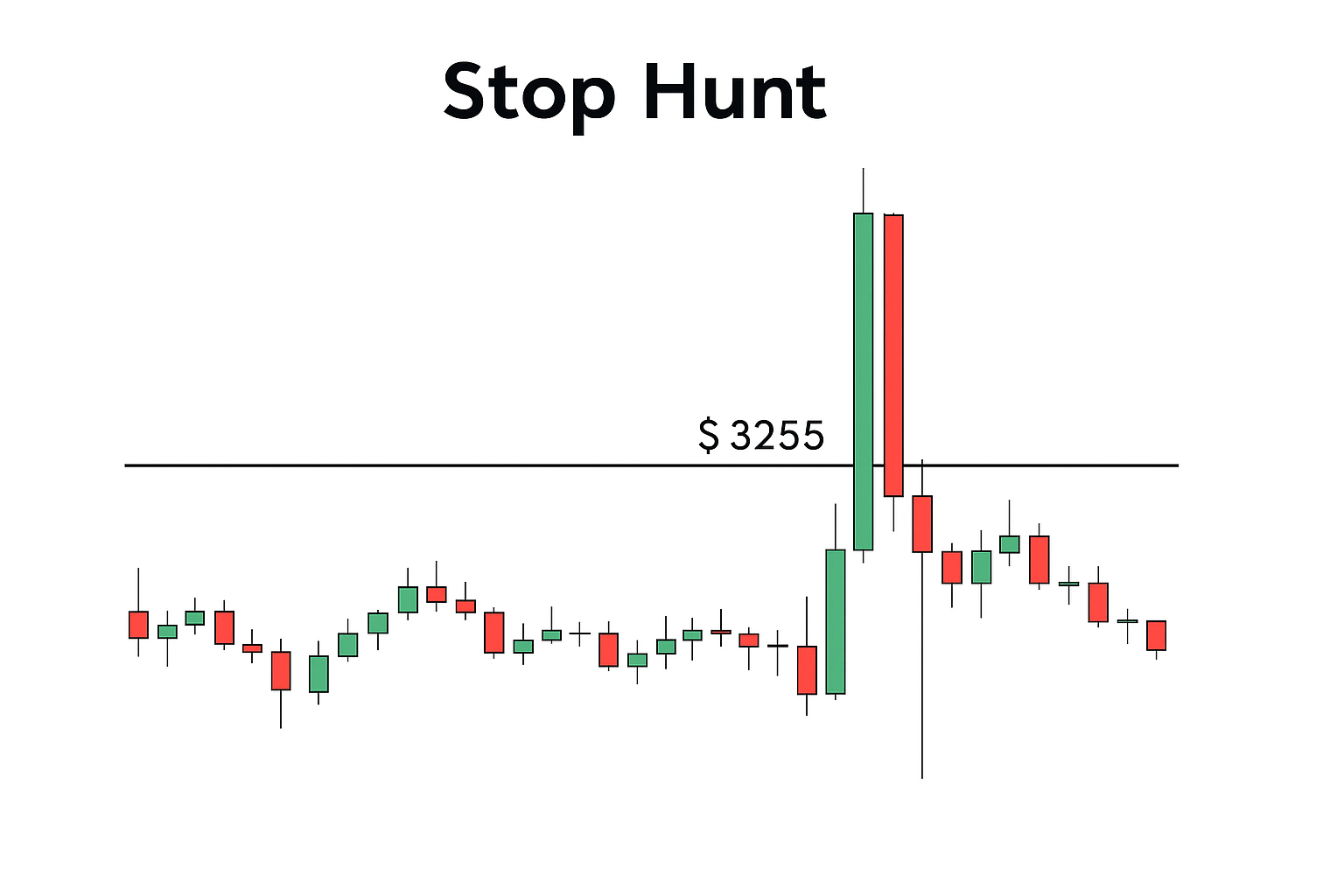
    Imagine price is hovering just below a well-known resistance level. Let’s call it $3,355 because hey, this is a real example from yesterday (July 1, 2025). Everyone’s watching it. Everyone’s talking about it. And under that price lies a graveyard of failed trades.

    Now—somewhere out there, a big player (call them the whale, the bank, or just the guy with deeper pockets than you) has a problem. They want to sell a massive amount of gold, but there’s a catch:

    You can’t sell big unless there’s someone willing to buy big.

    Enter the perfect mark: retail stop losses.


    The Play: Trigger the Stops, Sell Into the Panic

    So what does our whale do?

    They wait.

    They wait for price to grind its way up toward that $3,355 level—right up to the cliff’s edge—where they know a whole crowd of retail traders have stops placed just above.

    Those stops? They’re just exit orders on your trading platform, but an order to exit a “sell” is actually a “buy” order. And those buy orders are just there waiting to be triggered. So if you’re short from $3,350 and you use a stop loss you’d probably set it around $3,3055-6ish. Guess what happens when price taps that level.

    Your broker submits a buy order (your exit order) at market price—and the whale is happy to take the other side.

    So the big player—calm, calculated, and probably sipping something expensive—drops a large buy order just beneath the stop zone. That push is enough to spike price up into the liquidity pocket… and boom:

    All those stop losses start firing like popcorn in a microwave.

    Normally, more buy orders would send the price even higher. BUT, at that exact moment—while you’re staring at your screen thinking “I knew it was going to break out!”—the big player is unloading. They’re selling into all those panicked buys, using your exit (and the buy orders from all the retail traders who saw the breakout and piled in) to fund their entry.


    The Aftermath: Gravity Returns

    Once they’re filled—once they’ve offloaded their entire position into your stop loss—the need to hold price up disappears.

    And just like that, the bounce becomes a flush.

    The breakout turns into a trap.

    And the candle that looked so promising turns into an obituary.


    So… Why Does This Matter?

    Because if you don’t understand why price moves, you’ll keep getting wrecked by how it moves.

    Stop hunts aren’t a conspiracy. They’re a feature of how smart money finds counterparties in a thin market.

    And while you’re tweeting “gold breakout incoming 🚀,” the professionals are already fading you with limit sell orders and setting their targets 20 points lower.


    What You Can Do Instead

    • Don’t place stops where everyone else does. Be smarter than the cluster.
    • Look for structure—real structure—not just price levels.
    • Learn to recognize impulsive moves without follow-through. That’s usually the tell.

    Or, if you’re still unsure?

    When in doubt, wait it out. Real breakouts don’t ask you to beg.


    Final thought:
    If your trade got stopped out and price reversed five seconds later, you weren’t unlucky.
    You were the liquidity.

    But hey—now you know. And next time, you might just be on the other side.

  • The Fixed Range Volume Profile: Why It Matters, and How to Use It

    The Fixed Range Volume Profile: Why It Matters, and How to Use It

    By The Barcelona Trader

    Let’s talk about a tool that actually matters.

    Not a gimmick. Not a “secret weapon.” Not some recycled 2007 YouTube strategy rebranded with a new acronym and a $997 course.

    I’m talking about the Fixed Range Volume Profile—also known as FRVP—and it’s one of the most powerful, overlooked tools a serious trader can add to their chart.

    If you trade gold and you’re not using it, you’re operating half-blind.


    What Is It?

    The Fixed Range Volume Profile shows you how much volume was traded at each price level—not over the entire chart, but over a specific window of time that you define.

    In TradingView, it’s already built in.

    Here’s how to find it:

    1. Open your chart
    2. Hit Indicators → search for “Fixed Range Volume Profile”
    3. Click it
    4. Then click and drag across any time segment you want to analyze—consolidation, breakout leg, pullback, whatever

    And just like that, the chart stops whispering and starts telling the truth.


    Let’s Talk About the Terms That Actually Matter

    There are a few key concepts FRVP gives you—and they’re not complicated, just underutilized:

    • POC (Point of Control):
      The price level where the most volume was traded in that time range.
      Think of it as the market’s center of gravity. The most accepted price.
      👉 Don’t trade into it blindly. Watch how price reacts around it—magnet or repeller?
    • Value Area (VA):
      The range that contains roughly 70% of all traded volume in your selected range.
      👉 Inside the value area = indecision. Outside it = opportunity.
    • HVN (High Volume Node):
      Thick volume = sticky price. Price tends to stall or revert here.
      👉 Don’t expect explosive moves through HVNs—they’re built for chop.
    • LVN (Low Volume Node):
      Thin volume = low interest = fast movement.
      👉 When price hits an LVN, it usually doesn’t stick around to negotiate.

    How I Use It (And How You Should Too)

    When I’m trading gold, I’m not just clicking buttons. I’m reading footprints. Here’s how FRVP helps:

    1. I define the zone.
      Drag the tool over a specific time range—like a recent breakout leg, a pre-market consolidation, or a trend correction.
    2. I identify the POC.
      I want to know where the market was most comfortable. Spoiler: that’s not where I want to be trading.
    3. I watch for reaction at the edges.
      The edges of the value area and the nearby volume nodes tell me whether this is a breakout, a rejection, or a trap waiting to happen.
    4. I trade away from acceptance, not into it.
      Think like a magnet: price is attracted to the POC, but once it gets there, it’s just as likely to spring away from it as it is to stay. Context is everything.

    Why It’s So Useful—Especially on Gold

    Gold is a twitchy, emotionally charged instrument.
    It reacts to structure. It respects levels. And it loves to trap traders at the worst possible moment.

    The FRVP gives you clarity about where the market actually did business.
    Not where you think it should have. Not where your Fibonacci said it might.
    Where traders actually showed up with size.

    That’s an edge.


    One Last Thing

    Don’t treat this like a magic wand. It’s not a signal generator. It’s a context tool.

    Use it to:

    • Frame your bias
    • Stay out of trouble
    • Avoid chasing candles through chop
    • And stop trying to buy pullbacks that are actually just re-tests of a sticky high-volume node

    Trade like a professional: wait for the market to leave a trail—then follow it.


    The Fixed Range Volume Profile doesn’t predict anything.
    But it does explain everything.
    And sometimes, that’s exactly what you need.

  • The Forgotten Power of Pivots

    The Forgotten Power of Pivots

    By The Barcelona Trader

    Let me tell you something the YouTube trading bros won’t:

    Pivots still matter.

    I know—I know. They’re not shiny. They don’t come with acronyms like ICT or SMC. They’re not based on smart money, liquidity raids, or whatever other spooky bedtime story is trending this week in Trading TikTok land.

    But pivots? They’ve been around longer than most of these kids have been alive.
    And they still work—especially on gold.


    A Brief History of the Pivot

    Pivots were originally created by floor traders. Not the latte-sipping, dual-screen influencers of today, but actual open-outcry traders—guys who wore weird jackets, shouted across rooms, and made six figures while doing math with a pencil stub.

    They used pivots to figure out:

    • Where price might stall
    • Where the market might reverse
    • Where they might finally stop averaging into a loser and cry into their trading jacket

    The Daily Pivot Point (DPP) was the anchor. Everything else—support and resistance levels—was built from that.

    And it wasn’t just daily. You’d calculate weekly pivots. Monthly. And then you’d watch for confluence. Because that’s where things got interesting.


    What Tono Taught Me to Use (And Why It Works)

    Here’s my pivot stack:

    • DR3 – Daily Resistance 3
    • DR2 – Daily Resistance 2
    • DM4 – Midway between DR2 and DR3
    • DR1
    • DM3
    • DPP – Daily Pivot Point
    • DM2
    • DS1
    • DM1
    • DS2 – Daily Support 2
    • DS3 – Daily Support 3

    I use the same structure for weekly and monthly pivots.

    And no, it’s not because I’m nostalgic for the ‘90s.

    It’s because when a Daily and a Weekly pivot align? That’s not just a level—it’s a statement.
    Same goes for a Monthly and a Weekly, or a Daily and a Monthly.
    These are the levels where the market pauses, thinks about its life choices, and often turns around.


    Why Most Traders Ignore Them (And Why That’s a Mistake)

    Pivots have fallen out of fashion because they’re too simple.
    They don’t come with a 20-hour video course or a 200-page PDF with watermark branding and “edge” in the title.

    They’re just math.
    But guess what?

    So is the market.

    The big players still see these levels. Banks, institutions, prop firms—they may not talk about pivots, but they absolutely react to them. And when you’re trading something as volatile and technically sensitive as gold, those reactions matter.


    Why Pivots Work So Well on Gold

    Gold is emotional.
    It’s reactive.
    It’s loved, hated, hoarded, and dumped.

    And it respects technical levels better than just about any other instrument. Especially when the world’s on edge—which, spoiler, is always.

    That’s why when DR1 lines up with the Weekly Pivot and price slams into it?
    I’m watching.
    That’s not a coincidence. That’s order flow memory.

    You can trade gold without pivots, sure.

    You can also skydive without a parachute.
    It’s only a problem once.


    The Point

    If you’re serious about trading gold—especially if you’re scalping it or working breakouts on the lower timeframes—pivots aren’t optional. They’re your context. They’re your map. They help you understand when a move has juice… and when it’s running into a wall that price has respected 300 times over the last five years.

    SMC? ICT? Smart money this, imbalance that?

    Cool. If it works for you, great.

    But don’t throw out the tools that have been working longer than you’ve been alive just because some guy in a backwards hat on YouTube called them “retail nonsense.”

    Because let me tell you what’s nonsense:

    Ignoring a Monthly Pivot that just aligned with a Weekly and a Daily—and has already seen reactions all week—just because it doesn’t fit your “order block narrative.”


    Use your pivots.
    Stack your timeframes.
    And trade like someone who didn’t just Google “how to become a millionaire in 30 days.”

  • How We Describe Our Edge

    How We Describe Our Edge

    There’s no shortage of ways to trade the markets—truly, it’s a buffet of chaos. Which is exactly why so many new traders wind up cross-eyed by the time they finish their second week in the content rabbit hole. One expert swears off trading news events like they’re cursed scrolls, while another lives and dies by the NFP candle. One says to let your winners run until the sun explodes. Another says, “Grab that profit like it’s the last slice of pizza.” And there you are—wide-eyed, caffeinated, and trying to weld together twelve contradictory systems into one hybrid beast that doesn’t resemble a strategy so much as a cry for help.

    But here’s the thing: most of that advice isn’t bad—it just doesn’t belong in the same toolbox. A tight stop makes perfect sense if you’re swing trading stocks. It makes less sense if you’re scalping gold on a 10-second chart while riding adrenaline like it’s a rollercoaster. Even among scalpers, there are flavors: some fade, some chase, some break out, some hedge, and some just vibe it out and hope for the best. So the real problem isn’t that you’re being misled. It’s that you’re being overwhelmed. Trying to synthesize a dozen trading philosophies at once is like trying to conduct an orchestra where each musician is playing a different song. The fix? Pick one system. One style. One voice to follow. Go deep, not wide. Get consistent. Then evolve.

    The strategy we use is built on sharp, tick-based Renko entries layered with clear inflection points like pivots and POCs. We add to that a scalper’s rulebook, refined price action instincts, and—in spot gold—a hedging method that lets us absorb volatility and stay in the game longer than most.

    In gold futures, we swap out hedging for our Hot Stove Exit: fast, disciplined trade management that cuts heat before it burns capital. We scale this across multiple accounts, keeping risk per contract constant. The edge isn’t just in spotting setups—it’s in surviving long enough to let them pay.

    Sure, it might sound complex at first, but once it clicks, it’s like seeing the Matrix—and realizing you’ve been trading in crayon this whole time. So what makes our style different? We’re not here for 2% or 5% gains like it’s some polite retirement portfolio. We show you how we withdraw 70%, 80%, even 100% of our account size every month while leaving our base capital in for the following month so we can do it again. Not grow it. Not compound it. Withdraw it. As in: “Thank you, broker, I’ll take that in cash.”

  • The Hot Stove Exit™ – How I Learned to Stop Melting My Hand Off

    The Hot Stove Exit™ – How I Learned to Stop Melting My Hand Off

    There’s this moment in trading—maybe you know it—where price starts going against you and instead of cutting the trade, you… freeze. You hesitate. You stare at the screen like a dog trying to do algebra. And just like that, a minor flesh wound becomes a third-degree burn.

    I used to do that. A lot.
    Now I don’t.
    Not because I became superhuman.
    But because I trained myself to do what any kid learns in the kitchen:

    You touch a hot stove, you pull your hand back.

    That’s the principle behind what I call the Hot Stove Exit™—and it’s one of the most important rules in my entire system.


    🧠 What Is a Hot Stove Exit?

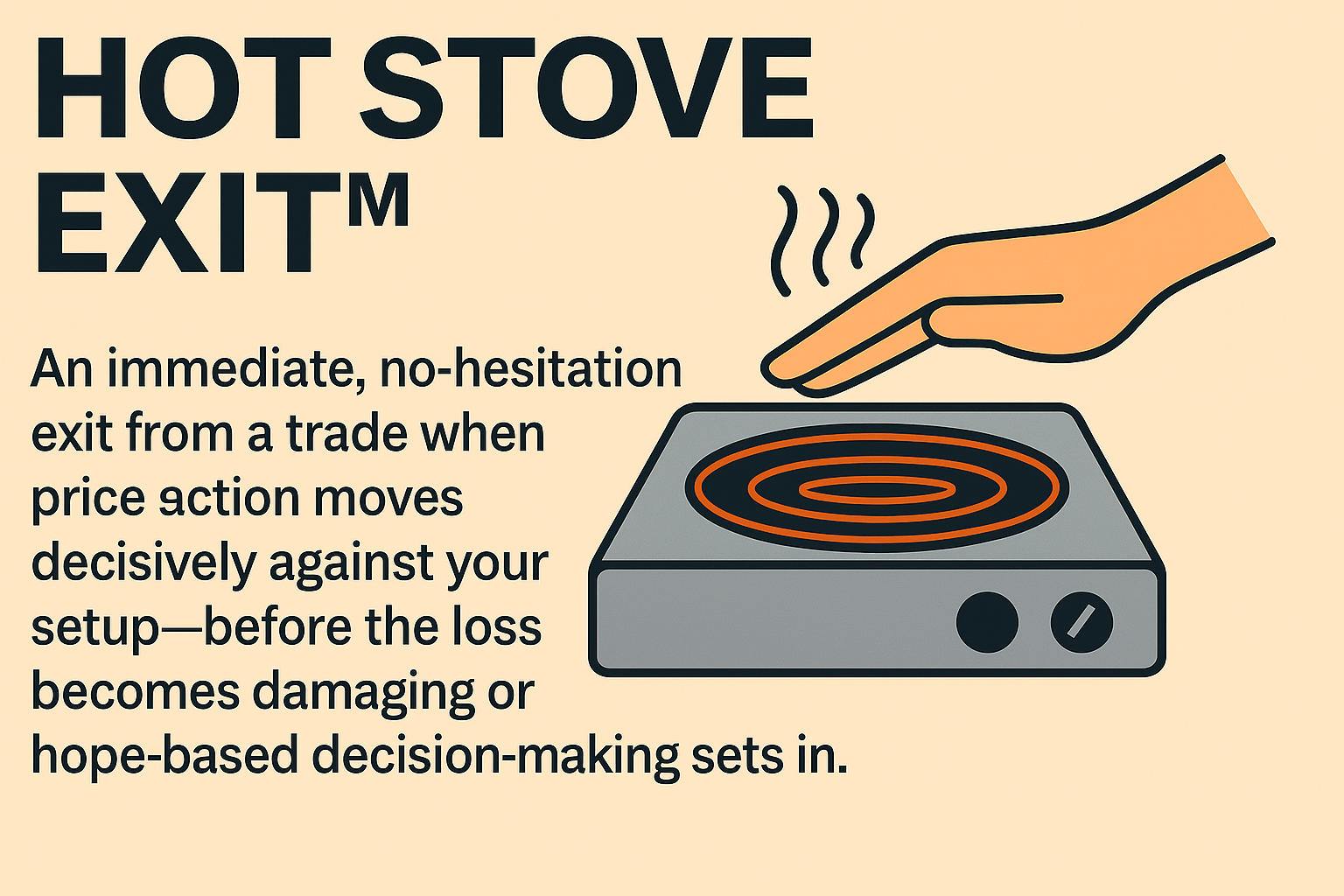
    Hot Stove Exit™ is an immediate, no-hesitation exit when a trade starts to go wrong—before the damage becomes emotional, financial, or existential. It’s not a panic move. It’s a power move. It’s instinct honed by discipline.

    You don’t argue with it.
    You don’t wait to see if the pain stops.
    You get out.

    Like… now.


    ⚙️ When to Use It

    Here’s your cheat sheet. You should take a Hot Stove Exit if:

    • Your setup invalidates right after entry.
    • Price rips through your entry zone like it wasn’t even there.
    • You feel a little voice saying, “Maybe I’ll just give it more room.”
    • You’re telling yourself, “It’s probably just a pullback…” while staring into the abyss.
    • You know what you should do, and you’re already bargaining with it.

    Exit.
    Don’t think.
    Just click.


    🆚 Stop Loss vs Hot Stove Exit

    Old ThinkingHot Stove Exit™ Thinking
    “I’ll put my stop 25 pips away and hope I’m not wicked out.”“If this trade invalidates, I’m out before I feel pain.”
    “Let’s give it a little more room.”“If I’m hesitating, I’m already late.”
    “Maybe it’ll come back.”“Hope is not a strategy. Get out.”

    Most retail traders treat stop-losses like seatbelts… that they unbuckle as soon as the car starts skidding.

    The Hot Stove Exit™ doesn’t ask for permission. It acts.


    🏋️‍♂️ How I Trained It (and Still Do)

    Like any muscle, this took reps.

    • I journaled every time I didn’t take the exit. It was humbling. It was also fuel.
    • I ran replay drills. I’d practice entering, watching for invalidation, and exiting without hesitation.
    • I started tagging “Hot Stove” exits in my notes so I could see how often they saved me.
    • I redefined “winning.” If I exited cleanly and avoided a face-melter, that was a win—even if the trade was red.

    You know what started happening?
    I stopped blowing up.
    I stopped hedging in desperation.
    I started trusting myself more.


    📜 The Rules in My System

    Here’s what’s written into my playbook—and should probably be in yours too:

    • If a trade invalidates in the early moments, I exit without hesitation.
    • If I feel hesitation, that is the signal. Exit.
    • If I’m using hope as an argument, I’ve already lost. Get out.
    • A small clean loss is always better than a slow-motion account nuke.

    💡 The Takeaway

    The Hot Stove Exit™ isn’t just a technique.
    It’s a philosophy.

    It’s the belief that your capital is sacred and your rules protect it.
    It’s choosing discipline over drama.
    It’s a trader’s version of wisdom—earned in the fire.

    So the next time your hand’s on that burner?
    Pull it back.

    Fast.

    You’ll thank yourself later.

    P.S. Take the name Hot Stove Exit with a grain of salt. It’s just another name I gave to what is often called a manual hard stop.

  • Why Signals Don’t Work—And What Actually Does

    Why Signals Don’t Work—And What Actually Does

    To a new trader, signals seem like a no-brainer.

    Someone who knows what they’re doing tells you when to enter.
    You copy the trade. You size it properly. You exit when they say.
    Done.

    So why doesn’t that work?

    Here’s the truth:
    Signals seem simple. But trading isn’t.

    And the second you try to reduce a live, high-stakes decision-making process to a notification on your phone, the whole thing starts to fall apart.

    Let’s break this down.


    1. Trading is more than entry and exit.

    A trade signal gives you a moment in time.
    But it doesn’t give you the reasoning behind it, the conditions for exiting early, or the context that shaped the decision in the first place.

    The signal provider might:

    • Be scaling in or out
    • Have a hedge running
    • Be adjusting risk mid-trade
    • Be trading a specific news narrative you’re unaware of

    You don’t see any of that.
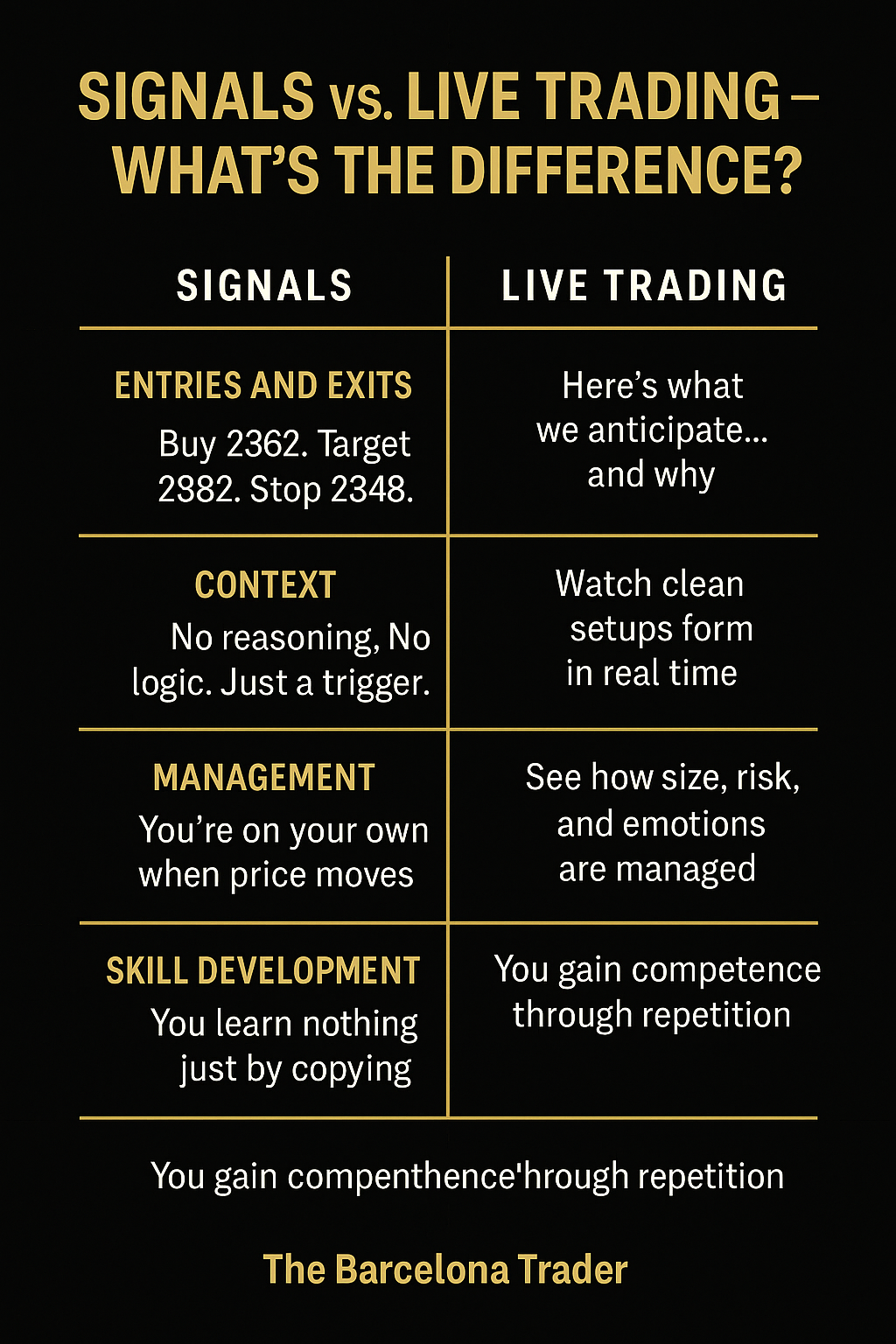
    All you get is “Buy 2362. Target 2382. Stop 2348.”

    You think you’re copying their trade.
    You’re not.
    You’re copying a snapshot—without the logic, the management, or the mindset.

    That’s not replication. That’s blindfolded imitation.


    2. Even “good” signals don’t account for your psychology.

    Let’s say the trade goes red at first.
    The signal provider is calm—they’ve seen this setup play out a hundred times.
    You? You panic, bail early, then watch the trade hit full TP.

    Now you’re gun-shy.
    The next trade? You hesitate—or size up to make back what you missed.
    Your mindset is compromised.
    That’s not the signal’s fault. But it is your outcome.

    Trading success isn’t just about what you do.
    It’s about how you react to what happens after.

    And no signal can manage your fear, your greed, or your FOMO for you.


    3. You’re not learning. You’re leaning.

    Following signals might feel like progress.
    But it’s not. It’s stalling.

    • You’re not building skill
    • You’re not learning structure
    • You’re not developing any self-trust

    So the moment the signals stop—or the provider has a bad week—you’ve got nothing to fall back on.

    You didn’t grow. You just followed.
    And now you’re back where you started, only more frustrated and down a few thousand dollars.


    4. Copy trading systems are built differently. Signals aren’t.

    Let’s get one thing straight:
    Copy trading ≠ signal following.

    With copy trading, the provider’s exact trades are executed on your account in real time—same entry, same exit, same scale.
    But with signals? You’re placing your own trade, at your own broker, with your own latency, your own emotions, and your own money.

    There’s nothing “automatic” about it.
    And unless you’re glued to your screen with zero distractions, it’s easy to miss a signal—or worse, execute it late and at the wrong level.

    Signals don’t account for slippage, spreads, emotions, or context.
    That’s why they fail.


    So what does work?

    Live trading. In real time. With real context.

    When you trade live with us—watching the charts as we mark levels, explain setups, manage risk, and take positions—you’re not just copying a call.

    You’re learning how to:

    • Spot clean entries before they form
    • Understand why a trade is taken—or skipped
    • Manage size, cut losses, and hold through volatility
    • Adapt when the market fakes out or flips
    • Control your own decision-making under real pressure

    It’s not signals. It’s training.

    Because the goal isn’t to follow someone forever.
    The goal is to eventually not need anyone at all.


    Signals can show you what someone else did.
    Live trading shows you how to do it yourself.

    And in the long run, that’s the only skill that matters.

  • How AI Will—and Won’t—Change the Game for Retail Traders

    How AI Will—and Won’t—Change the Game for Retail Traders

    Let’s be honest: the market was never “fair.”
    But it was, at times, predictable enough that a disciplined retail trader could carve out an edge.

    Now? The game is changing.

    Because the big players—hedge funds, quant desks, algorithmic trading firms—are integrating artificial intelligence into their infrastructure at scale. And we’re not talking about ChatGPT asking “what is a trendline.” We’re talking about machine learning models trained on terabytes of real-time data, adjusting in milliseconds, front-running your moves, and adapting faster than any human ever could.

    If you think retail trading is tough now, wait until the other team starts reading your playbook before you’ve even called the play.


    So, how will AI change the market?

    1. It’ll make the market more reactive—and less forgiving.

    Expect faster moves, tighter ranges, and more “liquidity sweeps” that just so happen to take out your stop before price reverses.
    That’s not a coincidence. That’s precision targeting by AI-powered systems designed to exploit common retail behavior.

    2. Market structure will evolve—again.

    Classic patterns, setups, and timing windows that worked for decades may stop working as AI models learn to identify, counter, and reverse them.
    If your edge is based purely on old-school retail psychology… it may have a short shelf life.

    3. Fakeouts will get smarter.

    The “stop hunt” is going institutional.
    AI can now detect the likely clustering of retail stops and liquidity zones—and trigger just enough volatility to flush them out.
    Then the move you were waiting for happens… after you’re out.

    4. News and sentiment will get priced in faster.

    No more waiting for the market to “digest” a Fed statement.
    AI models already scrape, translate, and analyze economic releases, social media, and speech tone in real time.
    By the time you react, the market has already moved.

    5. Retail emotion becomes even more exploitable.

    The more retail traders post trades, share biases, and reveal positioning online, the more data AI has to use against them.
    TradingView ideas. Twitter charts. Discord sentiment.
    It’s all intel. And the machines are watching.


    So what does this mean for you?

    It means the bar is going up.
    Not because you’re not smart enough. But because the competition is evolving faster than most retail traders can adapt.

    And here’s the uncomfortable truth:
    You can be emotionally disciplined, technically sound, and still get chewed up if you’re trading an outdated edge against an adaptive machine.


    But here’s what AI can’t do:

    • It can’t stop you from sitting out a chop day.
    • It can’t force you into an overleveraged trade.
    • It can’t break your rules for you.

    That’s still your job.

    And that’s where your edge lives now—not just in strategy, but in execution, awareness, and adaptability.


    Retail traders won’t be locked out of the game. But the game is different now.
    Cleaner charts won’t save you.
    Stronger discipline might.
    Smarter positioning definitely will.

    Adapt—or become target practice.


  • How Retail Traders Can Use AI to Improve Their Trading – And What It Won’t Help Improve

    How Retail Traders Can Use AI to Improve Their Trading – And What It Won’t Help Improve

    Let’s talk about the new buzzword on every trading forum, YouTube video, and overpriced Discord: AI.

    Apparently, artificial intelligence is going to change everything.
    And sure, some of that is true.
    But before you start outsourcing your trades to ChatGPT and packing your bags for Bali, let’s break this down like traders—not fanboys.

    Because yes, AI is powerful.
    But it won’t save you from the real work.


    ✅ What AI Will  Do for Retail Traders

    1. Speed up your learning curve

    Want to learn how to mark up a chart, understand CPI, or decode risk-reward ratios?
    AI can explain it in seconds. Better than most YouTubers. And without trying to sell you a $997 masterclass.

    2. Automate the boring stuff

    Trade journaling, backtesting summaries, economic calendar alerts—AI can help streamline all of it.
    If you’re not already using it to log trades and reflect on performance, you’re leaving free edge on the table.

    3. Analyze massive amounts of data

    AI can scan markets faster than any human.
    It can identify correlations, patterns, anomalies—especially useful for quantitative traders or data nerds running multi-asset strategies.

    4. Generate trading ideas (that you still need to vet)

    Need to brainstorm scenarios?
    AI can map out potential setups, help you plan different trade outcomes, or simulate market conditions. But—and this is key—you still need to filter those ideas through your lens.


    ❌ What AI Won’t Do (No Matter What They Promise)

    1. Make you a profitable trader by itself

    You are still the execution layer.
    And AI can’t manage your fear, FOMO, tilt, or revenge trades.
    You’re still the one clicking the button. And the P&L still lives or dies by your discipline.

    2. Replace intuition earned through experience

    AI can tell you what happened.
    It can’t feel the market. It doesn’t know what it’s like to take a drawdown and show up anyway.
    That kind of intuition? You earn it the hard way—trade by trade.

    3. Fix your psychology

    AI doesn’t care if you’ve blown three evals and are holding onto your last $500.
    It can’t talk you down when you’re about to triple your lot size at 9:58 AM because you “need to end green today.”

    It can spot inefficiencies.
    It can’t stop you from becoming one.

    4. Hand you a shortcut to mastery

    Every new trader is looking for the magic system, the secret algo, the holy grail.
    Now they think it’s AI.
    But here’s the truth: AI is a tool.
    If you don’t already have a process, it’s just another distraction.


    So, what’s the move?

    Use AI to sharpen your edge—not replace it.
    Use it to review, refine, and reflect—not to auto-trade your way to ruin.
    And if you’re serious about becoming elite?
    Focus on the one thing AI can’t replicate:

    Your ability to stay calm under pressure and execute when it counts.

    That’s still the final frontier.