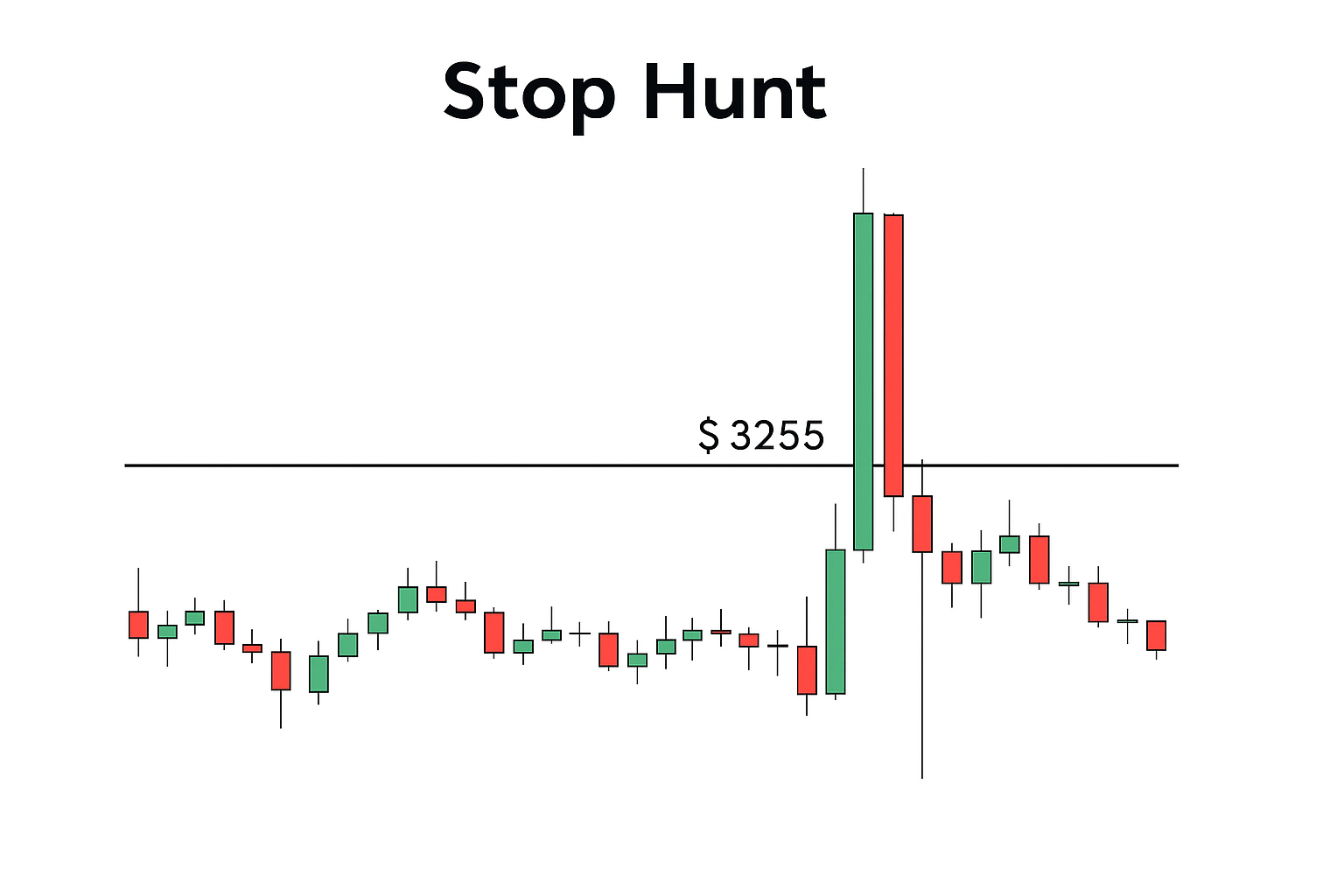
Have you ever heard of a stop hunt?
Maybe you’ve seen it called a liquidity grab, a fakeout, or if you’re feeling extra dramatic, a Judas candle. Whatever you call it, the mechanics are the same—and if you’ve ever placed a stop loss above a major level, or if you’ve ever jumped on what looked like a breakout only to have to turn against you like a spurned lover, you’ve probably donated to one.
Let’s walk through it in plain English. Not theory. Not fairy tales. Just how this really works.
The Setup: A Big Level, a Bunch of Stops, and a Patient Predator
Imagine price is hovering just below a well-known resistance level. Let’s call it $3,355 because hey, this is a real example from yesterday (July 1, 2025). Everyone’s watching it. Everyone’s talking about it. And under that price lies a graveyard of failed trades.
Now—somewhere out there, a big player (call them the whale, the bank, or just the guy with deeper pockets than you) has a problem. They want to sell a massive amount of gold, but there’s a catch:
You can’t sell big unless there’s someone willing to buy big.
Enter the perfect mark: retail stop losses.
The Play: Trigger the Stops, Sell Into the Panic
So what does our whale do?
They wait.
They wait for price to grind its way up toward that $3,355 level—right up to the cliff’s edge—where they know a whole crowd of retail traders have stops placed just above.
Those stops? They’re just exit orders on your trading platform, but an order to exit a “sell” is actually a “buy” order. And those buy orders are just there waiting to be triggered. So if you’re short from $3,350 and you use a stop loss you’d probably set it around $3,3055-6ish. Guess what happens when price taps that level.
Your broker submits a buy order (your exit order) at market price—and the whale is happy to take the other side.
So the big player—calm, calculated, and probably sipping something expensive—drops a large buy order just beneath the stop zone. That push is enough to spike price up into the liquidity pocket… and boom:
All those stop losses start firing like popcorn in a microwave.
Normally, more buy orders would send the price even higher. BUT, at that exact moment—while you’re staring at your screen thinking “I knew it was going to break out!”—the big player is unloading. They’re selling into all those panicked buys, using your exit (and the buy orders from all the retail traders who saw the breakout and piled in) to fund their entry.
The Aftermath: Gravity Returns
Once they’re filled—once they’ve offloaded their entire position into your stop loss—the need to hold price up disappears.
And just like that, the bounce becomes a flush.
The breakout turns into a trap.
And the candle that looked so promising turns into an obituary.
So… Why Does This Matter?
Because if you don’t understand why price moves, you’ll keep getting wrecked by how it moves.
Stop hunts aren’t a conspiracy. They’re a feature of how smart money finds counterparties in a thin market.
And while you’re tweeting “gold breakout incoming 🚀,” the professionals are already fading you with limit sell orders and setting their targets 20 points lower.
What You Can Do Instead
- Don’t place stops where everyone else does. Be smarter than the cluster.
- Look for structure—real structure—not just price levels.
- Learn to recognize impulsive moves without follow-through. That’s usually the tell.
Or, if you’re still unsure?
When in doubt, wait it out. Real breakouts don’t ask you to beg.
Final thought:
If your trade got stopped out and price reversed five seconds later, you weren’t unlucky.
You were the liquidity.
But hey—now you know. And next time, you might just be on the other side.
Leave a Reply