There’s this moment in trading—maybe you know it—where price starts going against you and instead of cutting the trade, you… freeze. You hesitate. You stare at the screen like a dog trying to do algebra. And just like that, a minor flesh wound becomes a third-degree burn.
I used to do that. A lot.
Now I don’t.
Not because I became superhuman.
But because I trained myself to do what any kid learns in the kitchen:
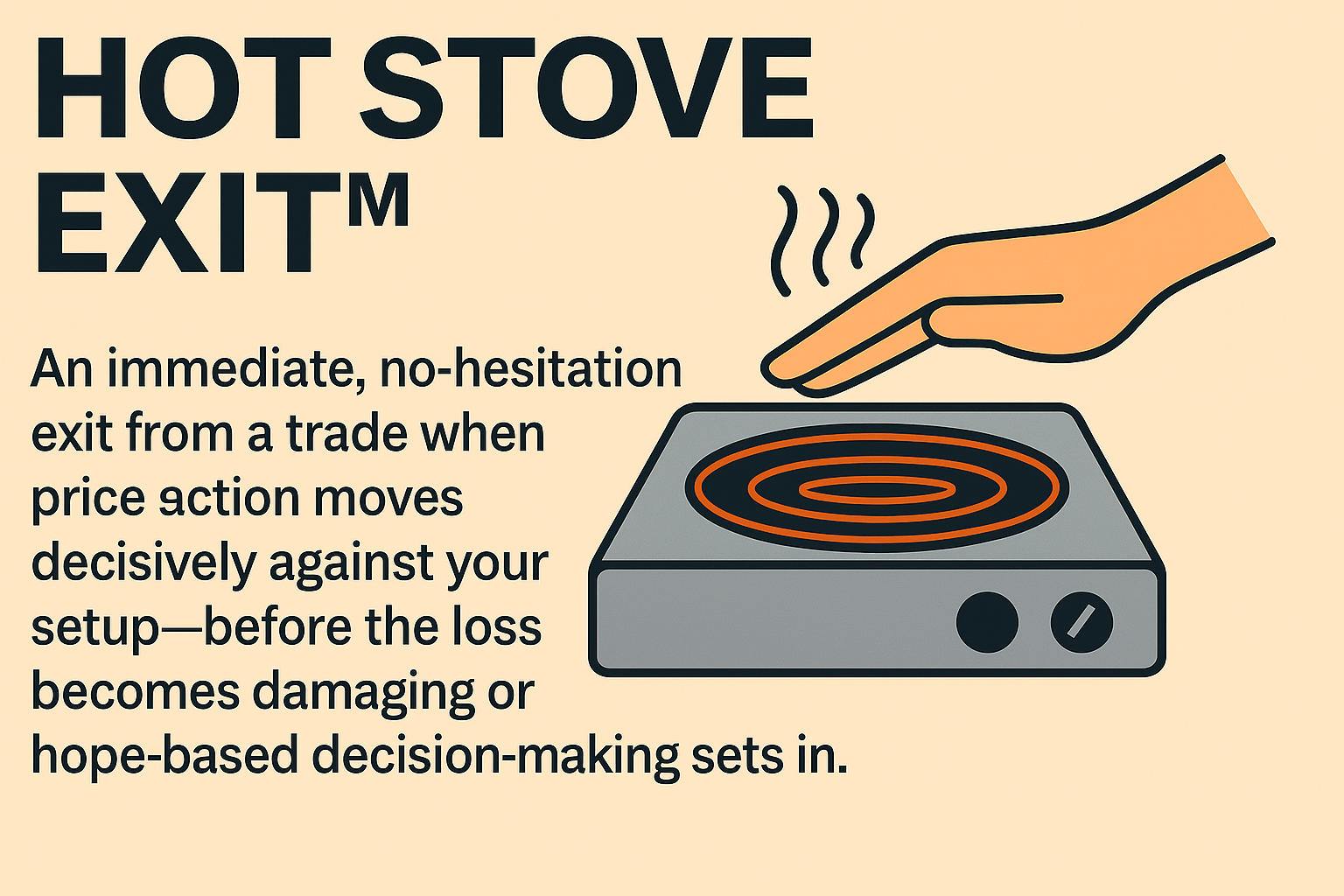
You touch a hot stove, you pull your hand back.
That’s the principle behind what I call the Hot Stove Exit™—and it’s one of the most important rules in my entire system.
🧠 What Is a Hot Stove Exit?
A Hot Stove Exit™ is an immediate, no-hesitation exit when a trade starts to go wrong—before the damage becomes emotional, financial, or existential. It’s not a panic move. It’s a power move. It’s instinct honed by discipline.
You don’t argue with it.
You don’t wait to see if the pain stops.
You get out.
Like… now.
⚙️ When to Use It
Here’s your cheat sheet. You should take a Hot Stove Exit if:
- Your setup invalidates right after entry.
- Price rips through your entry zone like it wasn’t even there.
- You feel a little voice saying, “Maybe I’ll just give it more room.”
- You’re telling yourself, “It’s probably just a pullback…” while staring into the abyss.
- You know what you should do, and you’re already bargaining with it.
Exit.
Don’t think.
Just click.
🆚 Stop Loss vs Hot Stove Exit
| Old Thinking | Hot Stove Exit™ Thinking |
|---|---|
| “I’ll put my stop 25 pips away and hope I’m not wicked out.” | “If this trade invalidates, I’m out before I feel pain.” |
| “Let’s give it a little more room.” | “If I’m hesitating, I’m already late.” |
| “Maybe it’ll come back.” | “Hope is not a strategy. Get out.” |
Most retail traders treat stop-losses like seatbelts… that they unbuckle as soon as the car starts skidding.
The Hot Stove Exit™ doesn’t ask for permission. It acts.
🏋️♂️ How I Trained It (and Still Do)
Like any muscle, this took reps.
- I journaled every time I didn’t take the exit. It was humbling. It was also fuel.
- I ran replay drills. I’d practice entering, watching for invalidation, and exiting without hesitation.
- I started tagging “Hot Stove” exits in my notes so I could see how often they saved me.
- I redefined “winning.” If I exited cleanly and avoided a face-melter, that was a win—even if the trade was red.
You know what started happening?
I stopped blowing up.
I stopped hedging in desperation.
I started trusting myself more.
📜 The Rules in My System
Here’s what’s written into my playbook—and should probably be in yours too:
- If a trade invalidates in the early moments, I exit without hesitation.
- If I feel hesitation, that is the signal. Exit.
- If I’m using hope as an argument, I’ve already lost. Get out.
- A small clean loss is always better than a slow-motion account nuke.
💡 The Takeaway
The Hot Stove Exit™ isn’t just a technique.
It’s a philosophy.
It’s the belief that your capital is sacred and your rules protect it.
It’s choosing discipline over drama.
It’s a trader’s version of wisdom—earned in the fire.
So the next time your hand’s on that burner?
Pull it back.
Fast.
You’ll thank yourself later.
P.S. Take the name Hot Stove Exit with a grain of salt. It’s just another name I gave to what is often called a manual hard stop.
Leave a Reply