Tag: education

  • Which TradingView Indicators I Use (and Why)

    Which TradingView Indicators I Use (and Why)

    By The Barcelona Trader

    Every trader’s chart is like their kitchen.

    Some keep it minimalist: one chart, one candle type, one crusty RSI from 1984.
    Others layer on so many indicators it looks like a Christmas tree had a seizure.

    I like tools that work—and I keep them clean, readable, and purposeful. I don’t chase the “magic indicator.” I just want clarity, structure, and actionable context.

    So here’s exactly what I use on TradingView—from candles to signals—and why.


    Candles: Heiken Ashi (Yes, Really)

    First, the basics: I use Heiken Ashi candles.
    I know some people get weird about this, but hear me out.

    Heiken Ashi smooths out noise. It gives you a better sense of trend structure. It’s not great for precise entry signals—but that’s not what I use candles for anyway. I use them for reading context, flow, and rhythm.

    I’ve got:

    • Gold candles for bullish moves—because, duh, I trade gold.
    • Blue candles for bearish moves—because… I like blue. That’s it. No deeper reason.

    My Indicator Stack

    🔹 Support & Resistance

    This one auto-plots key S/R levels—and it does a pretty damn good job.

    I use it to keep my chart honest. We all “see levels” when we want to—but this plots zones based on actual reactions, not my imagination.


    🔹 Three 32-period EMAs

    • One set to High
    • One to Low
    • One to Close

    Why three? Because I want to see structure.
    The high/low EMAs create a “channel” that shows me the heartbeat of price. When candles close outside that band, something’s shifting.

    This is how I keep one eye on trend bias without pretending I’m smarter than price.


    🔹 Linear Regression Channel

    This one gives me context on trend strength and direction.

    It’s math-y, yes. But it’s helpful for spotting mean reversion zones, exhaustion, and whether price is respecting a statistically clean slope—or faking everyone out.


    🔹 Support & Resistance with Breaks and Bounces

    This does what it says on the tin:
    It highlights when levels are being tested, broken, or respected.

    I don’t base entries off this alone, but it’s extremely helpful for confirming behavior.
    If I see a bounce where I expect one—or a break where there shouldn’t be one—it flags something worth digging into.


    🔹 200 EMA

    The classic. The legend. The granddaddy of moving averages.

    It’s not sexy, but it works.

    I use it mostly as a macro directional bias—especially when trading on lower timeframes. If price is aggressively under or over the 200 EMA, that’s information.


    🔹 Consolidation Zones

    This one identifies areas where price is going sideways—building energy, or just stalling before a move.

    It’s hugely helpful for avoiding entries in chop.
    No one likes getting smacked around in a fakeout. This helps me stay out of flat zones unless I have a specific plan to fade or trade the breakout.


    🔹 ChartPrime’s Free Indicator: Swing Ranges

    This one plots swing highs and lows across multiple timeframes.

    I use it to see where momentum has shifted and where price might hit a wall. If gold is pushing into a prior swing high with low conviction, I’m paying attention.


    🔹 ChartPrime’s Swing High/Low Tool

    Even cleaner than the swing ranges. It shows real turning points, not just every tiny pullback.

    I don’t trade off this in isolation, but I use it for context—especially in combination with my EMAs and S/R.


    🔹 Elite Algo: Main Signal Indicator (Paid)

    This is one of the few premium tools I pay for. It combines trend direction, entry signals, and filters into a sleek little package. I don’t even use the signals. They’re way late for how I trade. But I like their trend dashboard and and their trend cloud.

    Do I trust it blindly? Of course not.
    But it’s excellent for confirming setups I already have on my radar.


    🔹 Elite Algo: Volume Indicator (Paid)

    This shows volume in a way that makes sense.

    No weird rainbow bars. No clutter.
    Just clean visual confirmation of where interest is showing up—or vanishing.


    Final Thoughts: Use Tools, Not Crutches

    The indicators above help me see the market clearly.
    They don’t make decisions for me.
    They don’t replace discipline.
    They don’t fix bad habits.

    But they do give me structure, clarity, and data—and when I combine that with a clean mindset and a defined system, that’s where the magic happens.

    Don’t look for the indicator that does the work for you.
    Use the ones that make your work cleaner.

    And if you’re chasing 12 signals, 14 trendlines, and three different colors of VWAP?

    Let’s simplify.

    Because simple, structured trading—especially on gold—is the real flex.

  • The Fixed Range Volume Profile: Why It Matters, and How to Use It

    The Fixed Range Volume Profile: Why It Matters, and How to Use It

    By The Barcelona Trader

    Let’s talk about a tool that actually matters.

    Not a gimmick. Not a “secret weapon.” Not some recycled 2007 YouTube strategy rebranded with a new acronym and a $997 course.

    I’m talking about the Fixed Range Volume Profile—also known as FRVP—and it’s one of the most powerful, overlooked tools a serious trader can add to their chart.

    If you trade gold and you’re not using it, you’re operating half-blind.


    What Is It?

    The Fixed Range Volume Profile shows you how much volume was traded at each price level—not over the entire chart, but over a specific window of time that you define.

    In TradingView, it’s already built in.

    Here’s how to find it:

    1. Open your chart
    2. Hit Indicators → search for “Fixed Range Volume Profile”
    3. Click it
    4. Then click and drag across any time segment you want to analyze—consolidation, breakout leg, pullback, whatever

    And just like that, the chart stops whispering and starts telling the truth.


    Let’s Talk About the Terms That Actually Matter

    There are a few key concepts FRVP gives you—and they’re not complicated, just underutilized:

    • POC (Point of Control):
      The price level where the most volume was traded in that time range.
      Think of it as the market’s center of gravity. The most accepted price.
      👉 Don’t trade into it blindly. Watch how price reacts around it—magnet or repeller?
    • Value Area (VA):
      The range that contains roughly 70% of all traded volume in your selected range.
      👉 Inside the value area = indecision. Outside it = opportunity.
    • HVN (High Volume Node):
      Thick volume = sticky price. Price tends to stall or revert here.
      👉 Don’t expect explosive moves through HVNs—they’re built for chop.
    • LVN (Low Volume Node):
      Thin volume = low interest = fast movement.
      👉 When price hits an LVN, it usually doesn’t stick around to negotiate.

    How I Use It (And How You Should Too)

    When I’m trading gold, I’m not just clicking buttons. I’m reading footprints. Here’s how FRVP helps:

    1. I define the zone.
      Drag the tool over a specific time range—like a recent breakout leg, a pre-market consolidation, or a trend correction.
    2. I identify the POC.
      I want to know where the market was most comfortable. Spoiler: that’s not where I want to be trading.
    3. I watch for reaction at the edges.
      The edges of the value area and the nearby volume nodes tell me whether this is a breakout, a rejection, or a trap waiting to happen.
    4. I trade away from acceptance, not into it.
      Think like a magnet: price is attracted to the POC, but once it gets there, it’s just as likely to spring away from it as it is to stay. Context is everything.

    Why It’s So Useful—Especially on Gold

    Gold is a twitchy, emotionally charged instrument.
    It reacts to structure. It respects levels. And it loves to trap traders at the worst possible moment.

    The FRVP gives you clarity about where the market actually did business.
    Not where you think it should have. Not where your Fibonacci said it might.
    Where traders actually showed up with size.

    That’s an edge.


    One Last Thing

    Don’t treat this like a magic wand. It’s not a signal generator. It’s a context tool.

    Use it to:

    • Frame your bias
    • Stay out of trouble
    • Avoid chasing candles through chop
    • And stop trying to buy pullbacks that are actually just re-tests of a sticky high-volume node

    Trade like a professional: wait for the market to leave a trail—then follow it.


    The Fixed Range Volume Profile doesn’t predict anything.
    But it does explain everything.
    And sometimes, that’s exactly what you need.

  • The Forgotten Power of Pivots

    The Forgotten Power of Pivots

    By The Barcelona Trader

    Let me tell you something the YouTube trading bros won’t:

    Pivots still matter.

    I know—I know. They’re not shiny. They don’t come with acronyms like ICT or SMC. They’re not based on smart money, liquidity raids, or whatever other spooky bedtime story is trending this week in Trading TikTok land.

    But pivots? They’ve been around longer than most of these kids have been alive.
    And they still work—especially on gold.


    A Brief History of the Pivot

    Pivots were originally created by floor traders. Not the latte-sipping, dual-screen influencers of today, but actual open-outcry traders—guys who wore weird jackets, shouted across rooms, and made six figures while doing math with a pencil stub.

    They used pivots to figure out:

    • Where price might stall
    • Where the market might reverse
    • Where they might finally stop averaging into a loser and cry into their trading jacket

    The Daily Pivot Point (DPP) was the anchor. Everything else—support and resistance levels—was built from that.

    And it wasn’t just daily. You’d calculate weekly pivots. Monthly. And then you’d watch for confluence. Because that’s where things got interesting.


    What Tono Taught Me to Use (And Why It Works)

    Here’s my pivot stack:

    • DR3 – Daily Resistance 3
    • DR2 – Daily Resistance 2
    • DM4 – Midway between DR2 and DR3
    • DR1
    • DM3
    • DPP – Daily Pivot Point
    • DM2
    • DS1
    • DM1
    • DS2 – Daily Support 2
    • DS3 – Daily Support 3

    I use the same structure for weekly and monthly pivots.

    And no, it’s not because I’m nostalgic for the ‘90s.

    It’s because when a Daily and a Weekly pivot align? That’s not just a level—it’s a statement.
    Same goes for a Monthly and a Weekly, or a Daily and a Monthly.
    These are the levels where the market pauses, thinks about its life choices, and often turns around.


    Why Most Traders Ignore Them (And Why That’s a Mistake)

    Pivots have fallen out of fashion because they’re too simple.
    They don’t come with a 20-hour video course or a 200-page PDF with watermark branding and “edge” in the title.

    They’re just math.
    But guess what?

    So is the market.

    The big players still see these levels. Banks, institutions, prop firms—they may not talk about pivots, but they absolutely react to them. And when you’re trading something as volatile and technically sensitive as gold, those reactions matter.


    Why Pivots Work So Well on Gold

    Gold is emotional.
    It’s reactive.
    It’s loved, hated, hoarded, and dumped.

    And it respects technical levels better than just about any other instrument. Especially when the world’s on edge—which, spoiler, is always.

    That’s why when DR1 lines up with the Weekly Pivot and price slams into it?
    I’m watching.
    That’s not a coincidence. That’s order flow memory.

    You can trade gold without pivots, sure.

    You can also skydive without a parachute.
    It’s only a problem once.


    The Point

    If you’re serious about trading gold—especially if you’re scalping it or working breakouts on the lower timeframes—pivots aren’t optional. They’re your context. They’re your map. They help you understand when a move has juice… and when it’s running into a wall that price has respected 300 times over the last five years.

    SMC? ICT? Smart money this, imbalance that?

    Cool. If it works for you, great.

    But don’t throw out the tools that have been working longer than you’ve been alive just because some guy in a backwards hat on YouTube called them “retail nonsense.”

    Because let me tell you what’s nonsense:

    Ignoring a Monthly Pivot that just aligned with a Weekly and a Daily—and has already seen reactions all week—just because it doesn’t fit your “order block narrative.”


    Use your pivots.
    Stack your timeframes.
    And trade like someone who didn’t just Google “how to become a millionaire in 30 days.”

  • When You Don’t Know What You Don’t Know: The Trader’s Early Years

    When You Don’t Know What You Don’t Know: The Trader’s Early Years

    There’s a special kind of purgatory in trading. Not the blow-up-your-account-on-a-whim kind. I’m talking about the early years. The “I think I might be getting good but also I might be an idiot” phase. The silent, maddening ambiguity of not knowing if your strategy is flawed, the market’s just acting up, or you’re the problem.

    Spoiler: it’s probably all three. But the worst part? You can’t tell.

    If this is you, I’ve got good news and bad news. The good news: you’re not alone. The bad news: that doesn’t make the fog go away.


    Welcome to the Dunning-Kruger Forest, Population: You

    At first, you think you’ve found it—the setup, the edge, the holy grail with three confirmations and a candle pattern that whispers sweet profits into your ear. You win a few trades and suddenly the world makes sense.

    Then you lose. Then you lose again. And now every candle looks like it’s gaslighting you. Your confidence? Gone. Your strategy? A fever dream. Your trading desk? A crime scene.

    The ambiguity of this stage is brutal. You don’t yet have the reps to know if your idea would work in the long run. You haven’t been burned enough to recognize a broken system—or to realize that maybe your system is fine, but you keep throwing your hand on the stove.


    What You Need to Know About Shortcuts

    Here’s where I have to stop you, gently but firmly, and drop a word of caution.

    There are no shortcuts in this game. None. Zero. It doesn’t matter how clever you are or how many motivational YouTube reels you watch and no matter what that scene in Limitless makes you believe, if only you had the right drugs.

    Sure, some people pick things up faster than others—just like some folks can learn a new language in six months while others take six years. But everyone has to learn the grammar, the syntax, the meaning behind the noise. Trading is no different.

    If you’ve come into this because you need to make money fast—or because you’re hoping to be the exception—you’re going to be especially tempted to engineer a shortcut. And the cruel irony is, if you are that one-in-a-million with a special knack, you’ll only know it in hindsight. There’s no reliable way to tell upfront.

    So please hear this: I don’t know a single successful trader who hasn’t blown multiple accounts. Not one. They’ve all had their ‘this is the bottom of the pit’ moments. You are doing yourself a disservice if you don’t give yourself the room to try, fail, and try again.

    Think about how babies learn to walk. There is no such thing as the baby who stands up one day and just struts off across the room like a tiny little Steve Jobs in a diaper. Every single one of them falls. It’s not just expected—it’s how they learn balance, strength, and how to recover.

    Same with trading. If you haven’t fallen down, you don’t even know what you don’t know.


    How to Tell If This Is You

    Here’s a quick check. If you answer “yes” to more than a few of these, you’re in the early fog—and that’s okay:

    • Are you changing your rules every week because “this week’s market was different”?
    • Do you find yourself winning and still feeling confused?
    • Do you lose and immediately go back to the drawing board, convinced your strategy is trash?
    • Do you get shaken out of trades right before they do what you originally expected?
    • Do you feel like trading is 70% technical and 30% sorcery?
    • Are you suspicious that other traders are seeing something you’re not?

    Sound familiar?


    The Real Problem: No Control Group

    In science, if something fails, you rerun the experiment. You isolate variables. You tweak one thing at a time.

    In trading? Good luck. Markets change. Your discipline fluctuates. News bombs drop. And the sample size is never large enough for comfort. So you don’t know if your system works. You don’t know if your edge is real. And that not-knowing will eat you alive if you let it.


    What You Can Do

    Here’s the lifeline: you need structure. Not answers. Not certainty. Structure.

    • Pick a strategy and stick to it for 100 trades.
    • Track everything—setup type, execution, emotion, result.
    • Categorize your losses: was it you, the market, or the system?
    • Revisit only after you’ve collected real data—not vibes.

    And above all, start building the muscle of self-trust. That means obeying your own rules. That means exiting when you said you’d exit. That means not revenge-trading because your feelings got hurt.


    Final Word

    The early years are foggy for everyone. That’s not a failure. That’s the climb. And clarity doesn’t come from brilliance—it comes from endurance, data, and doing the work. The traders who make it through aren’t necessarily the smartest. They’re the ones who kept walking through the fog without throwing away the map.

    If that’s you—keep going.

    You’re not lost. You’re just early.

  • Why Learning to Trade Is So Hard

    Why Learning to Trade Is So Hard

    Learning to trade is hard.

    Not “organic chemistry” hard. Not “learning Mandarin from scratch” hard.
    It’s something worse: It’s ambiguous.

    You don’t get a clean answer. No red X or green check.
    No clear sense of whether you did it right—only a P&L that whispers, “Maybe.”

    And that’s the killer.

    Most things you learn have a feedback loop that makes sense. You shoot a basketball. It goes in or it doesn’t. You write a song. It moves someone or it doesn’t. But trading? You can do everything wrong and still make money. Or do everything right and get stopped out like a rookie.

    So let’s get to the real reason this is so brutal:

    You can’t tell if your system is bad—or if you’re just bad at executing it.

    And that’s where traders lose their minds.

    You start second-guessing.
    You change systems too early.
    You stick with losers too long.
    You tell yourself it’s just variance—but secretly you think you’re the problem.

    Spoiler: You might be the problem.
    But the system might be garbage too. And until you get consistent, you won’t know.

    Welcome to the most maddening apprenticeship in the world.


    The Real Curriculum of Trading

    You thought you were here to learn price action?

    Nah.

    You’re here to learn how to not lose your mind while waiting to know if you’re good.

    You’re learning how to:

    • Trust a process you can’t prove until after the fact.
    • Take the same setup five times in a row even if the last three were losers.
    • Exit a losing trade even when every bone in your body says “just hold a little longer.”
    • Walk away from the screen when your P&L is red and your ego is screaming.

    These are not “trading skills.”
    These are emotional skills. Psychological endurance. Risk tolerance. Identity management.

    No course on candlestick patterns is going to give you that.


    Why Most People Quit

    Most people don’t quit trading because it’s boring or because they can’t understand the mechanics.

    They quit because they can’t tolerate the ambiguity.
    They can’t sit with the idea that they’re six months into this thing and still don’t know if they’re improving—or just creatively blowing up their account in slower motion.

    They crave certainty in an uncertain game.

    And that’s fatal.

    Because trading doesn’t hand you certainty. It offers you probability.
    It offers you edge.
    And it offers you pain.

    Your job is to get good enough at managing the pain to let the edge play out.


    If You’re Still Here…

    If you’re still at it—still refining your process, still showing up, still trying to do the boring, disciplined thing instead of chasing dopamine—then you’re already further than most.

    And if you’ve got a system with a true edge, even a small one?
    Then it’s not about your strategy anymore.
    It’s about your survival.

    Not blowing up. Not giving in.
    Not needing to be right—just needing to follow the rules long enough to become right.

    Because the truth is:

    Trading doesn’t reward intelligence. It rewards endurance.

    So ask yourself:

    Can you execute a good plan poorly without losing faith in it?

    Can you trade like a machine even when your emotions are howling?

    Can you sit in ambiguity long enough to find clarity on the other side?

    If the answer is yes—even on your bad days—then you might actually make it.


  • How We Describe Our Edge

    How We Describe Our Edge

    There’s no shortage of ways to trade the markets—truly, it’s a buffet of chaos. Which is exactly why so many new traders wind up cross-eyed by the time they finish their second week in the content rabbit hole. One expert swears off trading news events like they’re cursed scrolls, while another lives and dies by the NFP candle. One says to let your winners run until the sun explodes. Another says, “Grab that profit like it’s the last slice of pizza.” And there you are—wide-eyed, caffeinated, and trying to weld together twelve contradictory systems into one hybrid beast that doesn’t resemble a strategy so much as a cry for help.

    But here’s the thing: most of that advice isn’t bad—it just doesn’t belong in the same toolbox. A tight stop makes perfect sense if you’re swing trading stocks. It makes less sense if you’re scalping gold on a 10-second chart while riding adrenaline like it’s a rollercoaster. Even among scalpers, there are flavors: some fade, some chase, some break out, some hedge, and some just vibe it out and hope for the best. So the real problem isn’t that you’re being misled. It’s that you’re being overwhelmed. Trying to synthesize a dozen trading philosophies at once is like trying to conduct an orchestra where each musician is playing a different song. The fix? Pick one system. One style. One voice to follow. Go deep, not wide. Get consistent. Then evolve.

    The strategy we use is built on sharp, tick-based Renko entries layered with clear inflection points like pivots and POCs. We add to that a scalper’s rulebook, refined price action instincts, and—in spot gold—a hedging method that lets us absorb volatility and stay in the game longer than most.

    In gold futures, we swap out hedging for our Hot Stove Exit: fast, disciplined trade management that cuts heat before it burns capital. We scale this across multiple accounts, keeping risk per contract constant. The edge isn’t just in spotting setups—it’s in surviving long enough to let them pay.

    Sure, it might sound complex at first, but once it clicks, it’s like seeing the Matrix—and realizing you’ve been trading in crayon this whole time. So what makes our style different? We’re not here for 2% or 5% gains like it’s some polite retirement portfolio. We show you how we withdraw 70%, 80%, even 100% of our account size every month while leaving our base capital in for the following month so we can do it again. Not grow it. Not compound it. Withdraw it. As in: “Thank you, broker, I’ll take that in cash.”

  • The Hot Stove Exit™ – How I Learned to Stop Melting My Hand Off

    The Hot Stove Exit™ – How I Learned to Stop Melting My Hand Off

    There’s this moment in trading—maybe you know it—where price starts going against you and instead of cutting the trade, you… freeze. You hesitate. You stare at the screen like a dog trying to do algebra. And just like that, a minor flesh wound becomes a third-degree burn.

    I used to do that. A lot.
    Now I don’t.
    Not because I became superhuman.
    But because I trained myself to do what any kid learns in the kitchen:

    You touch a hot stove, you pull your hand back.

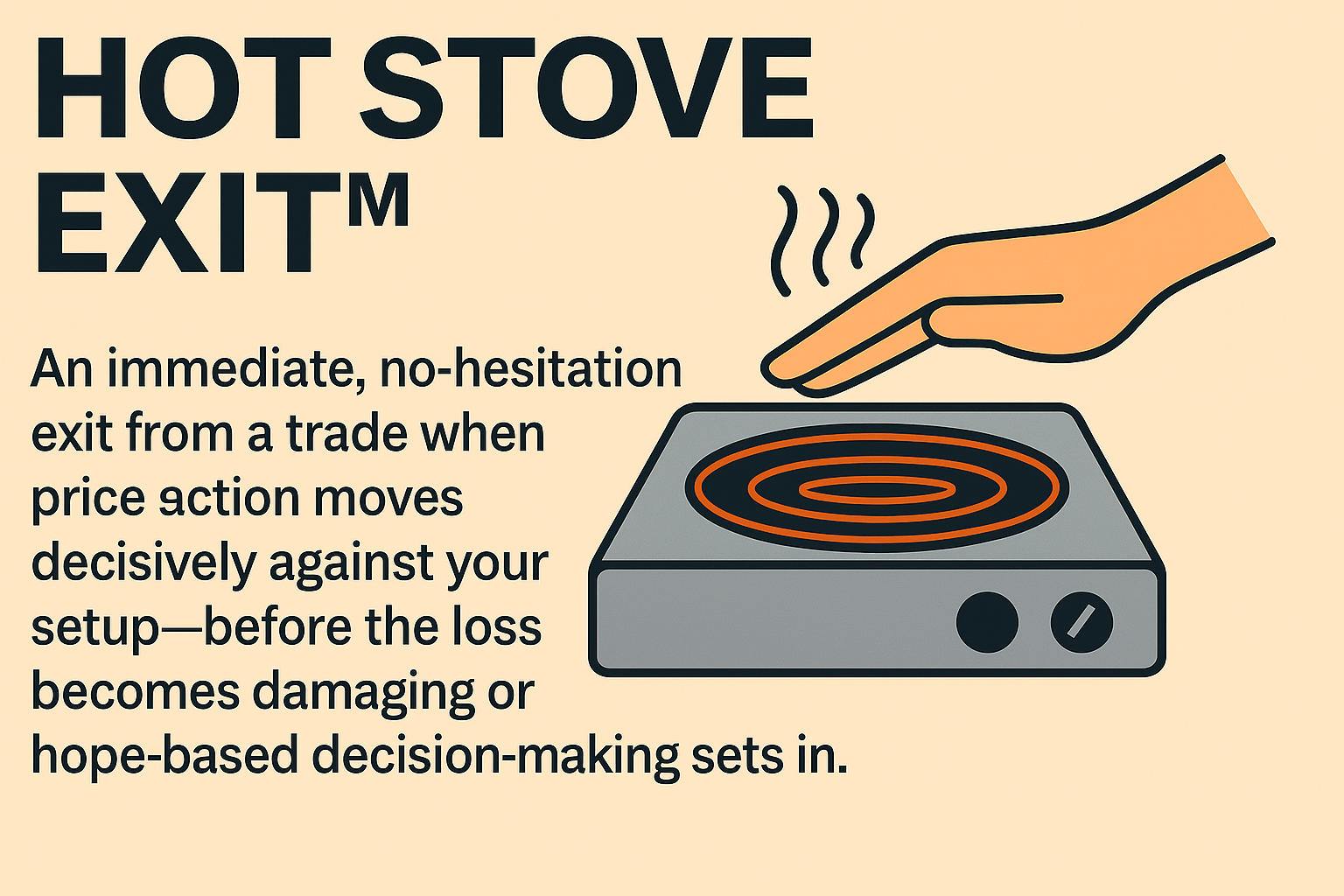
    That’s the principle behind what I call the Hot Stove Exit™—and it’s one of the most important rules in my entire system.


    🧠 What Is a Hot Stove Exit?

    Hot Stove Exit™ is an immediate, no-hesitation exit when a trade starts to go wrong—before the damage becomes emotional, financial, or existential. It’s not a panic move. It’s a power move. It’s instinct honed by discipline.

    You don’t argue with it.
    You don’t wait to see if the pain stops.
    You get out.

    Like… now.


    ⚙️ When to Use It

    Here’s your cheat sheet. You should take a Hot Stove Exit if:

    • Your setup invalidates right after entry.
    • Price rips through your entry zone like it wasn’t even there.
    • You feel a little voice saying, “Maybe I’ll just give it more room.”
    • You’re telling yourself, “It’s probably just a pullback…” while staring into the abyss.
    • You know what you should do, and you’re already bargaining with it.

    Exit.
    Don’t think.
    Just click.


    🆚 Stop Loss vs Hot Stove Exit

    Old ThinkingHot Stove Exit™ Thinking
    “I’ll put my stop 25 pips away and hope I’m not wicked out.”“If this trade invalidates, I’m out before I feel pain.”
    “Let’s give it a little more room.”“If I’m hesitating, I’m already late.”
    “Maybe it’ll come back.”“Hope is not a strategy. Get out.”

    Most retail traders treat stop-losses like seatbelts… that they unbuckle as soon as the car starts skidding.

    The Hot Stove Exit™ doesn’t ask for permission. It acts.


    🏋️‍♂️ How I Trained It (and Still Do)

    Like any muscle, this took reps.

    • I journaled every time I didn’t take the exit. It was humbling. It was also fuel.
    • I ran replay drills. I’d practice entering, watching for invalidation, and exiting without hesitation.
    • I started tagging “Hot Stove” exits in my notes so I could see how often they saved me.
    • I redefined “winning.” If I exited cleanly and avoided a face-melter, that was a win—even if the trade was red.

    You know what started happening?
    I stopped blowing up.
    I stopped hedging in desperation.
    I started trusting myself more.


    📜 The Rules in My System

    Here’s what’s written into my playbook—and should probably be in yours too:

    • If a trade invalidates in the early moments, I exit without hesitation.
    • If I feel hesitation, that is the signal. Exit.
    • If I’m using hope as an argument, I’ve already lost. Get out.
    • A small clean loss is always better than a slow-motion account nuke.

    💡 The Takeaway

    The Hot Stove Exit™ isn’t just a technique.
    It’s a philosophy.

    It’s the belief that your capital is sacred and your rules protect it.
    It’s choosing discipline over drama.
    It’s a trader’s version of wisdom—earned in the fire.

    So the next time your hand’s on that burner?
    Pull it back.

    Fast.

    You’ll thank yourself later.

    P.S. Take the name Hot Stove Exit with a grain of salt. It’s just another name I gave to what is often called a manual hard stop.

  • Who Should—and Who Shouldn’t—Consider Trading

    Who Should—and Who Shouldn’t—Consider Trading

    Let’s have an honest conversation.

    Trading isn’t for everyone.
    And no matter what the gurus tell you, it’s not a side hustle you can casually pick up between lattes and leg day.

    So if you’re thinking about diving in, here’s a brutally honest breakdown:


    ✅ Who Should Consider Trading:

    1. People who love solving puzzles

    Markets aren’t slot machines. They’re logic puzzles with missing pieces and constantly shifting rules. If you enjoy sitting in uncertainty and figuring out patterns—welcome.

    2. People who can manage their emotions under pressure

    You know that guy who calmly changes a flat tire in a thunderstorm while everyone else panics?
    That guy might make a good trader.

    3. People who are obsessive learners

    If you can fall down a rabbit hole of technical setups, backtesting, market structure, and economic theory for hours without blinking—you’re probably wired for this.

    4. People who take responsibility for their actions

    You took the trade. You set the risk. You lost the money. Can you own that without blaming Powell, your broker, or Mercury in retrograde? If yes, you’ve got a shot.

    5. People who are okay with slow success

    No instant gratification here. If you can show up daily, fail gracefully, learn, refine, and keep showing up? You’re the kind of stubborn this game rewards.


    ❌ Who Shouldn’t Consider Trading:

    1. People looking for fast cash

    If your goal is to double your money by Friday or “make back what you lost last month,” go to Vegas. At least they give you free drinks when you blow your bankroll.

    2. People who can’t sit still

    If you need action every five minutes, you’ll force trades that shouldn’t exist. Trading is mostly boredom interrupted by occasional terror. If that’s not your thing—no judgment.

    3. People who hate uncertainty

    There are no guarantees. You can do everything right and still take a loss. If you need certainty, structure, and a paycheck every two weeks—trading is not your path.

    4. People who don’t want to journal or review their own behavior

    If you’re not willing to study your own patterns, impulses, and mistakes, this game will eat you alive. You don’t just trade the market—you trade yourself.

    5. People who refuse to be wrong

    This one’s a killer. If being wrong bruises your ego, don’t trade. Trading requires being wrong often—and learning to be okay with it. It’s not failure. It’s feedback.


    So… should you trade?

    If reading this list made you nod? Maybe.
    If it made you twitch, sweat, or mutter “well not me exactly, but…”—probably not.
    At least not yet.

    This game is simple, but it’s not easy.
    It’s not a grind for everyone. But it is a grind.
    And if you’re not wired for it—you will find a hundred easier ways to make money.

    But if you are?

    There’s nothing like it.


  • The Tedium of Trading

    The Tedium of Trading

    Nobody tells you this when you’re getting started, but I’m going to do you a favor:

    Trading is boring.
    Stupidly boring.
    Like-watching-a-pot-of-gold-not-boil boring.

    Not always, of course.
    There are moments of chaos, adrenaline, and “holy sh*t I nailed that entry”—
    But those moments are rare.

    Most of the time?
    You’re waiting.
    Staring.
    Marking levels.
    Checking news.
    Scrolling.
    Talking to yourself.
    Convincing yourself not to click anything.
    And then deleting the Discord app for the fifth time that week.

    This is the part that almost no one posts about.
    Because let’s be honest: “Traded nothing for three hours, went flat, journaled, ate a sandwich” doesn’t make for exciting content.

    But that’s the job.


    Trading isn’t charts and fireworks.

    It’s mostly sitting still, managing boredom without making a mistake.

    It’s knowing the level you want, seeing price dance 20 pips below it for 45 minutes, and still not jumping the gun.
    It’s waiting for your setup to actually trigger, while your brain whispers,
    “Come on, we could just get in now. We know what we’re doing.”

    Sure you do, cowboy.
    That’s how you blow $800 on a Tuesday morning.


    And then—suddenly—it happens.

    The setup forms.
    Structure confirms.
    The candle closes.
    And now you have… 90 seconds to make a decision that took you 4 hours of discipline to earn.

    You click.
    You manage.
    You hold. Or cut. Or hedge.
    And then…
    back to the boredom.


    This is the real rhythm of trading:
    Boredom. Boredom. Boredom. Decision.
    Repeat.

    If you can’t master the boredom, you’ll never survive the trade.
    Because the trades don’t get you.
    The boredom does.

    It eats at your discipline.
    It invites your impulses.
    It tricks you into “doing something” just to feel productive.
    And nine times out of ten, that “something” costs you money.


    So if you’re bored while trading…
    Good.
    That means you’re doing it right.

    You’re not overtrading.
    You’re not chasing.
    You’re not making stuff up just to stay stimulated.

    You’re waiting.
    Like a sniper.
    Like a pro.

    And when the moment comes—you’re ready.


    Let the others post fireworks.
    You focus on the part that matters:

    The boring, brutal, beautiful discipline of doing nothing… until it’s time.

  • Why Signals Don’t Work—And What Actually Does

    Why Signals Don’t Work—And What Actually Does

    To a new trader, signals seem like a no-brainer.

    Someone who knows what they’re doing tells you when to enter.
    You copy the trade. You size it properly. You exit when they say.
    Done.

    So why doesn’t that work?

    Here’s the truth:
    Signals seem simple. But trading isn’t.

    And the second you try to reduce a live, high-stakes decision-making process to a notification on your phone, the whole thing starts to fall apart.

    Let’s break this down.


    1. Trading is more than entry and exit.

    A trade signal gives you a moment in time.
    But it doesn’t give you the reasoning behind it, the conditions for exiting early, or the context that shaped the decision in the first place.

    The signal provider might:

    • Be scaling in or out
    • Have a hedge running
    • Be adjusting risk mid-trade
    • Be trading a specific news narrative you’re unaware of

    You don’t see any of that.
    All you get is “Buy 2362. Target 2382. Stop 2348.”

    You think you’re copying their trade.
    You’re not.
    You’re copying a snapshot—without the logic, the management, or the mindset.

    That’s not replication. That’s blindfolded imitation.


    2. Even “good” signals don’t account for your psychology.

    Let’s say the trade goes red at first.
    The signal provider is calm—they’ve seen this setup play out a hundred times.
    You? You panic, bail early, then watch the trade hit full TP.

    Now you’re gun-shy.
    The next trade? You hesitate—or size up to make back what you missed.
    Your mindset is compromised.
    That’s not the signal’s fault. But it is your outcome.

    Trading success isn’t just about what you do.
    It’s about how you react to what happens after.

    And no signal can manage your fear, your greed, or your FOMO for you.


    3. You’re not learning. You’re leaning.

    Following signals might feel like progress.
    But it’s not. It’s stalling.

    • You’re not building skill
    • You’re not learning structure
    • You’re not developing any self-trust

    So the moment the signals stop—or the provider has a bad week—you’ve got nothing to fall back on.

    You didn’t grow. You just followed.
    And now you’re back where you started, only more frustrated and down a few thousand dollars.


    4. Copy trading systems are built differently. Signals aren’t.

    Let’s get one thing straight:
    Copy trading ≠ signal following.

    With copy trading, the provider’s exact trades are executed on your account in real time—same entry, same exit, same scale.
    But with signals? You’re placing your own trade, at your own broker, with your own latency, your own emotions, and your own money.

    There’s nothing “automatic” about it.
    And unless you’re glued to your screen with zero distractions, it’s easy to miss a signal—or worse, execute it late and at the wrong level.

    Signals don’t account for slippage, spreads, emotions, or context.
    That’s why they fail.


    So what does work?

    Live trading. In real time. With real context.

    When you trade live with us—watching the charts as we mark levels, explain setups, manage risk, and take positions—you’re not just copying a call.

    You’re learning how to:

    • Spot clean entries before they form
    • Understand why a trade is taken—or skipped
    • Manage size, cut losses, and hold through volatility
    • Adapt when the market fakes out or flips
    • Control your own decision-making under real pressure

    It’s not signals. It’s training.

    Because the goal isn’t to follow someone forever.
    The goal is to eventually not need anyone at all.


    Signals can show you what someone else did.
    Live trading shows you how to do it yourself.

    And in the long run, that’s the only skill that matters.