Tag: forex

  • When the World Gets Laid Off and Everyone Starts Trading

    When the World Gets Laid Off and Everyone Starts Trading

    Let’s play something out.

    Let’s say it’s a year or two from now.
    AI has finished doing what it’s been quietly doing in the background—decimating white-collar jobs.

    Not blue-collar. Not frontline.
    I’m talking mid-career, highly educated, salaried professionals—marketing managers, financial analysts, product leads, lawyers, consultants, you name it.

    The very people who used to smirk when someone said they were trading for a living.
    Gone. Displaced. Deskless.

    And now guess what?

    They start trading.


    From Meetings to Markets

    You’ll see them flood in by the tens of thousands—people who used to run brand strategy for fintech apps, or give quarterly updates to boardrooms, or write spreadsheets that made other spreadsheets nervous.

    And now they’re sitting in front of TradingView, eyes wide, asking ChatGPT,

    “How do I scalp gold futures on a 10-second chart?”

    And the internet will answer.

    And they will believe it.

    And they will get wrecked.

    Not because they’re stupid.
    Because they’ve spent their whole careers being rewarded for effortintellect, and showing up early to meetings.

    None of that helps here.


    Trading Isn’t the New Career. It’s the New Fantasy.

    In this scenario, trading becomes the next “learn to code.”
    A myth wrapped in urgency: “If I can just make $500 a day…”

    You’ll see:

    • YouTube channels with slick ex-consultants explaining breakouts they don’t actually trade
    • Discord servers filled with high-IQ people drawing perfect fib levels over completely random price action
    • LinkedIn posts that start with “After losing my job to AI, I found purpose in the markets…”

    It’ll feel like a revolution.
    But it will be a bloodbath.

    Because the market is not your therapist. It’s not your comeback story.
    And it does not care how many degrees you have.


    And Then Comes the Twist: AI Enters Trading Too

    While all these displaced professionals are trying to trade using AI tools, institutions are deploying next-gen AI againstthem.

    AI will:

    • Scrape forums and sentiment
    • Detect overused pattern bots
    • Trigger fake breakouts to trap GPT-trained retail traders
    • Adapt faster than the humans using it

    So now you’ve got millions of people trying to get rich using AI to trade…
    While actual market-moving AI is front-running their ideas and laughing in code.


    Trading Becomes a Combat Sport

    At this point, trading stops being a clever side hustle.
    It becomes a full-contact performance profession.

    Like boxing, or jiu-jitsu—except you’re fighting liquidity, latency, and your own impulse control.

    Edge becomes rare again.

    You won’t win because you’re smart.
    You’ll win because you’re:

    • Disciplined when others chase
    • Calm when others spiral
    • Structured when others are talking to their chatbot

    You’ll win because you trained.


    Where This Leaves You

    If you’re reading this, and you’re already walking the tightrope of trading mastery—discipline, clean execution, no sizing up out of boredom—then this flood of new traders?

    It’s not a threat.
    It’s an opportunity.

    Because most of them will bring brains and effort.
    But you’ve already built what actually matters:

    • Mechanical exits
    • Emotional containment
    • Trade-by-trade detachment

    They’ll bring tools. You’ll bring scars.
    And when the market gets noisy, twitchy, and crowded?

    You’ll still be here, hitting clean setups and walking away like a ghost.


    So What Happens When Everyone Starts Trading?

    Mostly?
    They lose.

    They treat trading like a new app to master, not a new identity to forge.

    And in a world where everyone’s using AI to predict the market, the only real edge left is knowing when to trust yourself instead.

    Because the bots will get smarter.
    The masses will keep flooding in.
    But the discipline? The self-trust? The rules that hold under fire?

    That’s still human.
    That’s still rare.
    And that’s still yours to own—if you’ve done the work.

  • Why Creatives (Yes, You) Should Learn to Trade

    Why Creatives (Yes, You) Should Learn to Trade

    By The Barcelona Trader

    Let’s rip the Band-Aid off:

    The world is changing—and not in a way that’s super friendly to creatives.

    You’ve probably felt it already.

    The commissions are thinner.
    The gigs are drier.
    The royalties? Let’s just say Spotify isn’t exactly making sure your kids eat.

    And then there’s AI.

    It’s not coming for your job.
    It’s already sitting in your chair, pretending it wrote that song you spent a month crafting.

    Images.
    Videos.
    Music.
    Lyrics.
    Even entire branding packages—generated in 30 seconds by some kid who doesn’t know what a compressor is.


    So Now What?

    You can complain. (I’ve done it. Cathartic.)
    You can double down on passion. (Necessary. But won’t pay rent.)

    Or—you can build a new skill that doesn’t replace your creativity, but funds it.

    I’m talking about trading.


    Wait, What? Creatives? Trading?

    Yeah, I get it. It sounds absurd.

    But hear me out.

    • Trading is pattern recognition.
    • Trading is emotional management.
    • Trading is flow state under pressure.
    • Trading is knowing when to improvise—and when to hit the damn note exactly as written.

    Sound familiar?

    If you’ve ever played a solo in front of a crowd, released music to a silent room, or said yes to a freelance project that paid in “exposure,” then you already have more mental toughness than most retail traders walking in with a hoodie and a dream.

    Creatives are uniquely wired for trading.
    They just need a system.


    Why Now? Because It Takes Time.

    Here’s the truth they don’t put on the sales page:

    Trading is not a side hustle. It’s a second profession.

    It takes time.
    It takes reps.
    It takes failure, frustration, and coming back anyway.

    So if you’re looking at the state of the world and thinking, “I need to create a safety net for my future,” then now is the time to start. Because it’s going to take you a year or two before you’re really cooking.

    Start today, and future-you might just thank you by not panicking the next time the algorithm changes.


    Who Are We? We’re You—Just a Few Years Ahead

    I’m Mike McCready, also known as The Barcelona Trader (ok, I just made up a trading name for myself).

    I spent the first half of my life in the music business:

    • I had hit songs in Catalunya.
    • Brought Springsteen, Prince, and U2 to town.
    • Ran companies – Polyhonic HMI, Music Xray.
    • Achieved international media coverage for my companies and our products and services.
    • Even had the honor of being turned into a Harvard Business School case study.

    And now?

    I trade gold. Full-time. Clean sessions, funded accounts, and a whole new stage.

    My partner in this madness is Tono Miakoda—another music industry veteran turned elite gold scalper. Tono’s been trading for nearly 20 years, mentoring quietly behind the scenes, and developing one of the most precise gold trading models I’ve ever seen.


    The Mission: Creatives Who Trade

    We’ve launched a new initiative just for people like us—creatives who are ready to learn the skill that funds freedom.

    We’re building:

    • free trading education stream on YouTube
    • A precision-based system specifically suited to disciplined, artistic minds
    • A paid Zoom Room for serious students who want real-time mentorship
    • And a custom-built GoldGPT AI coach trained on our exact methods, for when we’re not live

    We don’t promise Lambos.
    We don’t push crypto pumps.
    We teach real traders how to trade with real rules—using a system that works.


    Final Note

    If you’ve ever said:

    “I just need a second income stream that doesn’t destroy my soul,”
    or
    “I want to be self-reliant without giving up who I am,”

    then this is your moment.

    Because trading won’t replace your art.
    It will protect it.

    And in a world that increasingly values content over craft?
    That might just be the most creative thing you can do.

  • How to Fail as a Trader(A helpful guide for anyone trying to burn their dreams to the ground)

    How to Fail as a Trader(A helpful guide for anyone trying to burn their dreams to the ground)

    Let’s flip this thing.

    Charlie Munger—Warren Buffett’s famously cranky sidekick—used to preach a concept called inversion:

    “Tell me where I’m going to die, that way I’ll never go there.”

    So, instead of asking how to succeed in trading, let’s explore the more entertaining route:
    How to absolutely, unequivocally FAIL.
    Blow it. Flame out. Wreck your accounts, your confidence, and possibly your marriage.

    Ready? Let’s begin.


    Step 1: Trade When You’re Bored

    Forget waiting for real setups. If the chart is open and you’ve got fingers, it’s showtime.
    Better yet—trade while checking Discord, eating lunch, and watching other traders on YouTube.
    The market rewards divided attention, right?


    Step 2: Hold Your Losers (Because Hope Is a Strategy)

    Once it goes against you, double down on optimism.
    Tell yourself it’s just a “deep pullback.”
    Talk to it like a plant.
    Wait long enough and you’ll either be right… or margin called.


    Step 3: Ignore Your Hot Stove Exit

    You created it for a reason.
    Now ignore it for no reason.
    Tell yourself this time is different.
    Keep burning your hand and wondering why your trading confidence is toast.


    Step 4: Start Sharp, Finish Stupid

    Nail your first few trades. Then get cocky.
    Loosen your rules.
    Scale up.
    Try something “new” mid-session.
    Finish the day with regret and a self-pity burrito.


    Step 5: Abandon the Setup When It Doesn’t Work

    That A+ breakout setup failed? Time to declare it dead.
    Don’t bother with probabilities or long-run edge.
    Just chase whatever worked five minutes ago for that guy on YouTube.


    Step 6: Attach Your Self-Worth to Your P&L

    If you made money, you’re a genius.
    If you lost money, you’re a fraud.
    Your entire identity should swing on a 3-minute candle.


    Step 7: Don’t Journal Your Bad Sessions

    That’s too painful. Just pretend it didn’t happen.
    Better yet, gaslight your future self by only recording the wins.
    Future-you will love not knowing what went wrong.


    Step 8: Compare Yourself to Other Traders

    Especially the ones with Lambos in their thumbnails.
    They’re definitely showing their real P&L.
    You’re clearly behind.
    Panic accordingly.


    Step 9: Break the Rules That Just Saved You

    The structure worked yesterday, so obviously today it’s optional.
    Wing it. Trust your gut.
    You’re due, after all.


    Bonus Step: Take It All Very Personally

    This isn’t just trading. This is your worth.
    Your legacy.
    Your last shot at proving you’re not a complete disappointment.
    No pressure.


    So… Want to Succeed Instead?

    Then do the opposite.

    • Trade when the setup earns it.
    • Exit when the risk says so.
    • Let your edge breathe.
    • Treat process like religion.
    • Feel the feelings—but don’t trade the feelings.
    • And journal like your future self is trying to avoid your current mistakes.

    Inversion exposes the rot.
    Now you know what it looks like.
    Walk the other way.

    And if you’re not sure which way that is, we can help.
    This is exactly what we coach—every day, in real time, with real skin in the game.

    Let’s not just survive. Let’s build something that lasts.


  • Why 95% of Traders Fail

    Why 95% of Traders Fail

    We’ve all heard the stat:
    “95% of traders fail.”

    And we’ve all had the same reaction:

    “Well, sure… but I’m going to be one of the 5%.”
    “I mean, look at me. I’ve watched like four YouTube videos. I journal now. I have a cool screen name.”

    I get it. I did too.
    But here’s the truth:

    Most traders fail not because they’re dumb… but because they’re human.

    And trading punishes humanity.
    Relentlessly.


    So why do 95% fail?

    Let’s break it down—not with blame, but with brutal clarity.


    1. They think trading is about being right.

    Spoiler: it’s not.

    It’s about managing risk when you’re wrong, and squeezing every ounce of juice when you’re right.
    Most people enter the trade thinking, “This better work.”
    The 5% enter thinking, “If this doesn’t work, I already know exactly what I’ll do.”

    That’s not optimism.
    That’s professionalism.


    2. They want certainty in a probability game.

    You know who really struggles in trading?
    Smart people.

    People who are used to solving problems, getting answers, being right on tests.
    Trading doesn’t care about your IQ.

    There’s no right answer.
    Just better reactions.


    3. They overtrade.

    This is the classic.

    They wake up.
    They sit down.
    And they go, “Okay, market—give me something.”

    Except the market’s not a vending machine.
    You don’t get paid for activity. You get paid for selectivity.

    Most people can’t handle that.
    They’re dopamine junkies with access to leverage.


    4. They treat losses like personal failures.

    You lose a trade. You feel dumb. You overcorrect. You get timid. You miss a setup. You feel more dumb. You force a trade to make up for it. Now you’re in a drawdown spiral powered by shame.

    Meanwhile, the 5%?
    They take a loss and say, “Yep. That’s one of the planned losses. Next.”

    It’s not stoicism. It’s survival.


    5. They learn five systems and master none.

    One week it’s Smart Money Concepts.
    Next week it’s Order Blocks.
    Now it’s Pivots. Then ICT. Then TDI. Then AI bots.

    Their TradingView chart looks like Jackson Pollock got into technical analysis.

    The 5%?
    They pick one system, one style, one set of rules—and they beat it into their muscle memory.


    6. They confuse confidence with certainty.

    They think confidence means knowing the trade will work.

    Nope.
    Confidence is knowing what to do if it doesn’t.


    7. They never develop a personal code.

    Most traders chase performance.
    But the 5%? They build discipline around identity.

    “I don’t hold past my exit.”
    “I don’t trade outside my hours.”
    “I don’t chase to feel better.”

    They don’t need willpower. They’ve got rules.
    And they follow them even when it hurts.

    Especially when it hurts.


    So… is it hopeless?

    Not at all.
    You’re reading this, which already puts you in a better spot than most.

    Because awareness isn’t the finish line, but it’s where the real work begins.

    The good news?

    You don’t have to be perfect.
    You don’t have to win every day.
    You don’t have to be psychic, or special, or some emotionless cyborg.

    You just have to be better than the 95%.
    Which means:

    • Master one system
    • Follow your own damn rules
    • Stop trading your feelings
    • Respect the math
    • And show up clean, every day

    The market’s not out to get you.
    But it has no interest in saving you either.

    And once you realize that?

    You’re halfway to the 5%.

  • Market Update: When Wall Street’s Models Fail—Your Moment to Trade Smarter

    Market Update: When Wall Street’s Models Fail—Your Moment to Trade Smarter

    July 7, 2025 – Let’s talk about the Bloomberg headline today that made retail traders everywhere sit up a little straighter:

    Misfiring Models Leave Wall Street Currency Traders Flying Blind.”

    Translation:
    The big guys have no idea what’s going on. Their models are failing.
    Their predictive edges—built on rate differentials, macro correlations, and years of backtested elegance—have stopped working.

    If you trade gold, FX, or really any market with real-time volatility, this is very good news.
    Because when the quants can’t see straight, the market opens up for traders who can actually feel it.


    This Is Not a Drill: Institutional Edges Are Failing

    The Bloomberg piece reads like a postmortem on macro logic. Traders who once relied on pristine models are now getting chopped to pieces. The reason?

    Because the world changed.

    • Geopolitics are volatile.
    • Central banks are improvising.
    • AI-generated noise is flooding the system.
    • Sentiment swings harder than a Reddit short squeeze.

    And the models?
    They’re still trying to find alpha in a spreadsheet while gold is over here doing interpretive dance on the 10-second chart.


    Why This Matters for Retail Traders

    When Wall Street is flying blind, here’s what happens:

    1. They React Late. You React Fast.
      Their models don’t update mid-candle. Yours do.
      Because you are the model.
    2. They Need Logic. You Trade Structure.
      Institutions hate irrationality. But for the price-action scalper?
      Irrational = juicy.
      Clean breakout. Clear failure. One bar confirmation. We don’t care why—it just has to move.
    3. They Hesitate. You Execute.
      Their internal risk checks, team consensus, and model recalibrations mean they wait.
      You’re a one-person navy seal team with trigger discipline and a mouse.
    4. Their Confidence Is Shaken. Yours Is Building.
      If you’ve been drilling clean sessions, managing exits, respecting your Hot Stove, and journaling like your funding depends on it (because it does), then your edge is sharpening while theirs is glitching.

    The Human Trader Strikes Back

    This is the cycle:

    • First, the machines outperform.
    • Then the market adjusts.
    • Then the machines misfire.
    • Then the humans who survived the first wave start printing.

    The next 12–18 months could be your sweet spot.

    Because while everyone else is either:

    • Just now waking up to trading, or
    • Running back to corporate after getting slapped around, you’re already in the arena.

    So What Now?

    If you’re going to get into this game—or stay in it—you need to:

    1. Train with people who understand this landscape.
      Not YouTube bros showing you how to slap indicators on a chart.
      Not someone promising 10% a month with no heat.
    2. Learn a system that works in chaotic, real-world conditions.
      One that doesn’t require perfect correlation.
      One that works because of the madness, not in spite of it.

    That’s what we’re doing here.
    This isn’t casual trading.
    It’s not a side hustle.

    It’s combat math for degenerates with discipline.
    And right now, while Wall Street’s flying blind…
    you’ve never had a better shot.

  • Have You Ever Been Stop-Hunted? Here’s What Just Happened to You.

    Have You Ever Been Stop-Hunted? Here’s What Just Happened to You.

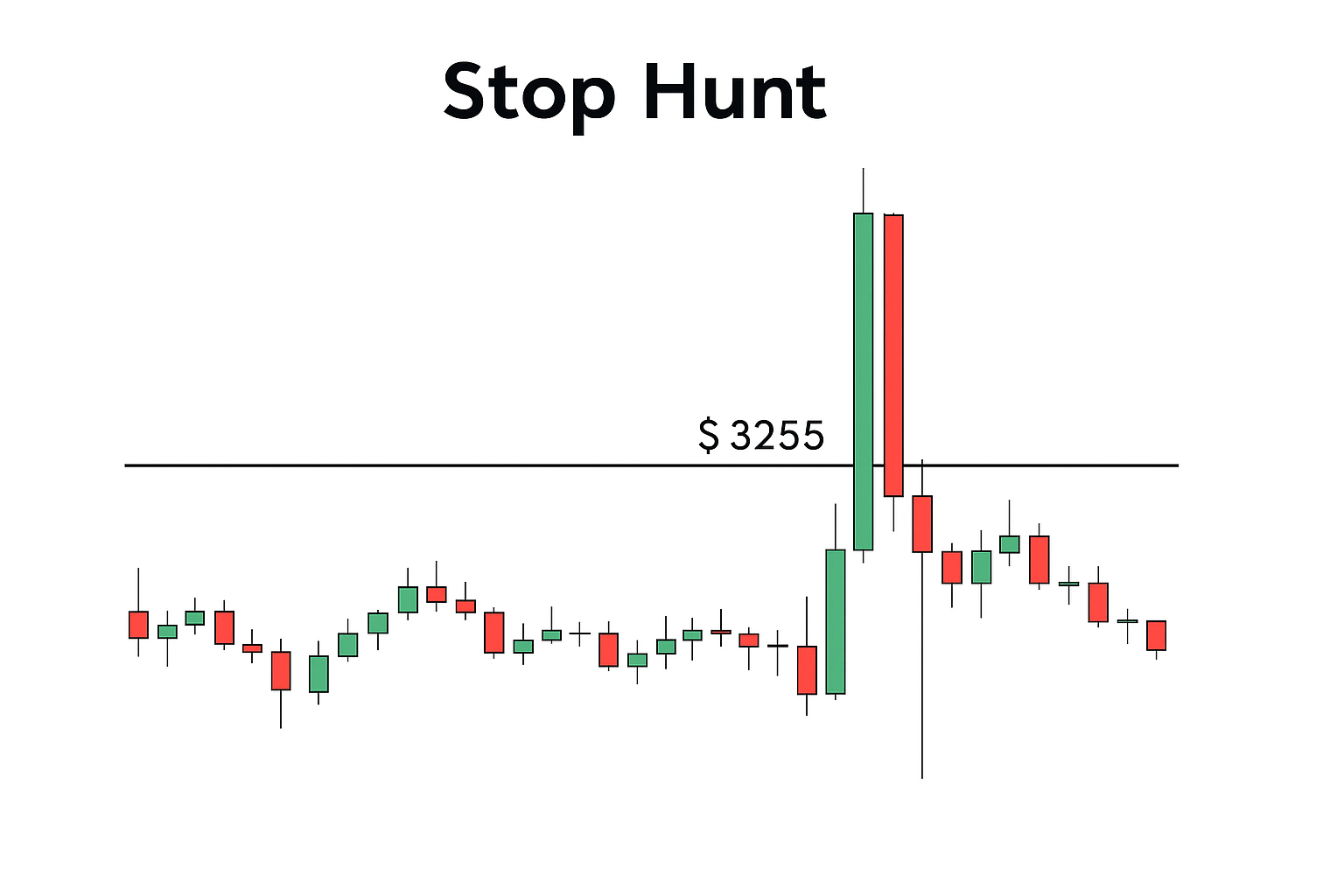
    Have you ever heard of a stop hunt?

    Maybe you’ve seen it called a liquidity grab, a fakeout, or if you’re feeling extra dramatic, a Judas candle. Whatever you call it, the mechanics are the same—and if you’ve ever placed a stop loss above a major level, or if you’ve ever jumped on what looked like a breakout only to have to turn against you like a spurned lover, you’ve probably donated to one.

    Let’s walk through it in plain English. Not theory. Not fairy tales. Just how this really works.


    The Setup: A Big Level, a Bunch of Stops, and a Patient Predator

    Imagine price is hovering just below a well-known resistance level. Let’s call it $3,355 because hey, this is a real example from yesterday (July 1, 2025). Everyone’s watching it. Everyone’s talking about it. And under that price lies a graveyard of failed trades.

    Now—somewhere out there, a big player (call them the whale, the bank, or just the guy with deeper pockets than you) has a problem. They want to sell a massive amount of gold, but there’s a catch:

    You can’t sell big unless there’s someone willing to buy big.

    Enter the perfect mark: retail stop losses.


    The Play: Trigger the Stops, Sell Into the Panic

    So what does our whale do?

    They wait.

    They wait for price to grind its way up toward that $3,355 level—right up to the cliff’s edge—where they know a whole crowd of retail traders have stops placed just above.

    Those stops? They’re just exit orders on your trading platform, but an order to exit a “sell” is actually a “buy” order. And those buy orders are just there waiting to be triggered. So if you’re short from $3,350 and you use a stop loss you’d probably set it around $3,3055-6ish. Guess what happens when price taps that level.

    Your broker submits a buy order (your exit order) at market price—and the whale is happy to take the other side.

    So the big player—calm, calculated, and probably sipping something expensive—drops a large buy order just beneath the stop zone. That push is enough to spike price up into the liquidity pocket… and boom:

    All those stop losses start firing like popcorn in a microwave.

    Normally, more buy orders would send the price even higher. BUT, at that exact moment—while you’re staring at your screen thinking “I knew it was going to break out!”—the big player is unloading. They’re selling into all those panicked buys, using your exit (and the buy orders from all the retail traders who saw the breakout and piled in) to fund their entry.


    The Aftermath: Gravity Returns

    Once they’re filled—once they’ve offloaded their entire position into your stop loss—the need to hold price up disappears.

    And just like that, the bounce becomes a flush.

    The breakout turns into a trap.

    And the candle that looked so promising turns into an obituary.


    So… Why Does This Matter?

    Because if you don’t understand why price moves, you’ll keep getting wrecked by how it moves.

    Stop hunts aren’t a conspiracy. They’re a feature of how smart money finds counterparties in a thin market.

    And while you’re tweeting “gold breakout incoming 🚀,” the professionals are already fading you with limit sell orders and setting their targets 20 points lower.


    What You Can Do Instead

    • Don’t place stops where everyone else does. Be smarter than the cluster.
    • Look for structure—real structure—not just price levels.
    • Learn to recognize impulsive moves without follow-through. That’s usually the tell.

    Or, if you’re still unsure?

    When in doubt, wait it out. Real breakouts don’t ask you to beg.


    Final thought:
    If your trade got stopped out and price reversed five seconds later, you weren’t unlucky.
    You were the liquidity.

    But hey—now you know. And next time, you might just be on the other side.

  • Want to Blow Your Trading Account? Just Try Harder

    Want to Blow Your Trading Account? Just Try Harder

    In most high-performance arenas—sports, business, even creative work—when you’re behind, you can fight your way back.

    You refocus.
    You push harder.
    You create the next opportunity to score.

    A basketball player gets scored on? They sprint down the court and attack the rim.
    A founder loses a client? They jump on five sales calls and close the next one.
    Even a musician bombs a set? They lock themselves in the studio and come out sharper.

    Effort becomes the antidote to failure.

    But in trading?

    Effort gets you killed.

    You can’t hustle a setup into existence.
    You can’t push harder and force your way back into the green.
    You can’t attack the market and expect it to reward your grit.

    In fact, the more emotionally urgent it feels to act—the more dangerous it is to do anything.


    The Tools That Built You Will Break You Here

    If you’re wired like me, this is maddening.

    Because you’ve spent your whole life outworking your setbacks.
    Pain meant it was time to move.
    Discomfort meant it was time to do something.

    But in trading, those instincts betray you.

    • The urge to act becomes overtrading.
    • The urge to prove yourself becomes revenge trading.
    • The urge to fix things becomes refusing to exit a loser.

    It’s like being in a boxing match where the only winning move is to keep your gloves up and wait—not strike. Even when you’re hurt. Even when the crowd is jeering. Even when you know you could land one clean shot if you just swung.

    That’s what makes this game harder—and greater—than anything I’ve ever done.


    Here, Discipline Is Effort

    When you’re down in trading, the best thing you can do is often the hardest thing:

    Nothing.

    • You pause.
    • You obey the system.
    • You exit the trade even though your gut is screaming “Wait!”

    It doesn’t feel like effort.
    There’s no adrenaline spike. No high-five moment.
    Just silence and self-control and the long, slow build of mastery.

    But that invisible effort?
    That’s what gets you funded. That’s what makes this a career, not a phase.


    If You’re Wired to Win, This Will Hurt Before It Heals

    So if you’re reading this, and you’ve spent your whole life turning pressure into performance, just know:

    Trading doesn’t care how hard you try.
    It only cares whether you wait to strike.

    That’s the test.
    And if you can pass it, the game does reward you—massively.

    But only if you can endure the one thing that most high performers never learn to sit with:

    Discomfort without action.

    That’s the real work.
    And the ones who master that?

    They don’t just win trades.
    They become unshakeable.

  • Which TradingView Indicators I Use (and Why)

    Which TradingView Indicators I Use (and Why)

    By The Barcelona Trader

    Every trader’s chart is like their kitchen.

    Some keep it minimalist: one chart, one candle type, one crusty RSI from 1984.
    Others layer on so many indicators it looks like a Christmas tree had a seizure.

    I like tools that work—and I keep them clean, readable, and purposeful. I don’t chase the “magic indicator.” I just want clarity, structure, and actionable context.

    So here’s exactly what I use on TradingView—from candles to signals—and why.


    Candles: Heiken Ashi (Yes, Really)

    First, the basics: I use Heiken Ashi candles.
    I know some people get weird about this, but hear me out.

    Heiken Ashi smooths out noise. It gives you a better sense of trend structure. It’s not great for precise entry signals—but that’s not what I use candles for anyway. I use them for reading context, flow, and rhythm.

    I’ve got:

    • Gold candles for bullish moves—because, duh, I trade gold.
    • Blue candles for bearish moves—because… I like blue. That’s it. No deeper reason.

    My Indicator Stack

    🔹 Support & Resistance

    This one auto-plots key S/R levels—and it does a pretty damn good job.

    I use it to keep my chart honest. We all “see levels” when we want to—but this plots zones based on actual reactions, not my imagination.


    🔹 Three 32-period EMAs

    • One set to High
    • One to Low
    • One to Close

    Why three? Because I want to see structure.
    The high/low EMAs create a “channel” that shows me the heartbeat of price. When candles close outside that band, something’s shifting.

    This is how I keep one eye on trend bias without pretending I’m smarter than price.


    🔹 Linear Regression Channel

    This one gives me context on trend strength and direction.

    It’s math-y, yes. But it’s helpful for spotting mean reversion zones, exhaustion, and whether price is respecting a statistically clean slope—or faking everyone out.


    🔹 Support & Resistance with Breaks and Bounces

    This does what it says on the tin:
    It highlights when levels are being tested, broken, or respected.

    I don’t base entries off this alone, but it’s extremely helpful for confirming behavior.
    If I see a bounce where I expect one—or a break where there shouldn’t be one—it flags something worth digging into.


    🔹 200 EMA

    The classic. The legend. The granddaddy of moving averages.

    It’s not sexy, but it works.

    I use it mostly as a macro directional bias—especially when trading on lower timeframes. If price is aggressively under or over the 200 EMA, that’s information.


    🔹 Consolidation Zones

    This one identifies areas where price is going sideways—building energy, or just stalling before a move.

    It’s hugely helpful for avoiding entries in chop.
    No one likes getting smacked around in a fakeout. This helps me stay out of flat zones unless I have a specific plan to fade or trade the breakout.


    🔹 ChartPrime’s Free Indicator: Swing Ranges

    This one plots swing highs and lows across multiple timeframes.

    I use it to see where momentum has shifted and where price might hit a wall. If gold is pushing into a prior swing high with low conviction, I’m paying attention.


    🔹 ChartPrime’s Swing High/Low Tool

    Even cleaner than the swing ranges. It shows real turning points, not just every tiny pullback.

    I don’t trade off this in isolation, but I use it for context—especially in combination with my EMAs and S/R.


    🔹 Elite Algo: Main Signal Indicator (Paid)

    This is one of the few premium tools I pay for. It combines trend direction, entry signals, and filters into a sleek little package. I don’t even use the signals. They’re way late for how I trade. But I like their trend dashboard and and their trend cloud.

    Do I trust it blindly? Of course not.
    But it’s excellent for confirming setups I already have on my radar.


    🔹 Elite Algo: Volume Indicator (Paid)

    This shows volume in a way that makes sense.

    No weird rainbow bars. No clutter.
    Just clean visual confirmation of where interest is showing up—or vanishing.


    Final Thoughts: Use Tools, Not Crutches

    The indicators above help me see the market clearly.
    They don’t make decisions for me.
    They don’t replace discipline.
    They don’t fix bad habits.

    But they do give me structure, clarity, and data—and when I combine that with a clean mindset and a defined system, that’s where the magic happens.

    Don’t look for the indicator that does the work for you.
    Use the ones that make your work cleaner.

    And if you’re chasing 12 signals, 14 trendlines, and three different colors of VWAP?

    Let’s simplify.

    Because simple, structured trading—especially on gold—is the real flex.

  • The Fixed Range Volume Profile: Why It Matters, and How to Use It

    The Fixed Range Volume Profile: Why It Matters, and How to Use It

    By The Barcelona Trader

    Let’s talk about a tool that actually matters.

    Not a gimmick. Not a “secret weapon.” Not some recycled 2007 YouTube strategy rebranded with a new acronym and a $997 course.

    I’m talking about the Fixed Range Volume Profile—also known as FRVP—and it’s one of the most powerful, overlooked tools a serious trader can add to their chart.

    If you trade gold and you’re not using it, you’re operating half-blind.


    What Is It?

    The Fixed Range Volume Profile shows you how much volume was traded at each price level—not over the entire chart, but over a specific window of time that you define.

    In TradingView, it’s already built in.

    Here’s how to find it:

    1. Open your chart
    2. Hit Indicators → search for “Fixed Range Volume Profile”
    3. Click it
    4. Then click and drag across any time segment you want to analyze—consolidation, breakout leg, pullback, whatever

    And just like that, the chart stops whispering and starts telling the truth.


    Let’s Talk About the Terms That Actually Matter

    There are a few key concepts FRVP gives you—and they’re not complicated, just underutilized:

    • POC (Point of Control):
      The price level where the most volume was traded in that time range.
      Think of it as the market’s center of gravity. The most accepted price.
      👉 Don’t trade into it blindly. Watch how price reacts around it—magnet or repeller?
    • Value Area (VA):
      The range that contains roughly 70% of all traded volume in your selected range.
      👉 Inside the value area = indecision. Outside it = opportunity.
    • HVN (High Volume Node):
      Thick volume = sticky price. Price tends to stall or revert here.
      👉 Don’t expect explosive moves through HVNs—they’re built for chop.
    • LVN (Low Volume Node):
      Thin volume = low interest = fast movement.
      👉 When price hits an LVN, it usually doesn’t stick around to negotiate.

    How I Use It (And How You Should Too)

    When I’m trading gold, I’m not just clicking buttons. I’m reading footprints. Here’s how FRVP helps:

    1. I define the zone.
      Drag the tool over a specific time range—like a recent breakout leg, a pre-market consolidation, or a trend correction.
    2. I identify the POC.
      I want to know where the market was most comfortable. Spoiler: that’s not where I want to be trading.
    3. I watch for reaction at the edges.
      The edges of the value area and the nearby volume nodes tell me whether this is a breakout, a rejection, or a trap waiting to happen.
    4. I trade away from acceptance, not into it.
      Think like a magnet: price is attracted to the POC, but once it gets there, it’s just as likely to spring away from it as it is to stay. Context is everything.

    Why It’s So Useful—Especially on Gold

    Gold is a twitchy, emotionally charged instrument.
    It reacts to structure. It respects levels. And it loves to trap traders at the worst possible moment.

    The FRVP gives you clarity about where the market actually did business.
    Not where you think it should have. Not where your Fibonacci said it might.
    Where traders actually showed up with size.

    That’s an edge.


    One Last Thing

    Don’t treat this like a magic wand. It’s not a signal generator. It’s a context tool.

    Use it to:

    • Frame your bias
    • Stay out of trouble
    • Avoid chasing candles through chop
    • And stop trying to buy pullbacks that are actually just re-tests of a sticky high-volume node

    Trade like a professional: wait for the market to leave a trail—then follow it.


    The Fixed Range Volume Profile doesn’t predict anything.
    But it does explain everything.
    And sometimes, that’s exactly what you need.

  • The Forgotten Power of Pivots

    The Forgotten Power of Pivots

    By The Barcelona Trader

    Let me tell you something the YouTube trading bros won’t:

    Pivots still matter.

    I know—I know. They’re not shiny. They don’t come with acronyms like ICT or SMC. They’re not based on smart money, liquidity raids, or whatever other spooky bedtime story is trending this week in Trading TikTok land.

    But pivots? They’ve been around longer than most of these kids have been alive.
    And they still work—especially on gold.


    A Brief History of the Pivot

    Pivots were originally created by floor traders. Not the latte-sipping, dual-screen influencers of today, but actual open-outcry traders—guys who wore weird jackets, shouted across rooms, and made six figures while doing math with a pencil stub.

    They used pivots to figure out:

    • Where price might stall
    • Where the market might reverse
    • Where they might finally stop averaging into a loser and cry into their trading jacket

    The Daily Pivot Point (DPP) was the anchor. Everything else—support and resistance levels—was built from that.

    And it wasn’t just daily. You’d calculate weekly pivots. Monthly. And then you’d watch for confluence. Because that’s where things got interesting.


    What Tono Taught Me to Use (And Why It Works)

    Here’s my pivot stack:

    • DR3 – Daily Resistance 3
    • DR2 – Daily Resistance 2
    • DM4 – Midway between DR2 and DR3
    • DR1
    • DM3
    • DPP – Daily Pivot Point
    • DM2
    • DS1
    • DM1
    • DS2 – Daily Support 2
    • DS3 – Daily Support 3

    I use the same structure for weekly and monthly pivots.

    And no, it’s not because I’m nostalgic for the ‘90s.

    It’s because when a Daily and a Weekly pivot align? That’s not just a level—it’s a statement.
    Same goes for a Monthly and a Weekly, or a Daily and a Monthly.
    These are the levels where the market pauses, thinks about its life choices, and often turns around.


    Why Most Traders Ignore Them (And Why That’s a Mistake)

    Pivots have fallen out of fashion because they’re too simple.
    They don’t come with a 20-hour video course or a 200-page PDF with watermark branding and “edge” in the title.

    They’re just math.
    But guess what?

    So is the market.

    The big players still see these levels. Banks, institutions, prop firms—they may not talk about pivots, but they absolutely react to them. And when you’re trading something as volatile and technically sensitive as gold, those reactions matter.


    Why Pivots Work So Well on Gold

    Gold is emotional.
    It’s reactive.
    It’s loved, hated, hoarded, and dumped.

    And it respects technical levels better than just about any other instrument. Especially when the world’s on edge—which, spoiler, is always.

    That’s why when DR1 lines up with the Weekly Pivot and price slams into it?
    I’m watching.
    That’s not a coincidence. That’s order flow memory.

    You can trade gold without pivots, sure.

    You can also skydive without a parachute.
    It’s only a problem once.


    The Point

    If you’re serious about trading gold—especially if you’re scalping it or working breakouts on the lower timeframes—pivots aren’t optional. They’re your context. They’re your map. They help you understand when a move has juice… and when it’s running into a wall that price has respected 300 times over the last five years.

    SMC? ICT? Smart money this, imbalance that?

    Cool. If it works for you, great.

    But don’t throw out the tools that have been working longer than you’ve been alive just because some guy in a backwards hat on YouTube called them “retail nonsense.”

    Because let me tell you what’s nonsense:

    Ignoring a Monthly Pivot that just aligned with a Weekly and a Daily—and has already seen reactions all week—just because it doesn’t fit your “order block narrative.”


    Use your pivots.
    Stack your timeframes.
    And trade like someone who didn’t just Google “how to become a millionaire in 30 days.”