Tag: investing

  • Gold Has Surged Past $4,000 — And Strategists Think the Rally’s Not Over

    Gold Has Surged Past $4,000 — And Strategists Think the Rally’s Not Over

    Gold just cleared a new psychological frontier. It’s no longer a “might hit” — it’s a has hit — trading above $4,000 per ounce. That’s not a typo, and it’s not a miraculous flash in the pan. It’s a recalibration of what the markets now believe is possible.

    The question now: is this just the crest — or the opening act?

    The Bull Case Gets Wilder

    Analysts are raising sights in real time. Some are revising base forecasts; others are sketching out “blue sky” extremes.

    • Bank of America’s bold play: There’s talk of $5,000/oz in 2026, assuming investment demand continues to expand. To get there, inflows would need to climb about 14 % on top of already euphoric levels. They also mention that hitting $6,000 demands a 28 % bump — and $8,000 would push that even further, requiring a 55 % jump in gold purchases.
    • The more conservative houses aren’t asleep either. J.P. Morgan has adjusted its outlook: average ~$3,675/oz by late 2025, with a path toward $4,000 by mid-2026.  
    • On the ETF front, the inflows have been staggering. U.S.-listed gold ETFs alone have pulled in $32.7 billion so far this year, contributing — globally — to an estimated $57.1 billion in 2025 gold ETF inflows.  
    • Over longer arcs, fundamental bears like John Paulson are projecting $5,000 by 2028, citing central bank accumulation and macro stress.  

    Bottom line: in the last few months, the consensus ceiling for gold has receded farther into the horizon.

    The Drivers That Still Matter

    It’s not enough to recite predictions. You must understand the engine under the hood. Here are the forces still fuelling the fire:

    1. Institutional & Central Bank Demand
      The “sovereign buyer” narrative is not overblown. Central banks continue to buy gold — in many cases regardless of price. Their motivation: diversification, currency risk mitigation, and a latent fear that dollar hegemony may erode.
    2. ETF & Retail Capital Flows
      ETF inflows are the visible vapor trails of investor demand. They are easiest to track and hardest to fight. And in 2025 they’ve exploded.  
    3. Macro/Policy Conditions
      • Debt & Deficits: The U.S. and many developed markets are running large deficits and mounting debt. That raises the specter of currency debasement, inflation risk, or policy overreach.
      • Monetary Policy Uncertainty: If data surprises to the upside, central banks may get hawkish. But if growth stumbles, accommodation may be forced (or politically pressured).
      • Safe-Haven Demand & Uncertainty: In times of crisis (shutdowns, geopolitical shocks, trade war flareups), gold becomes a sanctuary of last resort.
    4. Technical & Sentiment Feedback Loops
      When price breaks records, momentum begets momentum. New buyers come in because they don’t want to miss this move. That inflates flows, which tighten markets, which push price, and so on. That reflexivity is dangerous — in both directions.

    Risks That Could Derail the Surge

    Because no narrative is bulletproof, here are the shock points to watch:

    • Fed or central bank hawkish surprise: If real yields surge, it could choke gold’s arithmetic.
    • Dollar rebound: A resurgent dollar, even temporarily, can inflict pain on the momentum trade.
    • Regime shifts in sentiment: Once gold becomes “everyone owns it,” the incremental buyers thin out and the exit becomes more panic than strategy.
    • Structure & liquidity breaks: At record prices, markets get fragile. Slippage, execution friction, supply constraints — any of those can amplify reversals.
    • Policy or political surprises: Tariff rulings, major elections, or fiscal pivots could shift the macro baseline quickly.

    Is Gold Scalping (Or Precision Trading) Still Useful Here?

    You’d better believe it. If you trade gold at the micro level, this kind of regime shift is fertile ground — but only if you respect its volatility and structure.

    When the trend is strong and the capital pools are deep, mispricings, liquidity gaps, and flow anomalies tend to be more consistent. But price will punish arrogance.

    Your Takeaway (In Guts, Not Graphs)

    • This is not the time for timid expectations. The new paradigm is: the ceiling just lifted.
    • But power in that paradigm comes to the disciplined — those who accept the fury under the surface.
    • Watch flows, positioning, central bank behavior, and yield curves more than shiny narrative soundbites.
    • If you trade gold at a micro level: don’t bet the ranch on macro direction alone. Use the regime to your advantage.

    Gold’s breaking records for good reason. It’s not just rallying — it’s evolving. And that’s when the game really begins.


  • Market Update: Oct. 6, 2025: Gold-Plated FOMO: When the Rally Becomes a Self-Feeding Beast

    Market Update: Oct. 6, 2025: Gold-Plated FOMO: When the Rally Becomes a Self-Feeding Beast

    “Gold’s biggest rally since the 1970s is being stoked by ‘gold-plated Fomo’ … You cannot ignore it. … There becomes a level when it becomes impossible not to own it.”

    — Luca Paolini, Pictet, quoted in Financial Times 

    That’s the kind of line that gives every macro trader a little shiver. Because it’s true — and dangerous.

    Gold has blasted nearly 50 % higher so far in 2025, touching a jaw-dropping $3,930/oz at its zenith.  What began as a fear trade—tariff wars, a tumbling dollar, inflation jitters—has morphed into a momentum monster. Even when the headlines cooled over summer, gold accelerated. September alone brought a ~12 % gain, the largest single-month jump since 2011. 

    What’s driving this mania? And, more importantly, when will the hangover hit?

    The Anatomy of Gold’s FOMO Frenzy

    1. The Herd Joins the Party

    One of the most telling lines in the FT piece: “Gold has become so big … that you cannot ignore it.”  That’s the shift—from “should I” to “must own.”

    ETF flows have been astronomical. Over just four weeks, gold-backed ETFs saw $13.6 billion of net new money.  For 2025 so far, inflows into these vehicles are above $60 billion, a calendar-year record.  The holdings now top ~3,800 tonnes, nearing peaks seen during COVID panic buying. 

    These aren’t just retail speculators scrambling. We’re seeing institutional, pension, even sovereign reserve behaviors leaning toward gold as a core allocation. That’s a structural upgrade in buyer base. 

    Morgan Stanley has floated a 60/20/20 (equities / bonds / gold) split — treating gold not as an afterthought, but as a peer asset.  Bank of America surveys suggest many fund managers still have gold around 2 %, leaving vast room to scale. 

    2. The Reflex Loop

    This is where things get reflexive—and scary. The more gold rises, the more inflows it attracts. The more inflows, the tighter physical markets and the less supply for new buyers, which pushes the price further upward. The loop feeds itself.

    Think of it as a spiral: each new buyer looks at the chart, sees the breakout, fears being left behind, and pours capital in. Then the next buyer sees that and says, “I can’t be the one missing this move.”

    3. Macro Tailwinds (Don’t Sleep on Them)

    FOMO is the amplifier—macro is the engine:

    • Inflation & Debt Overhang: With sovereign borrowing at extremes, many investors fear central banks will eventually tolerate above-target inflation rather than choke off growth. That threatens bond yields, which hurts fixed income.  
    • Bond Market Weakness: Weakness and volatility in bonds make gold more attractive as a diversifier or “escape hatch.”  
    • Dollar Jitters: A soft or volatile dollar pushes non-USD buyers to gold as hedge. Some investors are effectively shorting the dollar by buying gold.  
    • Fed Optionality Risk: If the Fed is pressured politically (as some lines in the FT suggest) or forced to pivot, markets now fear a loss of policy credibility. Gold becomes the “what if we lose control” hedge.  

    Some analysts (e.g. HSBC) believe gold could easily cross $4,000/oz in the near term given continued inflows and macro stress. 

    4. Miner Stocks: Heading in the Opposite Direction

    Interestingly, gold miners (via miner ETFs) haven’t uniformly kept pace. The VanEck Gold Miners ETF (GDX)—which tracks producers—has seen astronomical returns (over 100+ % YTD in some reports), but has also bled flows. That suggests many are not comfortable going upstream with all the operational and geopolitical risks.  Some investors prefer the “pure metal” play rather than mining exposure.

    How This Story Ends (Or Doesn’t)

    You’re probably asking yourself: Is this a peak, or does the rally still have a leg?

    I don’t have a crystal ball. But here are the paths I’m watching:

    1. Continuation: If inflows, macro stress, and weak dollar remain intact, we could see gold push yet further—even beyond $4,000. The reflexive loop has momentum.
    2. Pullback / Consolidation: If real yields surprise upside, inflation proves sticky (forcing central banks to behave hawkish), or if the dollar rebounds, gold could give back chunks.
    3. Volatility regime: Expect more violent pullbacks, snapbacks, and choppy ranges. When an asset is crowded, crosswinds blow harder.

    What This Means for Traders

    • Be careful chasing breakouts at all costs. FOMO rallies can flip fast.
    • Use proper risk control—stop losses, position sizing, guardrails.
    • Keep an eye on flows and sentiment: when gold becomes a crowd trade, reversal risk grows.
    • Don’t trust narratives alone. Just because everyone’s screaming “this time is different” doesn’t mean it is.

    Final Word

    Gold’s explosive rally this year is no accident. It’s built on both real macro fear and a rising wave of “I can’t be left behind” money. The phrase “gold-plated FOMO” isn’t just a catchy headline—it describes a moment when psychology and capital intersect in dangerous symmetry.

    Just remember: gold doesn’t care about your narrative, your hopes, or your conviction. When the music stops, your framing—position size, stop, timing—will be all that separates the winners from the wrecks.

  • You Are Not Your Thoughts (Thankfully)

    You Are Not Your Thoughts (Thankfully)

    One of the hardest truths in trading is this: you are not your thoughts. You’re the awareness of them. And if you don’t learn that early enough, your account balance will be the one to teach you. Brutally.

    Because here’s what happens. You take a few losses — maybe you followed your rules, maybe you didn’t — and suddenly the brain pipes up like a bad karaoke singer: “Let’s make it back. Double down. The next one’s the big one.”

    That voice isn’t wisdom. It’s desperation in a trench coat. And if you follow it, you’ll end up in a place every trader knows too well: staring at the screen, muttering to yourself about how unfair it all is, while your broker thanks you for the donation.

    Professional traders know this game isn’t about silencing those thoughts. That’s impossible. The brain loves to chatter. The skill is noticing the thoughts, labeling them (“ah, that’s revenge-trading talking”), and then not acting on them. It’s mindfulness, not mute mode.

    And mindfulness in trading isn’t just a five-minute meditation app exercise. Sometimes it means hours of watching the market do nothing and not inventing a setup that isn’t there. Sometimes it’s days. Sometimes it’s an entire week where your only win is that you didn’t throw good money after bad.

    That’s the real discipline: sitting still while your brain screams at you to move.

    It’s learning that a red day doesn’t mean you’re a failure, and a green day doesn’t mean you’re a genius. You’re just the awareness, steadying the ship while the thoughts thrash around below deck.

    Most people quit trading because they can’t separate the two. The pros? They practice it daily. Not perfectly — no one does — but enough to let the setups come to them instead of chasing ghosts.

    So next time the thoughts come barging in after a loss, remember: they’re not you. They’re just noise. Your job is to observe, breathe, and wait.

    Because the market will still be here tomorrow. Your account, on the other hand, might not survive if you keep letting your thoughts take the wheel.

  • Will the U.S. Actually Go to War with Venezuela? And What That Would Do to Gold

    Will the U.S. Actually Go to War with Venezuela? And What That Would Do to Gold

    Let’s talk about the elephant in the room — or rather, the seven U.S. Navy warships and 4,500 personnel currently floating in the Caribbean. Officially, they’re there to fight cartels. Unofficially, they’re parked uncomfortably close to Venezuela, and Caracas is not amused.

    So here’s the question: are we actually on the brink of a U.S.–Venezuela war, and more importantly, what does it mean for gold?


    The Setup

    On one side, Washington is flexing hard. Ships, Marines, even a fast-attack submarine — all parked within striking distance. They say it’s about stopping drug smuggling, but everyone knows it doubles as a pressure campaign on Nicolás Maduro’s regime.

    On the other side, Caracas is puffing its chest out. They’re mobilizing militias, yelling about sovereignty, and reminding anyone who’ll listen that most cocaine doesn’t even come from Venezuela. Classic playbook: rally nationalism, make noise, and hope the home crowd eats it up.


    The Odds of War

    Now, is this about to turn into Iraq 2.0? No. The current U.S. presence is way too small for a full invasion. Think gunboat diplomacy with a bit of “don’t test us” energy.

    The most likely scenario is limited action: tighter maritime patrols, maybe a precision strike or two, or a small special forces raid framed as “anti-cartel” rather than “anti-Caracas.” In other words: fireworks, not full-scale war.

    But here’s the thing — even a few fireworks are enough to light up the gold market.


    Gold’s Reaction if Shots Get Fired

    If the first missiles fly, gold’s first instinct is always the same: sprint higher. That’s the headline shock. Traders don’t wait to analyze, they just pile in.

    But sustaining those gains depends on the second-order effects:

    • Does the dollar surge as a safe haven, blunting gold’s rise?
    • Does oil spike, stoking inflation fears and giving gold extra fuel?
    • Do bond yields collapse on a flight to safety, doubling the tailwind for gold?

    Gold’s job is simple: respond to fear. Your job is not to chase the first vertical candle like it’s the last train out of Caracas. Wait for structure. Wait for confirmation. Then clip it clean.


    Why the U.S. and Venezuela Are Even in This Dance

    America’s goals: squeeze Maduro, protect U.S. oil interests in nearby Guyana, and send a message without owning the aftermath.
    Venezuela’s goals: rally nationalism, buy time, and make the cost of U.S. pressure high enough that Washington hesitates.

    Both sides want leverage more than they want war. But in geopolitics, accidents happen. A skirmish at sea, a strike gone wrong, a misstep in disputed oil waters — that’s all it takes to turn a standoff into a gold catalyst.


    What It Means for You as a Trader

    Don’t confuse low probability with low risk. Full war is unlikely, but even a hint of conflict is enough to move gold hard and fast. The pros won’t try to predict the screenplay — they’ll wait, watch, and pounce on the setups the market hands them.

    Your job is the same:

    • Stick to your rules.
    • Don’t trade the headline, trade the structure.
    • Remember: clean sessions beat hot takes.

    Because the only thing worse than being wrong about war is being right about war and still blowing your account.


    Final word: Gold doesn’t care about the politics, it cares about the fear. If Washington decides to play Top Gun: Caracas, the only thing that matters is whether you’re trading like a pro — or torching yourself chasing the noise.

  • How Gold Really Moves: Planes, Ledgers, and a Lot Less Romance Than You Think

    How Gold Really Moves: Planes, Ledgers, and a Lot Less Romance Than You Think

    The Ledger Shuffle

    Picture it: Beijing. The People’s Bank of China has finally had it with stacking U.S. Treasuries like Jenga blocks in the vault. The mood is clear — they want fewer dollars and more gold.

    In the movies, this is where they’d send a convoy of black sedans to a dock at midnight, where stevedores load gleaming bars onto a freighter bound for Shanghai. In the real world? It starts with a Bloomberg terminal.

    They pick up the phone to a bullion bank in London — HSBC, JPMorgan, or ICBC Standard. The trade is agreed at the “Loco London” price, meaning the gold in question already sits in a London vault, stamped, numbered, and 400 ounces to the bar. No one lifts a single ingot. The Bank of China’s name replaces someone else’s on the ledger at the London Precious Metals Clearing system. That’s it — ownership changes hands, but the bars don’t move an inch.


    Wall Street’s Gold

    Jump to Manhattan. A hedge fund wants to ride the next gold rally. They’re not building a vault in SoHo. They’ll buy a COMEX futures contract — 100 ounces per contract — traded on the CME.

    If they sell before expiration, it’s all just numbers on a screen. If they do take delivery (rare), the gold comes out of an approved COMEX depository in New York or Delaware, delivered in 100-ounce or kilo bars, often to another vault, not a penthouse apartment. Settlement is electronic until the moment someone says “I’ll take physical,” and even then it’s trucks, not treasure chests.


    The Small Investor’s Gold

    Now zoom in on an individual investor — say they’re in Chicago or Nairobi. They can click “Buy” on a gold ETF like GLD, which is nothing more than a claim on a portion of a massive pile of gold in a London vault.

    Or they could order physical coins or small bars from a dealer. That’s where the romance dies in a hail of packing peanuts: the “secure shipping” is a discreet FedEx box with the return address of “XYZ Logistics,” because no one wants porch pirates scoring a Krugerrand jackpot.


    The Big Picture

    Most gold in the world doesn’t actually move. The global market has built a system where central banks, funds, and traders shuffle claims on existing bars through ledgers. The gold sits, gathering dust, in high-security vaults under London, Zurich, or New York.

    Physical transport — by plane, truck, or ship — happens when someone repatriates reserves, meets a delivery obligation, or buys in a market far from the vault network.


    When Gold Actually Moves


    Venezuela, 2011 – The Repatriation Parade

    Hugo Chávez decided Venezuela’s gold reserves were safer at home than in foreign vaults. That meant hundreds of tons had to be moved from the Bank of England to Caracas. The gold was flown in batches on secure cargo planes, each bar cataloged and sealed. The arrival was treated like a military parade — armored trucks, soldiers, national TV coverage. It was theater and geopolitics wrapped in one shiny package.

    Germany, 2013 – The Patience Test

    Germany’s Bundesbank wanted to bring home 674 tons of gold from New York and Paris. They didn’t just call UPS. The move took years because of security, insurance, and scheduling constraints. Most of it traveled by plane in small shipments, with secrecy so tight that even flight crews didn’t know what they were carrying.

    India, 1991 – Pawnshop of Nations

    Facing a balance-of-payments crisis, India quietly shipped 47 tons of gold to London to secure an emergency IMF loan. The transfer was done discreetly, by air, in the dead of night. For a country with a cultural love of gold, it was a moment of national embarrassment — but it worked.

    The Swiss-to-Asia Pipeline

    On a smaller but constant scale, Swiss refineries melt London-standard 400-ounce bars into smaller 1-kilo bars preferred in Asia. Those bars travel by secure air freight to Hong Kong, Singapore, and Shanghai. This is one of the few predictable, ongoing physical flows — a quiet conveyor belt feeding private demand.


    “Most gold in the world never moves. The paperwork does.”

    Inside the Vault

    When a shipment finally arrives, the moment is less Indiana Jones and more surgical procedure.

    An armored truck backs into a secured bay. Armed guards watch as the containers — often dull metal boxes no bigger than an office file cabinet — are wheeled inside.

    The vault doors are massive, but they don’t creak like in the movies; they swing silently on precision bearings. Inside, it’s cool, dry, and brightly lit. Every movement is recorded from multiple angles.

    Bars are unloaded and placed on a scale, their weight checked down to a tenth of a gram. Each one’s serial number, refinery stamp, and purity mark are matched against the manifest. If anything is off, an assay — a drill-and-sample purity test — can be ordered on the spot.

    Once verified, the bars are stacked in numbered compartments, each stack assigned to an owner — a government, a bank, or sometimes a private fund. The ledger is updated, and the gold is effectively frozen in place until the next transfer, which might be tomorrow… or never.


    Myth vs. Reality: Gold on the Move

    MYTH: Central banks ship gold in pirate-style treasure chests.

    REALITY: It’s more like a filing cabinet on a pallet, wrapped, sealed, and moved by forklift. The romance is dead, but the insurance premiums are thriving.

    MYTH: Every gold trade means bars flying around the world.

    REALITY: Ninety-plus percent of trades never move a single bar. Ownership just flips in a clearing ledger, and the gold stays put in a vault.

    MYTH: Gold travels under constant armed escort.

    REALITY: Yes and no. The guards are there, but you won’t see them — the best security is invisibility. Unmarked trucks, quiet airport transfers, and no one on the flight crew knowing they’re sitting over a hundred million in bullion.

    MYTH: Taking delivery from COMEX means the gold shows up at your house.

    REALITY: It goes to a COMEX-approved vault. If you insist on home delivery, you’ll meet a whole new circle of friends: armored couriers, customs officials, and your insurance agent in cardiac arrest.

    MYTH: Gold moves mostly by ship because it’s heavy.

    REALITY: Planes are faster, more secure, and far less pirate-prone. Ships are reserved for bulk, low-urgency moves — or the occasional national repatriation stunt.


  • When a Truth Social Post Moves Gold $30: What Trump’s Fed Salvo Really Means

    When a Truth Social Post Moves Gold $30: What Trump’s Fed Salvo Really Means

    Well, that escalated quickly.

    Minutes after Donald Trump blasted out a Truth Social broadside about the Federal Reserve, gold ripped higher on our screens—about thirty bucks in twenty minutes. That’s not astrology. That’s policy risk hitting the tape.

    What just happened (the facts)

    • Trump says he’s removing Fed Governor Lisa Cook, posting the letter publicly. It’s an extraordinary move aimed right at the Board of Governors. The Financial Times and Reuters both confirmed the action and the posture behind it. 
    • This follows a month of pressure campaigns—Trump has urged the Fed’s Board to sideline Chair Jerome Powell and “assume control” if he doesn’t cut rates, an open challenge to the central bank’s independence. 
    • Global central bankers (yes, at Jackson Hole) are openly worried about the precedent: politicizing the Fed risks financial stability and credibility. Translation: higher risk premia, more volatility. 

    Can a president actually fire Fed governors?

    Sort of—if there’s legal cause.

    By law, governors serve 14-year terms and may be removed “for cause” (think misconduct or neglect of duty), not just policy disagreements. That’s been the consistent view of mainstream legal analysis for years. Any attempt to stretch “cause” into “I don’t like your dot plot” heads straight to court. 

    Why would Trump want this?

    Let’s drop the euphemisms. Installing loyalists at the Fed can:

    1. Force a faster, deeper rate-cut path (or at least jawbone it), which would juice risk assets in the short run and weaken real yields—classic bullish gold fuel.
    2. Consolidate control of the policy narrative heading into a choppy macro stretch: deficits, tariffs, dollar politics.
    3. Create a chilling effect inside the Fed: even if courts swat removals down, the message lands—vote with the White House or get lawyered up.

    None of that guarantees prosperity. It guarantees uncertainty—and gold loves uncertainty.

    Why gold spiked (and why it might keep a bid)

    • Fed independence risk = risk premium. Markets price in the chance of policy mistakes and credibility damage. That pushes safe-haven demand higher. (Central bankers literally flagged this risk today.) 
    • Lower real yields narrative. If the market believes cuts get pulled forward or are larger than the data would justify, real yields drift down. Gold doesn’t pay a coupon; it thrives when the opportunity cost falls.
    • Institutional optics. Firing a sitting governor—publicly—signals more battles to come (Powell’s term ends next year). The process story alone can keep volatility elevated. 

    The irony file

    While we’re on “governance and credibility,” a reminder: Trump is already a convicted felon in New York for falsifying business records (he received an unconditional discharge in January; the conviction stands). That doesn’t make him wrong about monetary policy, but it does make the “restore integrity” sermon a tough sell. 

    (Separately, a New York appeals court just threw out the half-billion-dollar civil fraud penalty, even as it left core liability findings intact—so expect both sides to wave that around as proof of everything. Markets care less about the spin and more about how the power struggle bleeds into policy.) 

    The opposing view (and why it matters)

    Opposition: The White House can’t lawfully purge the Fed for policy reasons; attempts will be enjoined; the institution will hold.

    Our take: Courts may ultimately check removals—but the process risk (letters, threats, litigation, vacancies) is enough to move markets now. The message to investors is: brace for political volatility embedded in monetary policy. That’s supportive of gold until the governance path is clear.

    How I’m thinking about it as a trader

    • Treat Fed-headlines as catalysts, not trends. Expect gap-y moves, then digestion.
    • Watch real yields and DXY—if either rolls over on the narrative, gold’s dips will be shallow.
    • Respect levels. Policy drama doesn’t repeal technicals; it amplifies them. Confluence > bravado.

    Bottom line: Even if the legal bid trips Trump up, the uncertainty premium is real. As long as the market believes the Fed could get bent out of shape by politics, gold will keep a safety bid—and every spicy post will keep the tinder dry.

  • Gold, Crime, and the Traders Caught in the Middle

    Gold, Crime, and the Traders Caught in the Middle

    The Financial Times just published a remarkable (and frankly chilling) piece on the dark underbelly of today’s gold rush. You can read it here, but let me break it down for traders who care less about the drama and more about what it means for the flows that drive price.

    The headline takeaway: organized crime has discovered that gold pays better than drugs. From the Amazon rainforest to South Africa’s abandoned shafts, gangs and militias are fighting bloody turf wars to control illicit mining operations. The numbers are staggering:

    • The UN says criminal groups are embedded in supply chains.
    • SwissAid estimated 435 tonnes of gold were smuggled out of Africa in 2022 alone—worth about $31 billion.
    • Peru’s regulator thinks 40% of its exports are illegal.

    Why gold? Because unlike cocaine or oil, gold is fungible. A bar refined in Dubai or Switzerland is chemically indistinguishable from one dug out of a jungle pit with mercury. That makes laundering easy.

    What this means for traders:

    1. Illicit supply props up liquidity.
      Tens of billions of dollars’ worth of unrecorded gold are moving through the system every year. This invisible flow adds to supply, making it harder to pin price action solely on “official” mining output or central bank demand. When we see demand stats from the World Gold Council, they’re only part of the story.
    2. Geopolitical risk premium isn’t just macro.
      Everyone talks about gold spiking on Fed policy or Middle East tensions. But this article is a reminder that price can also be shaped by underground wars in Colombia or militia financing in Sudan. If criminal networks lose control—or gain more—supply shocks can ripple into the formal market.
    3. The UAE as the ‘washing machine.’
      Dubai has become one of the biggest hubs for refining and re-exporting gold, and critics say it’s where a lot of the illegal metal gets laundered. Traders should watch how international pressure on Dubai plays out. If enforcement tightens, smuggled supply could get bottlenecked, creating squeezes.
    4. Why volatility may persist.
      Gold’s rally this year (up over 25%) has been pinned on safe-haven flows. But when illicit supply chains worth tens of billions sit in the shadows, volatility is baked in. Headlines about raids in Brazil or mine seizures in Africa may not seem like “market news,” but they influence how much gold actually makes it into formal circulation.

    Bottom line:
    Gold’s threefold rise over the past decade isn’t just about central banks and macro hedging—it’s also about the rise of “narco-miners” and illicit flows that blur the line between commodity and crime. As traders, we can’t control that, but we can recognize it. This is part of why gold trades the way it does: opaque, volatile, and sometimes downright irrational. Behind every tick on your chart, there may be more than just a central bank bid or a hedge fund unwind—there may be a gang with an AK-47 running a pit mine in the Amazon.

  • Pre-New York Session: Gold Market Update: Key Insights for August 19, 2025

    Pre-New York Session: Gold Market Update: Key Insights for August 19, 2025

    Gold Market Session Briefing — Monday, August 18, 2025 (New York Opening)

    Macro & Political Landscape

    • Gold traded higher this morning, up around 0.4%, as U.S. Treasury yields eased and the dollar weakened—tailwinds for the yellow metal.
    • Markets are fixated on today’s Trump–Zelenskiy–European leaders meeting about Ukraine. Any sign of peace may dent gold’s safe-haven allure.
    • All eyes are on this week’s Federal Reserve symposium in Jackson Hole, with many expecting signals of a September rate cut—another bullish cue for gold.
    • Ray Dalio chimed in, suggesting a 15% portfolio allocation into gold (or Bitcoin) amid rising fiscal instability—supporting long-term positioning.
    • Market outlooks are still cautious—no fireworks expected. Analysts foresee range-bound trading, with volatility flagged as the name of the game.

    Fundamentals & Sentiment Snapshot

    • XAUUSD sits near 3348.18, testing the lower end of its intraday range from 3323.68 to 3358.49.
    • GC1! futures hover around 3393.9, logs between 3368 and 3403.6.
    • The DXY is firm this morning, rising over the past few hours before dipping again—making gold less sticky.
    • U.S. 10-year yields are steady around 4.295%, offering no major headwind or tailwind to gold.
    • Volume is low—traders are establishing positions ahead of key events.
    • VIX is subdued at 15.61, suggesting no mainstream panic—yet.
    • FXBlue shows USD sentiment at –0.3 and XAU sentiment at +0.7—a slight tilt toward gold bulls, but retail isn’t full-steam ahead.

    Technical Levels & Pivot Structure

    (Based on hourly and 15-minute charts; pivots: DPP, WPP, MPP, DM2, DM4, WM2, WM4, MM2, MM4)

    Support Zones:

    • WPP / MPP confluence sitting around 3,345–3,350, aligning with recent lows and potential bounce zone.
    • DM2 near 3,330, anchored near mid-range structure from Friday—watch closely.

    Resistance Zones:

    • DPP near 3,360 — first level to monitor overhead.
    • DM4 at 3,390–3,395 — a clean break and hold here opens space to 4,000+ sentiment territory.

    No confirmed breakout zones on the 10-second scalping chart yet—market structure hasn’t hinted at a clean slope or trigger.


    Action Plan

    1. Hold the line above 3,345–3,350—until the geopolitical news unfolds, this area is your pivot for confirmation.
    2. Fade rallies under 3,360, unless they come with conviction and volume.
    3. Play breakout long if gold clears 3,390–3,395 cleanly—look for momentum carry to 3,400+.
    4. Avoid chasing until either geopolitical headlines or Fed clarity gives directional bias.

    What to Watch Today

    • Trump–Zelenskiy and European summit—any peace signals could soften safe-haven bids.
    • Jackson Hole event—specifically speeches for rate-cut cues.
    • Weekly U.S. jobless claims—slippage here could bolster gold; a surprise tighten may give it a kick downward.

    Bottom Line

    Gold is riding a gentle wave this morning, buoyed by geopolitical uncertainty and expectations for easier Fed policy. It’s wedged between a defense line around 3,345 and resistance near 3,360–3,395. If Reginald chooses to break structure, let him—don’t chase him. Let the price rip with conviction.

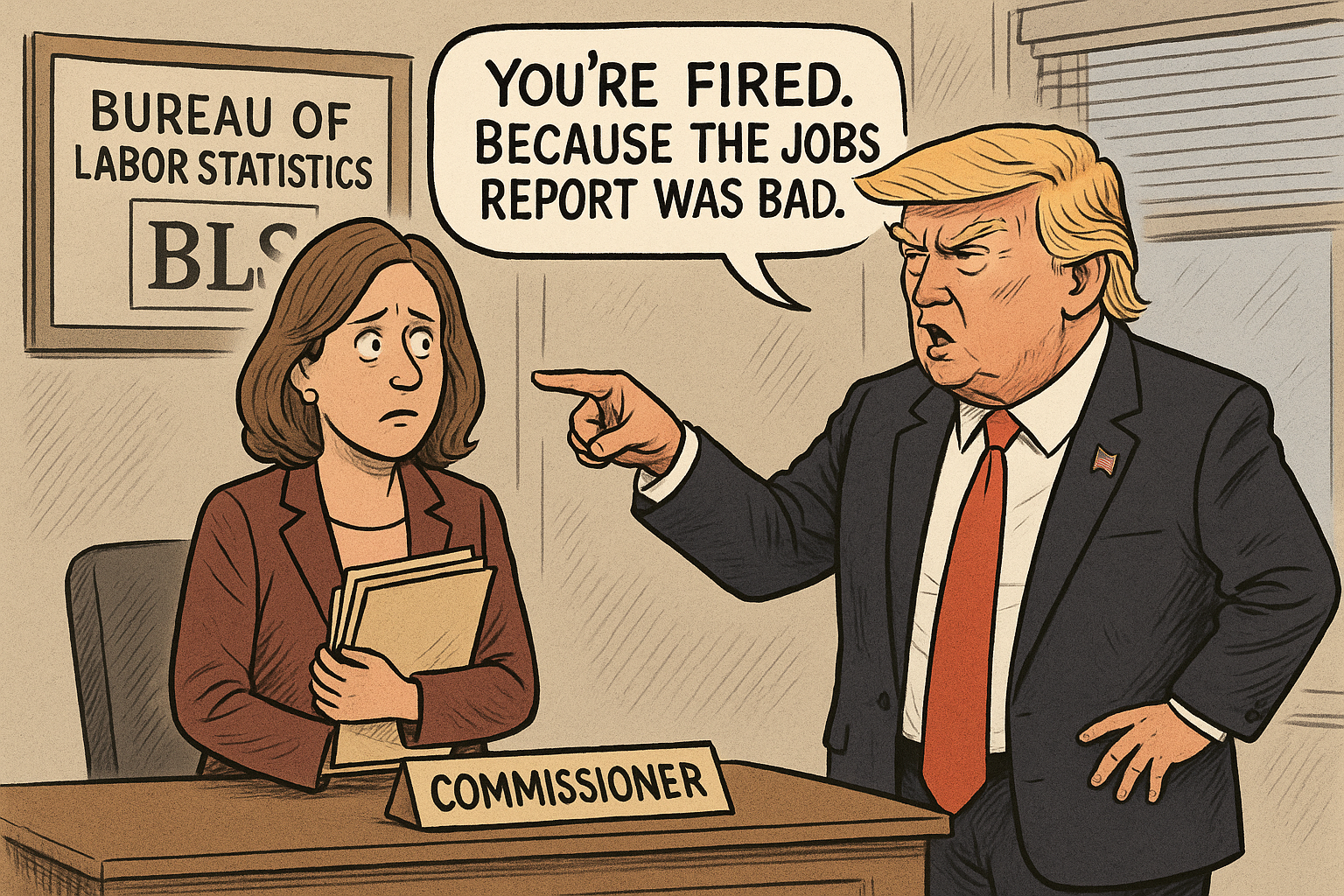
  • Market Update: Aug. 1, 2025: Trump Fired the BLS Commissioner. The Gold Market Noticed.

    Market Update: Aug. 1, 2025: Trump Fired the BLS Commissioner. The Gold Market Noticed.

    The Bureau of Labor Statistics has one job: tell the truth about the economy, even when it’s ugly.

    On Friday, it did just that. The July jobs report came in soft—only seventy-three thousand jobs added—and previous months were revised sharply downward. Nothing unusual there. The BLS releases initial estimates and then revises them as more data comes in. This is normal. Boring, even. Just how statistics work.

    But “boring” doesn’t play well in politics.

    Within hours, Donald Trump fired the BLS Commissioner, Erika McEntarfer. Not for breaking rules. Not for falsifying data. But for reporting a jobs number that made him look bad.

    And if you think this is just political drama with no market impact, think again. The gold market is already sniffing out what this kind of behavior signals—and it doesn’t smell like confidence.

    Let’s connect the dots.

    Markets don’t just care about jobs numbers. They care about whether the numbers are real. When you fire the referee because you don’t like the score, investors start asking: what’s next? Will future reports be massaged? Will we stop trusting U.S. data entirely? Will Fed policy decisions be distorted by manipulated inputs?

    This hits gold in two ways:

    1. Institutional Trust = Dollar Stability

    The U.S. dollar is the world’s reserve currency in large part because the world trusts U.S. institutions. If that trust wavers—even a little—gold becomes more attractive as a hedge. You don’t need hyperinflation for gold to rally. A few cracks in the wall of confidence will do just fine.

    2. Policy Uncertainty = Flight to Safety

    If economic reports are politically engineered, markets lose faith in the Fed’s ability to respond accurately. That drives volatility. And when volatility goes up, so does demand for gold. Fast.

    This isn’t hypothetical. The gold market ticked higher after the jobs report—not just because it missed expectations, but because the reaction from the White House was so extreme, it validated gold’s role as an insurance policy against institutional decay.

    And here’s the part no one wants to say out loud: if the numbers suddenly start improving next month, will anyone trust them?

    In the short term, the damage may be muted. But longer term, this kind of political interference puts a question mark next to every U.S. economic release. That’s not good for the bond market. It’s not good for the dollar. But it’s exactly the kind of slow-burning chaos that gold loves.

    So if you’re wondering why gold hasn’t broken down yet despite tightening policy and a cooling labor market—this is part of the answer.

    Trust is hard to build. Easy to destroy. And when it gets shaken? Traders buy insurance.

    And in case you forgot: insurance is spelled G-O-L-D.

  • What Happens to Gold Traders Like Us After Late-Stage Capitalism?

    What Happens to Gold Traders Like Us After Late-Stage Capitalism?

    You ever feel like the world is changing so fast that your charts need a geopolitical analyst and a therapist sitting next to you? Yeah. Me too.

    If you’ve been around long enough to trade through rate hikes, crypto booms, a pandemic, and the return of populism, you may have heard this phrase tossed around: late-stage capitalism. And you may be wondering: what happens after that?

    Let’s break it down—for gold traders like us. Because while the macro drama might seem a step removed from our scalps and hedges, the system you’re trading inside of is evolving fast. And if you’re not paying attention, it’ll run you over like a rogue CPI candle.


    Wait—What Is Late-Stage Capitalism, Exactly?

    It’s not a formal term. It’s more like an eye-roll from economists who see the system cracking at the seams. We’re talking about a phase where:

    • Mega-corporations run the show
    • Wealth inequality looks medieval
    • Markets are propped up by central bank steroids
    • “Jobs” become gigs with no benefits
    • Rent, healthcare, and education are luxury items

    Basically, capitalism stops being about opportunity and starts feeling like a casino rigged for the house.

    You’re not imagining it: the middle class is shrinking, trust in institutions is in freefall, and the word “freedom” is now a marketing slogan slapped on $70k pickup trucks and processed cheese.


    So What Comes After This? And What Does It Mean for Gold Traders Like Us?

    Good question. Nobody knows for sure, but there are a few likely paths. Some are survivable. Some are lucrative. Some… not so much. Let’s walk through the scenarios.


    1. State-Driven Capitalism

    The government doesn’t end capitalism. It just drives the bus now.

    Think: China-lite. National security becomes economic policy. Markets are “free,” but only as long as they don’t interfere with strategic goals.

    📌 What this means for you:
    Expect more interventions. Gold could surge or flatline based on policy whims, not price action. New regulations could restrict leverage, tax capital gains at higher rates, or limit short-term speculation. Brokers may face tighter controls. You’ll need to be nimble—and very plugged in to macro shifts.


    2. Technocratic-Neo-Feudalism

    Capitalism doesn’t die. It just puts on a hoodie and starts charging subscription fees for everything.

    This is where corporations become the real governments. BlackRock, Amazon, OpenAI—they’re not just companies anymore. They’re the new fiefdoms.

    📌 Impact for traders like us:
    If you’ve got elite tools, fast data, and discipline? You thrive. If not? You’ll drown in fees, algorithmic latency, and compliance screens. Getting access to real-time order flow and premium platforms might start to look more like joining a private club than opening a brokerage account.

    Welcome to trading as a privilege, not a hustle.


    3. Eco-Social Market Economies

    Capitalism with a conscience… and a carbon tax.

    Here, governments shift hard toward sustainability, worker protections, and climate action. Think UBI, green investments, and strict limits on speculation.

    📌 For us:
    Gold might benefit in the short term if fiat currencies wobble, but over time, financial speculation could be frowned upon—or taxed out of existence. Platforms might require stricter disclosures, and high-frequency scalping could be collateral damage in a crackdown on “unproductive capital.”

    Might be time to learn how to swing trade compost futures.


    4. Decentralized Utopianism

    Crypto wins. The empire falls. Welcome to the Wild West.

    A long shot, but not impossible. This is the future libertarians dream about: DAOs, DeFi, no central banks, and a peer-to-peer financial system that lives on-chain and outside the Fed’s reach.

    📌 For traders like us:
    The upside is huge—massive volatility, no middlemen, 24/7 liquidity. But it’s also the jungle. Scams, rug pulls, and total lack of recourse. You’ll need a PhD in digital security just to withdraw your profits.

    If you’re nimble and fast? It’s gold rush 2.0. If not? It’s game over in a flash crash.


    5. Collapse or Authoritarianism

    The system breaks. Markets get shut down. Gold becomes… gold.

    Worst case scenario. Political unrest, debt default, climate shocks, or military conflict tip the balance. In these cases, gold may skyrocket—but the ability to trade it might disappear.

    📌 Implications:
    You’re not scalping 10-second candles anymore. You’re holding physical bullion. Maybe burying it in the backyard. Maybe fleeing with it in a backpack. Trading platforms go dark. Capital controls come in. Trust is gone. It’s not a chart setup—it’s survival.

    Let’s hope we don’t get here.


    So… What’s the Move?

    For now, we’re still in the middle game. But the endgame pieces are moving. If you’re a serious gold trader—especially a scalper like me—you want to be:

    • More aware of the macro (and less reliant on the illusion of a stable system)
    • More adaptable (because the rules will change)
    • More strategic (build edge not just in entries, but in your understanding of the playing field itself)

    Late-stage capitalism may be giving us volatility—and volatility is oxygen for traders. But after that? The terrain gets wild.

    If you’ve got a system, a brain, and a sense of humor, you’ll make it.

    If you’re still looking for a savior or a shortcut… the next chapter might not be so kind.


    Want to keep up with the future of gold trading as it unfolds? Follow along, subscribe, or join the tribe. The system may change—but edge adapts.