Tag: personal-growth

  • The Hot Stove Exit™ – How I Learned to Stop Melting My Hand Off

    The Hot Stove Exit™ – How I Learned to Stop Melting My Hand Off

    There’s this moment in trading—maybe you know it—where price starts going against you and instead of cutting the trade, you… freeze. You hesitate. You stare at the screen like a dog trying to do algebra. And just like that, a minor flesh wound becomes a third-degree burn.

    I used to do that. A lot.
    Now I don’t.
    Not because I became superhuman.
    But because I trained myself to do what any kid learns in the kitchen:

    You touch a hot stove, you pull your hand back.

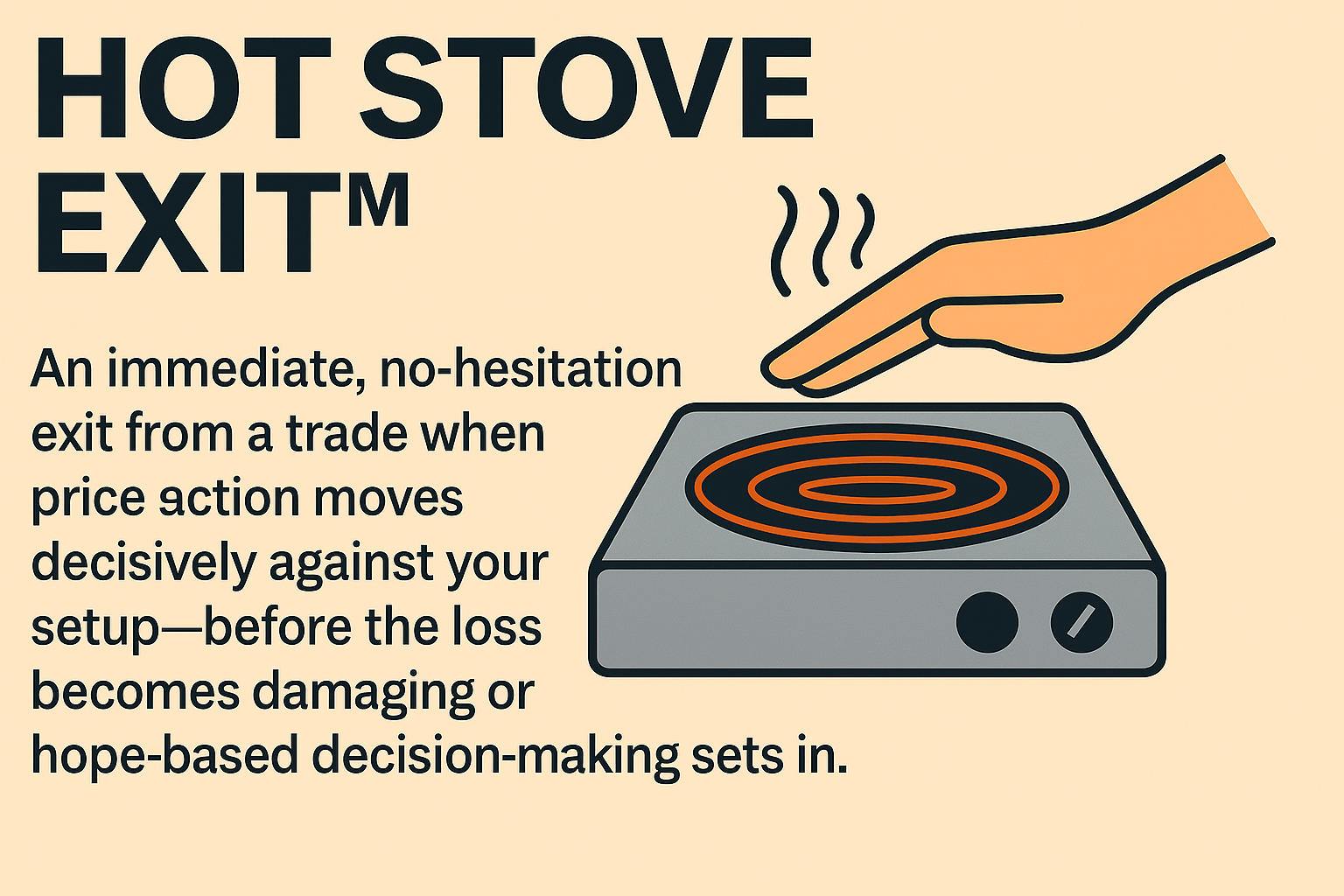
    That’s the principle behind what I call the Hot Stove Exit™—and it’s one of the most important rules in my entire system.


    🧠 What Is a Hot Stove Exit?

    Hot Stove Exit™ is an immediate, no-hesitation exit when a trade starts to go wrong—before the damage becomes emotional, financial, or existential. It’s not a panic move. It’s a power move. It’s instinct honed by discipline.

    You don’t argue with it.
    You don’t wait to see if the pain stops.
    You get out.

    Like… now.


    ⚙️ When to Use It

    Here’s your cheat sheet. You should take a Hot Stove Exit if:

    • Your setup invalidates right after entry.
    • Price rips through your entry zone like it wasn’t even there.
    • You feel a little voice saying, “Maybe I’ll just give it more room.”
    • You’re telling yourself, “It’s probably just a pullback…” while staring into the abyss.
    • You know what you should do, and you’re already bargaining with it.

    Exit.
    Don’t think.
    Just click.


    🆚 Stop Loss vs Hot Stove Exit

    Old ThinkingHot Stove Exit™ Thinking
    “I’ll put my stop 25 pips away and hope I’m not wicked out.”“If this trade invalidates, I’m out before I feel pain.”
    “Let’s give it a little more room.”“If I’m hesitating, I’m already late.”
    “Maybe it’ll come back.”“Hope is not a strategy. Get out.”

    Most retail traders treat stop-losses like seatbelts… that they unbuckle as soon as the car starts skidding.

    The Hot Stove Exit™ doesn’t ask for permission. It acts.


    🏋️‍♂️ How I Trained It (and Still Do)

    Like any muscle, this took reps.

    • I journaled every time I didn’t take the exit. It was humbling. It was also fuel.
    • I ran replay drills. I’d practice entering, watching for invalidation, and exiting without hesitation.
    • I started tagging “Hot Stove” exits in my notes so I could see how often they saved me.
    • I redefined “winning.” If I exited cleanly and avoided a face-melter, that was a win—even if the trade was red.

    You know what started happening?
    I stopped blowing up.
    I stopped hedging in desperation.
    I started trusting myself more.


    📜 The Rules in My System

    Here’s what’s written into my playbook—and should probably be in yours too:

    • If a trade invalidates in the early moments, I exit without hesitation.
    • If I feel hesitation, that is the signal. Exit.
    • If I’m using hope as an argument, I’ve already lost. Get out.
    • A small clean loss is always better than a slow-motion account nuke.

    💡 The Takeaway

    The Hot Stove Exit™ isn’t just a technique.
    It’s a philosophy.

    It’s the belief that your capital is sacred and your rules protect it.
    It’s choosing discipline over drama.
    It’s a trader’s version of wisdom—earned in the fire.

    So the next time your hand’s on that burner?
    Pull it back.

    Fast.

    You’ll thank yourself later.

    P.S. Take the name Hot Stove Exit with a grain of salt. It’s just another name I gave to what is often called a manual hard stop.

  • Who Should—and Who Shouldn’t—Consider Trading

    Who Should—and Who Shouldn’t—Consider Trading

    Let’s have an honest conversation.

    Trading isn’t for everyone.
    And no matter what the gurus tell you, it’s not a side hustle you can casually pick up between lattes and leg day.

    So if you’re thinking about diving in, here’s a brutally honest breakdown:


    ✅ Who Should Consider Trading:

    1. People who love solving puzzles

    Markets aren’t slot machines. They’re logic puzzles with missing pieces and constantly shifting rules. If you enjoy sitting in uncertainty and figuring out patterns—welcome.

    2. People who can manage their emotions under pressure

    You know that guy who calmly changes a flat tire in a thunderstorm while everyone else panics?
    That guy might make a good trader.

    3. People who are obsessive learners

    If you can fall down a rabbit hole of technical setups, backtesting, market structure, and economic theory for hours without blinking—you’re probably wired for this.

    4. People who take responsibility for their actions

    You took the trade. You set the risk. You lost the money. Can you own that without blaming Powell, your broker, or Mercury in retrograde? If yes, you’ve got a shot.

    5. People who are okay with slow success

    No instant gratification here. If you can show up daily, fail gracefully, learn, refine, and keep showing up? You’re the kind of stubborn this game rewards.


    ❌ Who Shouldn’t Consider Trading:

    1. People looking for fast cash

    If your goal is to double your money by Friday or “make back what you lost last month,” go to Vegas. At least they give you free drinks when you blow your bankroll.

    2. People who can’t sit still

    If you need action every five minutes, you’ll force trades that shouldn’t exist. Trading is mostly boredom interrupted by occasional terror. If that’s not your thing—no judgment.

    3. People who hate uncertainty

    There are no guarantees. You can do everything right and still take a loss. If you need certainty, structure, and a paycheck every two weeks—trading is not your path.

    4. People who don’t want to journal or review their own behavior

    If you’re not willing to study your own patterns, impulses, and mistakes, this game will eat you alive. You don’t just trade the market—you trade yourself.

    5. People who refuse to be wrong

    This one’s a killer. If being wrong bruises your ego, don’t trade. Trading requires being wrong often—and learning to be okay with it. It’s not failure. It’s feedback.


    So… should you trade?

    If reading this list made you nod? Maybe.
    If it made you twitch, sweat, or mutter “well not me exactly, but…”—probably not.
    At least not yet.

    This game is simple, but it’s not easy.
    It’s not a grind for everyone. But it is a grind.
    And if you’re not wired for it—you will find a hundred easier ways to make money.

    But if you are?

    There’s nothing like it.


  • The Tedium of Trading

    The Tedium of Trading

    Nobody tells you this when you’re getting started, but I’m going to do you a favor:

    Trading is boring.
    Stupidly boring.
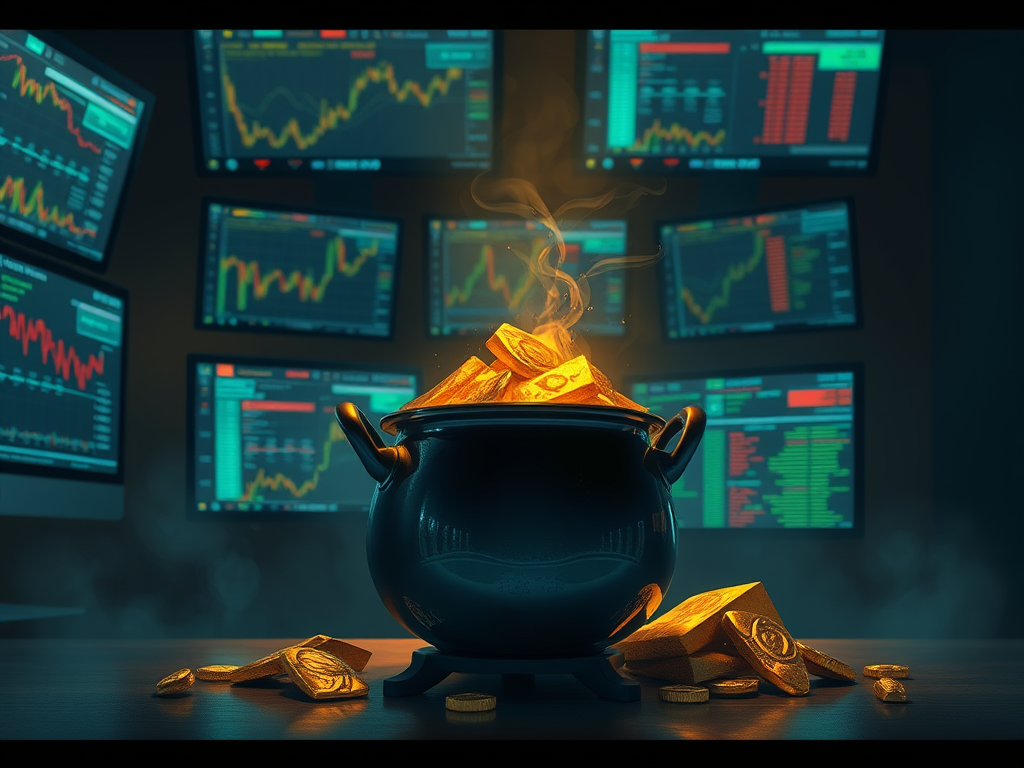
    Like-watching-a-pot-of-gold-not-boil boring.

    Not always, of course.
    There are moments of chaos, adrenaline, and “holy sh*t I nailed that entry”—
    But those moments are rare.

    Most of the time?
    You’re waiting.
    Staring.
    Marking levels.
    Checking news.
    Scrolling.
    Talking to yourself.
    Convincing yourself not to click anything.
    And then deleting the Discord app for the fifth time that week.

    This is the part that almost no one posts about.
    Because let’s be honest: “Traded nothing for three hours, went flat, journaled, ate a sandwich” doesn’t make for exciting content.

    But that’s the job.


    Trading isn’t charts and fireworks.

    It’s mostly sitting still, managing boredom without making a mistake.

    It’s knowing the level you want, seeing price dance 20 pips below it for 45 minutes, and still not jumping the gun.
    It’s waiting for your setup to actually trigger, while your brain whispers,
    “Come on, we could just get in now. We know what we’re doing.”

    Sure you do, cowboy.
    That’s how you blow $800 on a Tuesday morning.


    And then—suddenly—it happens.

    The setup forms.
    Structure confirms.
    The candle closes.
    And now you have… 90 seconds to make a decision that took you 4 hours of discipline to earn.

    You click.
    You manage.
    You hold. Or cut. Or hedge.
    And then…
    back to the boredom.


    This is the real rhythm of trading:
    Boredom. Boredom. Boredom. Decision.
    Repeat.

    If you can’t master the boredom, you’ll never survive the trade.
    Because the trades don’t get you.
    The boredom does.

    It eats at your discipline.
    It invites your impulses.
    It tricks you into “doing something” just to feel productive.
    And nine times out of ten, that “something” costs you money.


    So if you’re bored while trading…
    Good.
    That means you’re doing it right.

    You’re not overtrading.
    You’re not chasing.
    You’re not making stuff up just to stay stimulated.

    You’re waiting.
    Like a sniper.
    Like a pro.

    And when the moment comes—you’re ready.


    Let the others post fireworks.
    You focus on the part that matters:

    The boring, brutal, beautiful discipline of doing nothing… until it’s time.

  • Why Signals Don’t Work—And What Actually Does

    Why Signals Don’t Work—And What Actually Does

    To a new trader, signals seem like a no-brainer.

    Someone who knows what they’re doing tells you when to enter.
    You copy the trade. You size it properly. You exit when they say.
    Done.

    So why doesn’t that work?

    Here’s the truth:
    Signals seem simple. But trading isn’t.

    And the second you try to reduce a live, high-stakes decision-making process to a notification on your phone, the whole thing starts to fall apart.

    Let’s break this down.


    1. Trading is more than entry and exit.

    A trade signal gives you a moment in time.
    But it doesn’t give you the reasoning behind it, the conditions for exiting early, or the context that shaped the decision in the first place.

    The signal provider might:

    • Be scaling in or out
    • Have a hedge running
    • Be adjusting risk mid-trade
    • Be trading a specific news narrative you’re unaware of

    You don’t see any of that.
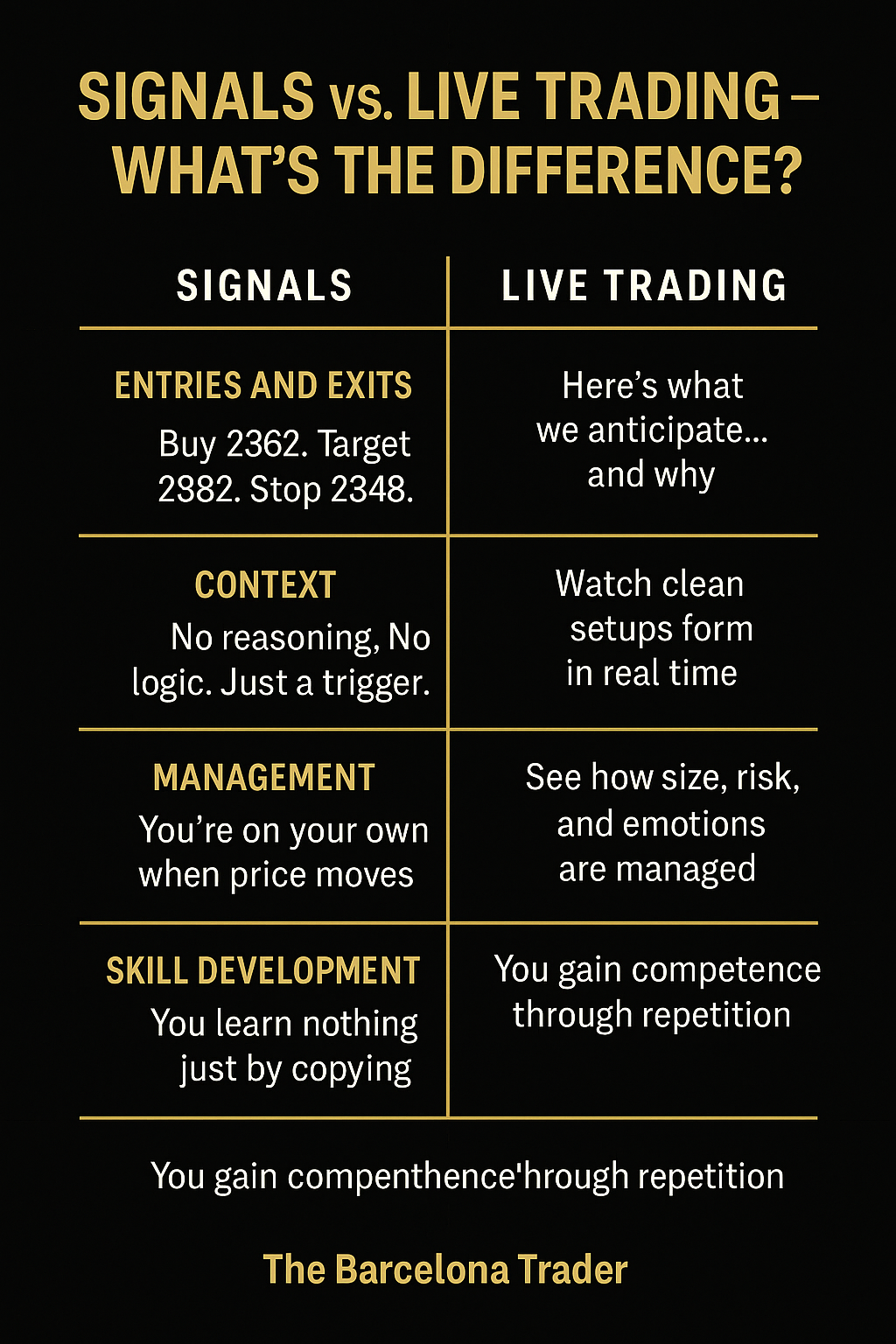
    All you get is “Buy 2362. Target 2382. Stop 2348.”

    You think you’re copying their trade.
    You’re not.
    You’re copying a snapshot—without the logic, the management, or the mindset.

    That’s not replication. That’s blindfolded imitation.


    2. Even “good” signals don’t account for your psychology.

    Let’s say the trade goes red at first.
    The signal provider is calm—they’ve seen this setup play out a hundred times.
    You? You panic, bail early, then watch the trade hit full TP.

    Now you’re gun-shy.
    The next trade? You hesitate—or size up to make back what you missed.
    Your mindset is compromised.
    That’s not the signal’s fault. But it is your outcome.

    Trading success isn’t just about what you do.
    It’s about how you react to what happens after.

    And no signal can manage your fear, your greed, or your FOMO for you.


    3. You’re not learning. You’re leaning.

    Following signals might feel like progress.
    But it’s not. It’s stalling.

    • You’re not building skill
    • You’re not learning structure
    • You’re not developing any self-trust

    So the moment the signals stop—or the provider has a bad week—you’ve got nothing to fall back on.

    You didn’t grow. You just followed.
    And now you’re back where you started, only more frustrated and down a few thousand dollars.


    4. Copy trading systems are built differently. Signals aren’t.

    Let’s get one thing straight:
    Copy trading ≠ signal following.

    With copy trading, the provider’s exact trades are executed on your account in real time—same entry, same exit, same scale.
    But with signals? You’re placing your own trade, at your own broker, with your own latency, your own emotions, and your own money.

    There’s nothing “automatic” about it.
    And unless you’re glued to your screen with zero distractions, it’s easy to miss a signal—or worse, execute it late and at the wrong level.

    Signals don’t account for slippage, spreads, emotions, or context.
    That’s why they fail.


    So what does work?

    Live trading. In real time. With real context.

    When you trade live with us—watching the charts as we mark levels, explain setups, manage risk, and take positions—you’re not just copying a call.

    You’re learning how to:

    • Spot clean entries before they form
    • Understand why a trade is taken—or skipped
    • Manage size, cut losses, and hold through volatility
    • Adapt when the market fakes out or flips
    • Control your own decision-making under real pressure

    It’s not signals. It’s training.

    Because the goal isn’t to follow someone forever.
    The goal is to eventually not need anyone at all.


    Signals can show you what someone else did.
    Live trading shows you how to do it yourself.

    And in the long run, that’s the only skill that matters.

  • Elite Trader Readiness Checklist – For traders who know the game—and are ready to master themselves

    Elite Trader Readiness Checklist – For traders who know the game—and are ready to master themselves

    Anyone can open a chart.
    Anyone can open a trade.
    But becoming a consistently profitable trader—the kind who survives long enough to thrive—requires more than setups, indicators, and hype.

    It requires self-mastery.

    This checklist isn’t for beginners. It’s not for the YouTube-comment-section traders who think they’re one secret indicator away from greatness.
    This is for those who already know the rules—but are finally ready to live by them.


    I. Core Competence

    • ✅ I have a clearly defined trading strategy (entries, exits, risk, timeframes)
    • ✅ I can articulate my edge in one or two sentences
    • ✅ I’ve backtested and/or forward-tested my system
    • ✅ I follow my strategy without second-guessing under pressure
    • ✅ I can identify trend, structure, and levels with confidence
    • ✅ I use position sizing that matches account size and risk tolerance

    If you can’t explain what you trade and why you trade it without rambling, you’re not ready. Period.


    II. Risk Mastery

    • ✅ I never exceed my max daily loss
    • ✅ I always honor my stop—mechanically or mentally
    • ✅ I use a soft stop and know when to cut early if structure breaks
    • ✅ I avoid revenge trades, overtrading, and adding to losers
    • ✅ I hedge with strict rules (e.g. never more than 15 pips from original entry)

    This is where most promising traders blow it—not because their edge failed, but because they did.


    III. Execution Discipline

    • ✅ I journal or log every trade (with rationale, chart, and emotional state)
    • ✅ I review my performance weekly, looking for recurring patterns
    • ✅ I trade only during my predefined sessions
    • ✅ I never take impulsive trades, no matter the temptation
    • ✅ I know my best setups and wait patiently for them

    Trading is a performance skill. If you’re not reviewing the tape, you’re just winging it.


    IV. Emotional Fitness

    • ✅ I can trade through anxiety without deviating from my plan
    • ✅ I stop trading when I’m tilted or emotionally compromised
    • ✅ I forgive past mistakes—but don’t forget the lessons
    • ✅ I no longer need to “make it back”
    • ✅ I trade like a business—not a gamble or redemption arc

    This is the hardest muscle to build.
    And it only grows when you stop treating trading like a slot machine and start treating it like a craft.


    V. Integrity and Accountability

    • ✅ I tell the truth about my results
    • ✅ I share both wins and losses without spin
    • ✅ I no longer posture or present myself as having “arrived”
    • ✅ I have at least one person who holds me accountable
    • ✅ I would trust myself with someone else’s capital

    You can’t fake this part.
    And if you have to hide your equity curve to protect your ego, you’re not ready to be elite. Yet.


    This is what elite readiness looks like.
    Not perfection. Not bragging rights.
    Just brutal honesty, quiet discipline, and the ability to execute when it matters.

    Check yourself.
    Then check your chart.

  • Cognitive Trap Radar: 10 Ways Your Brain Sabotages Your Trades

    Cognitive Trap Radar: 10 Ways Your Brain Sabotages Your Trades

    Every trader eventually figures this out the hard way:

    Your edge isn’t just on the chart—it’s in your mind.

    You can have the best setup in the world, but if your psychology is out of sync, the market will turn you into your own worst enemy.

    Some of these traps are loud—panic, FOMO, tilt.

    Others are subtle—like a quiet hesitation or a tiny deviation from your rules that seems harmless… until it’s not.

    Your job isn’t to eliminate these traps forever.

    Your job is to spot them early—and defuse them before they torch your session.

    Here’s the full radar map: 10 mental traps that quietly destroy good trading.


    1. The “Pause on the Stove” Trap (Analysis Freeze)

    Symptoms:

    • Trade moves against you fast
    • You freeze, trying to “stay calm and think”
    • That delay makes it worse

    Emotion: Regret avoidance disguised as logic

    Fix:

    • Trigger phrase: “Stove’s hot—get out.”
    • Hard stop = sacred
    • Exit immediately, then journal

    2. The “It’s Gotta Come Back” Trap (Hope Hold)

    Symptoms:

    • You’re deep in red
    • You can’t bring yourself to cut it
    • You wait… and hope

    Emotion: Loss avoidance

    Fix:

    • Say out loud: “Hope is not a strategy.”
    • Exit now. Log it. Reclaim control.
    • Repeat: “Discipline > Direction”

    3. The “Chase the Missed Move” Trap (FOMO Entry)

    Symptoms:

    • Price runs without you
    • You FOMO in mid-candle
    • You catch the top

    Emotion: Fear of missing out + self-doubt

    Fix:

    • Rule: “If it ran without me, it wasn’t mine.”
    • Set alerts for real setups
    • Never enter on emotion—especially not mid-run

    4. The “Win = I’m On Fire” Trap (Confidence Spike)

    Symptoms:

    • You loosen your rules after a few wins
    • You size up “just this once”
    • You believe you can’t miss

    Emotion: Overconfidence

    Fix:

    • Stop after 2 wins or when you hit target
    • Log emotions after every green session
    • If you take one more trade, make it an A+ setup only

    5. The “Just One More” Trap (Revenge/Closure Loop)

    Symptoms:

    • You’re near breakeven
    • You need one more trade to fix it
    • You force something that isn’t there

    Emotion: Incompletion + ego

    Fix:

    • Hard cutoff rule
    • Say: “One clean session > ten desperate ones.”
    • Walk away proud of your discipline—not your P&L

    6. The “Structure Overload” Trap (Analysis Paralysis)

    Symptoms:

    • You keep adding filters to avoid being wrong
    • No setup ever feels perfect
    • You miss trades waiting for certainty

    Emotion: Perfectionism masking fear

    Fix:

    • Define your minimum viable setup (3–4 core criteria)
    • Accept that A+ setups look messy in real time
    • Trust your system, not your craving for safety

    7. The “Historical Bias” Trap (Overfitting the Past)

    Symptoms:

    • You cling to setups that worked last week
    • You expect repeat performances
    • You trade nostalgia instead of price

    Emotion: Attachment to past success

    Fix:

    • Ask: “Am I trading this market—or last week’s?”
    • Adjust structure based on current flow
    • Don’t force history to repeat

    8. The “Cut Too Soon” Trap (Fear-Based Profit Taking)

    Symptoms:

    • You exit too early
    • You feel relief, not conviction
    • The move keeps running without you

    Emotion: Anxiety and risk aversion

    Fix:

    • Pre-define partial TP and BE zones
    • Zoom out and trust the plan
    • Say: “My job is to let the market prove me wrong—not my fear.”

    9. The “Trader Identity” Trap (Self-Worth = P&L)

    Symptoms:

    • Red days crush your mood
    • Green days inflate your ego
    • You tie your identity to the result

    Emotion: Ego attachment

    Fix:

    • Separate outcomes from execution
    • Ask: “Did I trade clean?”
    • Anchor your identity to process—not dollars

    10. The “Invisible Tilt” Trap (Subtle Emotional Drift)

    Symptoms:

    • You’re technically following your rules—but sloppily
    • Your rationale is fuzzy
    • You think you’re focused—but you’re not

    Emotion: Low-grade frustration masked as focus

    Fix:

    • Post-trade check-in: Calm, Tilted, Focused, or Foggy?
    • 2-loss rule = automatic break
    • Ask: “Would I be proud of this entry if it lost?”

    Bottom line?

    You don’t just need a trading strategy.

    You need a psychological counter-strategy.

    Because discipline doesn’t mean you never get emotional.

    It means you recognize when you’re compromised—and respond with clarity instead of chaos.

    Your setup doesn’t define your success.

    Your awareness does.

  • Trading Is Like Flying Through an Emergency—And You’re the Pilot

    Trading Is Like Flying Through an Emergency—And You’re the Pilot

    In a recent post, I said that trading is like learning to fly—except the sky is made of data.

    But I need to clarify something:
    It’s not just flying.
    It’s flying through a storm.
    In the dark.
    With alarms going off.
    And no one in the cockpit but you.

    You’re not cruising at 30,000 feet with smooth autopilot and peanuts.
    You’re in the middle of a systems failure while the market decides to nosedive 200 pips against you because Powell coughed mid-sentence.

    That’s the real skill.

    Reading the charts? That’s basic pilot training.
    Identifying zones, patterns, trends—that’s flight school stuff.

    But when the storm hits—when the breakout turns into a fakeout, when your plan gets stress-tested in real time, when the market whips and your pulse spikes—that’s when you find out who can fly and who just memorized the manual.

    Trading on a good day is a test of knowledge.

    Trading on a bad day is a test of nerves.

    • Can you stick to your plan when your P&L flashes red?
    • Can you close a loser without negotiating with yourself?
    • Can you walk away when your instincts scream, “Double down and fix this”?

    That’s the cockpit voice in your head.
    And most of the time, it’s wrong.

    You can’t override fear with logic unless you’ve rehearsed it.
    You can’t fly by instruments unless you trust the system.
    And you can’t survive turbulence unless you’ve already decided what to do when the alarms go off.

    That’s why your trading plan isn’t optional. It’s the checklist in a cockpit fire.
    It’s the difference between reacting and responding.

    Because when the market turns into an air emergency…

    You don’t rise to the level of your strategy.
    You fall to the level of your training.

  • The Final Frontier – Your Trading Psychology

    The Final Frontier – Your Trading Psychology

    When you’re just starting out in trading, everyone tells you the real challenge is “psychology.”
    They’re not wrong.
    They’re just… premature.

    Because if you’re a beginner, chances are psychology isn’t your biggest problem yet.
    At that stage, your biggest problem is that you don’t actually know what you’re doing.

    • You’re guessing at setups
    • You don’t know your edge
    • You have no defined risk
    • And your “trading plan” is whatever someone on YouTube said looked good last night

    Let’s call it what it is: you’re still in technical bootcamp.
    You don’t need a sports psychologist—you need to stop hitting buy because a candle “looked bullish.”

    But… once you’ve been at this a while—once you’ve got a system, you understand structure, you’ve journaled trades, maybe even passed an eval or two—then yeah…

    That’s when psychology becomes the final boss.

    It sneaks in after you’ve already done the hard part.
    And suddenly, you are the last thing standing between your system and your results.

    Not the chart. Not the Fed.
    Not Jerome Powell sneezing mid-sentence.
    You.

    This is the final frontier. And it’s a mindf*ck.

    Because now it’s not about knowledge—it’s about control.
    It’s about execution under pressure.
    It’s about making the right decision while your brain is telling you to do the opposite.

    So what can you do?


    🧠 Here are a few ways to start mastering your own psychology:

    1. Trade smaller
      If your hands are shaking, your size is too big. Period.
    2. Pre-plan your trade
      Define your entry, stop, and target. If it’s not on paper, it’s improv.
    3. Journal everything
      And I mean everything. Not just what you did—but how you felt.
    4. Take breaks after losses
      Your next trade shouldn’t be emotional triage.
    5. Create hard rules for max daily loss
      One rule can save you from one bad day nuking your month.
    6. Check your mental state before every session
      Hungry? Angry? Rushed? You’re compromised. Don’t trade compromised.
    7. Use alarms instead of staring at the chart
      Give your nervous system a chance. Constant screen watching = constant cortisol.
    8. Focus on process, not outcome
      Did you follow your plan? That’s the win. The P&L comes later.

    A Great Video You Should Watch

    I recently came across a fantastic breakdown of this topic by The Traveling Trader—and I’ve got to say, he nails it.
    The way he explains the psychological shifts, the traps, and the actionable tools is legit. It’s not fluff. It’s not a motivational speech. It’s real.

    So if this post hits a nerve—and you know psychology is what’s holding you back right now—go watch his video. I’ve embedded it below.

    👇👇👇
    Watch it. Rewatch it. Bookmark it. And then do the work.
    Because the chart won’t save you.
    Your plan won’t save you.
    Only you, with a calm brain and a click-ready finger, will.

  • The Secret Is There Is No Secret

    The Secret Is There Is No Secret

    You know the videos I’m talking about.

    The YouTube Shorts, the TikToks, the reels…
    All with the same formula:
    “Trading made no sense to me—until I discovered this ONE secret indicator…”

    And suddenly, the clouds parted, the strategy clicked, and now they never lose a trade again.

    Yeah. No.

    Let me tell you who those videos are for:
    They’re for already-profitable traders who might be looking to sharpen their edge.
    They’re for people who already know how to control risk, follow a plan, and execute with discipline.

    They are not for you if you’re still trying to become consistent.

    Because if you’re a beginner, or even just someone who hasn’t crossed into profitability yet, all those “secrets” do is distract you.

    You don’t need 12 indicators.
    You don’t need to learn a new strategy every weekend.
    You don’t need to chase some mystical concept called “Smart Money” that sounds more like a religion than a method.

    What you need is focus.

    One strategy.
    One setup.
    One process.
    Repeated.
    Refined.
    Mastered.

    Until you can take that one thing and execute it flawlessly, in any market condition, with zero hesitation, you have no business trying something new.

    Adding more tools before you’ve mastered the ones you already have is like trying to build a second floor before you’ve poured the foundation.
    It looks exciting. But it collapses every time.

    I’ve been there.

    I consumed every new concept.
    I tested every flashy indicator.
    And all it did was postpone the one thing that actually worked:

    Focus. Discipline. Simplicity.

    The secret isn’t in the indicator.

    The secret is in your ability to stick with something long enough for it to actually teach you something.

    So if you’re tired of spinning your wheels…
    Close the Shorts tab.
    Open your journal.
    Pick your one setup.
    And get to work.

    That’s the only “secret” that works.

  • The Part No One Talks About

    The Part No One Talks About

    There’s a part of the trading journey that almost no one warns you about.

    It’s not the beginning—when you’re reckless and euphoric and think you’re going to master the markets in six months.
    It’s not the blow-up phase either—when you burn an account and realize this game isn’t as easy as the YouTubers made it look.

    No, this part is later.
    This part is worse.

    It’s when you’re doing almost everything right… and it still isn’t showing up in your P&L.

    You’re finally sticking to your plan.
    You’re not revenge trading.
    You’re managing risk.
    You’re walking away when the market’s not clean.
    You’re doing all the internal work—but the external results still suck.

    This is the part where it’s darkest before the dawn.

    It’s brutal. Because the dopamine is gone. The chaos is behind you. But the consistency hasn’t paid off yet.

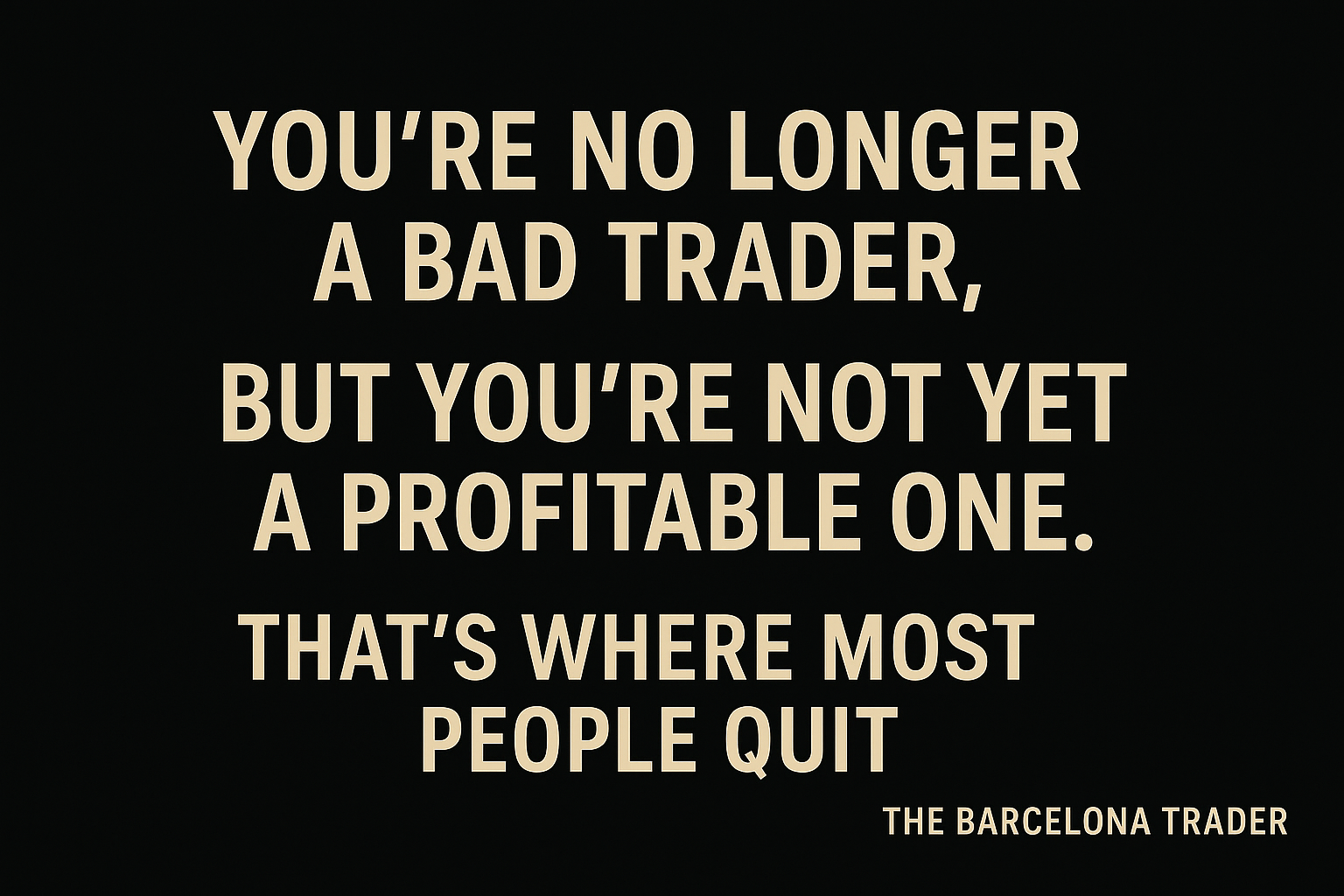
    You’re no longer a bad trader.
    But you’re not yet a profitable one.

    You’re stuck in the hallway between who you were… and who you’re becoming.

    And let me tell you—this is where most traders quit.
    Not because they’re failing. But because they’re improving… and it still feels like failure.

    But here’s the truth:
    This phase isn’t punishment. It’s proof.
    Proof that you’re getting closer.

    You’re not making impulsive trades anymore—so you’re not getting lucky.
    You’re not violating your plan—so there’s no home-run outliers.

    You’re left with the truth.
    The slow, grinding truth of a process that hasn’t finished yet.

    Keep going.

    This is the stretch where all the invisible work starts to compound.
    Where your equity curve feels flat, but your discipline curve is steep.
    Where your P&L is quiet, but your brain is finally rewiring.

    If you’re here, don’t quit.
    Don’t go looking for a new system.
    Don’t start over.
    Just keep showing up.

    Because if you make it through this phase—
    The results come fast.
    And they come from you—not a signal, not a fluke, not a lucky week.

    They come from the foundation you’re laying right now.

    You’re closer than you think.
    Stay in it.