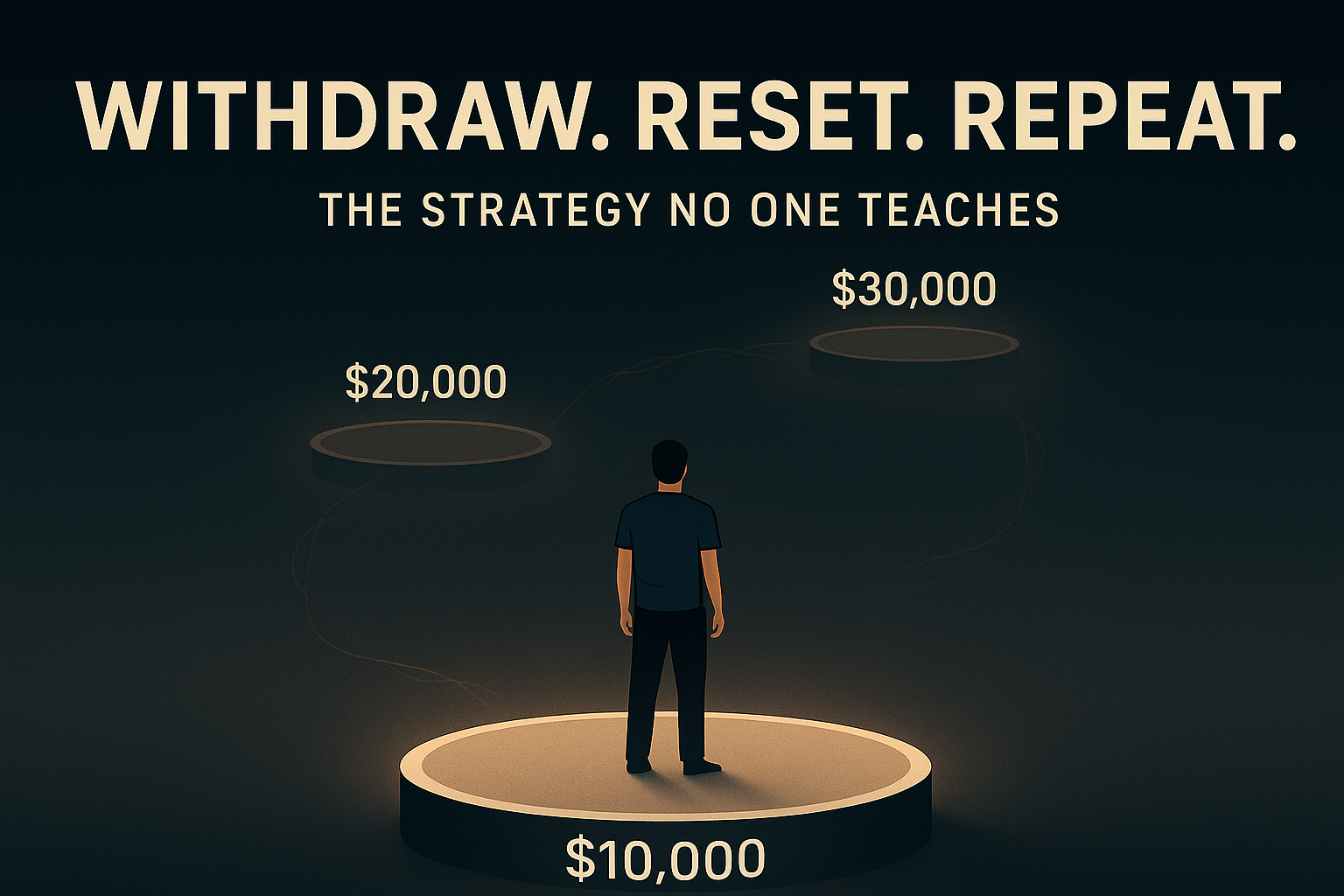
Let’s talk about a trading strategy that’s so sharp, so disciplined, and so mentally demanding that almost no one teaches it—because the gurus can’t stick with it themselves:
Making up to 100% of your entire account size—in profits—every single month and withdrawing it.
I’m talking about making back your whole account balance in gains, taking it all out, and starting over at the baseline the next month.
Start with $10,000. Finish with $20,000. You withdraw $10,000. Every. Single. Month.
Scale it across multiple accounts.
Sounds like a dream? That’s because it is—until you try to live inside it.
💡 The Core of the Strategy:
Fixed lot size. No scaling. (Say, 0.5 lots on XAUUSD = $50/pip.)
A clean, proven edge.
Hedging if necessary—but always with discipline and a tight recovery window.
Monthly withdrawals that zero out your profits back to the starting capital.
So if you start with $10K, your job is to make $10K in profit, extract it, and reset.
No compounding. No adding contracts. No reward for ego. Just: execute clean setups, manage risk like a machine, and pay yourself like clockwork.
🧠 Why No One Teaches This
Because it’s:
Not sexy.
Not flexible.
And very easy to screw up.
It doesn’t work unless you:
Respect risk more than reward.
Exit losers before they rot.
Never chase, stretch, or improvise.
And that’s where most traders fall apart—they need the hope of “just one big month” to justify the pain of drawdown. This strategy doesn’t allow that kind of emotional leak.
🧱 Why It Works (If You Do)
Every month, you reduce risk of ruin by withdrawing capital, not building exposure.
You avoid the psychological drift that comes with account growth (“Well, I can afford this loss…”)
You build consistency—and predictability—in your income stream.
It’s trading as a profession, not a personality test.
🚫 Why It’s Rare
Because to do it, you need:
Emotional immunity to greed.
Trust in the math of your edge, not the dopamine of a bigger position size.
A flawless exit strategy.
A level of discipline that feels, at times, superhuman.
📌 Bottom Line:
This is a strategy for people who would rather make $10K a month consistently across 10 accounts than risk blowing one $100K account chasing the high.
It’s not about getting rich fast. It’s about getting rich forever—slowly, precisely, boringly.
Most traders will never be taught to do this.
But if you master it? You’ve cracked the game.
TL;DR:
Withdraw every dime above your starting balance each month. Start over. Do it again. The hard part isn’t the market. It’s you.
Here’s what I’ve learned the hard way: I am not a rational person who occasionally gets emotional. I’m an emotional animal who manages to have rational experiences.
Most of the time, I can play the part of the disciplined trader. Cool head, tight rules, clean exits. Bruce Banner at the desk. But the second anger gets triggered — a loss that stings, a stop that feels unfair — Banner is gone and the Hulk takes over.
And the Hulk doesn’t “trade.” The Hulk smashes buttons. He doubles down on losers, chases reversals, and treats my account like it owes him money. He is not interested in logic, or setups, or risk management. He is interested in destruction — and he’s very, very good at it.
Here’s the cruel part: you can’t negotiate with the Hulk. Once the adrenaline hits, once the blood pressure spikes, the transformation is already underway. There’s no talking him down. By the time I’m green and raging, the account is already red and bleeding.
So the only move is prevention. At the very first flicker of anger, at the very first whisper that the Hulk might be coming, I have to walk away. If I don’t, it’s too late.
Because the first loss never kills my account. The Hulk does.
Let’s talk about gold. Not the “I just bought another fake Rolex off Canal Street” kind of gold, but the real stuff. The shiny metal that kings killed for, empires bankrupted themselves over, and miners ruined their lungs chasing down streams with pans like they were auditioning for Gold Rush: Dysentery Edition.
Gold isn’t just valuable because it’s shiny, or because rappers decided to make it a status symbol. Gold is valuable because it’s cosmically rare. The atoms in your wedding band—or in my trading charts—were born in cataclysms so violent they make a stock market crash look like a kids’ lemonade stand going out of business.
The Old Story: Neutron Star Smash-Ups
For years, scientists thought that nearly all gold came from neutron star mergers—basically, when two ultra-dense stellar corpses slam into each other and spray the universe with debris. These collisions produce gravitational waves, gamma-ray bursts, and—if you’re lucky—enough precious metal to keep Tiffany’s in business for a few billion years.
It made sense. Those events release the kind of energy needed to force protons and neutrons together into heavy elements like gold, platinum, and uranium. Without them, the periodic table would have ended somewhere around tin foil.
But there was a problem: these mergers don’t happen often enough, or early enough, to account for all the gold we see around us today. It was a nice theory, but like most “the market only goes up” narratives, it had some holes.
The New Twist: Magnetar Tantrums
Enter the latest research, reported in The Washington Post. Turns out, there’s another culprit in the cosmic gold factory: magnetars.
Think of magnetars as neutron stars with a bad attitude and magnetic fields so intense they make your fridge magnet look like a participation trophy. When they throw a tantrum—what scientists call a “flare”—they blast out more energy in a tenth of a second than our Sun will produce in 100,000 years.
One such flare in 2004 was so powerful it actually messed with Earth’s ionosphere, and that was from 30,000 light years away. Do you know how violent you have to be to reach across 30,000 light years and still smack us?
These magnetar flares appear to have the perfect recipe for gold-making: searing heat, an avalanche of neutrons, and enough explosive force to fling that newly-forged heavy metal into the galaxy. According to the study, a single flare could cough up more gold and platinum than the mass of Mars. Yes, Mars. That rusty little ball we’ve been sending rovers to.
How It Got Here: From Stars to Streams
So if the gold was forged in these cosmic demolition derbies, how did it end up tucked away in veins under Nevada or sprinkled in streams in the Yukon?
When Earth formed, heavy elements—including gold—sank into its molten core. By rights, most of the planet’s gold should be completely inaccessible, locked away like a cosmic hedge fund. The reason we have any at all in the crust is because later, asteroids (also packed with heavy metals) slammed into Earth and delivered fresh deposits. You can thank random space rocks for your wedding ring and for the California Gold Rush.
Once here, gold tends to cluster in veins—formed when hot fluids carrying dissolved gold seep through cracks in rock and cool, leaving behind glittery traces. It’s also found in alluvial deposits—streams and rivers where erosion has washed nuggets out of those veins and concentrated them in little pockets, making life briefly exciting for men with pans and big dreams.
That’s why prospectors stood knee-deep in freezing rivers, swishing pans like they were stirring soup. They weren’t idiots—they were chasing the natural process of erosion and concentration. The fact that most of them died broke and toothless just adds to gold’s mystique.
Why It’s Rare (and Precious)
Gold is rare because the universe had to pull off some truly ridiculous stunts to make it in the first place. It’s not renewable. There are no biological gold farms, no photosynthesis of bling. Once it’s here, that’s it. And the stuff we find is only a tiny fraction of what exists—most of it remains trapped in Earth’s core, well beyond the reach of human mining.
That rarity, combined with its incorruptibility (it doesn’t rust, tarnish, or rot), made it the universal symbol of wealth and power. You can melt it down, reshape it, bury it for 5,000 years, and it’ll come back looking brand new. It’s the cockroach of precious metals—indestructible, eternal, and here long after the rest of us are gone.
So What Do We Do With This Knowledge?
Next time you see gold charts spike—or you hear some guy in a cowboy hat ranting about fiat currency—remember: you’re not just looking at a shiny commodity. You’re looking at the aftermath of neutron stars colliding, magnetars losing their temper, and asteroids sucker-punching Earth.
Gold is cosmic shrapnel, forged in violence, delivered by chaos, and hoarded by humans who still think shiny equals safe. Maybe that’s why I like trading it. It’s honest. It doesn’t pretend to care about you. It’s just the universe’s way of reminding us that even after billions of years, we’re still panning in the cosmic stream, hoping to catch something rare.

One of the hardest truths in trading is this: you are not your thoughts. You’re the awareness of them. And if you don’t learn that early enough, your account balance will be the one to teach you. Brutally.
Because here’s what happens. You take a few losses — maybe you followed your rules, maybe you didn’t — and suddenly the brain pipes up like a bad karaoke singer: “Let’s make it back. Double down. The next one’s the big one.”
That voice isn’t wisdom. It’s desperation in a trench coat. And if you follow it, you’ll end up in a place every trader knows too well: staring at the screen, muttering to yourself about how unfair it all is, while your broker thanks you for the donation.
Professional traders know this game isn’t about silencing those thoughts. That’s impossible. The brain loves to chatter. The skill is noticing the thoughts, labeling them (“ah, that’s revenge-trading talking”), and then not acting on them. It’s mindfulness, not mute mode.
And mindfulness in trading isn’t just a five-minute meditation app exercise. Sometimes it means hours of watching the market do nothing and not inventing a setup that isn’t there. Sometimes it’s days. Sometimes it’s an entire week where your only win is that you didn’t throw good money after bad.
That’s the real discipline: sitting still while your brain screams at you to move.
It’s learning that a red day doesn’t mean you’re a failure, and a green day doesn’t mean you’re a genius. You’re just the awareness, steadying the ship while the thoughts thrash around below deck.
Most people quit trading because they can’t separate the two. The pros? They practice it daily. Not perfectly — no one does — but enough to let the setups come to them instead of chasing ghosts.
So next time the thoughts come barging in after a loss, remember: they’re not you. They’re just noise. Your job is to observe, breathe, and wait.
Because the market will still be here tomorrow. Your account, on the other hand, might not survive if you keep letting your thoughts take the wheel.
Let’s talk about the elephant in the room — or rather, the seven U.S. Navy warships and 4,500 personnel currently floating in the Caribbean. Officially, they’re there to fight cartels. Unofficially, they’re parked uncomfortably close to Venezuela, and Caracas is not amused.
So here’s the question: are we actually on the brink of a U.S.–Venezuela war, and more importantly, what does it mean for gold?
The Setup
On one side, Washington is flexing hard. Ships, Marines, even a fast-attack submarine — all parked within striking distance. They say it’s about stopping drug smuggling, but everyone knows it doubles as a pressure campaign on Nicolás Maduro’s regime.
On the other side, Caracas is puffing its chest out. They’re mobilizing militias, yelling about sovereignty, and reminding anyone who’ll listen that most cocaine doesn’t even come from Venezuela. Classic playbook: rally nationalism, make noise, and hope the home crowd eats it up.
The Odds of War
Now, is this about to turn into Iraq 2.0? No. The current U.S. presence is way too small for a full invasion. Think gunboat diplomacy with a bit of “don’t test us” energy.
The most likely scenario is limited action: tighter maritime patrols, maybe a precision strike or two, or a small special forces raid framed as “anti-cartel” rather than “anti-Caracas.” In other words: fireworks, not full-scale war.
But here’s the thing — even a few fireworks are enough to light up the gold market.
Gold’s Reaction if Shots Get Fired
If the first missiles fly, gold’s first instinct is always the same: sprint higher. That’s the headline shock. Traders don’t wait to analyze, they just pile in.
But sustaining those gains depends on the second-order effects:
Does the dollar surge as a safe haven, blunting gold’s rise?
Does oil spike, stoking inflation fears and giving gold extra fuel?
Do bond yields collapse on a flight to safety, doubling the tailwind for gold?
Gold’s job is simple: respond to fear. Your job is not to chase the first vertical candle like it’s the last train out of Caracas. Wait for structure. Wait for confirmation. Then clip it clean.
Why the U.S. and Venezuela Are Even in This Dance
America’s goals: squeeze Maduro, protect U.S. oil interests in nearby Guyana, and send a message without owning the aftermath. Venezuela’s goals: rally nationalism, buy time, and make the cost of U.S. pressure high enough that Washington hesitates.
Both sides want leverage more than they want war. But in geopolitics, accidents happen. A skirmish at sea, a strike gone wrong, a misstep in disputed oil waters — that’s all it takes to turn a standoff into a gold catalyst.
What It Means for You as a Trader
Don’t confuse low probability with low risk. Full war is unlikely, but even a hint of conflict is enough to move gold hard and fast. The pros won’t try to predict the screenplay — they’ll wait, watch, and pounce on the setups the market hands them.
Your job is the same:
Stick to your rules.
Don’t trade the headline, trade the structure.
Remember: clean sessions beat hot takes.
Because the only thing worse than being wrong about war is being right about war and still blowing your account.
Final word: Gold doesn’t care about the politics, it cares about the fear. If Washington decides to play Top Gun: Caracas, the only thing that matters is whether you’re trading like a pro — or torching yourself chasing the noise.
Picture it: Beijing. The People’s Bank of China has finally had it with stacking U.S. Treasuries like Jenga blocks in the vault. The mood is clear — they want fewer dollars and more gold.
In the movies, this is where they’d send a convoy of black sedans to a dock at midnight, where stevedores load gleaming bars onto a freighter bound for Shanghai. In the real world? It starts with a Bloomberg terminal.
They pick up the phone to a bullion bank in London — HSBC, JPMorgan, or ICBC Standard. The trade is agreed at the “Loco London” price, meaning the gold in question already sits in a London vault, stamped, numbered, and 400 ounces to the bar. No one lifts a single ingot. The Bank of China’s name replaces someone else’s on the ledger at the London Precious Metals Clearing system. That’s it — ownership changes hands, but the bars don’t move an inch.
Wall Street’s Gold
Jump to Manhattan. A hedge fund wants to ride the next gold rally. They’re not building a vault in SoHo. They’ll buy a COMEX futures contract — 100 ounces per contract — traded on the CME.
If they sell before expiration, it’s all just numbers on a screen. If they do take delivery (rare), the gold comes out of an approved COMEX depository in New York or Delaware, delivered in 100-ounce or kilo bars, often to another vault, not a penthouse apartment. Settlement is electronic until the moment someone says “I’ll take physical,” and even then it’s trucks, not treasure chests.
The Small Investor’s Gold
Now zoom in on an individual investor — say they’re in Chicago or Nairobi. They can click “Buy” on a gold ETF like GLD, which is nothing more than a claim on a portion of a massive pile of gold in a London vault.
Or they could order physical coins or small bars from a dealer. That’s where the romance dies in a hail of packing peanuts: the “secure shipping” is a discreet FedEx box with the return address of “XYZ Logistics,” because no one wants porch pirates scoring a Krugerrand jackpot.
The Big Picture
Most gold in the world doesn’t actually move. The global market has built a system where central banks, funds, and traders shuffle claims on existing bars through ledgers. The gold sits, gathering dust, in high-security vaults under London, Zurich, or New York.
Physical transport — by plane, truck, or ship — happens when someone repatriates reserves, meets a delivery obligation, or buys in a market far from the vault network.
When Gold Actually Moves
Venezuela, 2011 – The Repatriation Parade
Hugo Chávez decided Venezuela’s gold reserves were safer at home than in foreign vaults. That meant hundreds of tons had to be moved from the Bank of England to Caracas. The gold was flown in batches on secure cargo planes, each bar cataloged and sealed. The arrival was treated like a military parade — armored trucks, soldiers, national TV coverage. It was theater and geopolitics wrapped in one shiny package.
Germany, 2013 – The Patience Test
Germany’s Bundesbank wanted to bring home 674 tons of gold from New York and Paris. They didn’t just call UPS. The move took years because of security, insurance, and scheduling constraints. Most of it traveled by plane in small shipments, with secrecy so tight that even flight crews didn’t know what they were carrying.
India, 1991 – Pawnshop of Nations
Facing a balance-of-payments crisis, India quietly shipped 47 tons of gold to London to secure an emergency IMF loan. The transfer was done discreetly, by air, in the dead of night. For a country with a cultural love of gold, it was a moment of national embarrassment — but it worked.
The Swiss-to-Asia Pipeline
On a smaller but constant scale, Swiss refineries melt London-standard 400-ounce bars into smaller 1-kilo bars preferred in Asia. Those bars travel by secure air freight to Hong Kong, Singapore, and Shanghai. This is one of the few predictable, ongoing physical flows — a quiet conveyor belt feeding private demand.
“Most gold in the world never moves. The paperwork does.”
Inside the Vault
When a shipment finally arrives, the moment is less Indiana Jones and more surgical procedure.
An armored truck backs into a secured bay. Armed guards watch as the containers — often dull metal boxes no bigger than an office file cabinet — are wheeled inside.
The vault doors are massive, but they don’t creak like in the movies; they swing silently on precision bearings. Inside, it’s cool, dry, and brightly lit. Every movement is recorded from multiple angles.
Bars are unloaded and placed on a scale, their weight checked down to a tenth of a gram. Each one’s serial number, refinery stamp, and purity mark are matched against the manifest. If anything is off, an assay — a drill-and-sample purity test — can be ordered on the spot.
Once verified, the bars are stacked in numbered compartments, each stack assigned to an owner — a government, a bank, or sometimes a private fund. The ledger is updated, and the gold is effectively frozen in place until the next transfer, which might be tomorrow… or never.
Myth vs. Reality: Gold on the Move
MYTH: Central banks ship gold in pirate-style treasure chests.
REALITY: It’s more like a filing cabinet on a pallet, wrapped, sealed, and moved by forklift. The romance is dead, but the insurance premiums are thriving.
MYTH: Every gold trade means bars flying around the world.
REALITY: Ninety-plus percent of trades never move a single bar. Ownership just flips in a clearing ledger, and the gold stays put in a vault.
MYTH: Gold travels under constant armed escort.
REALITY: Yes and no. The guards are there, but you won’t see them — the best security is invisibility. Unmarked trucks, quiet airport transfers, and no one on the flight crew knowing they’re sitting over a hundred million in bullion.
MYTH: Taking delivery from COMEX means the gold shows up at your house.
REALITY: It goes to a COMEX-approved vault. If you insist on home delivery, you’ll meet a whole new circle of friends: armored couriers, customs officials, and your insurance agent in cardiac arrest.
MYTH: Gold moves mostly by ship because it’s heavy.
REALITY: Planes are faster, more secure, and far less pirate-prone. Ships are reserved for bulk, low-urgency moves — or the occasional national repatriation stunt.
Even though we’re gold traders, it pays to keep an eye on the broader market. Gold doesn’t exist in a vacuum. Sentiment, risk appetite, and tech euphoria (or panic) spill into every corner of the financial system. And right now, all eyes are on Nvidia’s earnings call.
Tomorrow, Nvidia reports. The stock has been the darling of the AI revolution, the poster child for “chips to infinity.” The hype is so thick you could spread it on toast. But with that hype comes a dangerous cocktail: greed on one side, fear on the other. The market’s pricing in a huge move either way. Think ravenous bulls or bloodied bears. No middle ground.
Fear, Greed, and the Nvidia Narrative
Wall Street expects Nvidia to post monstrous numbers — revenues that look like they were dreamed up in a fever. If they deliver, greed will roar. The stock could gap higher, dragging tech and risk appetite along for the ride. Traders everywhere will feel braver. Gold may dip as capital rushes back into “risk on.”
But if Nvidia stumbles? If guidance falters, or if investors sniff that the AI boom isn’t paying the bills yet? Fear takes over. We’re not just talking about one stock missing earnings. We’re talking about an existential wobble in the narrative that’s powered the market for two years: the idea that large language models are marching us toward artificial general intelligence.
The Jitters: What If LLMs Aren’t AGI?
Here’s the unspoken fear: what if all this LLM hype doesn’t get us to AGI at all? What if we’ve built bigger and bigger parrots, but not actual intelligence? That thought terrifies investors because if the story cracks, so does the justification for the trillions poured into chips, data centers, and every stock riding Nvidia’s coattails.
And it’s not a crazy thought. LLMs are brilliant mimics — dazzling at text prediction — but lousy at real reasoning. They’re great at “System 1” style thinking: fast, intuitive, fuzzy. But they stumble on “System 2” reasoning: logic, planning, genuine problem-solving. That’s why some fear the whole AGI narrative is sitting on wobbly stilts.
If Not LLMs, Then What?
If LLMs hit a wall, the race for AGI won’t end. It will just pivot. Here are the most credible alternatives:
Neuromorphic & Brain-Inspired Computing Chips designed like brains, using spiking neurons and in-memory computing. More efficiency, less brute force.
Hybrid & Symbolic AI Marrying neural nets with logic-based reasoning — fast intuition plus deliberate thought. It’s a way to get real structure into the chaos.
Embodied AI Intelligence grounded in the physical world. Think robots that actually learn by doing, not just predicting words on a screen.
Whole-Brain Emulation Scan and simulate an actual brain neuron by neuron. It sounds like science fiction, but it has serious believers.
Cognitive Architectures Building AI with modular systems — memory, planning, reasoning — stitched together in a way that more closely resembles human thought.
Who’s Out in Front?
Intel and DARPA-backed labs are making progress in neuromorphic chips.
IBM and academic groups are leading in neuro-symbolic AI.
DeepMind and robotics outfits are pushing embodied intelligence.
Brain emulation projects are still fringe, but they’re not dead.
In other words, if the market stops worshipping at the altar of LLMs, there are plenty of other temples waiting.
Why This Matters for Traders Like Us
Here’s why we should care as gold traders: the outcome of Nvidia’s call will ripple across everything.
If they smash expectations, risk-on explodes, equities pump, and gold might sag as money chases tech.
If they falter, doubt spreads like wildfire, risk-off dominates, and gold benefits as capital looks for a safe haven.
This isn’t just about Nvidia’s revenue. It’s about whether the market still believes the LLM-to-AGI story — or whether fear drives a pivot to other AGI narratives. Either way, tomorrow’s call is a moment of truth.
Final Thought
So yes, we’re gold traders. But don’t kid yourself: what happens on that earnings call can shape our tape tomorrow. Nvidia’s numbers aren’t just numbers. They’re a Rorschach test for the greed and fear driving this market.
And remember — the real joke is on us, believing AGI will come from the next quarterly guidance.
If you’ve ever sat there staring at your chart thinking, “Where the hell is this thing going?” — welcome to the club. That’s why traders lean on pivot points. They’re not crystal balls. They’re not insider tips from some guy who “knows a guy.” They’re just math.
But here’s the thing: math works. Pivots give you a framework for where the market might slam on the brakes, do a U-turn, or gun it like a teenager in dad’s Camaro. They’re not guarantees. They’re guideposts. And if you’re trading without them, you’re basically running through a minefield in flip-flops.
The Mother Pivot
Everything starts with the Pivot Point (PP) itself. Think of it as the gravitational center of yesterday’s chaos:PP=High+Low+Close3PP=3High+Low+Close
That’s it. No secret sauce. Just the average of the high, low, and close. The market’s way of saying, “Here’s the middle ground — now let’s fight about it.”
The Resistance & Support Gang
Once you’ve got your pivot, you spin off the levels that traders live and die by:
R1 (Resistance 1):
R1=(2×PP)−LowR1=(2×PP)−Low
S1 (Support 1):
S1=(2×PP)−HighS1=(2×PP)−High
R2:
R2=PP+(High−Low)R2=PP+(High−Low)
S2:
S2=PP−(High−Low)S2=PP−(High−Low)
R3:
R3=High+2×(PP−Low)R3=High+2×(PP−Low)
S3:
S3=Low−2×(High−PP)S3=Low−2×(High−PP)
Call them “levels,” call them “lines in the sand.” I call them the places you’ll regret ignoring when price slaps you in the face.
The Midpoints — Because Humans Hate Waiting
Traders are impatient. That’s why I also plot the midpoints — the halfway houses between the big levels:
M1: Between S1 and S2
M2: Between S1 and PP
M3: Between PP and R1
M4: Between R2 and R3
They don’t get as much hype, but they matter. Markets often pause there, like they’re catching their breath before the next sprint.
Same Formula, Different Flavor
Here’s the beauty (or the horror, depending on how you see it): the formulas don’t change. Only the timeframe does.
That’s it. Pivots are universal. Same math, different battlefield.
Or Skip the Math (Because Life Is Short)
If you’d rather not do the arithmetic every night like some medieval accountant, I’ve got you covered. I built a simple spreadsheet where you just plug in the open, high, low, and close. It spits out all the pivots for you — daily, weekly, monthly.
Use it. Abuse it. Just don’t blame me if you ignore the levels and get steamrolled.
The Bottom Line
Pivot points won’t make you a genius. They won’t turn your $500 account into a Lambo. But they will give you a reliable map — one that the market respects often enough to keep them on my charts every single session.
Trading without pivots? That’s like skydiving without checking the parachute. Sure, you might be fine… until you’re not.
There’s a certain flavor of trading guru out there—you’ve seen them. Tight T-shirt, protein shake, testosterone-infused motivational posts. “Discipline starts at 5 AM in the gym, bro. If you can’t do that, you’ll never be a trader.”
And to be fair, they’re not entirely wrong.
But they’re not entirely right either.
Trading is a form of psychological athleticism.
At its core, trading is about doing the correct thing while your brain is screaming at you to do the wrong thing. Over. And over. And over.
It is pain tolerance, but not physical. It’s not about how much you can bench press. It’s about how long you can sit inside a trade that’s gone $150 against you and calmly click out exactly where your exit rule tells you to, rather than where your ego wants you to.
Where the gym analogy works
When you train physically, you deliberately introduce discomfort to build resilience. You force yourself into pain under controlled conditions.
You’re sore, but you do the reps.
You’re tired, but you finish the workout.
You’re tempted to quit, but you don’t.
That process does strengthen your nervous system. It builds tolerance for discomfort. It creates evidence that you can act correctly even when uncomfortable.
That skill absolutely transfers into trading.
But here’s where the gym bros lose the plot:
They make it sound like you need to be in peak “Alpha Mode” before every trading session.
Like if you don’t get 8 hours of sleep, eat salmon and quinoa, meditate for 20 minutes, and hit a personal deadlift record… … you’re not “primed” to execute.
And while yes—healthy routines help—it’s a false expectation that you can or need to be at peak readiness every time you sit at the screens.
The uncomfortable truth:
You will trade tired. You will trade frustrated. You will trade stressed. You will trade while your kid is sick, your dog puked on the carpet, and your neighbor’s leaf blower is firing up for the third time that morning.
And you still have to execute.
Because the real skill isn’t trading while feeling good. It’s trading well while feeling like garbage.
So does trading become easier?
Yes — but not because the discomfort goes away. It gets easier because you stop fearing the discomfort.
You stop negotiating with your emotional brain.
You stop arguing with the voice that says:
“This feels bad.”
“I want out.”
“I can’t take another loss.”
And instead you calmly say back:
“Noted. But I will still obey my system.”
Eventually, it becomes muscle memory. Sort of.
When you start, trading feels like learning a foreign language while someone screams in your ear. Every decision feels loaded with pressure.
But over time, as you consistently act correctly inside discomfort, your brain starts to rewire:
The discomfort remains.
But your response becomes automatic.
You act correctly faster.
You spend less time spiraling.
That’s the true version of “muscle memory” in trading.
So, should you hit the gym?
Yes.
But not because your biceps will make you a better trader.
You do it because voluntarily enduring discomfort in any domain trains your nervous system for voluntary discomfort everywhere.
And trading is voluntary discomfort on steroids.
The real takeaway
Trading mastery isn’t about achieving perfect emotional neutrality. It’s about executing correctly despite imperfect emotions.
Every rep in the gym, every hard conversation you have in your personal life, every time you face a stressful truth you’d rather avoid — —it’s all training for the psychological game you’ll face at the charts.
Because in the end, trading mastery is nothing more than emotional pain tolerance, skillfully directed.
Minutes after Donald Trump blasted out a Truth Social broadside about the Federal Reserve, gold ripped higher on our screens—about thirty bucks in twenty minutes. That’s not astrology. That’s policy risk hitting the tape.
What just happened (the facts)
Trump says he’s removing Fed Governor Lisa Cook, posting the letter publicly. It’s an extraordinary move aimed right at the Board of Governors. The Financial Times and Reuters both confirmed the action and the posture behind it.
This follows a month of pressure campaigns—Trump has urged the Fed’s Board to sideline Chair Jerome Powell and “assume control” if he doesn’t cut rates, an open challenge to the central bank’s independence.
Global central bankers (yes, at Jackson Hole) are openly worried about the precedent: politicizing the Fed risks financial stability and credibility. Translation: higher risk premia, more volatility.
Can a president actually fire Fed governors?
Sort of—if there’s legal cause.
By law, governors serve 14-year terms and may be removed “for cause” (think misconduct or neglect of duty), not just policy disagreements. That’s been the consistent view of mainstream legal analysis for years. Any attempt to stretch “cause” into “I don’t like your dot plot” heads straight to court.
Why would Trump want this?
Let’s drop the euphemisms. Installing loyalists at the Fed can:
Force a faster, deeper rate-cut path (or at least jawbone it), which would juice risk assets in the short run and weaken real yields—classic bullish gold fuel.
Consolidate control of the policy narrative heading into a choppy macro stretch: deficits, tariffs, dollar politics.
Create a chilling effect inside the Fed: even if courts swat removals down, the message lands—vote with the White House or get lawyered up.
None of that guarantees prosperity. It guarantees uncertainty—and gold loves uncertainty.
Why gold spiked (and why it might keep a bid)
Fed independence risk = risk premium. Markets price in the chance of policy mistakes and credibility damage. That pushes safe-haven demand higher. (Central bankers literally flagged this risk today.)
Lower real yields narrative. If the market believes cuts get pulled forward or are larger than the data would justify, real yields drift down. Gold doesn’t pay a coupon; it thrives when the opportunity cost falls.
Institutional optics. Firing a sitting governor—publicly—signals more battles to come (Powell’s term ends next year). The process story alone can keep volatility elevated.
The irony file
While we’re on “governance and credibility,” a reminder: Trump is already a convicted felon in New York for falsifying business records (he received an unconditional discharge in January; the conviction stands). That doesn’t make him wrong about monetary policy, but it does make the “restore integrity” sermon a tough sell.
(Separately, a New York appeals court just threw out the half-billion-dollar civil fraud penalty, even as it left core liability findings intact—so expect both sides to wave that around as proof of everything. Markets care less about the spin and more about how the power struggle bleeds into policy.)
The opposing view (and why it matters)
Opposition: The White House can’t lawfully purge the Fed for policy reasons; attempts will be enjoined; the institution will hold.
Our take: Courts may ultimately check removals—but the process risk (letters, threats, litigation, vacancies) is enough to move markets now. The message to investors is: brace for political volatility embedded in monetary policy. That’s supportive of gold until the governance path is clear.
How I’m thinking about it as a trader
Treat Fed-headlines as catalysts, not trends. Expect gap-y moves, then digestion.
Watch real yields and DXY—if either rolls over on the narrative, gold’s dips will be shallow.
Respect levels. Policy drama doesn’t repeal technicals; it amplifies them. Confluence > bravado.
Bottom line: Even if the legal bid trips Trump up, the uncertainty premium is real. As long as the market believes the Fed could get bent out of shape by politics, gold will keep a safety bid—and every spicy post will keep the tinder dry.