Tag: finance

  • How The U.S. Benefits by the Dollar Being the World’s Reserve Currency – and Why It Matters to Traders

    How The U.S. Benefits by the Dollar Being the World’s Reserve Currency – and Why It Matters to Traders

    Everyone’s always yelling about “de-dollarization,” like it’s going to happen next Tuesday.
    Spoiler: It’s not.

    And here’s why—the U.S. dollar is the world’s reserve currency.
    Which, if you’re new to this, is kind of like holding the master key to the global economy.

    So what does that actually mean?

    1. America gets to print the money everyone else needs.

    Let’s start here: most international trade—especially in oil, commodities, and global finance—is settled in USD.
    That means countries need dollars on hand at all times.
    So when the U.S. runs a deficit? It just issues more dollars.
    Other countries? They have to earn those dollars by exporting goods or holding U.S. debt.

    That’s not just power—it’s leverage.

    2. Global demand for dollars props up U.S. debt.

    The U.S. has a massive national debt.
    But because the dollar is the reserve currency, global central banks buy U.S. Treasuries like they’re gold.
    Why?
    Because they need safe, liquid, dollar-denominated assets.
    That constant demand keeps U.S. borrowing costs artificially low.

    You and I don’t get that luxury when we’re broke.

    3. The dollar lets America export inflation.

    When the U.S. prints money, it doesn’t just affect domestic prices.
    Because so many other countries use the dollar for trade, dollar inflation gets exported.
    That means rising U.S. liquidity gets diffused globally—watering down the full impact at home.

    In other words: America can flood the world with dollars, and everyone else helps clean it up.

    4. It gives U.S. sanctions real teeth.

    When the U.S. wants to punish a country (see: Iran, Russia, Venezuela), it doesn’t just send troops.
    It cuts off access to dollars and the SWIFT system.
    No dollars = no trade = economic suffocation.

    That only works because the dollar is the system.

    5. It creates forced demand—even in crisis.

    During global uncertainty, everyone runs to the dollar.
    Even if the U.S. caused the crisis.
    Why? Because when things go sideways, investors don’t want risk—they want liquidity.
    And nothing’s more liquid than the dollar.

    It’s the ultimate “we may be crazy, but we’re the best house in a bad neighborhood” trade.


    So why does this matter to traders?

    Because when you’re trading gold, oil, or any dollar-paired asset, you’re not just watching charts.

    You’re watching the gravitational pull of a currency that’s still the center of the financial universe.
    When DXY moves, the world adjusts.

    And until someone builds a global alternative with equal trust, liquidity, legal enforcement, and geopolitical power?

    The dollar’s still king.

    And if you’d like to keep reading, I’ll tell you how the dollar became the world’s reserve currency.

    It didn’t happen by accident.
    It happened at a little gathering in 1944 called the Bretton Woods Conference—basically the global finance version of drafting a new constitution.

    World War II was still wrapping up. Europe was wrecked. Currencies were unstable. Global trade was chaos.
    So 44 countries got together in New Hampshire (because apparently the Ritz in Geneva was booked) and agreed to something radical:

    The U.S. dollar would be pegged to gold.
    And every other major currency would peg to the dollar.

    This meant the dollar became the convertible anchor of the entire postwar financial system.

    Why the dollar?
    Because the U.S. had two things nobody else had in 1944:

    • A stable government with global influence
    • Most of the world’s gold reserves

    The deal was simple:
    You trust the dollar because we’ll redeem it for gold.
    And in return, the U.S. becomes the backbone of global finance.

    That system lasted until 1971, when Nixon pulled the plug and took the U.S. off the gold standard.
    Why? Because Vietnam was expensive, inflation was spiking, and America didn’t feel like bleeding gold to every country that showed up with a redemption slip.

    So what happened?

    Everyone panicked…
    And then?

    Nothing.
    They kept using the dollar anyway.

    Because there was no alternative.
    And because by that point, the U.S. had embedded itself so deeply into global trade and debt markets that switching awaywould’ve caused more damage than staying.

    And here we are.

    The gold is gone. The promise is gone.
    But the trust, the infrastructure, and the dominance remain.

    That’s how the dollar became—and stayed—the world’s reserve currency.

  • The Final Frontier – Your Trading Psychology

    The Final Frontier – Your Trading Psychology

    When you’re just starting out in trading, everyone tells you the real challenge is “psychology.”
    They’re not wrong.
    They’re just… premature.

    Because if you’re a beginner, chances are psychology isn’t your biggest problem yet.
    At that stage, your biggest problem is that you don’t actually know what you’re doing.

    • You’re guessing at setups
    • You don’t know your edge
    • You have no defined risk
    • And your “trading plan” is whatever someone on YouTube said looked good last night

    Let’s call it what it is: you’re still in technical bootcamp.
    You don’t need a sports psychologist—you need to stop hitting buy because a candle “looked bullish.”

    But… once you’ve been at this a while—once you’ve got a system, you understand structure, you’ve journaled trades, maybe even passed an eval or two—then yeah…

    That’s when psychology becomes the final boss.

    It sneaks in after you’ve already done the hard part.
    And suddenly, you are the last thing standing between your system and your results.

    Not the chart. Not the Fed.
    Not Jerome Powell sneezing mid-sentence.
    You.

    This is the final frontier. And it’s a mindf*ck.

    Because now it’s not about knowledge—it’s about control.
    It’s about execution under pressure.
    It’s about making the right decision while your brain is telling you to do the opposite.

    So what can you do?


    🧠 Here are a few ways to start mastering your own psychology:

    1. Trade smaller
      If your hands are shaking, your size is too big. Period.
    2. Pre-plan your trade
      Define your entry, stop, and target. If it’s not on paper, it’s improv.
    3. Journal everything
      And I mean everything. Not just what you did—but how you felt.
    4. Take breaks after losses
      Your next trade shouldn’t be emotional triage.
    5. Create hard rules for max daily loss
      One rule can save you from one bad day nuking your month.
    6. Check your mental state before every session
      Hungry? Angry? Rushed? You’re compromised. Don’t trade compromised.
    7. Use alarms instead of staring at the chart
      Give your nervous system a chance. Constant screen watching = constant cortisol.
    8. Focus on process, not outcome
      Did you follow your plan? That’s the win. The P&L comes later.

    A Great Video You Should Watch

    I recently came across a fantastic breakdown of this topic by The Traveling Trader—and I’ve got to say, he nails it.
    The way he explains the psychological shifts, the traps, and the actionable tools is legit. It’s not fluff. It’s not a motivational speech. It’s real.

    So if this post hits a nerve—and you know psychology is what’s holding you back right now—go watch his video. I’ve embedded it below.

    👇👇👇
    Watch it. Rewatch it. Bookmark it. And then do the work.
    Because the chart won’t save you.
    Your plan won’t save you.
    Only you, with a calm brain and a click-ready finger, will.

  • You Can Teach Trading—But Only So Far

    You Can Teach Trading—But Only So Far

    You can teach someone how to trade.
    But only up to a point.

    You can teach setups.
    You can teach risk management.
    You can teach how to mark up a chart, read macroeconomic indicators, and identify momentum shifts on a 5-second timeframe.

    You can teach patience.
    You can preach discipline.
    You can scream “Stick to your damn stop loss!” until you’re blue in the face.

    But none of it matters until you decide to stop lighting your own capital on fire.

    The Hard Truth

    Trading isn’t plumbing. It’s not accounting.
    You don’t pass a test, hang a certificate on your wall, and suddenly become consistent.

    There’s a point in every trader’s journey where no mentor, no YouTube video, no golden Discord server can save you. And that point usually comes right after you already know what you’re supposed to do… but still don’t do it.

    That’s the line between being taught and actually learning.

    You can learn what you need to know from a course and some are a LOT better than others. I recommend this one. But you don’t truly learn until the moment you finally honor your own rules.

    You learn it when you don’t add to a loser.
    When you don’t chase the second breakout after missing the first.
    When you close a trade because your setup broke down—not because you “hope it bounces.”

    That’s not something anyone can program into you.
    That’s earned. That’s internalized. That’s learned the hard way.

    The Market Doesn’t Care

    It doesn’t care how many hours you studied.
    It doesn’t care how bad you want it.
    The market is the final exam—and it doesn’t hand out A’s for effort. It tests your actions. Not your knowledge.

    The best mentors in the world can only walk you to the edge.
    After that?
    It’s your hand on the mouse. Your capital on the line. Your brain versus your brain.

    So Here’s the Real Lesson

    If you’re still in that loop—study, blow account, repeat—it might be time to stop trying to find a better teacher. And start being a better student.

    Of your mistakes.
    Of your impulses.
    Of your emotions.

    The edge isn’t in the strategy.
    It’s in your ability to execute it without flinching.

    And that’s not taught.
    That’s learned.

  • The Part No One Talks About

    The Part No One Talks About

    There’s a part of the trading journey that almost no one warns you about.

    It’s not the beginning—when you’re reckless and euphoric and think you’re going to master the markets in six months.
    It’s not the blow-up phase either—when you burn an account and realize this game isn’t as easy as the YouTubers made it look.

    No, this part is later.
    This part is worse.

    It’s when you’re doing almost everything right… and it still isn’t showing up in your P&L.

    You’re finally sticking to your plan.
    You’re not revenge trading.
    You’re managing risk.
    You’re walking away when the market’s not clean.
    You’re doing all the internal work—but the external results still suck.

    This is the part where it’s darkest before the dawn.

    It’s brutal. Because the dopamine is gone. The chaos is behind you. But the consistency hasn’t paid off yet.

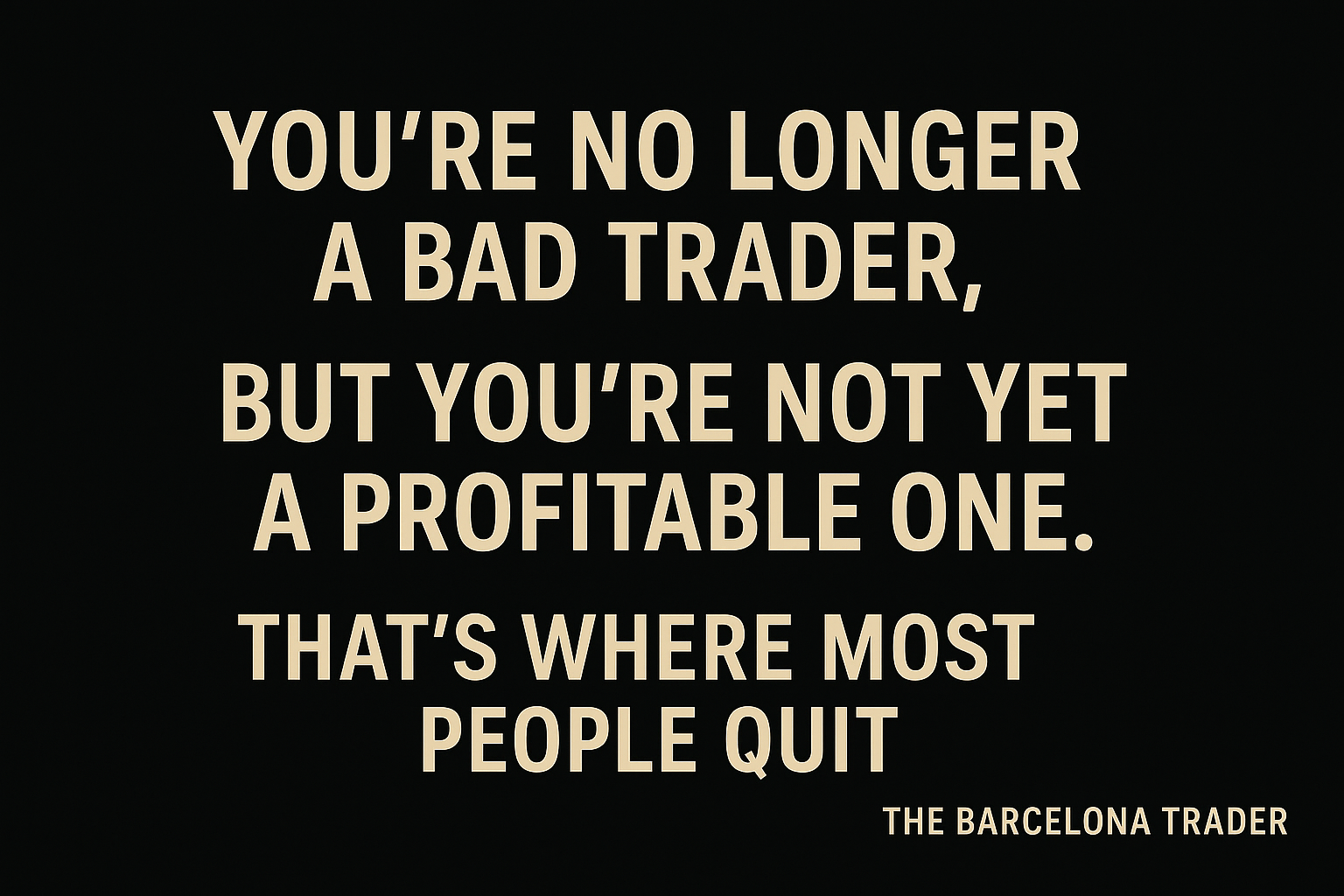
    You’re no longer a bad trader.
    But you’re not yet a profitable one.

    You’re stuck in the hallway between who you were… and who you’re becoming.

    And let me tell you—this is where most traders quit.
    Not because they’re failing. But because they’re improving… and it still feels like failure.

    But here’s the truth:
    This phase isn’t punishment. It’s proof.
    Proof that you’re getting closer.

    You’re not making impulsive trades anymore—so you’re not getting lucky.
    You’re not violating your plan—so there’s no home-run outliers.

    You’re left with the truth.
    The slow, grinding truth of a process that hasn’t finished yet.

    Keep going.

    This is the stretch where all the invisible work starts to compound.
    Where your equity curve feels flat, but your discipline curve is steep.
    Where your P&L is quiet, but your brain is finally rewiring.

    If you’re here, don’t quit.
    Don’t go looking for a new system.
    Don’t start over.
    Just keep showing up.

    Because if you make it through this phase—
    The results come fast.
    And they come from you—not a signal, not a fluke, not a lucky week.

    They come from the foundation you’re laying right now.

    You’re closer than you think.
    Stay in it.

  • Why Traders Get So Intense about Trading

    Why Traders Get So Intense about Trading

    Ever notice how traders become a little much?

    Not just interested. Not just focused.

    But full-blown, charts-in-the-shower, “I’ll be there after London closes” obsessed?

    You start out thinking you’ll learn to make a little money on the side.

    Two years later, you’re ignoring dinner, talking about liquidity sweeps like they’re plot twists in a Scorsese film, and arguing with your own journal.

    What is it about trading that turns normal people into hyper-disciplined, caffeine-fueled, market-monitoring maniacs?

    Here’s my take.

    1. It’s brutally honest.

    In a world full of spin and sugarcoating, trading tells you the truth—daily.

    You’re either right or you’re not.

    You respected your risk or you didn’t.

    There’s no boss to blame. No co-worker to cover for you. Just your decisions, reflected back in numbers. It’s clarity—and it’s addictive.

    2. It promises freedom—but makes you earn it.

    The idea that you can master a skill, deploy it from anywhere, and build your own financial runway? That’s powerful.

    But unlike get-rich-quick schemes, trading doesn’t hand it to you.

    It demands effort. Consistency. Self-awareness.

    The harder it is, the more legit it feels. And when you finally make it through the fog, it changes you.

    3. The game never ends.

    Every day is a new puzzle.

    No two sessions are the same. There’s always something to improve. A better entry. A cleaner exit. A more disciplined mindset.

    It becomes a self-mastery project disguised as a career.

    4. You see progress—and that’s intoxicating.

    Not every day. Not every trade.

    But slowly, you see it. The restraint. The setups you walk away from. The losses you take without spiraling.

    And you start thinking: What else in life could I apply this to?

    That’s when you realize… you’re hooked.

    5. It makes you better. Or it breaks you trying.

    And deep down, we respect that.

    Trading doesn’t care about your résumé. It cares about your resolve.

    It forces you to confront your ego, your habits, your fears—and either fix them or keep paying for them.

    There’s something quietly beautiful about that kind of accountability.


    So yeah—traders can be intense.

    We get weird. We wake up early. We cancel plans. We say things like “price is building energy.”

    But we’re not crazy. We’re just called.

    Because once you taste what it feels like to trade with clarity—to trust yourself under pressure—you don’t want to go back.

    And when that happens?

    You’re not “interested” anymore.

    You’re in.

  • When You Need A Stern Talking-to After Breaking Your Rules

    When You Need A Stern Talking-to After Breaking Your Rules

    Look me in the eye.

    You want to be a trader? Then act like one.

    A trader doesn’t beg the market for mercy. A trader doesn’t hold and hope. A trader doesn’t violate their own rules and call it strategy.

    Every time you ignore your stop, every time you say “just a little more,” you’re not just risking money —you’re proving to yourself that you can’t be trusted when it matters most.

    That’s not a loss. That’s self-betrayal. And it’s worse than red on a chart.

    Your spouse/family etc. is depending on you. You said you’d make this work. So what are you gonna tell them? That you almost had discipline? That you knew better, but clicked anyway? That your plan didn’t fail — you did?

    You don’t get to blame the market. You don’t get to say it was “just one trade.”

    If you can’t follow your own rules, then stop pretending this is a business. Because it’s not. It’s a slot machine with better lighting.

    But if you’re done with that —If today’s the day you build trust one trade at a time —

    Then sit your ass down, trade your plan, and walk away with your self-respect intact.

    You don’t need a win. You need a clean session.

    Be a person of your word. Prove it — to yourself. Right now.

  • DAB: The Hidden Bias That Destroys Profitable Traders

    DAB: The Hidden Bias That Destroys Profitable Traders

    There’s a moment—every trader knows it—when you’ve had a good run. You’re up for the session, maybe even on a streak. The charts have been generous. You’re calm. Confident. Dialed in.

    And then it happens.

    You take one more trade. Maybe it’s not your best setup. Maybe it is. But this time… it turns. Fast. And instead of cutting it when your rules say to, you freeze.

    Why?

    Because it’s not just a losing trade.

    It’s threatening to take back your wins.

    And the pain of giving up $150 of profit feels worse than the risk of losing everything.

    That’s DAB—Drawdown Aversion Bias.

    A psychological trap where the fear of surrendering a small win causes us to abandon the very discipline that earned that win in the first place.


    What DAB Sounds Like:

    • “It’s only a pullback. It’ll bounce.”
    • “I’ll just wait a little longer—then close.”
    • “I’ve had such a good day, I deserve this trade to work.”
    • “I can’t give it all back now…”

    DAB doesn’t scream. It whispers. And its voice sounds a lot like hope.


    Why DAB Is So Dangerous

    Because it doesn’t strike in chaos—it strikes in confidence.

    After you’ve already proven you can win.

    It tricks you into thinking you’ve earned an exception to your rules.

    That you’ve ascended past discipline.

    And before you know it, you’re $600 in drawdown on a trade you never should’ve let go past -$150.

    You’re negotiating with yourself.

    You’re justifying, praying, watching.

    You’re no longer trading.


    How to Defuse DAB

    1. Name It.If you can spot it, you can stop it. When that creeping resistance to cutting a loser shows up, say it out loud: “This is DAB.”
    2. Use a Session Trailing Stop.Decide ahead of time: once I’m up X, I won’t give back more than Y—no exceptions.
    3. Pre-Commit a Max Per-Trade Risk Once Green.E.g. “If I’m up $500, no trade may risk more than $150 of that.”
    4. Journaling the Feeling.Capture what it feels like in the moment DAB kicks in. You’ll start to see the pattern—and build immunity.
    5. Honor the Exit More Than the Outcome.Don’t judge the trade by what happened after you closed it.Judge it by whether you followed the rules that keep you in the game.

    Final Thought:

    Most traders don’t blow their accounts on their worst day.

    They blow it trying to protect their best ones.

    DAB is sneaky. It’s emotional.

    And if you don’t learn to beat it, it will beat you.

    But when you master it?

    You don’t just keep your profits.

    You earn your trust back. Trade by trade.

  • The Most Expensive Losses Don’t Cost Money — They Cost Self-Trust

    The Most Expensive Losses Don’t Cost Money — They Cost Self-Trust

    There are two kinds of losses in trading.

    There’s the kind where you followed your plan, took a clean setup, managed risk, and the market just didn’t cooperate. That kind of loss is part of the game. You absorb it, log it, and move on.

    And then there’s the other kind — the kind where you knew better… and did it anyway.


    The $1,200 Lesson (Again)

    Last night, I took a sell in gold that started to move against me. No big deal at first. My brain told me to exit — the setup was invalidated, momentum had shifted, and it wasn’t part of my edge anymore.

    But my brain wasn’t the loudest voice in the room.

    My hope was louder. My attachment to the gains I’d made earlier in the session was louder. My fear of walking away with a red number was loudest of all.

    So I held it.

    • First it went $170 against me.
    • Then $500.
    • Then $800.
    • Then over $1,200.

    It eventually came back — a market miracle — and I closed the trade at a $510 loss. Not catastrophic, but enough to erase all my earnings for the session plus $80.

    But here’s the part that hurt the most:

    I didn’t break a rule I didn’t know.

    I broke one I’d sworn I wouldn’t break again.


    What Really Breaks When You Hold Too Long

    The issue isn’t the dollar loss.

    It’s the damage to your self-trust.

    Every time you ignore your exit plan, hesitate when you know you should act, or let a “just one more minute” impulse override your discipline — you chip away at your own belief that you’re someone who follows through.

    And when you stop believing your own rules — they stop working.

    Because rules without self-trust aren’t rules.

    They’re suggestions. And suggestions don’t save accounts.


    When the Lesson Finally Landed

    I’ve made this mistake before. Maybe you have too.

    But last night, something clicked. Not because of the money. But because I felt it — that disorienting drop in self-respect when I realized I’d traded like a beginner. Like someone still learning the lesson I’d already learned ten times before.

    So I’m making a change. Not a tweak to my system. Not a new exit strategy.

    A hard line.

    From here on out, my discipline is non-negotiable. Because if I want to reach the next level — funded, consistent, emotionally durable — I need more than setups.

    I need to trust myself.


    For the Trader Reading This

    If this hits close to home, good. Let it.

    We all want to be consistent. But that starts with being honest. So ask yourself:

    • Do you still flinch when it’s time to exit?
    • Do you override your stops, hoping for a turn?
    • Do you say “never again” — and then do it again?

    If so, you don’t need more information. You need integrity.

    Build that, and the edge will follow.


    Final Word

    The market isn’t trying to punish you. It’s trying to reveal you — to show you where your discipline ends and where you start making exceptions.

    Last night, I saw that edge again.

    It didn’t come from a perfect trade.

    It came from a bad one that finally taught me the cost of breaking trust with myself.

    Let this be the last time we both need that lesson

  • The Gold Market Isn’t a Fair Fight — And That’s Exactly Why We Trade It

    The Gold Market Isn’t a Fair Fight — And That’s Exactly Why We Trade It

    I used to think the gold market was a dignified place — a realm where central banks, jewelers, and bullion dealers transacted based on genuine supply and demand. A place where price moved because someone needed to hedge, deliver, or diversify.

    How quaint.

    Then I started trading it.

    What I discovered is that beneath the polished veneer of the gold market lies a battleground teeming with sharks, spoofers, and algorithmic predators. It’s less of a serene exchange and more of a high-stakes poker game — except the house has a PhD in behavioral finance and an army of bots sniffing out retail fear like blood in the water.


    🕵️‍♂️ The Puppet Masters Behind the Curtain

    Let’s start with spoofing — the art of placing massive orders with no intention of executing them, purely to trick the market into thinking there’s demand or supply. It’s like shouting “fire” in a crowded theater just to cut to the front of the popcorn line.

    Example? Look no further than JPMorgan, whose traders spent nearly a decade playing the precious metals markets like a piano — layering fake orders to move price and triggering stop-losses for fun and profit. The result? A tidy $920 million fine, which sounds like a lot until you consider how much they probably made. No criminal charges. Just another day in the financial Hunger Games.

    And then there’s Andrew Maguire, the whistleblower who exposed manipulation in the silver market — watching in real-time as massive sell orders were dumped to create panic, only for the same players to scoop it up cheaper seconds later. This isn’t conspiracy theory. It’s documented market behavior.


    🧠 Why Retail Traders Are So Often the Punchline

    The average retail trader is taught that the market is logical, efficient, and maybe even a little fair. Which is adorable.

    What really happens is this: large players — institutions, market makers, and liquidity providers — spend a non-trivial amount of effort figuring out where retail money is sitting. They want to know:

    • Who’s long?
    • Where are the stops?
    • Where is the “obvious” breakout entry?

    And then?

    They trigger those levels on purpose.

    Enter the bull trap: price rips above resistance, retail floods in long, thinking “we’re breaking out!” — only for it to reverse and cascade down. Retail gets stopped out. Institutions scoop it up cheaper.

    Or the bear trap: price plunges below support, retail shorts in a panic, convinced the bottom’s falling out — and then the market V-shapes higher, fueled by their stop orders.

    It’s not personal. It’s just math. When you’re running millions or billions, you need liquidity to enter a position. You find it where the retail stops are — just beyond the obvious lines on the chart.

    This isn’t theoretical. It happens every day.

    If you’ve ever had a perfect breakout trade reverse the moment you entered — congrats. You’ve been stop-hunted.


    🎯 Why We Still Trade Gold Anyway

    So if it’s rigged, manipulated, and full of traps… why trade gold?

    Because volatility is opportunity. And gold — unlike most markets — moves every day. It doesn’t sit around waiting for an earnings report or some quarterly guidance. It breathes. It pulses. It reacts to everything — inflation prints, rate whispers, war rumors, DXY jitters, 10-year yields, and occasionally just the mood of the room.

    We don’t trade everything. We trade gold. Because when you focus on one instrument long enough, you start to see the traps before they’re laid. The price action whispers to you. You sense when a candle is real and when it’s bait. You stop being lunch, and start getting your share.

    But here’s the thing: gold isn’t just any market. It’s one of the hardest instruments in the world to master. It moves fast. It fakes out both sides. It responds to signals from five different markets at once. It humbles the cocky and rewards only the obsessive.

    Which is why we believe: if you can learn to ride the gold bull, you can ride any bull in the rodeo. All it takes is a few adjustments to your saddle.


    📉 Our Edge: Specialization, Not Magic

    Most retail traders lose because they try to trade everything — chasing action instead of mastering one battlefield. But gold rewards patience. It rewards focus. Every fake breakout, every stop hunt, every trap becomes a lesson — if you’re paying attention.

    Our group doesn’t claim perfection. We take hits. But we understand this market. We know what it’s capable of. And we know what we’re capable of when we stick to the plan.


    So yes — the gold market is rigged, sharp-edged, and full of people trying to take your money.

    But that’s why it’s worth mastering.

    Not because it’s safe.

    Because it’s real.

  • Many Gurus Just Make Up New Words for the Same Trading Terms

    Many Gurus Just Make Up New Words for the Same Trading Terms

    If you’re new to trading and feel like every guru is speaking a different language, you’re not crazy. You’re just surrounded by a bunch of guys trying to copyright Fibonacci.

    Here’s the truth:

    Most of them are describing the exact same things.

    They just rename everything to sound smarter—or to sell you something.

    Let’s decode a few:

    • Supply and Demand ZonesThese are just Support and Resistance with a rebrand.Same zones. Same price reaction. Slightly better graphics.
    • Contraction > Expansion > TrendOr if you’re into Wyckoff: Accumulation > Manipulation > Distribution.Or if you’re into memes: Chop > Fakeout > Dump.Same movie, different subtitles.
    • Liquidity GrabStop hunt. Nothing new here. Just the market doing what it does best:faking you out so it can run the other direction and ruin your morning.
    • ImbalanceA fancy word for “Price moved too fast and left a gap.”You could just say “gap,” but that won’t get you followers on TikTok.
    • Fair Value Gap (FVG)Price might come back here. Or not. Who knows.But call it a Fair Value Gap and suddenly it sounds like Morgan Stanley left a breadcrumb trail for you to follow.
    • Institutional CandleThis is just an engulfing candle, people.JP Morgan didn’t specially handcraft that wick for you. Calm down.
    • Premium and Discount ZonesHighs and lows of a range.In other words: Buy Low. Sell High. Revolutionary stuff, right?
    • Breaker Block vs Order BlockOne faked out. One didn’t. But sure, let’s treat it like a cosmic distinction that unlocks the secrets of the universe.
    • Mitigation ZoneThe market came back to a level and respected it.Otherwise known as… Support. Again.
    • Smart Money Concepts (SMC)This one’s special because it’s just structure, liquidity, and S&R…with attitude.

    None of these terms are wrong. They’re just… dressed up.

    Like putting aviators on a cat and calling it a tiger.

    And the worst part?

    I learned all of this the hard way.

    I spent months—years—listening to every guru, every strategy, every contradictory opinion. I chased one shiny system after another thinking I was missing some crucial piece of the puzzle.

    Turns out, they were all saying the same thing. Just using different vocabulary to sell it as exclusive.

    So if you’re confused, frustrated, or feel like everyone else gets it but you?

    You’re not behind. You’re just at the part of the journey where the fog hasn’t cleared yet.

    Stick with it.

    Pick a language that makes sense to you, and stop jumping ship every time someone on YouTube invents a new term for “price bounced.”

    Because in the end, trading isn’t about knowing every term.

    It’s about knowing yourself.

    And sticking to a system long enough for it to actually work.

    That’s the part no one can sell you.