Tag: finance

  • The 8 Stages of a Trader: From Wide-Eyed Novice to Elite Trader

    The 8 Stages of a Trader: From Wide-Eyed Novice to Elite Trader

    Let’s be honest—most people who get into trading won’t make it. Not because they’re dumb. Most are actually pretty sharp. But they’re either impatient, overconfident, allergic to discipline—or some glorious cocktail of all three. So they flame out. They blame the markets. And they go back to their regularly scheduled life.

    But a few… a very few… make it.

    If you’re one of the lunatics who refuses to quit, here’s what that journey usually looks like. Think of it as your roadmap—or your obituary, depending on how the next few months go.


    🟤 Stage 1: The Novice

    Mindset: Hopeful. Clueless. Occasionally euphoric.
    Favorite quote: “I think I’ve figured this out.”
    Behavior: Trading like you’re in a casino, but with worse odds. Clicking buttons. Chasing trends. Watching YouTube videos with thumbnails that say “$5K in 5 Minutes.”
    Your job: Don’t blow up your life. Learn what a setup actually looks like. Understand risk. Get humbled. That’s the door you have to walk through.

    Milestone to escape:
    Your first real, gut-punch moment of clarity where you go, “Oh… this is going to take actual work.”


    🟡 Stage 2: The Aspiring Trader

    Mindset: Obsessed. Bouncing between hope and despair.
    Favorite quote: “Maybe this new strategy will work.”
    Behavior: You try 37 different approaches in a week. You change your rules hourly. You blame the market, your broker, or the moon phase when it doesn’t work.
    Your job: Pick a damn lane. Pick one approach. Learn its nuances. Build skill, not fantasy.

    Milestone to escape:
    You stop hunting for unicorn indicators and start learning to read price like it’s your job. Because it is.


    🟠 Stage 3: The System Student

    Mindset: Focused. Fragile. Easily spooked.
    Favorite quote: “I just need more data.”
    Behavior: You’ve chosen a system. Congrats. Now you hesitate when it shows up. You miss trades. You second-guess exits. You have moments of brilliance—and moments of sheer, uncut panic.
    Your job: Trade the setups. Log the trades. Watch your own patterns. Start developing emotional muscle memory. That’s where consistency is born.

    Milestone to escape:
    You complete a stretch of clean, rules-following sessions—regardless of profit. You’re showing discipline even when it sucks. That’s big.


    🔵 Stage 4: The Disciplined Operator

    Mindset: Calm. Still slightly dead inside.
    Favorite quote: “I don’t care what gold should do. I care what it is doing.”
    Behavior: You show up. You follow your rules. You protect capital. You take your losses like a grown-up. You journal. You review. You actually learn.
    Your job: Stack clean sessions. Refine execution. Tighten up your exits. Start to separate your thoughts from your actions. This is where you become dangerous.

    Milestone to escape:
    A solid streak of A-grade sessions with no drama. You’re now a real operator. Most never get here.


    🟣 Stage 5: The Funded Professional

    Mindset: Strategic. Accountable. Mildly paranoid.
    Favorite quote: “I protect capital above all.”
    Behavior: You trade prop firm capital or real size with confidence. You understand your edge. You don’t need to be right. You just need to not be stupid.
    Your job: Execute under pressure. Avoid overtrading. Don’t blow up when your edge is on break. Withdraw your winnings. Take yourself seriously.

    Milestone to escape:
    You pass challenges and get your first real payout. This isn’t a hobby anymore.


    🟢 Stage 6: The Consistent Money-Maker

    Mindset: Detached. In control. Zero theatrics.
    Favorite quote: “I’d rather be flat than forced.”
    Behavior: You withdraw money monthly. You let the good days ride and survive the boring ones. You don’t need the market to entertain you. You just need it to offer something once.
    Your job: Maintain rhythm. Don’t get greedy. Don’t get lazy. Just hit singles. The home runs show up on their own.

    Milestone to escape:
    12 consecutive green weeks. Clean trades. No rule-breaking. You’re now printing.


    🟠 Stage 7: The Adaptive Technician

    Mindset: Dynamic. Quietly elite.
    Favorite quote: “The market’s always changing. So am I.”
    Behavior: You notice subtle shifts in volatility and liquidity. You evolve your tactics without changing your core. You take what’s there—and only what’s there.
    Your job: Be water. Flow around obstacles. Keep your edge sharp without losing what made it work in the first place.

    Milestone to escape:
    You outperform in tough markets while the herd is complaining. You didn’t adapt—you evolved.


    🔴 Stage 8: The Elite Trader

    Mindset: Zen warlord. You trade. You don’t talk about it.
    Favorite quote: “That was a good loss.”
    Behavior: You size up with precision. You take trades no one else sees. You stop trying to be right and just play your game. You’re scaling multiple accounts, compounding monthly, and—if you feel like it—mentoring the next generation.
    Your job: Protect peace. Manage growth. Maintain dominance. And for god’s sake, don’t get cocky.

    Milestone:
    Consistent six-figure withdrawals, low drawdown, complete emotional detachment. Your trading is boring. Your results are not.


    Optional Final Stage: The Architect
    You don’t just trade. You build. You teach. You systematize. You leave a mark.
    You create something that helps others win—without selling your soul or your strategy.


    Wherever you are on this journey, the rules are the same:

    • Don’t overtrade.
    • Protect capital.
    • Obey your exits.
    • Observe your mind.
    • Don’t quit right before it gets good.

    Most won’t make it.
    But someone will.
    Might as well be you.

  • Market Update: July 17, 2025: What If Trump Fires Powell? Why It Matters for Gold Traders

    Market Update: July 17, 2025: What If Trump Fires Powell? Why It Matters for Gold Traders

    Can the President Even Do That?

    First things first: The short answer is probably no—but that hasn’t stopped Trump from testing the boundaries.

    Under the Federal Reserve Act, the President appoints the Fed Chair—but can only remove them “for cause”, meaning misconduct, inefficiency, or malfeasance. Disagreements over policy (like rate levels) don’t qualify.

    Plus, a recent Supreme Court ruling confirmed that the Fed Chair is protected from removal on political grounds . Some legal voices say it’s still an open question—but any attempt by Trump would almost certainly lead to a landmark court fight .


    Why Trump Wants Someone Else in the Chair

    Trump’s pressure on Powell isn’t random. He’s publicly criticized the Fed for not cutting rates fast enough, arguing that high rates stifle economic growth.

    And now—he’s found a new angle. He’s accusing Powell of overseeing a $2.5 billion Fed building renovation gone wild, potentially justifying a “for cause” removal.

    If Trump could replace Powell with someone who’ll slash rates, it might boost short-term sentiment—but at what cost?


    How Markets Would React (Especially Gold)

    Let’s break it down:

    MarketLikely Reaction
    Stock Markets & DollarInitial shock, a rally in stocks fueled by rate-cut optimism—but sentiment could crater if confidence in Fed independence collapses. Dollar weakness likely as markets angle for looser policy .
    Treasury BondsVolatility spikes. If independence erodes, bond yields might rise regardless of intended rate cuts—due to uncertainty .
    GoldBoom time. Gold shot up ~1.6% immediately after Powell-firing rumors surfaced . If markets begin to fear politicization of Fed, that rally could deepen. But the reverse—Trump standing down—can send gold lower.

    So What Would This Mean for Our Trading?

    1. Volatility spikes.— Emotional trades follow. This is your edge if you can stay calm.
    2. Watch correlation shifts. Dollar down = gold up—except when bonds mess with the mix.
    3. Trade structure, not rumor. Price will move fast after headlines—but obey structure, not hype.
    4. Stay nimble. These headlines could ignite short-lived freak-rallies that reverse fast.

    The Big Picture

    • Trump can’t legally fire Powell—for now. But he’s testing the boundaries, and that alone rattles markets.
    • A successful removal would be cataclysmic for market confidence, and gold would likely rally hard.
    • But even the rumor mill has already moved gold 1–2%—and then reversed on denials.
    • As scalpers, we don’t make macro predictions. We trade the liquidity pulses—this sort of drama can create ideal entry points.

    Final Thought:

    Whatever happens next—to Powell, or the Fed’s structure—just remember:

    Our job isn’t to guess who’s tweeting or suing.
    It’s to read the response: what the market actually does—right now.

    Stay aware. Stay calm. Stay grid-ready.

    Because in the end, political showdowns make the stage… but price action writes the play.

  • The Coin Flip Analogy: Trading Success Explained

    The Coin Flip Analogy: Trading Success Explained

    Let’s play a game.

    I flip a coin. Every time it lands on heads, I give you $10. Every time it lands on tails, you give me $5.

    Wanna play?

    You’d be a fool not to. It’s not even close. The longer we play, the more money piles up in your corner.

    Of course, you might lose the first flip. Or the second. Or even three in a row. But if you understand the rules of the game—and if you’re not sabotaged by emotion—you won’t flinch. You’ll keep flipping. Because you know how this story ends.

    Now here’s the twist:

    That’s trading.
    That’s exactly what trading should feel like—if you’re doing it right.

    But what do most people do?

    They lose a trade—or two—and suddenly they’re questioning the whole system. Their palms sweat. Their brain starts writing little horror stories about failure and doom. They tighten up. They hesitate. They stop flipping.

    Or worse—they panic, double down, and blow themselves up.

    All because they don’t understand the nature of the game.

    They want every flip to work. They want every trade to win. They want control in a game built on uncertainty.

    They can’t handle losses—even small, expected, built-into-the-math losses—because they haven’t trained themselves to see the bigger picture. They’re so focused on the last $5 they had to give back, they miss the $10 that was coming next.

    If that’s you—if you’re stuck in that cycle—it’s not your fault. The human brain is wired to hate loss. Loss aversion isn’t a bug in your system. It’s default code.

    But here’s the good news:
    You can reprogram it.

    You just have to play the game long enough—with the odds tilted in your favor—to see that the outcome of any one trade doesn’t matter.

    What matters is that you take the right kinds of trades.
    What matters is that your wins are bigger than your losses.
    What matters is that you keep flipping the damn coin.

    And when it lands on tails?
    Smile. You just paid your edge tax. Now flip again.

    This analogy came via The Duomo Initiative.

  • If Everyone Traded, They’d Have to Make It Illegal

    If Everyone Traded, They’d Have to Make It Illegal

    Let’s just say it out loud:
    If everyone became a trader, governments would have to shut it down.

    Not because trading is immoral.
    Not because it’s unsafe.
    But because nothing else would get done.

    No bridges would get built.
    No crops harvested.
    No packages delivered.
    No classrooms taught.
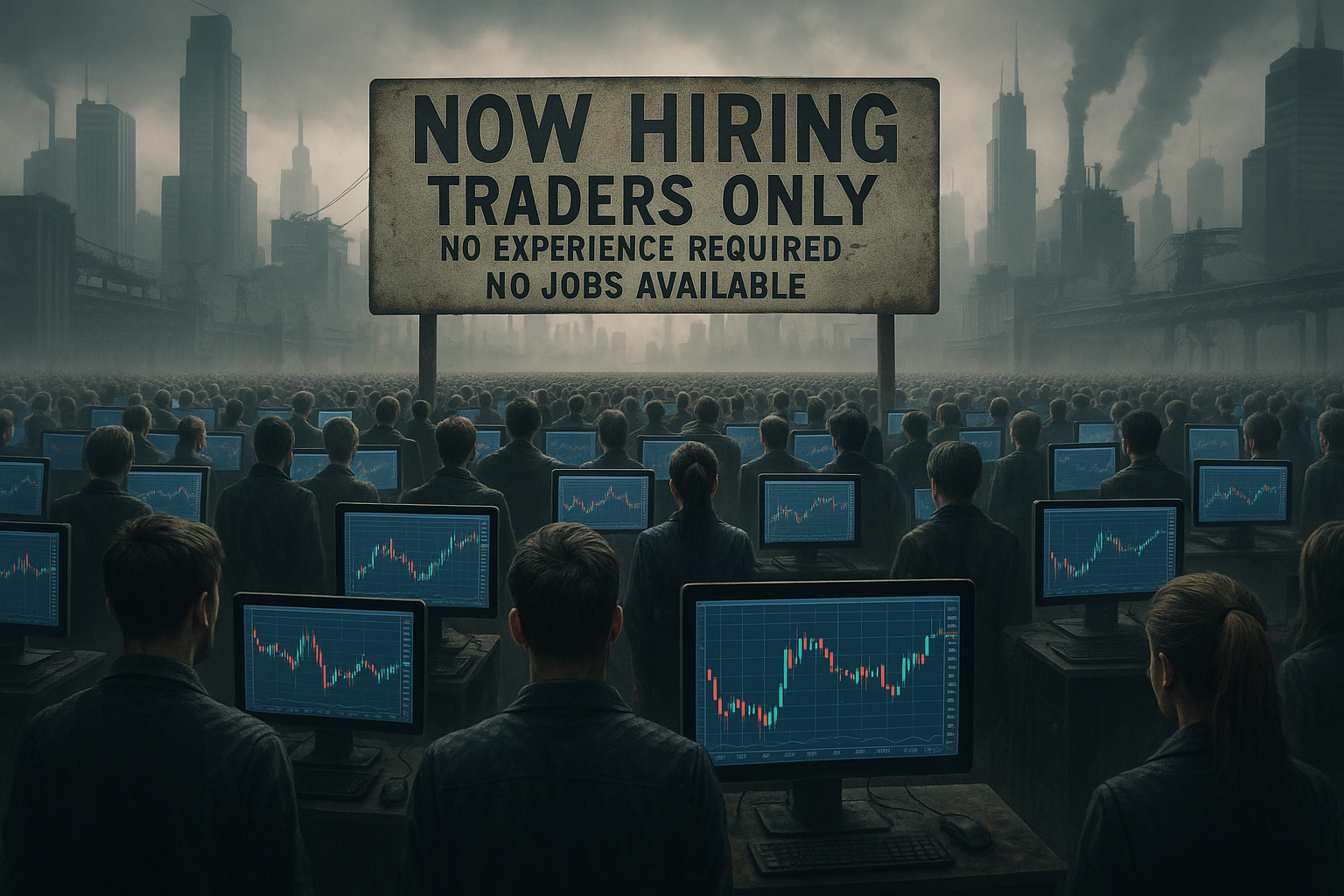
    Just a planet full of overstimulated humans staring at charts, scalping gold, and tweeting about “liquidity grabs.”

    And while that does sound kind of amazing (especially the no meetings part), it’s also the exact kind of thing that would trigger massive economic collapse and a swift legislative response.

    Because society needs plumbers.
    It needs nurses.
    It needs people who don’t panic when their stop gets hit by two pips.

    If everyone tried to trade for a living?
    You better believe governments would step in.

    They’d regulate it.
    They’d tax it like vice.
    They’d require a license to place a limit order and a psych eval before opening a funded account.

    Speculative activity would become the new black market.


    But here’s the twist…

    We’re not that far from this becoming reality.

    Because even if we all wanted to keep our jobs and contribute to society like good little worker bees…

    AI is coming for those jobs anyway.

    And not just the repetitive ones.

    We’re talking:

    • Graphic designers
    • Copywriters
    • Video editors
    • Coders
    • Financial analysts
    • Project managers
    • Customer service reps
    • Junior lawyers
    • Middle managers
    • You

    All of it. Gone.

    Replaced by increasingly intelligent, emotionally vacant software that works 24/7, doesn’t unionize, and doesn’t post memes on Slack during meetings.


    So what happens when the robots take the jobs?

    People do what people do:

    They look for the last place left to make money independently.

    And what’s still there?

    Trading.

    It’s permissionless.
    It’s global.
    It doesn’t care about your résumé, your GPA, or your criminal record.
    All it asks is:
    “Can you handle the truth? And the risk?”

    So the flood begins.
    Millions of displaced workers log onto TradingView.
    They open demo accounts.
    They buy ring lights and launch trading channels called things like “EdgeSniperFX” or “GoldWolvesUnited.”

    And then…


    All hell breaks loose.

    Liquidity spikes at weird hours.
    Entire nations start blowing accounts.
    The IMF launches a Prop Firm Regulation Division.
    Your neighbor who used to do your taxes is now shouting about Smart Money Concepts and swing highs.

    The world becomes one giant speculative casino.

    But worse than that?

    The markets get too crowded.
    Volume explodes.
    Noise increases.
    Algos weaponize retail behavior.

    And suddenly the thing that was once your quiet edge… becomes a global mosh pit.


    So… now what?

    We can’t all trade.
    We know that.

    But soon, a lot more people are going to try.

    Because once the machines take the jobs and the gig economy turns into an AI content farm, what’s left?

    Trading becomes the last frontier of uncapped income…
    and the first step on the ladder out of economic irrelevance.

    It won’t be for everyone.
    It can’t be for everyone.
    But for those who can do it—who can master the emotional discipline, the risk management, the math, the mindset?

    It will become a kind of superpower.


    So yes—if everyone traded, they’d make it illegal.
    But the irony is, we may be heading toward a world where everyone has to try.

    And if that happens?

    The traders who already have the skills, the rules, and the mental game dialed in…
    Will inherit the last, strangest, most chaotic version of capitalism the world has ever seen.

    Welcome to the final frontier.
    Let’s hope your stop holds.

  • When the World Gets Laid Off and Everyone Starts Trading

    When the World Gets Laid Off and Everyone Starts Trading

    Let’s play something out.

    Let’s say it’s a year or two from now.
    AI has finished doing what it’s been quietly doing in the background—decimating white-collar jobs.

    Not blue-collar. Not frontline.
    I’m talking mid-career, highly educated, salaried professionals—marketing managers, financial analysts, product leads, lawyers, consultants, you name it.

    The very people who used to smirk when someone said they were trading for a living.
    Gone. Displaced. Deskless.

    And now guess what?

    They start trading.


    From Meetings to Markets

    You’ll see them flood in by the tens of thousands—people who used to run brand strategy for fintech apps, or give quarterly updates to boardrooms, or write spreadsheets that made other spreadsheets nervous.

    And now they’re sitting in front of TradingView, eyes wide, asking ChatGPT,

    “How do I scalp gold futures on a 10-second chart?”

    And the internet will answer.

    And they will believe it.

    And they will get wrecked.

    Not because they’re stupid.
    Because they’ve spent their whole careers being rewarded for effortintellect, and showing up early to meetings.

    None of that helps here.


    Trading Isn’t the New Career. It’s the New Fantasy.

    In this scenario, trading becomes the next “learn to code.”
    A myth wrapped in urgency: “If I can just make $500 a day…”

    You’ll see:

    • YouTube channels with slick ex-consultants explaining breakouts they don’t actually trade
    • Discord servers filled with high-IQ people drawing perfect fib levels over completely random price action
    • LinkedIn posts that start with “After losing my job to AI, I found purpose in the markets…”

    It’ll feel like a revolution.
    But it will be a bloodbath.

    Because the market is not your therapist. It’s not your comeback story.
    And it does not care how many degrees you have.


    And Then Comes the Twist: AI Enters Trading Too

    While all these displaced professionals are trying to trade using AI tools, institutions are deploying next-gen AI againstthem.

    AI will:

    • Scrape forums and sentiment
    • Detect overused pattern bots
    • Trigger fake breakouts to trap GPT-trained retail traders
    • Adapt faster than the humans using it

    So now you’ve got millions of people trying to get rich using AI to trade…
    While actual market-moving AI is front-running their ideas and laughing in code.


    Trading Becomes a Combat Sport

    At this point, trading stops being a clever side hustle.
    It becomes a full-contact performance profession.

    Like boxing, or jiu-jitsu—except you’re fighting liquidity, latency, and your own impulse control.

    Edge becomes rare again.

    You won’t win because you’re smart.
    You’ll win because you’re:

    • Disciplined when others chase
    • Calm when others spiral
    • Structured when others are talking to their chatbot

    You’ll win because you trained.


    Where This Leaves You

    If you’re reading this, and you’re already walking the tightrope of trading mastery—discipline, clean execution, no sizing up out of boredom—then this flood of new traders?

    It’s not a threat.
    It’s an opportunity.

    Because most of them will bring brains and effort.
    But you’ve already built what actually matters:

    • Mechanical exits
    • Emotional containment
    • Trade-by-trade detachment

    They’ll bring tools. You’ll bring scars.
    And when the market gets noisy, twitchy, and crowded?

    You’ll still be here, hitting clean setups and walking away like a ghost.


    So What Happens When Everyone Starts Trading?

    Mostly?
    They lose.

    They treat trading like a new app to master, not a new identity to forge.

    And in a world where everyone’s using AI to predict the market, the only real edge left is knowing when to trust yourself instead.

    Because the bots will get smarter.
    The masses will keep flooding in.
    But the discipline? The self-trust? The rules that hold under fire?

    That’s still human.
    That’s still rare.
    And that’s still yours to own—if you’ve done the work.

  • Why Creatives (Yes, You) Should Learn to Trade

    Why Creatives (Yes, You) Should Learn to Trade

    By The Barcelona Trader

    Let’s rip the Band-Aid off:

    The world is changing—and not in a way that’s super friendly to creatives.

    You’ve probably felt it already.

    The commissions are thinner.
    The gigs are drier.
    The royalties? Let’s just say Spotify isn’t exactly making sure your kids eat.

    And then there’s AI.

    It’s not coming for your job.
    It’s already sitting in your chair, pretending it wrote that song you spent a month crafting.

    Images.
    Videos.
    Music.
    Lyrics.
    Even entire branding packages—generated in 30 seconds by some kid who doesn’t know what a compressor is.


    So Now What?

    You can complain. (I’ve done it. Cathartic.)
    You can double down on passion. (Necessary. But won’t pay rent.)

    Or—you can build a new skill that doesn’t replace your creativity, but funds it.

    I’m talking about trading.


    Wait, What? Creatives? Trading?

    Yeah, I get it. It sounds absurd.

    But hear me out.

    • Trading is pattern recognition.
    • Trading is emotional management.
    • Trading is flow state under pressure.
    • Trading is knowing when to improvise—and when to hit the damn note exactly as written.

    Sound familiar?

    If you’ve ever played a solo in front of a crowd, released music to a silent room, or said yes to a freelance project that paid in “exposure,” then you already have more mental toughness than most retail traders walking in with a hoodie and a dream.

    Creatives are uniquely wired for trading.
    They just need a system.


    Why Now? Because It Takes Time.

    Here’s the truth they don’t put on the sales page:

    Trading is not a side hustle. It’s a second profession.

    It takes time.
    It takes reps.
    It takes failure, frustration, and coming back anyway.

    So if you’re looking at the state of the world and thinking, “I need to create a safety net for my future,” then now is the time to start. Because it’s going to take you a year or two before you’re really cooking.

    Start today, and future-you might just thank you by not panicking the next time the algorithm changes.


    Who Are We? We’re You—Just a Few Years Ahead

    I’m Mike McCready, also known as The Barcelona Trader (ok, I just made up a trading name for myself).

    I spent the first half of my life in the music business:

    • I had hit songs in Catalunya.
    • Brought Springsteen, Prince, and U2 to town.
    • Ran companies – Polyhonic HMI, Music Xray.
    • Achieved international media coverage for my companies and our products and services.
    • Even had the honor of being turned into a Harvard Business School case study.

    And now?

    I trade gold. Full-time. Clean sessions, funded accounts, and a whole new stage.

    My partner in this madness is Tono Miakoda—another music industry veteran turned elite gold scalper. Tono’s been trading for nearly 20 years, mentoring quietly behind the scenes, and developing one of the most precise gold trading models I’ve ever seen.


    The Mission: Creatives Who Trade

    We’ve launched a new initiative just for people like us—creatives who are ready to learn the skill that funds freedom.

    We’re building:

    • free trading education stream on YouTube
    • A precision-based system specifically suited to disciplined, artistic minds
    • A paid Zoom Room for serious students who want real-time mentorship
    • And a custom-built GoldGPT AI coach trained on our exact methods, for when we’re not live

    We don’t promise Lambos.
    We don’t push crypto pumps.
    We teach real traders how to trade with real rules—using a system that works.


    Final Note

    If you’ve ever said:

    “I just need a second income stream that doesn’t destroy my soul,”
    or
    “I want to be self-reliant without giving up who I am,”

    then this is your moment.

    Because trading won’t replace your art.
    It will protect it.

    And in a world that increasingly values content over craft?
    That might just be the most creative thing you can do.

  • Market Update: When Wall Street’s Models Fail—Your Moment to Trade Smarter

    Market Update: When Wall Street’s Models Fail—Your Moment to Trade Smarter

    July 7, 2025 – Let’s talk about the Bloomberg headline today that made retail traders everywhere sit up a little straighter:

    Misfiring Models Leave Wall Street Currency Traders Flying Blind.”

    Translation:
    The big guys have no idea what’s going on. Their models are failing.
    Their predictive edges—built on rate differentials, macro correlations, and years of backtested elegance—have stopped working.

    If you trade gold, FX, or really any market with real-time volatility, this is very good news.
    Because when the quants can’t see straight, the market opens up for traders who can actually feel it.


    This Is Not a Drill: Institutional Edges Are Failing

    The Bloomberg piece reads like a postmortem on macro logic. Traders who once relied on pristine models are now getting chopped to pieces. The reason?

    Because the world changed.

    • Geopolitics are volatile.
    • Central banks are improvising.
    • AI-generated noise is flooding the system.
    • Sentiment swings harder than a Reddit short squeeze.

    And the models?
    They’re still trying to find alpha in a spreadsheet while gold is over here doing interpretive dance on the 10-second chart.


    Why This Matters for Retail Traders

    When Wall Street is flying blind, here’s what happens:

    1. They React Late. You React Fast.
      Their models don’t update mid-candle. Yours do.
      Because you are the model.
    2. They Need Logic. You Trade Structure.
      Institutions hate irrationality. But for the price-action scalper?
      Irrational = juicy.
      Clean breakout. Clear failure. One bar confirmation. We don’t care why—it just has to move.
    3. They Hesitate. You Execute.
      Their internal risk checks, team consensus, and model recalibrations mean they wait.
      You’re a one-person navy seal team with trigger discipline and a mouse.
    4. Their Confidence Is Shaken. Yours Is Building.
      If you’ve been drilling clean sessions, managing exits, respecting your Hot Stove, and journaling like your funding depends on it (because it does), then your edge is sharpening while theirs is glitching.

    The Human Trader Strikes Back

    This is the cycle:

    • First, the machines outperform.
    • Then the market adjusts.
    • Then the machines misfire.
    • Then the humans who survived the first wave start printing.

    The next 12–18 months could be your sweet spot.

    Because while everyone else is either:

    • Just now waking up to trading, or
    • Running back to corporate after getting slapped around, you’re already in the arena.

    So What Now?

    If you’re going to get into this game—or stay in it—you need to:

    1. Train with people who understand this landscape.
      Not YouTube bros showing you how to slap indicators on a chart.
      Not someone promising 10% a month with no heat.
    2. Learn a system that works in chaotic, real-world conditions.
      One that doesn’t require perfect correlation.
      One that works because of the madness, not in spite of it.

    That’s what we’re doing here.
    This isn’t casual trading.
    It’s not a side hustle.

    It’s combat math for degenerates with discipline.
    And right now, while Wall Street’s flying blind…
    you’ve never had a better shot.

  • Which TradingView Indicators I Use (and Why)

    Which TradingView Indicators I Use (and Why)

    By The Barcelona Trader

    Every trader’s chart is like their kitchen.

    Some keep it minimalist: one chart, one candle type, one crusty RSI from 1984.
    Others layer on so many indicators it looks like a Christmas tree had a seizure.

    I like tools that work—and I keep them clean, readable, and purposeful. I don’t chase the “magic indicator.” I just want clarity, structure, and actionable context.

    So here’s exactly what I use on TradingView—from candles to signals—and why.


    Candles: Heiken Ashi (Yes, Really)

    First, the basics: I use Heiken Ashi candles.
    I know some people get weird about this, but hear me out.

    Heiken Ashi smooths out noise. It gives you a better sense of trend structure. It’s not great for precise entry signals—but that’s not what I use candles for anyway. I use them for reading context, flow, and rhythm.

    I’ve got:

    • Gold candles for bullish moves—because, duh, I trade gold.
    • Blue candles for bearish moves—because… I like blue. That’s it. No deeper reason.

    My Indicator Stack

    🔹 Support & Resistance

    This one auto-plots key S/R levels—and it does a pretty damn good job.

    I use it to keep my chart honest. We all “see levels” when we want to—but this plots zones based on actual reactions, not my imagination.


    🔹 Three 32-period EMAs

    • One set to High
    • One to Low
    • One to Close

    Why three? Because I want to see structure.
    The high/low EMAs create a “channel” that shows me the heartbeat of price. When candles close outside that band, something’s shifting.

    This is how I keep one eye on trend bias without pretending I’m smarter than price.


    🔹 Linear Regression Channel

    This one gives me context on trend strength and direction.

    It’s math-y, yes. But it’s helpful for spotting mean reversion zones, exhaustion, and whether price is respecting a statistically clean slope—or faking everyone out.


    🔹 Support & Resistance with Breaks and Bounces

    This does what it says on the tin:
    It highlights when levels are being tested, broken, or respected.

    I don’t base entries off this alone, but it’s extremely helpful for confirming behavior.
    If I see a bounce where I expect one—or a break where there shouldn’t be one—it flags something worth digging into.


    🔹 200 EMA

    The classic. The legend. The granddaddy of moving averages.

    It’s not sexy, but it works.

    I use it mostly as a macro directional bias—especially when trading on lower timeframes. If price is aggressively under or over the 200 EMA, that’s information.


    🔹 Consolidation Zones

    This one identifies areas where price is going sideways—building energy, or just stalling before a move.

    It’s hugely helpful for avoiding entries in chop.
    No one likes getting smacked around in a fakeout. This helps me stay out of flat zones unless I have a specific plan to fade or trade the breakout.


    🔹 ChartPrime’s Free Indicator: Swing Ranges

    This one plots swing highs and lows across multiple timeframes.

    I use it to see where momentum has shifted and where price might hit a wall. If gold is pushing into a prior swing high with low conviction, I’m paying attention.


    🔹 ChartPrime’s Swing High/Low Tool

    Even cleaner than the swing ranges. It shows real turning points, not just every tiny pullback.

    I don’t trade off this in isolation, but I use it for context—especially in combination with my EMAs and S/R.


    🔹 Elite Algo: Main Signal Indicator (Paid)

    This is one of the few premium tools I pay for. It combines trend direction, entry signals, and filters into a sleek little package. I don’t even use the signals. They’re way late for how I trade. But I like their trend dashboard and and their trend cloud.

    Do I trust it blindly? Of course not.
    But it’s excellent for confirming setups I already have on my radar.


    🔹 Elite Algo: Volume Indicator (Paid)

    This shows volume in a way that makes sense.

    No weird rainbow bars. No clutter.
    Just clean visual confirmation of where interest is showing up—or vanishing.


    Final Thoughts: Use Tools, Not Crutches

    The indicators above help me see the market clearly.
    They don’t make decisions for me.
    They don’t replace discipline.
    They don’t fix bad habits.

    But they do give me structure, clarity, and data—and when I combine that with a clean mindset and a defined system, that’s where the magic happens.

    Don’t look for the indicator that does the work for you.
    Use the ones that make your work cleaner.

    And if you’re chasing 12 signals, 14 trendlines, and three different colors of VWAP?

    Let’s simplify.

    Because simple, structured trading—especially on gold—is the real flex.

  • Gold at $3,400: Mania, Momentum, or Just the End of the World?

    Gold at $3,400: Mania, Momentum, or Just the End of the World?

    Gold’s doing what gold does when the world looks like a powder keg with a matchbook addiction: it’s going up. Not politely. Not steadily. I mean up—like it overheard Jerome Powell whispering “rate cuts” and decided it was 2008 with a vengeance.

    We’re nearly 30% higher on the year. That’s right: Gold has outperformed stocks, bonds, crypto, and probably your therapist’s investment portfolio. Even Bitcoin’s having to take a back seat in the Fear Trade limo. The yellow metal has swagger again—pirate-level swagger.

    So what’s driving this Gold Rush, 2025 edition?

    Spoiler: It’s not euphoria. It’s dread.

    Geopolitical Chaos: Gold’s Favorite Playlist

    At the top of the fear list is the simmering pot of Middle East tensions—Israel and Iran are doing that thing where markets pretend not to panic… and then panic. The worry is that the conflict will spread and disrupt oil supplies. Less oil = higher prices = more inflation anxiety = more central bank constipation.

    The logic is pretty simple: If you think the world might be going to hell, gold is your emergency go-bag. No counterparty risk. No default. No real yield, either—but let’s not get picky when the house might be on fire.

    Have We Hit Peak Panic?

    Some experts think yes.

    Jim Paulsen—ex-Wells Fargo, now a Substack guy with time to think—says gold has basically become the solution to whatever keeps you up at night. Debt, war, inflation, weak leaders, strongmen, climate chaos, TikTok bans—you name it, gold’s your safe word.

    But Paulsen warns: when fear hits a fever pitch, the trade often hits its peak. Consumer confidence, for example, is sitting near post-WWII lows. That’s not bullish for humanity—but ironically, it might mean gold has already priced in the apocalypse.

    And here’s where it gets weird: the VIX is under 20. In English: Wall Street’s fear-o-meter is chilling out. We’re not exactly calm, but we’re not screaming anymore either. Stocks are clawing back toward all-time highs. Labor’s cooling gently, inflation isn’t spiraling, and the Fed’s flirting with rate cuts again like it’s prom season.

    So… is gold about to run out of steam?

    The Dissenters: Gold Isn’t a God

    Enter the skeptics.

    Mona Mahajan at Edward Jones says gold’s been riding momentum and may soon burn out like every other meme-fueled trade that forgot to check the fundamentals.

    Chris Brightman of Research Affiliates doesn’t mince words: “Gold is not a store of value. It’s a speculative asset.”

    Translation: If you think of gold as some quiet, reliable Swiss banker in your portfolio, you’re mistaking it for the wrong metal. Gold is more like a drama queen with trust issues—it might protect you from currency collapse, or it might leave you stranded in a $300 drawdown wondering why you didn’t buy T-bills like a grown-up.

    But Then There’s Yardeni…

    Of course, no gold debate would be complete without a bullish oracle. Ed Yardeni predicts gold will hit $4,000 by New Year’s Eve, and $5,000 by the end of 2026—if, you know, things keep unraveling.

    That’s a big “if” with a lot of fireworks behind it. But hey, if anyone knows how to draw up a doomsday rally chart, it’s Yardeni.

    So What Do We Actually Know?

    • We know gold has momentum.
    • We know fear fuels gold.
    • We know fear is high, but maybe no longer rising.
    • We know oil markets are one bad headline away from a coronary.
    • And we know that if the world keeps wobbling, gold still has room to run.

    But we also know this: gold doesn’t pay rent. And when the fear fades (or just pauses), that shiny yellow rock can drop faster than a TikTok influencer’s crypto coin.

    So what do you do?

    Simple: Diversify. (Yes, it’s boring. Yes, it’s correct.)


    TL;DR

    Gold is up. So is anxiety. Maybe the fear rally has more legs. Maybe it’s cooked. Either way, gold isn’t your religion—it’s just one part of the plan. Stay nimble. Stay hedged. And maybe don’t bet the farm on a rock, no matter how shiny.

  • Gold Just Dethroned the Euro—And Central Banks Are Hoarding It Like It’s the Last Can of Beans in a Fallout Shelter

    Gold Just Dethroned the Euro—And Central Banks Are Hoarding It Like It’s the Last Can of Beans in a Fallout Shelter

    Something strange is happening behind the curtain of global finance. And it’s not a magician pulling rabbits—it’s central banks pulling bullion.

    According to a new report by the European Central Bank, gold has leapfrogged the euro to become the second-most important reserve asset in the world. That’s right—second only to the almighty (and increasingly wobbly) U.S. dollar.

    Gold now makes up 20% of global central bank reserves, while the euro trails behind at 16%. It’s the kind of headline that makes you wonder if Bretton Woods is about to rise from the dead wearing a “Told You So” T-shirt.

    And this isn’t some fluke driven by one country going full pirate and burying treasure under their central bank. We’re talking about a record-shattering accumulation spree: over 1,000 tonnes of gold bought by central banks for the third year in a row. That’s one-fifth of all the gold dug up worldwide in 2024—and twice the average haul from the entire 2010s.

    What’s going on? Well, it turns out when geopolitics start looking like the Season 9 finale of Game of Thrones, central banks stop trusting IOUs and start reaching for things that can’t be frozen, sanctioned, or inflated into confetti.

    Let’s talk numbers.

    • Gold reserves held by central banks are at 36,000 tonnes—just a whisker shy of the 1965 peak during the Bretton Woods era, when the world ran on a gold-backed dollar and haircuts were flatter than interest rates.
    • Buyers leading the charge? India, China, Turkey, and Poland. Yes, Poland is stacking bars like it’s 1938 and the neighbors are getting twitchy again.
    • Gold hit $3,500/oz in 2024, up 30% last year and another 27% since January. Not bad for a rock that does absolutely nothing except not go to zero.

    Why Now?

    The usual objections—gold doesn’t pay interest, costs money to store, and can’t be emailed—are getting drowned out by louder concerns:

    • U.S. debt is ballooning.
    • The dollar is still dominant but increasingly weaponized.
    • If you’re a central bank in a country that might tick off Washington, you don’t want your reserves held in dollars or euros that can be frozen with a single press conference.

    In fact, the ECB found a correlation worth raising an eyebrow over: five of the ten biggest gold-hoarding years since 1999 came from countries that were sanctioned that year or the year before. Coincidence? Nope. This is about sanction-proofing.

    A recent survey of 57 central banks backed it up. The big motivators?

    • Fear of sanctions.
    • Anticipation of a shift in the global monetary order.
    • A growing need to diversify away from the dollar—without jumping into the arms of the euro or renminbi.

    Oh, and remember how gold used to move opposite to real yields? Not anymore. That classic inverse relationship snapped in 2022. Now, gold isn’t trading as a hedge against inflation—it’s trading as a hedge against everything.

    What This Means

    • For traders like me: The gold market’s no longer just about Fed whispers and CPI prints. There’s a geopolitical undercurrent that’s turning this market into a molten blend of macro chess and fear management.
    • For the world: The dollar’s still king, but its crown is tarnishing. Gold is back in the conversation—not as a relic, but as the silent asset that can’t be hacked, sanctioned, or reprinted by a politician with a reelection campaign to fund.

    Final Thought

    The euro just got demoted, gold is flexing like it’s 1965, and central banks are hoarding metal like they know something we don’t. You don’t need to be a conspiracy theorist to see the writing on the vault wall.

    So, next time someone tells you gold is a boomer asset, just smile and tell them: “So are central banks.”