Tag: finance

  • Gold, Crime, and the Traders Caught in the Middle

    Gold, Crime, and the Traders Caught in the Middle

    The Financial Times just published a remarkable (and frankly chilling) piece on the dark underbelly of today’s gold rush. You can read it here, but let me break it down for traders who care less about the drama and more about what it means for the flows that drive price.

    The headline takeaway: organized crime has discovered that gold pays better than drugs. From the Amazon rainforest to South Africa’s abandoned shafts, gangs and militias are fighting bloody turf wars to control illicit mining operations. The numbers are staggering:

    • The UN says criminal groups are embedded in supply chains.
    • SwissAid estimated 435 tonnes of gold were smuggled out of Africa in 2022 alone—worth about $31 billion.
    • Peru’s regulator thinks 40% of its exports are illegal.

    Why gold? Because unlike cocaine or oil, gold is fungible. A bar refined in Dubai or Switzerland is chemically indistinguishable from one dug out of a jungle pit with mercury. That makes laundering easy.

    What this means for traders:

    1. Illicit supply props up liquidity.
      Tens of billions of dollars’ worth of unrecorded gold are moving through the system every year. This invisible flow adds to supply, making it harder to pin price action solely on “official” mining output or central bank demand. When we see demand stats from the World Gold Council, they’re only part of the story.
    2. Geopolitical risk premium isn’t just macro.
      Everyone talks about gold spiking on Fed policy or Middle East tensions. But this article is a reminder that price can also be shaped by underground wars in Colombia or militia financing in Sudan. If criminal networks lose control—or gain more—supply shocks can ripple into the formal market.
    3. The UAE as the ‘washing machine.’
      Dubai has become one of the biggest hubs for refining and re-exporting gold, and critics say it’s where a lot of the illegal metal gets laundered. Traders should watch how international pressure on Dubai plays out. If enforcement tightens, smuggled supply could get bottlenecked, creating squeezes.
    4. Why volatility may persist.
      Gold’s rally this year (up over 25%) has been pinned on safe-haven flows. But when illicit supply chains worth tens of billions sit in the shadows, volatility is baked in. Headlines about raids in Brazil or mine seizures in Africa may not seem like “market news,” but they influence how much gold actually makes it into formal circulation.

    Bottom line:
    Gold’s threefold rise over the past decade isn’t just about central banks and macro hedging—it’s also about the rise of “narco-miners” and illicit flows that blur the line between commodity and crime. As traders, we can’t control that, but we can recognize it. This is part of why gold trades the way it does: opaque, volatile, and sometimes downright irrational. Behind every tick on your chart, there may be more than just a central bank bid or a hedge fund unwind—there may be a gang with an AK-47 running a pit mine in the Amazon.

  • Pre-New York Session: Gold Market Update: Key Insights for August 19, 2025

    Pre-New York Session: Gold Market Update: Key Insights for August 19, 2025

    Gold Market Session Briefing — Monday, August 18, 2025 (New York Opening)

    Macro & Political Landscape

    • Gold traded higher this morning, up around 0.4%, as U.S. Treasury yields eased and the dollar weakened—tailwinds for the yellow metal.
    • Markets are fixated on today’s Trump–Zelenskiy–European leaders meeting about Ukraine. Any sign of peace may dent gold’s safe-haven allure.
    • All eyes are on this week’s Federal Reserve symposium in Jackson Hole, with many expecting signals of a September rate cut—another bullish cue for gold.
    • Ray Dalio chimed in, suggesting a 15% portfolio allocation into gold (or Bitcoin) amid rising fiscal instability—supporting long-term positioning.
    • Market outlooks are still cautious—no fireworks expected. Analysts foresee range-bound trading, with volatility flagged as the name of the game.

    Fundamentals & Sentiment Snapshot

    • XAUUSD sits near 3348.18, testing the lower end of its intraday range from 3323.68 to 3358.49.
    • GC1! futures hover around 3393.9, logs between 3368 and 3403.6.
    • The DXY is firm this morning, rising over the past few hours before dipping again—making gold less sticky.
    • U.S. 10-year yields are steady around 4.295%, offering no major headwind or tailwind to gold.
    • Volume is low—traders are establishing positions ahead of key events.
    • VIX is subdued at 15.61, suggesting no mainstream panic—yet.
    • FXBlue shows USD sentiment at –0.3 and XAU sentiment at +0.7—a slight tilt toward gold bulls, but retail isn’t full-steam ahead.

    Technical Levels & Pivot Structure

    (Based on hourly and 15-minute charts; pivots: DPP, WPP, MPP, DM2, DM4, WM2, WM4, MM2, MM4)

    Support Zones:

    • WPP / MPP confluence sitting around 3,345–3,350, aligning with recent lows and potential bounce zone.
    • DM2 near 3,330, anchored near mid-range structure from Friday—watch closely.

    Resistance Zones:

    • DPP near 3,360 — first level to monitor overhead.
    • DM4 at 3,390–3,395 — a clean break and hold here opens space to 4,000+ sentiment territory.

    No confirmed breakout zones on the 10-second scalping chart yet—market structure hasn’t hinted at a clean slope or trigger.


    Action Plan

    1. Hold the line above 3,345–3,350—until the geopolitical news unfolds, this area is your pivot for confirmation.
    2. Fade rallies under 3,360, unless they come with conviction and volume.
    3. Play breakout long if gold clears 3,390–3,395 cleanly—look for momentum carry to 3,400+.
    4. Avoid chasing until either geopolitical headlines or Fed clarity gives directional bias.

    What to Watch Today

    • Trump–Zelenskiy and European summit—any peace signals could soften safe-haven bids.
    • Jackson Hole event—specifically speeches for rate-cut cues.
    • Weekly U.S. jobless claims—slippage here could bolster gold; a surprise tighten may give it a kick downward.

    Bottom Line

    Gold is riding a gentle wave this morning, buoyed by geopolitical uncertainty and expectations for easier Fed policy. It’s wedged between a defense line around 3,345 and resistance near 3,360–3,395. If Reginald chooses to break structure, let him—don’t chase him. Let the price rip with conviction.

  • Why Trading Is More Like Pro Sports Than You Think

    Why Trading Is More Like Pro Sports Than You Think

    By The Barcelona Trader

    Let’s kill the myth right now:

    Trading is not about freedom.
    Not at the top level. Not if you’re serious.

    It’s not about beach laptops, passive income, or sipping margaritas while price hits your TP.

    That’s Instagram.
    Real trading?

    It’s elite performance.
    It’s blood, sweat, and drawdown.
    It’s discipline over dopamine—every damn day.


    Think Trading’s Not a Sport? Ask Your Heart Rate.

    You want to know if trading is athletic?

    Check your pulse the next time you’re:

    • Managing a $1,200 unrealized loss
    • Fighting off revenge trade temptation
    • Or staring at a high-probability setup you just know will fake you out the moment you enter

    The stress is real. The emotional stakes are high.
    And if you think pushing buttons isn’t physical, then you’ve never sweated through a T-shirt while scalping NFP.


    Here’s Why It Maps to Athletics

    1. Routine = Results
      Athletes warm up. Review tape. Sleep well. Eat right.Traders?
      You prep levels. Journal sessions. Reset your mindset. Sleep—or don’t—and see what it costs you.
    2. You Train in Silence. You Perform in Public.
      No one sees the work.
      They just see the outcomes: “You made how much this month?”But they didn’t see the losses you walked away from.
      The setups you passed on.
      The months where you played defense, not offense.
    3. You Fight Yourself More Than You Fight the Market
      Ask any fighter what the real battle is.
      It’s not the opponent—it’s themselves.Same in trading.Your edge doesn’t matter if you can’t execute it.
      And most of us aren’t beaten by the chart—we’re beaten by our own impatience, our ego, or our inner 3rd grader who just wants to press the button because it’s shiny.

    The Habits of an Elite Trader (Read: Athlete)

    • You follow the plan even when it’s boring.
      (Welcome to the gym. You’re doing reps.)
    • You take clean setups only.
      (Would you sprint a 400m at full speed during warm-up? No? Then don’t trade chop.)
    • You recover after losses.
      (Traders rest. They study film. They come back stronger. The amateurs rage-click and blow the account.)
    • You train your psychology like a pro.
      (Visualization. Affirmations. Self-talk. You think athletes are the only ones who do this?)

    What Makes Trading Even Harder Than Sports

    Here’s the kicker:

    In sports, you get immediate feedback.
    In trading? Not so much.

    You can do everything right and still lose money.
    You can break every rule and still walk away green.

    That kind of uncertainty doesn’t exist on the field.
    Only here.

    That’s why traders need even more discipline than most athletes.
    We don’t just manage performance. We manage ambiguity.


    The Point

    If you want to trade at a high level, stop looking at it like a shortcut to freedom.

    Start looking at it like training camp.

    • Show up early.
    • Stick to your routine.
    • Track everything.
    • Rest like it matters.
    • Respect the craft.

    Because trading, like sport, rewards the prepared, punishes the sloppy, and makes legends out of the disciplined.


    Trading isn’t a hustle. It’s a performance.
    And the market doesn’t care if you’re tired. It only cares if you’re ready.


  • Margin: The Silent Killer (and the Friend You Keep Ignoring)

    Margin: The Silent Killer (and the Friend You Keep Ignoring)

    If you’re serious about trading, you need to understand margin.

    Not vaguely.

    Not “Yeah yeah, I know what margin is.”

    You need to understand it precisely.

    Because margin is one of those things that quietly sits in the background of your trading account…

    … until one day it punches you right in the teeth.


    Let’s start simple: What is margin?

    Margin is collateral.

    It’s the money your broker holds aside while you have an open position.

    Think of it like a security deposit on an apartment.

    You don’t “spend” it — but you can’t use it for anything else while you’re in the trade.

    The bigger your trade size?

    The bigger your margin requirement.


    Margin lets you control large positions with relatively small capital.

    That’s the entire point of leveraged trading.

    Without margin, you’d need hundreds of thousands of dollars to trade even a modest position on gold.

    With margin, you can control huge positions with a much smaller account.

    But here’s the part most new traders don’t fully grasp:

    Margin works both ways.

    It lets you make big trades…

    But it also exposes you to account-crushing losses if you aren’t watching it closely.


    Let’s build a real-world example with XAUUSD.

    Suppose you’re trading XAUUSD (spot gold) with your offshore CFD broker.

    Let’s say they offer you 1:100 leverage (pretty common).

    The current price of gold is $2,400/oz.

    You decide to open a trade for 0.50 lots — that’s a $50 lot size (because on gold, 1 lot = $100 per pip).

    What does that mean in actual notional value?

    0.50 lots = 50 ounces.

    At $2,400 per ounce:

    50 oz × $2,400 = $120,000 notional position size.


    Now, what’s the margin requirement?

    With 1:100 leverage:

    $120,000 ÷ 100 = $1,200 margin required.

    So you need $1,200 of available margin just to open that trade.


    But wait, it doesn’t stop there.

    1️⃣ 

    If price goes higher while you’re in the trade (and you’re short), your margin usage grows indirectly:

    • Your margin requirement stays the same based on position size.
    • But your free margin shrinks as unrealized losses mount.

    2️⃣ 

    If you open multiple trades, each new trade eats up margin:

    • You stack trades, you stack margin requirements.
    • Margin compounds fast if you’re hedging or scaling into positions.

    3️⃣ 

    If your broker changes margin requirements (during news events, weekends, or volatility), you can get hit with sudden margin adjustments.


    Now let’s talk about margin calls — the part that ruins careers.

    A margin call happens when your free margin (your available cushion) gets too low.

    • If your open losses eat up your account balance to the point where you don’t have enough to support the required margin…
    • Your broker steps in and starts automatically closing your trades to protect themselves.

    Yes — the broker protects themselves first.

    You may be thinking, “I’d never let that happen because I manage my drawdown well.”

    But ask anyone who’s blown an account —

    margin calls happen faster than your nervous system can react when you’re emotionally compromised.


    Here’s why you absolutely must monitor margin levels constantly:

    • Because it’s not just price movement that matters.
    • It’s how much capacity you have left to absorb that movement.

    You can be completely “safe” one minute, then two bad candles later you’re in margin call territory — especially with leveraged instruments like gold.


    The higher gold’s price rises, the higher margin costs climb too.

    Let’s say gold moves from $2,400 to $2,500.

    Now that same 0.50 lot trade (50 oz) is controlling:

    50 oz × $2,500 = $125,000 notional position.

    Your new margin requirement at 1:100 leverage:

    $125,000 ÷ 100 = $1,250 margin required.

    Same lot size. Same broker.

    But you need more margin simply because the price moved.

    This is why experienced traders keep track not just of price, but also of notional exposure and how margin demand shifts as prices move.


    Margin isn’t just “some number in the corner of your screen.”

    It’s your breathing room.

    When that breathing room gets tight, so does your ability to:

    • Think clearly
    • Manage trades
    • Avoid desperate revenge trading

    Many traders don’t blow accounts because their trades were wrong —

    they blow accounts because their margin management left them no room to stay alive long enough for trades to resolve.


    The bottom line:

    • Margin is your security deposit on risk.
    • Leverage makes it dangerous fast.
    • Ignoring it is how traders blow accounts even when they think they’re being “disciplined.”

    The traders who survive?

    They keep their eyes glued to margin just as much as to price.

    Your margin level is the lifeboat. Never sail past your lifeboat.


  • When My Trading Hydra Found a New Way to Kill Me

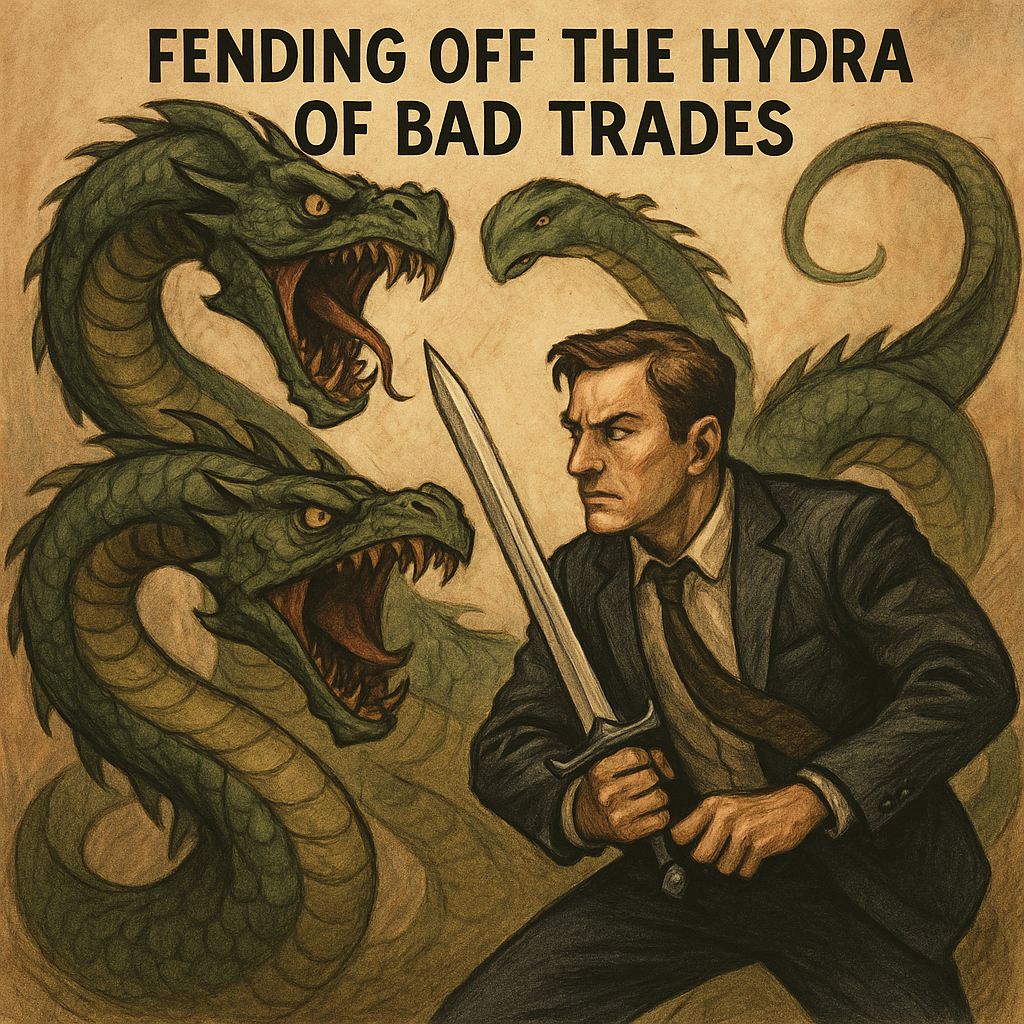
    When My Trading Hydra Found a New Way to Kill Me

    I thought I’d finally beaten my worst trading habit with a perfect $120 stop loss. Instead, my brain used the safety net as an excuse to take worse trades, rack up losses, and go full revenge mode — proving the Hydra wasn’t dead, just plotting.

    Yesterday, I wrote about finally out-smarting myself. My biggest trading enemy wasn’t the market, the algos, or even Jerome Powell’s ability to tank gold with a single eyebrow twitch. It was me — specifically, me refusing to take the loss I knew I should take.

    I fixed that by wiring an automatic $120 hot stove exit onto every trade. If it hit, I was out. No debate. No “just one more tick.” No “maybe it’ll come back.” And it worked — instantly. My losses were clean, my head was clear, and I felt like I’d finally caged the beast.

    Victory, right?

    Not so fast. Anyone who’s read their mythology knows the Hydra doesn’t go quietly. Chop off one head, and another grows back — sometimes uglier.


    The New Head

    Now that my per-trade loss was capped, something shifted in my brain. The fear that used to keep me picky about entries got… lazy. I started taking lower-quality setups. Not garbage, but not my best.

    Here’s how it spiraled:

    1. Take a C+ setup.
    2. Lose. No biggie — the loss is capped.
    3. Take another mediocre setup. Lose again.
    4. By the third or fourth loss, I’m annoyed, so I take a bigger swing to “make it back.”
    5. That swing doesn’t work — and now the Hydra’s laughing while I nuke my day.

    The problem wasn’t my stop loss. It was what the safety net did to my discipline.


    The Kill Shot

    Same fix as last time: remove the choice.

    • $360 max session loss. When I hit it, I’m locked out. Revenge trade impossible.
    • Hard stop times. 11:00 AM ET for the NY Session, 10:00 PM ET for the Asia Session. The clock says stop, I’m done.
    • Back to A+, A, and A- setups only. No “just okay” trades because “what’s the harm?” The harm is right there in my P&L.

    The $120 HSE protects me from one bad trade. The $360 cap protects me from a bad stretch. The strict setup filter protects me from starting the slide in the first place.


    The Next Heads I’m Watching For

    • Setup dilution creeping back in when the market’s slow.
    • Cutting winners early after a losing streak, afraid to “let it come back.”
    • Trading on tilt when outside life distractions bleed into the session.

    Bottom Line

    An elite trader doesn’t beat the Hydra once — they keep sharpening the blade. Every time a new head appears, it gets chopped and the wound gets sealed.

    So yeah, I use crutches. Locks. Kill switches. Call them whatever you want. They work. And the only thing dumber than leaning on a crutch is limping without one.

    The Hydra can keep growing heads. I’ll keep swinging.

  • The Day I Finally Outsmarted Myself

    The Day I Finally Outsmarted Myself

    For a long time now, my biggest enemy in trading hasn’t been the market, the algorithms, or even Jerome Powell’s ability to tank gold with a single eyebrow twitch.
    It’s been me.
    More specifically, me refusing to take the loss I knew I should take — the hot stove exit, or HSE.

    The HSE is simple in theory: the moment a trade is clearly invalidated, you get out. You touch the hot stove, it burns, you pull your hand back.
    Except in my case, I’d leave my hand there a few more seconds, just to “see if maybe it stops hurting.”


    Why I Didn’t Just Automate It Earlier

    If you’re thinking, “Mike, just use a stop loss, problem solved,” you’re both right and wrong.
    My broker, Tradovate, has a group trading feature that lets me execute one trade and mirror it across all my accounts — but it doesn’t allow bracket orders. That means no automatic stop loss when using that setup. And my trades are too short in duration to manually type one in after entry.

    I thought about using a third-party copy trader before, but I talked myself out of it. Too much hassle. Too much potential for lag. Too many stories of things going wrong. And, in true trader fashion, I told myself, “I’ll just fix it with discipline.”
    (Insert laugh track here.)


    Why That Changed

    Fast-forward to this week. I finally reached the point where my manual HSE violations were costing me too much — not just in money, but in mental capital.
    So I set up Tradesyncer, connected it to all my accounts, and now every single trade I take has an automatic $120 stop loss. If it hits, I’m out. No debate. No “just another tick.” No “it’ll come back.”

    And the first day I used it?
    I felt calmer. More focused. More like an operator and less like a gambler negotiating with himself.


    A Crutch? Absolutely. And I’m Proud of It.

    Yes, it’s a crutch. But here’s the thing about crutches: elite athletes use them all the time. Not the wooden kind from the ER — the mental and technological kind that make their performance bulletproof.

    An elite trader doesn’t care whether the edge comes from discipline, experience, technology, or a three-legged goat that predicts FOMC outcomes.
    The only metric that matters is: does it make you money?

    So now I’ve got my crutch, and it’s keeping me from burning my hand on the stove. That’s not weakness — that’s just good risk management.

  • Market Update: August 8, 2025: When Gold Tariffs Mess with Prices: Spot vs Futures Chaos

    Market Update: August 8, 2025: When Gold Tariffs Mess with Prices: Spot vs Futures Chaos

    Alright traders, buckle up—because gold just got another plot twist.

    In the past 24–48 hours, the U.S. slapped tariffs on one-kilo and 100-ounce gold bars, blindsiding the market where these were previously exempt. Big flashpoint: these bars come largely from Switzerland—the global refining mecca. The result? Futures and spot prices went haywire—practically shouting at each other. Let’s break down what’s happening and how to trade through it.


    The Headlines You Couldn’t Ignore

    • Tariffs land: According to Reuters, U.S. Customs reclassified one-kilo bars under a tariff-able code, triggering Comex futures to surge to a record high of $3,534.10, while spot gold held around $3,386—creating a freakish $100+ gap.
    • Market reactionKitco and Bloomberg report a jittery bullion market—futures racing while spot hangs back, driven by disrupted supply chains and rising uncertainty. This is messy—and exactly the kind of chaos we trade with intent . Although, for me, it’s better to hang back because I like a market with a bit more predictability.

    Why Futures and Spot Prices Diverged Like Two Ships in the Night

    Trading gold is already a game of timing. Tariffs just turned it into a water-skiing rodeo.

    1. Swiss supply disruption: Switzerland refines a massive chunk of one-kilo bars used in COMEX deliveries. The tariffs make that route expensive or legally dicey, throwing futures supply into disarray.
    2. Backwardation madness: Futures popped because traders are betting supply will stay tight. Spot, however, reflects what’s actually trading in London—and that market isn’t reacting as sharply—or as soon—because the gold hasn’t moved yet.
    3. Arbitrage block: This crushes flush-your-wallet opportunities. Where traders once profited from shipping gold from London to New York, the $100+ gap now makes that path untenable.

    What This Means for Traders (That’s You)

    • Take prices one market at a time. Futures are crazy right now. Spot may feel calmer. Your edge? Use both them as signals.
    • Watch futures expirations. If October or December futures prices keep climbing without physical supply backing it, you could get trapped in a squeeze faster than a margin call.
    • Lean on structure, not chaos. Use your existing levels—pivots, trend lines—and observe how spot and futures each respect them differently for clues.
    • Expect volatility. This divergence won’t close neatly. Think bang-bang moves, not smooth transitions.

    Your One-Page Recap:

    FactorSpot BehaviorFutures Behavior
    Swiss Refining TariffHolding, slow to moveRocketing higher
    Arbitrage AbilityBlocked or closedN/A – futures detach
    Opportunity CostNoneHigher risk / reward
    Trading MoveWait for spot structureBe ready to fade futures rip

    Final Thought

    Gold isn’t broken. It’s acting perfectly in a market that’s just been yanked off normal rails.

    Don’t panic. Just trade—knowing that price action isn’t random, just chaotic. And chaos is where we earn edge.

  • Market Update: Aug. 1, 2025: Trump Fired the BLS Commissioner. The Gold Market Noticed.

    Market Update: Aug. 1, 2025: Trump Fired the BLS Commissioner. The Gold Market Noticed.

    The Bureau of Labor Statistics has one job: tell the truth about the economy, even when it’s ugly.

    On Friday, it did just that. The July jobs report came in soft—only seventy-three thousand jobs added—and previous months were revised sharply downward. Nothing unusual there. The BLS releases initial estimates and then revises them as more data comes in. This is normal. Boring, even. Just how statistics work.

    But “boring” doesn’t play well in politics.

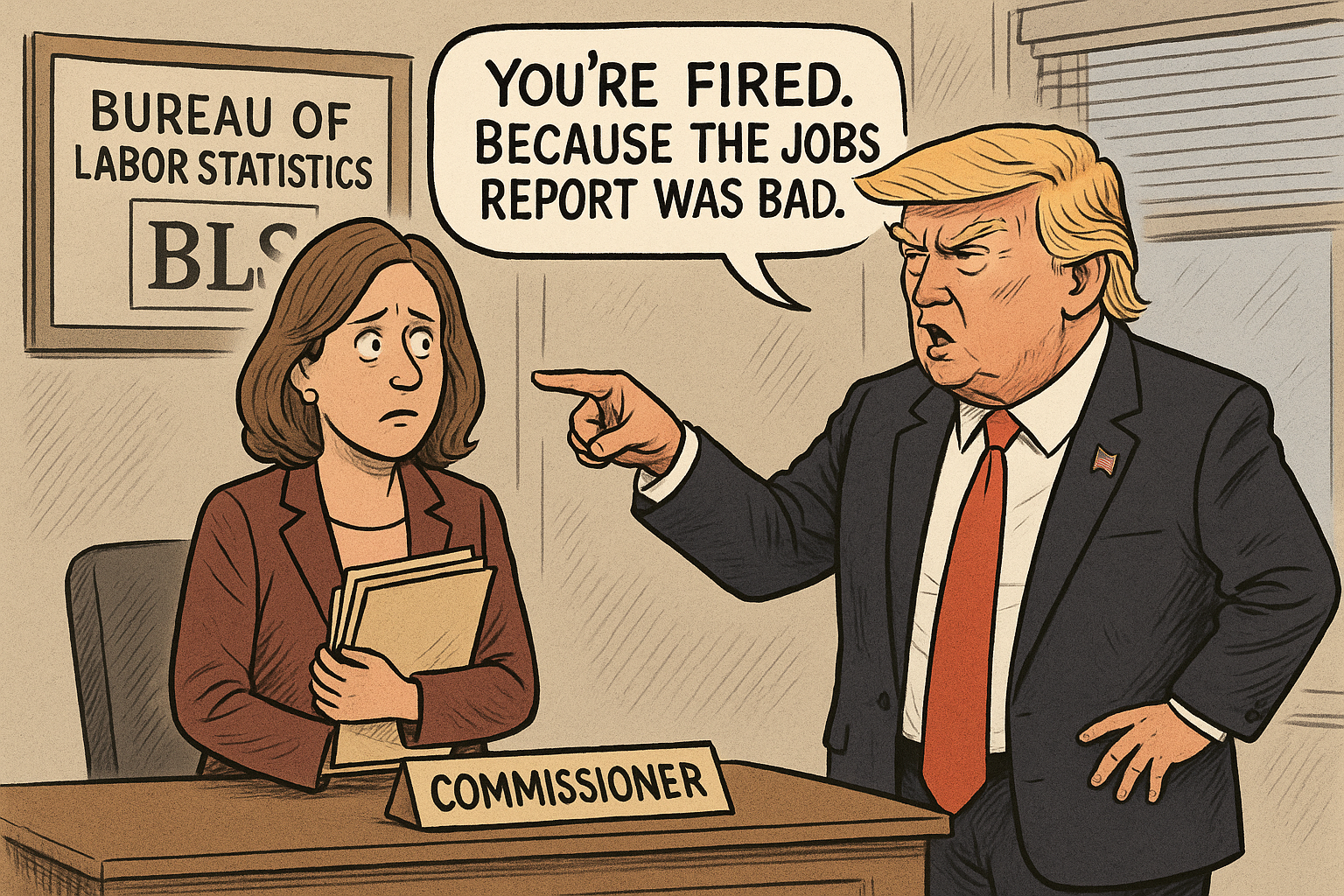
    Within hours, Donald Trump fired the BLS Commissioner, Erika McEntarfer. Not for breaking rules. Not for falsifying data. But for reporting a jobs number that made him look bad.

    And if you think this is just political drama with no market impact, think again. The gold market is already sniffing out what this kind of behavior signals—and it doesn’t smell like confidence.

    Let’s connect the dots.

    Markets don’t just care about jobs numbers. They care about whether the numbers are real. When you fire the referee because you don’t like the score, investors start asking: what’s next? Will future reports be massaged? Will we stop trusting U.S. data entirely? Will Fed policy decisions be distorted by manipulated inputs?

    This hits gold in two ways:

    1. Institutional Trust = Dollar Stability

    The U.S. dollar is the world’s reserve currency in large part because the world trusts U.S. institutions. If that trust wavers—even a little—gold becomes more attractive as a hedge. You don’t need hyperinflation for gold to rally. A few cracks in the wall of confidence will do just fine.

    2. Policy Uncertainty = Flight to Safety

    If economic reports are politically engineered, markets lose faith in the Fed’s ability to respond accurately. That drives volatility. And when volatility goes up, so does demand for gold. Fast.

    This isn’t hypothetical. The gold market ticked higher after the jobs report—not just because it missed expectations, but because the reaction from the White House was so extreme, it validated gold’s role as an insurance policy against institutional decay.

    And here’s the part no one wants to say out loud: if the numbers suddenly start improving next month, will anyone trust them?

    In the short term, the damage may be muted. But longer term, this kind of political interference puts a question mark next to every U.S. economic release. That’s not good for the bond market. It’s not good for the dollar. But it’s exactly the kind of slow-burning chaos that gold loves.

    So if you’re wondering why gold hasn’t broken down yet despite tightening policy and a cooling labor market—this is part of the answer.

    Trust is hard to build. Easy to destroy. And when it gets shaken? Traders buy insurance.

    And in case you forgot: insurance is spelled G-O-L-D.

  • Why Now Is the Perfect Time to Get Into Trading (Before Everyone Else Does, and Most of Them Quit)

    Why Now Is the Perfect Time to Get Into Trading (Before Everyone Else Does, and Most of Them Quit)

    There are moments in history when it pays to be early. Not just because you beat the rush, but because you’re already built for what comes next, long after the crowd burns out. This is one of those moments.

    As AI begins sweeping across white-collar industries, displacing analysts, marketers, consultants, and managers, a massive shift is coming: millions of people are going to try trading. Some already are. The pandemic was just the preview. What’s coming is bigger, more chaotic, and ultimately—more survivable for those who start now.


    Phase 1 (Now – 2026): The Flood

    AI is coming for jobs. Smart, ambitious people are about to be made redundant in record numbers. They’ll look for new income sources, and guess what keeps popping up on YouTube?

    “Trade from home!”

    “Make money in the markets!”

    “Prop firms will fund you!”

    Combine that with AI tools giving people a false sense of confidence, and you’ll get an explosion of new traders armed with:

    • A ChatGPT script
    • A few backtests
    • A dangerously inflated ego

    These traders will pile into the markets—and promptly get smoked.

    Because trading isn’t about having tools. It’s about having judgment under pressure. And that doesn’t come from TikTok. It comes from screen time, structure, and elite coaching.

    If you start now, you’ll be learning while the crowd is still overconfident. By the time they realize how hard this game really is, you’ll be calm, capable, and eating their exits.


    Phase 2 (2026 – 2028): The Great Washout

    As fast as they come in, they’ll start dropping like flies:

    • Failed prop firm challenges
    • Blown accounts
    • Social media silence
    • Regulation tightening

    Discords die. Reddit gets quiet. Influencers pivot to crypto mining or real estate. Everyone’s burned out or bitter.

    But not you.

    Because you’ve already:

    • Built your process
    • Learned real risk control
    • Tuned your emotional regulation

    You’re not chasing hype—you’re sharpening edge. You’re one of the few left standing, and it shows in your P&L.


    Phase 3 (2028 – 2032): The Thin Air

    By now, most humans have either quit, automated themselves out of trading, or become too afraid to click.

    AI is trading against itself. The market becomes faster, cleaner, colder. Behavioral mistakes are rarer—but when they happen, they’re massive.

    That’s your game now:

    • Fewer trades
    • Bigger size
    • Cleaner reads
    • Precision sniping

    There’s still money—serious money—but only for those who can wait, stalk, and strike without hesitation. Everyone else? Gone.

    And here’s the best part:

    New retail traders will still come in every cycle. Dumb money never dies. It just gets rebranded.


    So Why Get In Now?

    Because if you wait until everyone else floods in, you’ll be learning while they’re flailing.

    If you wait until they all leave, it’ll be too hard to learn.

    But if you start now, you get the best of both worlds:

    • You build competence while volatility is still rich with opportunity
    • You develop confidence while others are developing bad habits
    • You outlast the exodus and rise into the rare air where real traders live

    You won’t win by being faster than the bots. You’ll win by being better than the humans who think they can out-bot the bots.

    That takes a process. A system. And coaching that doesn’t sell you hype.


    One More Thing:

    If you’re going to get into trading right now, make sure you’re learning from people who:

    • Actually trade (not just teach)
    • Understand both human behavior and machine logic
    • Know what it takes to survive the phases ahead

    That’s what we do at The Barcelona Trader. We teach real systems. We coach real traders. And we’re doing it in real time—on Zoom, on stream, in the markets every day.

    If you’re ready to start before the flood and stay long after it recedes, you’re in the right place.

    Let’s build something that lasts.

  • In The Beginning, I Just Wanted to Trade, Dammit

    In The Beginning, I Just Wanted to Trade, Dammit

    When I first started learning to trade, all I wanted to do was… well, trade.

    I didn’t want to read more theory.
    I didn’t want to wait for the “right market conditions.”
    I didn’t want to do visualization exercises or light a scented candle to regulate my nervous system.

    I just wanted to get in there and throw some punches.

    But the kind of trading we do—scalping gold using a mash-up of indicators from multiple platforms—has one tiny inconvenience:

    You can’t really backtest it.

    Not properly. Not cleanly. Not the way the backtesting bros on YouTube tell you to.

    Because some of our indicators are on TradingView…
    Some are on Meta Trader 4…
    One’s from EliteAlgo…
    A couple come from Tono’s vault of secrets…
    And the whole system is designed to be lived in, not simulated.

    There’s no drag-and-drop environment where you can recreate the pace, pressure, and psychodrama of a real session on a real market with real capital.

    So that left me with only one option:
    Learn by trading. Live. In session.


    And that’s when the rulebook came out.

    “You shouldn’t trade unless market conditions are ideal.”
    “You shouldn’t trade if you’re tired, emotional, or distracted.”
    “You shouldn’t trade unless you’re in flow state with a green smoothie and a low resting heart rate.”

    Great.
    So basically, don’t trade.

    Because in the early days?
    I was always a little emotional.
    The market was never ideal.
    And my “flow state” was somewhere between caffeinated rage and quiet despair.

    But I was determined.
    Determined to be the one trader who could rise above it all.
    The one who could power through less-than-perfect conditions.

    “Those rules are for weak-minded traders. I will train myself to ignore them. I will transcend.”

    Spoiler:
    I did not transcend.


    Turns out, I was just doing what new traders do:

    • I overestimated my resilience.
    • I underestimated the market’s indifference.
    • And I thought “rules” were optional for people with vision.

    I wasn’t training to become resilient.
    I was training to become delusional.


    The joke was on me.

    Because here’s what I learned the hard way:

    • If the market conditions aren’t right, your edge isn’t there.
    • If your emotional state is off, your execution will suffer.
    • If your ego says “I’ve got this” while your account says otherwise… guess who’s right?

    There is no shortcut.
    There is no version of you that becomes immune to conditions.

    There is only the version of you that respects the craft—or blows up trying to shortcut it.


    But here’s the good news.

    Eventually, I stopped fighting the guardrails.
    I stopped chasing every chart flicker as a “learning opportunity.”
    I stopped thinking I was the exception.

    And ironically, that’s when I actually started learning.

    Not just how to trade…
    But how to show up like a trader.


    Final thought:

    If you’re in that phase—desperate to trade, frustrated by rules, convinced that you’re built different…

    You’re not broken.
    You’re just at the beginning.

    But take it from someone who tried to brute force his way through the mountain:

    The rules aren’t your enemy.
    They’re the rope that keeps you from falling off the cliff.

    You can either learn that by listening…
    Or by learning the way I did.

    One red session at a time.