Tag: gold

  • Don’t Be a Me: How I Got Suckered by a Telegram Signals Group

    Don’t Be a Me: How I Got Suckered by a Telegram Signals Group

    Early in my trading journey, I was starving for information. Hungry. Obsessed. I had a mentor, but I didn’t want to become a nuisance with my constant stream of rookie questions. So I did what every ambitious but impatient new trader does: I went looking for answers everywhere.

    YouTube? Check.

    Discord and Telegram? Check.

    Trading “gurus” with live streams and promises of secret sauce? Sadly, check.

    That’s how I ended up in a Telegram signals group.


    The Allure of Easy Trades

    This group was pumping out “signals” all day long. Every ping was like a dopamine hit. “Sell gold slowly,” the message would say. Then came the entry signal. Then, barely minutes later, the exit signal.

    Sometimes the move in my favor was so tiny it didn’t even cover the spread. Yet the provider would declare victory like they’d just nailed the trade of the year. I’d still be sitting in drawdown wondering what I was missing.

    Occasionally, yes, the trades made a little money. But just as often, the group would call it a “win” on a whisper of movement before the reversal took me under. And when the market really went against them? That’s when the stop loss magically got “adjusted” or the trade just got memory-holed. Rarely, and I mean rarely, would they flat-out admit they were wrong.

    Meanwhile, I was bleeding — financially and mentally. I thought I was the idiot. I thought I was the one who couldn’t execute what these “pros” were handing me on a platter.


    The Punchline: They Weren’t Even Traders

    Here’s the part that still makes me shake my head. Eventually, I discovered that the group I’d joined wasn’t even run by real traders. They weren’t analyzing charts, managing risk, or trading live accounts. They were simply copy-pasting signals from another group — which, surprise, turned out to be another scam.

    So not only was I paying for bad signals, I was paying for recycled bad signals. Think about that: I was losing money on knockoff trades from a knockoff provider. That’s like buying a fake Rolex and finding out it’s just a knockoff of another fake Rolex.

    At that point, the lesson became clear: if someone can churn out dozens of “winning” trades a day in a Telegram channel, they’re not traders — they’re marketers. And the only thing they’re trading is your subscription money for their lifestyle.


    The Hard Truth

    It took me longer than I’d like to admit to realize what was going on. The entire point of that signals group wasn’t to help me trade. It was to look successful enough to hook the free-trial crowd into paying full freight. I paid. I traded. I lost. They “won.”

    I wasn’t just taken for the subscription fee. I was taken for every dollar of drawdown those false victories left me holding.

    And here’s the kicker: the most damaging part wasn’t even the money. It was the false belief it planted — the idea that a “real trader” is in a trade all the time. That there’s always a setup. That more trades = more opportunities. That’s poison.


    What I Learned the Hard Way

    Yes, I eventually absorbed useful knowledge from various sources. But in the early days, I didn’t know how to filter it. I didn’t know how to separate good context from bad advice. And I sure as hell didn’t know that a Telegram channel blasting out trades like a firehose was closer to a carnival hustle than a trading plan.

    Trading isn’t about signals. It’s about discipline, structure, and patience. It’s about knowing when not to click as much as when to click. And no $50-a-month signal group is going to hand that to you.


    Don’t Be a Me

    So here’s the warning I wish someone had tattooed on my forehead when I was new:

    If you’re in a Telegram group that declares victory when the market barely sneezes, you’re not learning how to trade. You’re paying tuition to scammers whose business model depends on making you think you’re the problem.

    Don’t be a me. Save your cash. Save your mental health. Find a real mentor, build your own system, and understand that no one is going to sell you a shortcut to mastery.

  • When Gold Became Money: Humanity’s Shiniest Mistake

    When Gold Became Money: Humanity’s Shiniest Mistake

    Gold has been many things: decoration, status symbol, cause of wars, excuse for bad tattoos. But at some point in human history, it crossed the line from “shiny trinket” to “medium of exchange.” That shift—turning lumps of cosmic shrapnel into money—might be the most consequential branding campaign of all time.


    The First Spark: Egypt and Mesopotamia

    The earliest recorded use of gold as money goes back over 4,500 years. Ancient Egypt was hoarding it as early as 2600 BCE, calling it the “skin of the gods.” They didn’t quite use it as pocket change—more as a divine bling repository. Pharaohs weren’t making it rain; they were burying themselves with it.

    Meanwhile, in Mesopotamia, gold was being used in trade by about the same period, though not in neat little coins. It was weighed out in dust or bars, valued against silver and grain. Imagine buying your groceries with a handful of glitter and a scale—that was the system.

    So did gold-as-money start in one place? The evidence suggests it emerged in multiple cultures around the same time, like a bad meme spreading without Wi-Fi. Humans, scattered across the Near East and beyond, independently looked at this rare, shiny metal that never tarnished and thought: This should probably run the world.


    The Lydian Leap: First Coins

    Fast forward to about 600 BCE, and we get the first real “coins” in Lydia (modern-day Turkey). The Lydians stamped lumps of electrum (a natural gold-silver alloy) with official marks to prove authenticity. This was revolutionary: suddenly, you didn’t need scales or trust issues. The king’s stamp meant the weight and purity were guaranteed.

    This idea spread faster than bad financial advice on Reddit. Within a few centuries, the Greeks, Persians, and Romans were minting their own coins, and gold was firmly entrenched as the standard of value.


    Gold Across Civilizations

    • China: Used gold as a store of wealth but preferred bronze for day-to-day transactions. Gold was more of a status vault than a grocery fund.
    • India: Revered gold spiritually and culturally, using it in both jewelry and trade. Even today, India is one of the world’s largest consumers of gold—not because they all want to hedge inflation, but because weddings are basically Olympic events in precious metal.
    • The Americas: Civilizations like the Incas and Aztecs treated gold as sacred, a physical manifestation of the sun. They didn’t use it as currency in the Western sense; that brilliant idea came later when conquistadors showed up and said, “Oh cool, you call this the sweat of the gods? We call it collateral.”

    From Coins to Standards to Chaos

    Gold’s journey didn’t stop with coins. It went on to underpin empires:

    • The Roman Empire minted the aureus, a gold coin that symbolized stability—until, of course, they started shaving edges and debasing it, proving governments have always been creative with money-printing.
    • Medieval Europe ran on gold coins like florins and ducats, which became the global standard for trade.
    • Modern Era: By the 19th century, the Gold Standard was born—currencies pegged to a fixed weight of gold. It gave the illusion of discipline until World War I blew it up.
    • 1971: Nixon finally took the U.S. off the gold standard, which is why today the dollar is backed not by gold but by the world’s collective shrug and America’s military budget.

    So, One Origin or Many?

    Gold didn’t become “money” in just one place—it emerged organically across multiple civilizations. Human brains, separated by geography and culture, all zeroed in on the same thing: gold doesn’t corrode, it’s rare, it’s divisible, and it makes a great status flex. That convergence suggests it was less a cultural fad and more an inevitability.

    In other words: if aliens exist, I wouldn’t be surprised if they also argue about whether their currency should be pegged to some shiny cosmic metal.


    Why It Matters Now

    Gold’s story is our story. It’s the tale of how something completely useless—seriously, try building a house out of gold—became the ultimate symbol of power. We didn’t choose it for practicality. We chose it for psychology. It was rare, it was beautiful, and it was eternal.

    And that’s still true today. Every tick on the XAUUSD chart is a pulse of that ancient human obsession. The same force that drove Lydian kings to stamp coins, Egyptian pharaohs to hoard tombs, and conquistadors to plunder temples now drives traders, central banks, and yes, guys like me, staring at candles on a screen.

    Gold: the original influencer.

  • Market Update: Can Gold Break $3600 This Week?

    Market Update: Can Gold Break $3600 This Week?

    I recommend checking out Tamas’ YouTube Channel and looking into joining AlphaFX for some of the best fundamental analysis available anywhere.

  • Gold — NY Open Briefing (Thu, Sept 4, 2025 — 7:00 AM ET)

    Gold — NY Open Briefing (Thu, Sept 4, 2025 — 7:00 AM ET)

    Quick vibe: Gold is coming off a record print and a mild pullback. The dollar is meandering, yields are easing, volume’s elevated, and the calendar is stacked. Translation: there’s fuel — pick your spots or the tape will pick you apart.


    Watch Our Live Streams on YouTube

    Be Part of Our Live Streams in our Zoom Room

    Free Trading Course

    GoldGPT AI Trading Assistant

    Indicators I use

    Why Learning To Trade Is So Hard

    How To Use Pivot Points

    Why We Chart Gold on Spot Even When We Trade Futures

    Risk Management vs Emotional Mastery

    FAQs


    Fundamentals & Sentiment (what actually matters this morning)

    • Fed odds: Markets are heavily priced for a September cut. That keeps a floor under gold unless today’s data go “too hot.”
    • Jobs & services day: ADP (8:15 ET), Jobless Claims + Trade Balance + Productivity/Unit Labor Costs (8:30), S&P Global Services PMI (9:45), ISM Services (10:00). These are your landmines.
    • Oil drift: OPEC+ chatter about further output hikes has leaned oil lower this week. Lower oil → softer inflation impulse → modest headwind for “panic gold,” but supportive for “rate-cut gold.” Net: mixed, headline-dependent.
    • Tape context: Gold tapped an all-time high yesterday and eased on profit-taking. Still a bullish regime, but breakouts must stick—chasing the first spike is how wallets disappear.

    Market Snapshot

    • XAUUSD: 3538.8 (range 3511.75 – 3564.15).
    • GC1!: 3598.8 (range 3573.7 – 3621.6).
    • DXY: Sideways last few hours and on 15-min.
    • UST 10-yr: Falling on both the 2–3h and 15-min look.
    • Volume: High. VIX: 16.26 and falling.
    • FXBlue RCS: USD +0.7, XAU –0.3 (mild headwind unless yields keep sliding).

    Levels That Matter (acceptance or nothing)

    Spot XAUUSD

    • Top of box: 3564.15 — sustained trade above turns continuation longs into a job, not a wish.
    • Bottom of box: 3511.75 — sustained trade below opens the trapdoor.
    • Mid: ~3538 — right where we sit; mid-box is for patience, not heroics.

    GC1! Futures

    • 3621.6 (top) / 3573.7 (bottom) — use as confirmation for spot. If one breaks and the other shrugs, you wait.

    10-second breakout tells

    • 3–5 consecutive closes beyond the edge,
    • 60–120 seconds holding outside the prior range,
    • Pullback respects the level (body closes stay outside),
    • Tick/delta/footprint show follow-through, not a one-and-done lunge.

    If you don’t get those? It’s a fake. Fade back into the box only if USD and yields aren’t screaming against you.


    Scenarios (tie them to the calendar)

    1) Soft labor + soft services

    • ADP < consensus, Claims up, ISM Services sub-51 vibe → yields down, USD drifts → gold gets a continuation-long tailwind.
    • Plan: Wait for acceptance over 3564.15 (or 3621.6 on GC). Buy first clean pullback that holds the line.

    2) Surprise strength

    • Hot ADP/ISM, firmer productivity, claims benign → yields bounce, USD perks → gold tests the downside.
    • Plan: Acceptance below 3511.75/3573.7 = momentum shorts. If the break stuffs and snaps back inside, take the A-grade fade to mid-box—then leave it alone.

    3) Mixed tape / whipsaw day

    • One report hot, next cold → ranges rule.
    • Plan: No-man’s-land discipline. If you must trade, it’s failed breaks only with quick hands.

    Trade Plan (keep it surgical)

    • Continuation Long (A/A- only):
      1. Acceptance above 3564.15.
      2. First pullback holds above; enter.
      3. HSE = 12-tick hard stop (Hot Stove Exit: you yank your hand away instantly—no adds, no “one more tick”).
      4. If the level fails on closes, exit. No speeches.
    • Continuation Short (A/A- only):
      1. Acceptance below 3511.75.
      2. First pullback fails beneath; enter.
      3. Same 12-tick HSE.
      4. If the level’s reclaimed, eject.
    • Failed-Break Fade: Only after a real stick attempt. If price knifes back inside and holds, fade to mid-box with the same 12-tick HSE. One and done.

    Risk & Execution Notes (because future-you will thank you)

    • One contract until the data dust settles. You can always add on confirmed structure; you can’t un-tilt a bad fill.
    • First break after 8:15–10:00 releases is the “noise test.” If it looks manic, wait for the retest.
    • Green early? Permission to be boring. The market will open again tomorrow.

    Session Landmines — ET (set your alarms)

    • 8:15 — ADP Employment (Aug)
    • 8:30 — Initial Jobless Claims; Trade Balance (Jul); Productivity/Unit Labor Costs (Q2 rev.)
    • 9:45 — S&P Global US Services PMI (final, Aug)
    • 10:00 — ISM Services (Aug)
    • 12:00 — EIA Weekly Petroleum Status (holiday timing today)

    Bottom Line

    Gold’s perched mid-box with a calendar loaded for movement. Don’t predict the headline — tax the reaction. Acceptance or pass. Breakouts that hold are your paycheck; everything else is cardio.

  • Trading With the Hulk

    Trading With the Hulk

    Here’s what I’ve learned the hard way: I am not a rational person who occasionally gets emotional. I’m an emotional animal who manages to have rational experiences.

    Most of the time, I can play the part of the disciplined trader. Cool head, tight rules, clean exits. Bruce Banner at the desk. But the second anger gets triggered — a loss that stings, a stop that feels unfair — Banner is gone and the Hulk takes over.

    And the Hulk doesn’t “trade.” The Hulk smashes buttons. He doubles down on losers, chases reversals, and treats my account like it owes him money. He is not interested in logic, or setups, or risk management. He is interested in destruction — and he’s very, very good at it.

    Here’s the cruel part: you can’t negotiate with the Hulk. Once the adrenaline hits, once the blood pressure spikes, the transformation is already underway. There’s no talking him down. By the time I’m green and raging, the account is already red and bleeding.

    So the only move is prevention. At the very first flicker of anger, at the very first whisper that the Hulk might be coming, I have to walk away. If I don’t, it’s too late.

    Because the first loss never kills my account. The Hulk does.

  • The Cosmic Origins of Gold: Why We Treasure Stardust

    The Cosmic Origins of Gold: Why We Treasure Stardust

    Let’s talk about gold. Not the “I just bought another fake Rolex off Canal Street” kind of gold, but the real stuff. The shiny metal that kings killed for, empires bankrupted themselves over, and miners ruined their lungs chasing down streams with pans like they were auditioning for Gold Rush: Dysentery Edition.

    Gold isn’t just valuable because it’s shiny, or because rappers decided to make it a status symbol. Gold is valuable because it’s cosmically rare. The atoms in your wedding band—or in my trading charts—were born in cataclysms so violent they make a stock market crash look like a kids’ lemonade stand going out of business.


    The Old Story: Neutron Star Smash-Ups

    For years, scientists thought that nearly all gold came from neutron star mergers—basically, when two ultra-dense stellar corpses slam into each other and spray the universe with debris. These collisions produce gravitational waves, gamma-ray bursts, and—if you’re lucky—enough precious metal to keep Tiffany’s in business for a few billion years.

    It made sense. Those events release the kind of energy needed to force protons and neutrons together into heavy elements like gold, platinum, and uranium. Without them, the periodic table would have ended somewhere around tin foil.

    But there was a problem: these mergers don’t happen often enough, or early enough, to account for all the gold we see around us today. It was a nice theory, but like most “the market only goes up” narratives, it had some holes.


    The New Twist: Magnetar Tantrums

    Enter the latest research, reported in The Washington Post. Turns out, there’s another culprit in the cosmic gold factory: magnetars.

    Think of magnetars as neutron stars with a bad attitude and magnetic fields so intense they make your fridge magnet look like a participation trophy. When they throw a tantrum—what scientists call a “flare”—they blast out more energy in a tenth of a second than our Sun will produce in 100,000 years.

    One such flare in 2004 was so powerful it actually messed with Earth’s ionosphere, and that was from 30,000 light years away. Do you know how violent you have to be to reach across 30,000 light years and still smack us?

    These magnetar flares appear to have the perfect recipe for gold-making: searing heat, an avalanche of neutrons, and enough explosive force to fling that newly-forged heavy metal into the galaxy. According to the study, a single flare could cough up more gold and platinum than the mass of Mars. Yes, Mars. That rusty little ball we’ve been sending rovers to.


    How It Got Here: From Stars to Streams

    So if the gold was forged in these cosmic demolition derbies, how did it end up tucked away in veins under Nevada or sprinkled in streams in the Yukon?

    When Earth formed, heavy elements—including gold—sank into its molten core. By rights, most of the planet’s gold should be completely inaccessible, locked away like a cosmic hedge fund. The reason we have any at all in the crust is because later, asteroids (also packed with heavy metals) slammed into Earth and delivered fresh deposits. You can thank random space rocks for your wedding ring and for the California Gold Rush.

    Once here, gold tends to cluster in veins—formed when hot fluids carrying dissolved gold seep through cracks in rock and cool, leaving behind glittery traces. It’s also found in alluvial deposits—streams and rivers where erosion has washed nuggets out of those veins and concentrated them in little pockets, making life briefly exciting for men with pans and big dreams.

    That’s why prospectors stood knee-deep in freezing rivers, swishing pans like they were stirring soup. They weren’t idiots—they were chasing the natural process of erosion and concentration. The fact that most of them died broke and toothless just adds to gold’s mystique.


    Why It’s Rare (and Precious)

    Gold is rare because the universe had to pull off some truly ridiculous stunts to make it in the first place. It’s not renewable. There are no biological gold farms, no photosynthesis of bling. Once it’s here, that’s it. And the stuff we find is only a tiny fraction of what exists—most of it remains trapped in Earth’s core, well beyond the reach of human mining.

    That rarity, combined with its incorruptibility (it doesn’t rust, tarnish, or rot), made it the universal symbol of wealth and power. You can melt it down, reshape it, bury it for 5,000 years, and it’ll come back looking brand new. It’s the cockroach of precious metals—indestructible, eternal, and here long after the rest of us are gone.


    So What Do We Do With This Knowledge?

    Next time you see gold charts spike—or you hear some guy in a cowboy hat ranting about fiat currency—remember: you’re not just looking at a shiny commodity. You’re looking at the aftermath of neutron stars colliding, magnetars losing their temper, and asteroids sucker-punching Earth.

    Gold is cosmic shrapnel, forged in violence, delivered by chaos, and hoarded by humans who still think shiny equals safe. Maybe that’s why I like trading it. It’s honest. It doesn’t pretend to care about you. It’s just the universe’s way of reminding us that even after billions of years, we’re still panning in the cosmic stream, hoping to catch something rare.

  • You Are Not Your Thoughts (Thankfully)

    You Are Not Your Thoughts (Thankfully)

    One of the hardest truths in trading is this: you are not your thoughts. You’re the awareness of them. And if you don’t learn that early enough, your account balance will be the one to teach you. Brutally.

    Because here’s what happens. You take a few losses — maybe you followed your rules, maybe you didn’t — and suddenly the brain pipes up like a bad karaoke singer: “Let’s make it back. Double down. The next one’s the big one.”

    That voice isn’t wisdom. It’s desperation in a trench coat. And if you follow it, you’ll end up in a place every trader knows too well: staring at the screen, muttering to yourself about how unfair it all is, while your broker thanks you for the donation.

    Professional traders know this game isn’t about silencing those thoughts. That’s impossible. The brain loves to chatter. The skill is noticing the thoughts, labeling them (“ah, that’s revenge-trading talking”), and then not acting on them. It’s mindfulness, not mute mode.

    And mindfulness in trading isn’t just a five-minute meditation app exercise. Sometimes it means hours of watching the market do nothing and not inventing a setup that isn’t there. Sometimes it’s days. Sometimes it’s an entire week where your only win is that you didn’t throw good money after bad.

    That’s the real discipline: sitting still while your brain screams at you to move.

    It’s learning that a red day doesn’t mean you’re a failure, and a green day doesn’t mean you’re a genius. You’re just the awareness, steadying the ship while the thoughts thrash around below deck.

    Most people quit trading because they can’t separate the two. The pros? They practice it daily. Not perfectly — no one does — but enough to let the setups come to them instead of chasing ghosts.

    So next time the thoughts come barging in after a loss, remember: they’re not you. They’re just noise. Your job is to observe, breathe, and wait.

    Because the market will still be here tomorrow. Your account, on the other hand, might not survive if you keep letting your thoughts take the wheel.

  • Will the U.S. Actually Go to War with Venezuela? And What That Would Do to Gold

    Will the U.S. Actually Go to War with Venezuela? And What That Would Do to Gold

    Let’s talk about the elephant in the room — or rather, the seven U.S. Navy warships and 4,500 personnel currently floating in the Caribbean. Officially, they’re there to fight cartels. Unofficially, they’re parked uncomfortably close to Venezuela, and Caracas is not amused.

    So here’s the question: are we actually on the brink of a U.S.–Venezuela war, and more importantly, what does it mean for gold?


    The Setup

    On one side, Washington is flexing hard. Ships, Marines, even a fast-attack submarine — all parked within striking distance. They say it’s about stopping drug smuggling, but everyone knows it doubles as a pressure campaign on Nicolás Maduro’s regime.

    On the other side, Caracas is puffing its chest out. They’re mobilizing militias, yelling about sovereignty, and reminding anyone who’ll listen that most cocaine doesn’t even come from Venezuela. Classic playbook: rally nationalism, make noise, and hope the home crowd eats it up.


    The Odds of War

    Now, is this about to turn into Iraq 2.0? No. The current U.S. presence is way too small for a full invasion. Think gunboat diplomacy with a bit of “don’t test us” energy.

    The most likely scenario is limited action: tighter maritime patrols, maybe a precision strike or two, or a small special forces raid framed as “anti-cartel” rather than “anti-Caracas.” In other words: fireworks, not full-scale war.

    But here’s the thing — even a few fireworks are enough to light up the gold market.


    Gold’s Reaction if Shots Get Fired

    If the first missiles fly, gold’s first instinct is always the same: sprint higher. That’s the headline shock. Traders don’t wait to analyze, they just pile in.

    But sustaining those gains depends on the second-order effects:

    • Does the dollar surge as a safe haven, blunting gold’s rise?
    • Does oil spike, stoking inflation fears and giving gold extra fuel?
    • Do bond yields collapse on a flight to safety, doubling the tailwind for gold?

    Gold’s job is simple: respond to fear. Your job is not to chase the first vertical candle like it’s the last train out of Caracas. Wait for structure. Wait for confirmation. Then clip it clean.


    Why the U.S. and Venezuela Are Even in This Dance

    America’s goals: squeeze Maduro, protect U.S. oil interests in nearby Guyana, and send a message without owning the aftermath.
    Venezuela’s goals: rally nationalism, buy time, and make the cost of U.S. pressure high enough that Washington hesitates.

    Both sides want leverage more than they want war. But in geopolitics, accidents happen. A skirmish at sea, a strike gone wrong, a misstep in disputed oil waters — that’s all it takes to turn a standoff into a gold catalyst.


    What It Means for You as a Trader

    Don’t confuse low probability with low risk. Full war is unlikely, but even a hint of conflict is enough to move gold hard and fast. The pros won’t try to predict the screenplay — they’ll wait, watch, and pounce on the setups the market hands them.

    Your job is the same:

    • Stick to your rules.
    • Don’t trade the headline, trade the structure.
    • Remember: clean sessions beat hot takes.

    Because the only thing worse than being wrong about war is being right about war and still blowing your account.


    Final word: Gold doesn’t care about the politics, it cares about the fear. If Washington decides to play Top Gun: Caracas, the only thing that matters is whether you’re trading like a pro — or torching yourself chasing the noise.

  • How Gold Really Moves: Planes, Ledgers, and a Lot Less Romance Than You Think

    How Gold Really Moves: Planes, Ledgers, and a Lot Less Romance Than You Think

    The Ledger Shuffle

    Picture it: Beijing. The People’s Bank of China has finally had it with stacking U.S. Treasuries like Jenga blocks in the vault. The mood is clear — they want fewer dollars and more gold.

    In the movies, this is where they’d send a convoy of black sedans to a dock at midnight, where stevedores load gleaming bars onto a freighter bound for Shanghai. In the real world? It starts with a Bloomberg terminal.

    They pick up the phone to a bullion bank in London — HSBC, JPMorgan, or ICBC Standard. The trade is agreed at the “Loco London” price, meaning the gold in question already sits in a London vault, stamped, numbered, and 400 ounces to the bar. No one lifts a single ingot. The Bank of China’s name replaces someone else’s on the ledger at the London Precious Metals Clearing system. That’s it — ownership changes hands, but the bars don’t move an inch.


    Wall Street’s Gold

    Jump to Manhattan. A hedge fund wants to ride the next gold rally. They’re not building a vault in SoHo. They’ll buy a COMEX futures contract — 100 ounces per contract — traded on the CME.

    If they sell before expiration, it’s all just numbers on a screen. If they do take delivery (rare), the gold comes out of an approved COMEX depository in New York or Delaware, delivered in 100-ounce or kilo bars, often to another vault, not a penthouse apartment. Settlement is electronic until the moment someone says “I’ll take physical,” and even then it’s trucks, not treasure chests.


    The Small Investor’s Gold

    Now zoom in on an individual investor — say they’re in Chicago or Nairobi. They can click “Buy” on a gold ETF like GLD, which is nothing more than a claim on a portion of a massive pile of gold in a London vault.

    Or they could order physical coins or small bars from a dealer. That’s where the romance dies in a hail of packing peanuts: the “secure shipping” is a discreet FedEx box with the return address of “XYZ Logistics,” because no one wants porch pirates scoring a Krugerrand jackpot.


    The Big Picture

    Most gold in the world doesn’t actually move. The global market has built a system where central banks, funds, and traders shuffle claims on existing bars through ledgers. The gold sits, gathering dust, in high-security vaults under London, Zurich, or New York.

    Physical transport — by plane, truck, or ship — happens when someone repatriates reserves, meets a delivery obligation, or buys in a market far from the vault network.


    When Gold Actually Moves


    Venezuela, 2011 – The Repatriation Parade

    Hugo Chávez decided Venezuela’s gold reserves were safer at home than in foreign vaults. That meant hundreds of tons had to be moved from the Bank of England to Caracas. The gold was flown in batches on secure cargo planes, each bar cataloged and sealed. The arrival was treated like a military parade — armored trucks, soldiers, national TV coverage. It was theater and geopolitics wrapped in one shiny package.

    Germany, 2013 – The Patience Test

    Germany’s Bundesbank wanted to bring home 674 tons of gold from New York and Paris. They didn’t just call UPS. The move took years because of security, insurance, and scheduling constraints. Most of it traveled by plane in small shipments, with secrecy so tight that even flight crews didn’t know what they were carrying.

    India, 1991 – Pawnshop of Nations

    Facing a balance-of-payments crisis, India quietly shipped 47 tons of gold to London to secure an emergency IMF loan. The transfer was done discreetly, by air, in the dead of night. For a country with a cultural love of gold, it was a moment of national embarrassment — but it worked.

    The Swiss-to-Asia Pipeline

    On a smaller but constant scale, Swiss refineries melt London-standard 400-ounce bars into smaller 1-kilo bars preferred in Asia. Those bars travel by secure air freight to Hong Kong, Singapore, and Shanghai. This is one of the few predictable, ongoing physical flows — a quiet conveyor belt feeding private demand.


    “Most gold in the world never moves. The paperwork does.”

    Inside the Vault

    When a shipment finally arrives, the moment is less Indiana Jones and more surgical procedure.

    An armored truck backs into a secured bay. Armed guards watch as the containers — often dull metal boxes no bigger than an office file cabinet — are wheeled inside.

    The vault doors are massive, but they don’t creak like in the movies; they swing silently on precision bearings. Inside, it’s cool, dry, and brightly lit. Every movement is recorded from multiple angles.

    Bars are unloaded and placed on a scale, their weight checked down to a tenth of a gram. Each one’s serial number, refinery stamp, and purity mark are matched against the manifest. If anything is off, an assay — a drill-and-sample purity test — can be ordered on the spot.

    Once verified, the bars are stacked in numbered compartments, each stack assigned to an owner — a government, a bank, or sometimes a private fund. The ledger is updated, and the gold is effectively frozen in place until the next transfer, which might be tomorrow… or never.


    Myth vs. Reality: Gold on the Move

    MYTH: Central banks ship gold in pirate-style treasure chests.

    REALITY: It’s more like a filing cabinet on a pallet, wrapped, sealed, and moved by forklift. The romance is dead, but the insurance premiums are thriving.

    MYTH: Every gold trade means bars flying around the world.

    REALITY: Ninety-plus percent of trades never move a single bar. Ownership just flips in a clearing ledger, and the gold stays put in a vault.

    MYTH: Gold travels under constant armed escort.

    REALITY: Yes and no. The guards are there, but you won’t see them — the best security is invisibility. Unmarked trucks, quiet airport transfers, and no one on the flight crew knowing they’re sitting over a hundred million in bullion.

    MYTH: Taking delivery from COMEX means the gold shows up at your house.

    REALITY: It goes to a COMEX-approved vault. If you insist on home delivery, you’ll meet a whole new circle of friends: armored couriers, customs officials, and your insurance agent in cardiac arrest.

    MYTH: Gold moves mostly by ship because it’s heavy.

    REALITY: Planes are faster, more secure, and far less pirate-prone. Ships are reserved for bulk, low-urgency moves — or the occasional national repatriation stunt.


  • Pivot Points: The Trader’s Map of Mayhem

    Pivot Points: The Trader’s Map of Mayhem

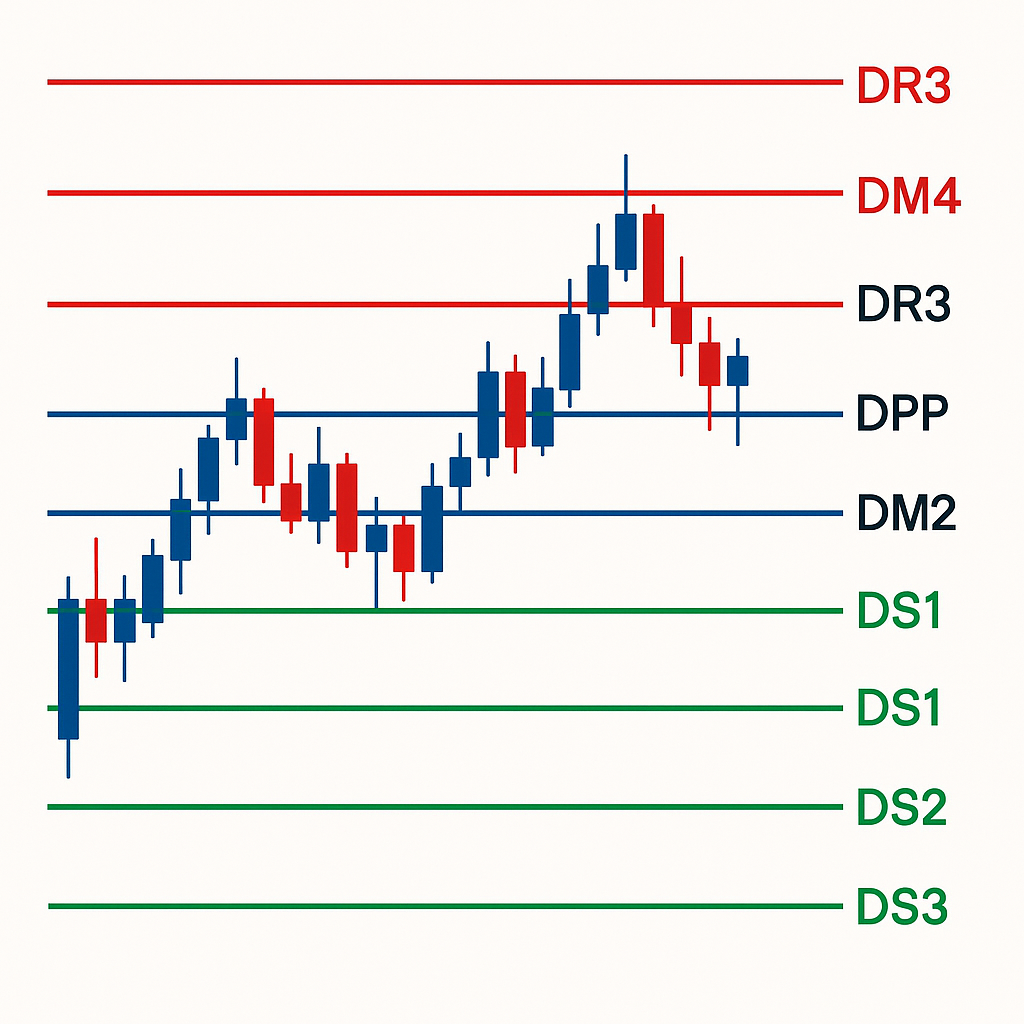
    If you’ve ever sat there staring at your chart thinking, “Where the hell is this thing going?” — welcome to the club. That’s why traders lean on pivot points. They’re not crystal balls. They’re not insider tips from some guy who “knows a guy.” They’re just math.

    But here’s the thing: math works. Pivots give you a framework for where the market might slam on the brakes, do a U-turn, or gun it like a teenager in dad’s Camaro. They’re not guarantees. They’re guideposts. And if you’re trading without them, you’re basically running through a minefield in flip-flops.


    The Mother Pivot

    Everything starts with the Pivot Point (PP) itself. Think of it as the gravitational center of yesterday’s chaos:PP=High+Low+Close3PP=3High+Low+Close​

    That’s it. No secret sauce. Just the average of the high, low, and close. The market’s way of saying, “Here’s the middle ground — now let’s fight about it.”


    The Resistance & Support Gang

    Once you’ve got your pivot, you spin off the levels that traders live and die by:

    • R1 (Resistance 1):

    R1=(2×PP)−LowR1=(2×PP)−Low

    • S1 (Support 1):

    S1=(2×PP)−HighS1=(2×PP)−High

    • R2:

    R2=PP+(High−Low)R2=PP+(High−Low)

    • S2:

    S2=PP−(High−Low)S2=PP−(High−Low)

    • R3:

    R3=High+2×(PP−Low)R3=High+2×(PP−Low)

    • S3:

    S3=Low−2×(High−PP)S3=Low−2×(High−PP)

    Call them “levels,” call them “lines in the sand.” I call them the places you’ll regret ignoring when price slaps you in the face.


    The Midpoints — Because Humans Hate Waiting

    Traders are impatient. That’s why I also plot the midpoints — the halfway houses between the big levels:

    • M1: Between S1 and S2
    • M2: Between S1 and PP
    • M3: Between PP and R1
    • M4: Between R2 and R3

    They don’t get as much hype, but they matter. Markets often pause there, like they’re catching their breath before the next sprint.


    Same Formula, Different Flavor

    Here’s the beauty (or the horror, depending on how you see it): the formulas don’t change. Only the timeframe does.

    • Daily pivots (DPP, DR1, DS1, etc.) → previous day’s OHLC
    • Weekly pivots (WPP, WR1, WS1, etc.) → previous week’s OHLC
    • Monthly pivots (MPP, MR1, MS1, etc.) → previous month’s OHLC

    That’s it. Pivots are universal. Same math, different battlefield.


    Or Skip the Math (Because Life Is Short)

    If you’d rather not do the arithmetic every night like some medieval accountant, I’ve got you covered. I built a simple spreadsheet where you just plug in the open, high, low, and close. It spits out all the pivots for you — daily, weekly, monthly.

    👉 Grab it here and make a copy

    Use it. Abuse it. Just don’t blame me if you ignore the levels and get steamrolled.


    The Bottom Line

    Pivot points won’t make you a genius. They won’t turn your $500 account into a Lambo. But they will give you a reliable map — one that the market respects often enough to keep them on my charts every single session.

    Trading without pivots? That’s like skydiving without checking the parachute. Sure, you might be fine… until you’re not.

    See you in the streams. Bring your helmet.