Tag: gold

  • Trading Is Psychological Pain Tolerance. The Gym Bros Are Half Right.

    Trading Is Psychological Pain Tolerance. The Gym Bros Are Half Right.

    There’s a certain flavor of trading guru out there—you’ve seen them.
    Tight T-shirt, protein shake, testosterone-infused motivational posts.
    Discipline starts at 5 AM in the gym, bro. If you can’t do that, you’ll never be a trader.

    And to be fair, they’re not entirely wrong.

    But they’re not entirely right either.


    Trading is a form of psychological athleticism.

    At its core, trading is about doing the correct thing while your brain is screaming at you to do the wrong thing.
    Over.
    And over.
    And over.

    It is pain tolerance, but not physical.
    It’s not about how much you can bench press.
    It’s about how long you can sit inside a trade that’s gone $150 against you and calmly click out exactly where your exit rule tells you to, rather than where your ego wants you to.


    Where the gym analogy works

    When you train physically, you deliberately introduce discomfort to build resilience.
    You force yourself into pain under controlled conditions.

    • You’re sore, but you do the reps.
    • You’re tired, but you finish the workout.
    • You’re tempted to quit, but you don’t.

    That process does strengthen your nervous system.
    It builds tolerance for discomfort.
    It creates evidence that you can act correctly even when uncomfortable.

    That skill absolutely transfers into trading.


    But here’s where the gym bros lose the plot:

    They make it sound like you need to be in peak “Alpha Mode” before every trading session.

    Like if you don’t get 8 hours of sleep, eat salmon and quinoa, meditate for 20 minutes, and hit a personal deadlift record…
    … you’re not “primed” to execute.

    And while yes—healthy routines help—it’s a false expectation that you can or need to be at peak readiness every time you sit at the screens.


    The uncomfortable truth:

    You will trade tired.
    You will trade frustrated.
    You will trade stressed.
    You will trade while your kid is sick, your dog puked on the carpet, and your neighbor’s leaf blower is firing up for the third time that morning.

    And you still have to execute.

    Because the real skill isn’t trading while feeling good.
    It’s trading well while feeling like garbage.


    So does trading become easier?

    Yes — but not because the discomfort goes away.
    It gets easier because you stop fearing the discomfort.

    You stop negotiating with your emotional brain.

    You stop arguing with the voice that says:

    • “This feels bad.”
    • “I want out.”
    • “I can’t take another loss.”

    And instead you calmly say back:

    “Noted.
    But I will still obey my system.”


    Eventually, it becomes muscle memory. Sort of.

    When you start, trading feels like learning a foreign language while someone screams in your ear.
    Every decision feels loaded with pressure.

    But over time, as you consistently act correctly inside discomfort, your brain starts to rewire:

    • The discomfort remains.
    • But your response becomes automatic.
    • You act correctly faster.
    • You spend less time spiraling.

    That’s the true version of “muscle memory” in trading.


    So, should you hit the gym?

    Yes.

    But not because your biceps will make you a better trader.

    You do it because voluntarily enduring discomfort in any domain trains your nervous system for voluntary discomfort everywhere.

    And trading is voluntary discomfort on steroids.


    The real takeaway

    Trading mastery isn’t about achieving perfect emotional neutrality.
    It’s about executing correctly despite imperfect emotions.

    Every rep in the gym, every hard conversation you have in your personal life, every time you face a stressful truth you’d rather avoid —
    —it’s all training for the psychological game you’ll face at the charts.

    Because in the end, trading mastery is nothing more than emotional pain tolerance, skillfully directed.


  • When a Truth Social Post Moves Gold $30: What Trump’s Fed Salvo Really Means

    When a Truth Social Post Moves Gold $30: What Trump’s Fed Salvo Really Means

    Well, that escalated quickly.

    Minutes after Donald Trump blasted out a Truth Social broadside about the Federal Reserve, gold ripped higher on our screens—about thirty bucks in twenty minutes. That’s not astrology. That’s policy risk hitting the tape.

    What just happened (the facts)

    • Trump says he’s removing Fed Governor Lisa Cook, posting the letter publicly. It’s an extraordinary move aimed right at the Board of Governors. The Financial Times and Reuters both confirmed the action and the posture behind it. 
    • This follows a month of pressure campaigns—Trump has urged the Fed’s Board to sideline Chair Jerome Powell and “assume control” if he doesn’t cut rates, an open challenge to the central bank’s independence. 
    • Global central bankers (yes, at Jackson Hole) are openly worried about the precedent: politicizing the Fed risks financial stability and credibility. Translation: higher risk premia, more volatility. 

    Can a president actually fire Fed governors?

    Sort of—if there’s legal cause.

    By law, governors serve 14-year terms and may be removed “for cause” (think misconduct or neglect of duty), not just policy disagreements. That’s been the consistent view of mainstream legal analysis for years. Any attempt to stretch “cause” into “I don’t like your dot plot” heads straight to court. 

    Why would Trump want this?

    Let’s drop the euphemisms. Installing loyalists at the Fed can:

    1. Force a faster, deeper rate-cut path (or at least jawbone it), which would juice risk assets in the short run and weaken real yields—classic bullish gold fuel.
    2. Consolidate control of the policy narrative heading into a choppy macro stretch: deficits, tariffs, dollar politics.
    3. Create a chilling effect inside the Fed: even if courts swat removals down, the message lands—vote with the White House or get lawyered up.

    None of that guarantees prosperity. It guarantees uncertainty—and gold loves uncertainty.

    Why gold spiked (and why it might keep a bid)

    • Fed independence risk = risk premium. Markets price in the chance of policy mistakes and credibility damage. That pushes safe-haven demand higher. (Central bankers literally flagged this risk today.) 
    • Lower real yields narrative. If the market believes cuts get pulled forward or are larger than the data would justify, real yields drift down. Gold doesn’t pay a coupon; it thrives when the opportunity cost falls.
    • Institutional optics. Firing a sitting governor—publicly—signals more battles to come (Powell’s term ends next year). The process story alone can keep volatility elevated. 

    The irony file

    While we’re on “governance and credibility,” a reminder: Trump is already a convicted felon in New York for falsifying business records (he received an unconditional discharge in January; the conviction stands). That doesn’t make him wrong about monetary policy, but it does make the “restore integrity” sermon a tough sell. 

    (Separately, a New York appeals court just threw out the half-billion-dollar civil fraud penalty, even as it left core liability findings intact—so expect both sides to wave that around as proof of everything. Markets care less about the spin and more about how the power struggle bleeds into policy.) 

    The opposing view (and why it matters)

    Opposition: The White House can’t lawfully purge the Fed for policy reasons; attempts will be enjoined; the institution will hold.

    Our take: Courts may ultimately check removals—but the process risk (letters, threats, litigation, vacancies) is enough to move markets now. The message to investors is: brace for political volatility embedded in monetary policy. That’s supportive of gold until the governance path is clear.

    How I’m thinking about it as a trader

    • Treat Fed-headlines as catalysts, not trends. Expect gap-y moves, then digestion.
    • Watch real yields and DXY—if either rolls over on the narrative, gold’s dips will be shallow.
    • Respect levels. Policy drama doesn’t repeal technicals; it amplifies them. Confluence > bravado.

    Bottom line: Even if the legal bid trips Trump up, the uncertainty premium is real. As long as the market believes the Fed could get bent out of shape by politics, gold will keep a safety bid—and every spicy post will keep the tinder dry.

  • Gold, Crime, and the Traders Caught in the Middle

    Gold, Crime, and the Traders Caught in the Middle

    The Financial Times just published a remarkable (and frankly chilling) piece on the dark underbelly of today’s gold rush. You can read it here, but let me break it down for traders who care less about the drama and more about what it means for the flows that drive price.

    The headline takeaway: organized crime has discovered that gold pays better than drugs. From the Amazon rainforest to South Africa’s abandoned shafts, gangs and militias are fighting bloody turf wars to control illicit mining operations. The numbers are staggering:

    • The UN says criminal groups are embedded in supply chains.
    • SwissAid estimated 435 tonnes of gold were smuggled out of Africa in 2022 alone—worth about $31 billion.
    • Peru’s regulator thinks 40% of its exports are illegal.

    Why gold? Because unlike cocaine or oil, gold is fungible. A bar refined in Dubai or Switzerland is chemically indistinguishable from one dug out of a jungle pit with mercury. That makes laundering easy.

    What this means for traders:

    1. Illicit supply props up liquidity.
      Tens of billions of dollars’ worth of unrecorded gold are moving through the system every year. This invisible flow adds to supply, making it harder to pin price action solely on “official” mining output or central bank demand. When we see demand stats from the World Gold Council, they’re only part of the story.
    2. Geopolitical risk premium isn’t just macro.
      Everyone talks about gold spiking on Fed policy or Middle East tensions. But this article is a reminder that price can also be shaped by underground wars in Colombia or militia financing in Sudan. If criminal networks lose control—or gain more—supply shocks can ripple into the formal market.
    3. The UAE as the ‘washing machine.’
      Dubai has become one of the biggest hubs for refining and re-exporting gold, and critics say it’s where a lot of the illegal metal gets laundered. Traders should watch how international pressure on Dubai plays out. If enforcement tightens, smuggled supply could get bottlenecked, creating squeezes.
    4. Why volatility may persist.
      Gold’s rally this year (up over 25%) has been pinned on safe-haven flows. But when illicit supply chains worth tens of billions sit in the shadows, volatility is baked in. Headlines about raids in Brazil or mine seizures in Africa may not seem like “market news,” but they influence how much gold actually makes it into formal circulation.

    Bottom line:
    Gold’s threefold rise over the past decade isn’t just about central banks and macro hedging—it’s also about the rise of “narco-miners” and illicit flows that blur the line between commodity and crime. As traders, we can’t control that, but we can recognize it. This is part of why gold trades the way it does: opaque, volatile, and sometimes downright irrational. Behind every tick on your chart, there may be more than just a central bank bid or a hedge fund unwind—there may be a gang with an AK-47 running a pit mine in the Amazon.

  • Why Chart Gold on Spot If Futures Drive the Market? Here’s Why.

    Why Chart Gold on Spot If Futures Drive the Market? Here’s Why.

    If you’ve been in the game long enough, you’ve probably noticed something weird:

    Everyone says the big money is trading gold futures—and they’re right.
    But when it’s time to map your pivots, chart your structure, or draw that sweet, sweet trendline, what do most pro traders use?

    Spot gold.

    So what gives?

    Let’s unpack why charting on spot (XAUUSD) is still the move—even if futures (GC1!) are setting the tempo.


    🧭 Spot Is the Anchor

    Spot gold is the market’s baseline consensus price—the global “now” price for an ounce of gold. It trades nearly 24/5, doesn’t expire, doesn’t roll, and doesn’t jump 30 bucks because of a contract change.

    If you’re looking for smooth continuity, spot gives you a chart that behaves like a sane adult. No weird gaps, no surprises at expiration. Just pure price history and structure.

    It’s the equivalent of using a ruler that’s actually straight.


    📉 Futures Drive Flow—But Mirror Spot

    Yes—gold futures dominate volume, especially during the New York session. COMEX is where the whales play. Central banks, hedge funds, algos, the “I moved the market by accident” crowd—they’re doing business in futures.

    But here’s the secret: futures and spot are glued together by arbitrage. If they diverge too far, high-frequency traders pounce. They long one, short the other, and lock in free money until the gap closes.

    Which means your levels on spot still matter, because everyone knows price can’t drift too far from the real-world gold value. And when it does? Smart money just brings it back.


    🧮 Why We Calculate Pivots on Spot

    Pivot formulas—classic, Camarilla, Woodie’s—are almost always built off daily high/low/close values. And on a spot chart, those values are stable, smooth, and globally agreed upon.

    But if you try to run those same calculations on futures during contract roll (when traders shift from one month’s contract to the next), you’ll often get:

    • Confusing price gaps
    • Shrinking or expanding ranges
    • A pivot level that means nothing on the new contract

    Spot gives you clean data. You don’t have to wonder if your S1 is off because COMEX just switched from June to August delivery.


    💡 Real-World Application: What Smart Traders Do

    • Chart on spot. Identify your structure, your supply and demand zones, and your pivots with confidence. It’s cleaner, smoother, and doesn’t play games.
    • Watch futures. That’s where the order flow shows its hand. Especially in the NY session, when GC1! volume spikes, use it to gauge momentum, volatility, and where the institutions are stepping in.

    Think of it like this:

    Futures light the match. Spot shows where the fire will spread.

    And if you understand both? You’re not just playing the game. You’re reading the rulebook while the others are still looking for the board.

  • I Wish Trading Added More Value

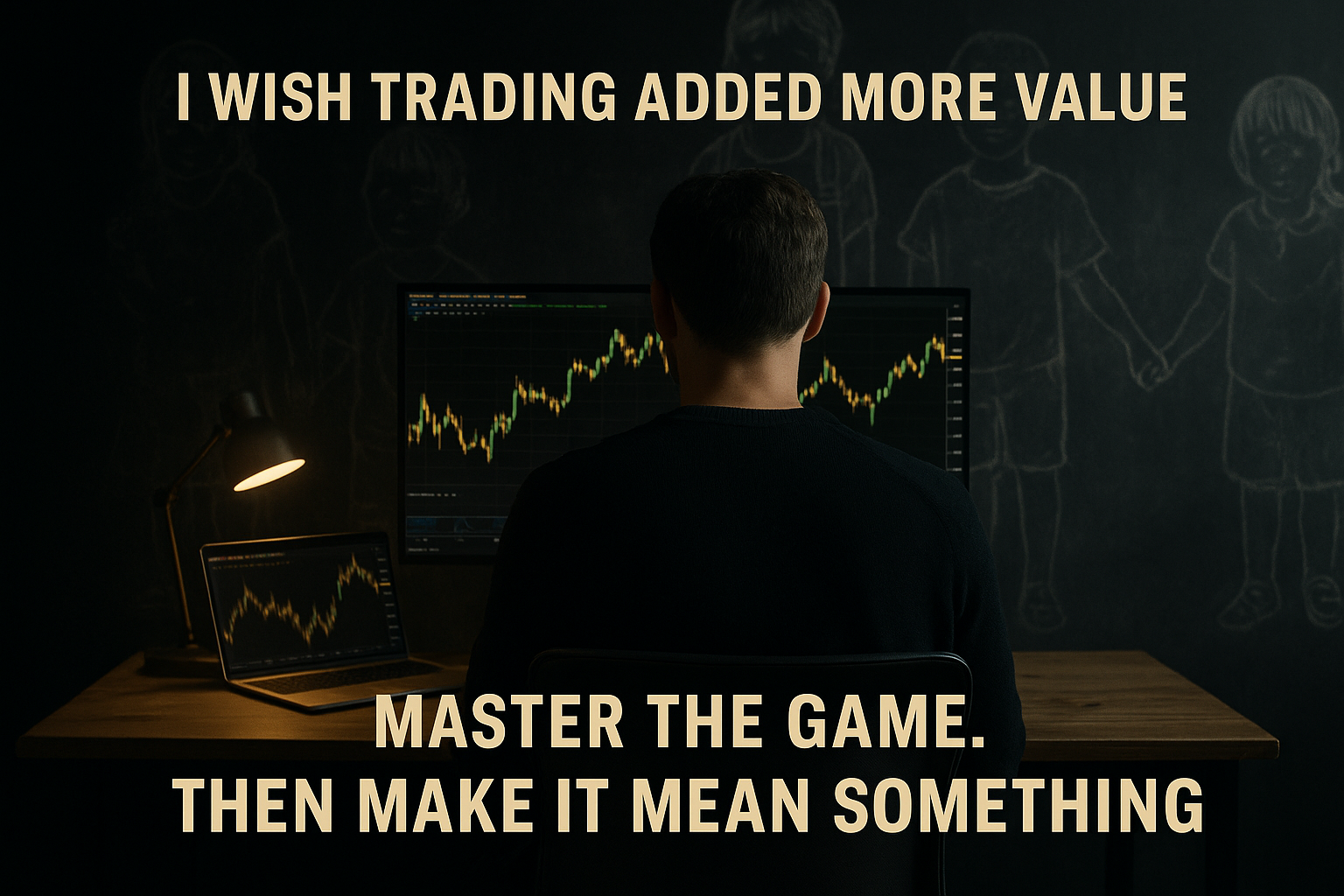
    I Wish Trading Added More Value

    By The Barcelona Trader

    There’s a lot of content out there comparing traders to elite athletes.

    And sure—we train like them. We review tape. We build routines.

    We talk about discipline, precision, mindset, and performance.

    I just wrote a post about it.

    (It was good. You should read it.)

    But if I’m being honest?

    I wish it mattered more.

    Because here’s the truth I don’t see many traders say out loud:

    We don’t fix anything.

    We don’t build anything.

    We don’t make anything better.


    We Exploit a Money Glitch

    What we do is find inefficiencies.

    Tiny moments of imbalance in a system that was designed—poorly, beautifully, and sometimes accidentally—to let us take advantage of price movement for profit.

    It’s a glitch.

    A repeatable, learnable glitch.

    It feels like a game.

    But the money’s real.

    And every dollar we make?

    Someone else loses.

    Usually a beginner.

    Often someone overleveraged.

    Sometimes someone who can’t afford to be wrong.

    We tell ourselves we’re “competing with institutions,” and sometimes that’s true.

    But a lot of the time?

    We’re just better at the game than the people on the other side of our trades.


    The Internal Conflict

    I’m not writing this because I’m ashamed to be a trader. I’m not.

    I’ve worked damn hard to be good at this.

    But I do feel the contradiction.

    There’s a quiet dissonance that comes from knowing that I’ve built a skill that:

    • Creates freedom for me
    • Offers precision, structure, and mastery
    • …but doesn’t really give anything back

    Not like a teacher.

    Not like a doctor.

    Not even like a coder or a builder or a writer.

    We don’t leave anything behind.

    We don’t plant anything that grows.


    So Why Do It?

    Because it’s honest.

    That may sound strange. But there’s something clean—stripped down—about trading.

    • It doesn’t lie to you.
    • It doesn’t pretend to be noble.
    • It rewards clarity, discipline, and execution. Nothing else.

    And maybe, just maybe…

    If we can master this thing that rewards nothing but control and commitment, we can free ourselves up to do something that does matter.

    Trading doesn’t have to be our legacy.

    But it can fund one.


    I don’t pretend trading is saving the world.

    But I do think it can give us the time, the focus, and the freedom to try.

    And maybe that’s enough—for now.

  • Pre-New York Session: Gold Market Update: Key Insights for August 19, 2025

    Pre-New York Session: Gold Market Update: Key Insights for August 19, 2025

    Gold Market Session Briefing — Monday, August 18, 2025 (New York Opening)

    Macro & Political Landscape

    • Gold traded higher this morning, up around 0.4%, as U.S. Treasury yields eased and the dollar weakened—tailwinds for the yellow metal.
    • Markets are fixated on today’s Trump–Zelenskiy–European leaders meeting about Ukraine. Any sign of peace may dent gold’s safe-haven allure.
    • All eyes are on this week’s Federal Reserve symposium in Jackson Hole, with many expecting signals of a September rate cut—another bullish cue for gold.
    • Ray Dalio chimed in, suggesting a 15% portfolio allocation into gold (or Bitcoin) amid rising fiscal instability—supporting long-term positioning.
    • Market outlooks are still cautious—no fireworks expected. Analysts foresee range-bound trading, with volatility flagged as the name of the game.

    Fundamentals & Sentiment Snapshot

    • XAUUSD sits near 3348.18, testing the lower end of its intraday range from 3323.68 to 3358.49.
    • GC1! futures hover around 3393.9, logs between 3368 and 3403.6.
    • The DXY is firm this morning, rising over the past few hours before dipping again—making gold less sticky.
    • U.S. 10-year yields are steady around 4.295%, offering no major headwind or tailwind to gold.
    • Volume is low—traders are establishing positions ahead of key events.
    • VIX is subdued at 15.61, suggesting no mainstream panic—yet.
    • FXBlue shows USD sentiment at –0.3 and XAU sentiment at +0.7—a slight tilt toward gold bulls, but retail isn’t full-steam ahead.

    Technical Levels & Pivot Structure

    (Based on hourly and 15-minute charts; pivots: DPP, WPP, MPP, DM2, DM4, WM2, WM4, MM2, MM4)

    Support Zones:

    • WPP / MPP confluence sitting around 3,345–3,350, aligning with recent lows and potential bounce zone.
    • DM2 near 3,330, anchored near mid-range structure from Friday—watch closely.

    Resistance Zones:

    • DPP near 3,360 — first level to monitor overhead.
    • DM4 at 3,390–3,395 — a clean break and hold here opens space to 4,000+ sentiment territory.

    No confirmed breakout zones on the 10-second scalping chart yet—market structure hasn’t hinted at a clean slope or trigger.


    Action Plan

    1. Hold the line above 3,345–3,350—until the geopolitical news unfolds, this area is your pivot for confirmation.
    2. Fade rallies under 3,360, unless they come with conviction and volume.
    3. Play breakout long if gold clears 3,390–3,395 cleanly—look for momentum carry to 3,400+.
    4. Avoid chasing until either geopolitical headlines or Fed clarity gives directional bias.

    What to Watch Today

    • Trump–Zelenskiy and European summit—any peace signals could soften safe-haven bids.
    • Jackson Hole event—specifically speeches for rate-cut cues.
    • Weekly U.S. jobless claims—slippage here could bolster gold; a surprise tighten may give it a kick downward.

    Bottom Line

    Gold is riding a gentle wave this morning, buoyed by geopolitical uncertainty and expectations for easier Fed policy. It’s wedged between a defense line around 3,345 and resistance near 3,360–3,395. If Reginald chooses to break structure, let him—don’t chase him. Let the price rip with conviction.

  • Why Trading Is More Like Pro Sports Than You Think

    Why Trading Is More Like Pro Sports Than You Think

    By The Barcelona Trader

    Let’s kill the myth right now:

    Trading is not about freedom.
    Not at the top level. Not if you’re serious.

    It’s not about beach laptops, passive income, or sipping margaritas while price hits your TP.

    That’s Instagram.
    Real trading?

    It’s elite performance.
    It’s blood, sweat, and drawdown.
    It’s discipline over dopamine—every damn day.


    Think Trading’s Not a Sport? Ask Your Heart Rate.

    You want to know if trading is athletic?

    Check your pulse the next time you’re:

    • Managing a $1,200 unrealized loss
    • Fighting off revenge trade temptation
    • Or staring at a high-probability setup you just know will fake you out the moment you enter

    The stress is real. The emotional stakes are high.
    And if you think pushing buttons isn’t physical, then you’ve never sweated through a T-shirt while scalping NFP.


    Here’s Why It Maps to Athletics

    1. Routine = Results
      Athletes warm up. Review tape. Sleep well. Eat right.Traders?
      You prep levels. Journal sessions. Reset your mindset. Sleep—or don’t—and see what it costs you.
    2. You Train in Silence. You Perform in Public.
      No one sees the work.
      They just see the outcomes: “You made how much this month?”But they didn’t see the losses you walked away from.
      The setups you passed on.
      The months where you played defense, not offense.
    3. You Fight Yourself More Than You Fight the Market
      Ask any fighter what the real battle is.
      It’s not the opponent—it’s themselves.Same in trading.Your edge doesn’t matter if you can’t execute it.
      And most of us aren’t beaten by the chart—we’re beaten by our own impatience, our ego, or our inner 3rd grader who just wants to press the button because it’s shiny.

    The Habits of an Elite Trader (Read: Athlete)

    • You follow the plan even when it’s boring.
      (Welcome to the gym. You’re doing reps.)
    • You take clean setups only.
      (Would you sprint a 400m at full speed during warm-up? No? Then don’t trade chop.)
    • You recover after losses.
      (Traders rest. They study film. They come back stronger. The amateurs rage-click and blow the account.)
    • You train your psychology like a pro.
      (Visualization. Affirmations. Self-talk. You think athletes are the only ones who do this?)

    What Makes Trading Even Harder Than Sports

    Here’s the kicker:

    In sports, you get immediate feedback.
    In trading? Not so much.

    You can do everything right and still lose money.
    You can break every rule and still walk away green.

    That kind of uncertainty doesn’t exist on the field.
    Only here.

    That’s why traders need even more discipline than most athletes.
    We don’t just manage performance. We manage ambiguity.


    The Point

    If you want to trade at a high level, stop looking at it like a shortcut to freedom.

    Start looking at it like training camp.

    • Show up early.
    • Stick to your routine.
    • Track everything.
    • Rest like it matters.
    • Respect the craft.

    Because trading, like sport, rewards the prepared, punishes the sloppy, and makes legends out of the disciplined.


    Trading isn’t a hustle. It’s a performance.
    And the market doesn’t care if you’re tired. It only cares if you’re ready.


  • Why Trading Is One of the Hardest Things You’ll Ever Do (Even If That Dumb Guy You Know Is Somehow Good at It)

    Why Trading Is One of the Hardest Things You’ll Ever Do (Even If That Dumb Guy You Know Is Somehow Good at It)

    Let’s just say it:
    Trading might be the most psychologically demanding, emotionally taxing, and intellectually humbling pursuit you’ll ever take on.

    You’re battling markets that don’t care about your hopes, your charts, or your horoscope. You’re staring down uncertainty with real money on the line, trying to make decisions under pressure that require ice in your veins and steel in your spine.

    It’s brutal.
    It’s lonely.
    It’s a mirror that doesn’t lie.

    But here’s the part that can mess with your head:
    You might know a trader who isn’t exactly a beacon of brilliance. The kind of guy who thinks the moon landing was fake but trusts his cousin’s Forex signals. And somehow… he’s making money.

    How is that possible?

    Because trading success isn’t always a clean reflection of IQ or worldview.
    You don’t need to be a philosopher-king or a Nobel laureate.
    You need to follow your rules.
    You need to manage risk.
    You need to execute—again and again—without letting your ego hijack the wheel.

    The truth is, some people with deeply questionable opinions about life, women, and geopolitics can still be emotionally disciplined in a trade.
    That’s the paradox.
    You can be a narrow thinker and a consistent trader.
    And you can be a brilliant, introspective, highly-evolved human who still blows up their account because they couldn’t click the exit button when it mattered.

    So yes, trading is one of the hardest things you’ll ever do—not because it requires raw intellect, but because it demands mastery over self. And let’s be honest, most people never get there.

    If you’re on the path, if you’re doing the work, if you’re confronting your own behavior with brutal honesty—then you’re already ahead of the curve.

    Welcome to the grind.
    It’s not fair. It’s not easy.
    And it’s definitely not for everyone.

    But for those who can learn to navigate it with discipline and humility… it’s the closest thing we’ve got to alchemy.

  • Candlesticks: Your Window Into the Market’s Mood Swings

    Candlesticks: Your Window Into the Market’s Mood Swings

    If you’re new to trading, you’ve probably already been told you “just need to learn candlestick patterns.”
    And sure — just like you “just need to go to the gym” to get ripped.
    In reality, candlesticks are less about predicting the future and more about reading the emotional wreckage of the recent past.


    The Anatomy of a Candlestick

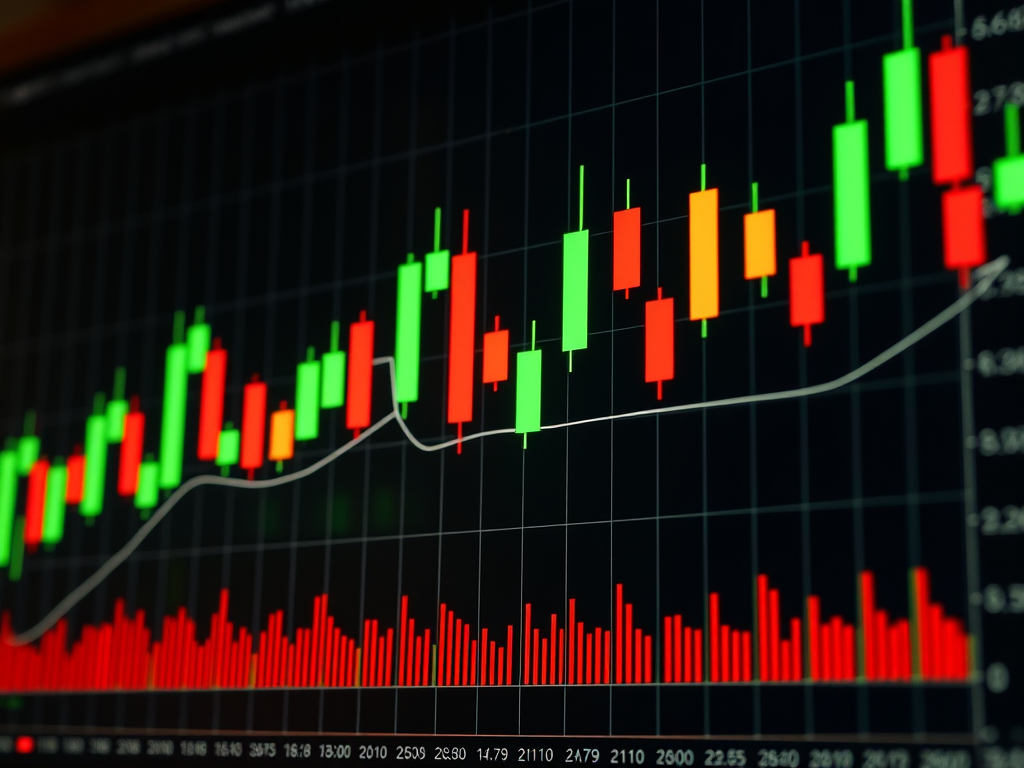
    Every candlestick is basically four price points wearing a costume:

    1. Open – Where price started when that candle began.
    2. Close – Where price ended when the candle wrapped up.
    3. High – The highest point price reached during that candle’s life.
    4. Low – The lowest point price reached.

    The body of the candle is the space between the open and close.
    The wicks (also called shadows) are the little sticks poking out the top and bottom, showing where price traveled but didn’t stay.
    Think of the wicks as “emotional outbursts” — moments when the market got dramatic, then quickly changed its mind.

    Green (or white) candles usually mean price went up from open to close.
    Red (or black) means price went down.
    That’s it. No magic — just a price diary.


    Timeframes: Same Story, Different Zoom Level

    Candles can be set to almost any timeframe.
    This changes what each candle represents:

    • 10-second candles: Trading on these is like listening to a gossipy friend live-tweet a breakup. You get every emotional micro-spasm — great for scalping, dangerous for your sanity.
    • 1-minute candles: Still fast, but you start to see small swings take shape. The trading equivalent of speed dating.
    • 5-minute candles: Popular for intraday traders. Big enough to filter noise, small enough to still get multiple entries in a session.
    • 15-minute candles: Now you’re watching the market from a slight distance. Less twitchy, but still tradable. Imagine hearing about the fight after the dust has settled, not during the yelling.

    The smaller the timeframe, the more noise you’ll see — and the more discipline you’ll need not to chase every wiggle.


    Japanese Candlesticks vs. Heiken Ashi

    Both are just ways of drawing price action, but they tell the story differently.

    Japanese Candlesticks (Regular)

    • Each candle reflects the actual open, high, low, and close for that time period.
    • They’re brutally honest — no smoothing, no sugarcoating.
    • Great for traders who want raw data and can handle mood swings.

    Heiken Ashi

    • Uses an average of current and previous candles to smooth out the noise.
    • A Heiken Ashi candle’s “open” and “close” aren’t the real open and close — they’re calculated.
    • Upside: Trends look cleaner, you won’t freak out at every blip.
    • Downside: There’s a delay in showing reversals — kind of like a slow friend who only realizes the party’s over after everyone’s gone home.

    So Which Should You Use?

    • If you’re scalping on a 10-second or 1-minute chart and need every tick of truth? Japanese candlesticks.
    • If you want to stay in trends longer and not get whipsawed to death? Heiken Ashi.
    • If you’re trying to decide which one’s better overall? That’s like asking whether you should use chopsticks or a fork — depends on what’s on your plate.

    Final Word

    Candlesticks aren’t magic spells. They’re just the market’s mood swings painted green and red.
    If you understand how they work across timeframes — and the difference between raw truth (Japanese) and smoothed story (Heiken Ashi) — you’ve already got an edge over the people still treating them like tarot cards.

  • Margin: The Silent Killer (and the Friend You Keep Ignoring)

    Margin: The Silent Killer (and the Friend You Keep Ignoring)

    If you’re serious about trading, you need to understand margin.

    Not vaguely.

    Not “Yeah yeah, I know what margin is.”

    You need to understand it precisely.

    Because margin is one of those things that quietly sits in the background of your trading account…

    … until one day it punches you right in the teeth.


    Let’s start simple: What is margin?

    Margin is collateral.

    It’s the money your broker holds aside while you have an open position.

    Think of it like a security deposit on an apartment.

    You don’t “spend” it — but you can’t use it for anything else while you’re in the trade.

    The bigger your trade size?

    The bigger your margin requirement.


    Margin lets you control large positions with relatively small capital.

    That’s the entire point of leveraged trading.

    Without margin, you’d need hundreds of thousands of dollars to trade even a modest position on gold.

    With margin, you can control huge positions with a much smaller account.

    But here’s the part most new traders don’t fully grasp:

    Margin works both ways.

    It lets you make big trades…

    But it also exposes you to account-crushing losses if you aren’t watching it closely.


    Let’s build a real-world example with XAUUSD.

    Suppose you’re trading XAUUSD (spot gold) with your offshore CFD broker.

    Let’s say they offer you 1:100 leverage (pretty common).

    The current price of gold is $2,400/oz.

    You decide to open a trade for 0.50 lots — that’s a $50 lot size (because on gold, 1 lot = $100 per pip).

    What does that mean in actual notional value?

    0.50 lots = 50 ounces.

    At $2,400 per ounce:

    50 oz × $2,400 = $120,000 notional position size.


    Now, what’s the margin requirement?

    With 1:100 leverage:

    $120,000 ÷ 100 = $1,200 margin required.

    So you need $1,200 of available margin just to open that trade.


    But wait, it doesn’t stop there.

    1️⃣ 

    If price goes higher while you’re in the trade (and you’re short), your margin usage grows indirectly:

    • Your margin requirement stays the same based on position size.
    • But your free margin shrinks as unrealized losses mount.

    2️⃣ 

    If you open multiple trades, each new trade eats up margin:

    • You stack trades, you stack margin requirements.
    • Margin compounds fast if you’re hedging or scaling into positions.

    3️⃣ 

    If your broker changes margin requirements (during news events, weekends, or volatility), you can get hit with sudden margin adjustments.


    Now let’s talk about margin calls — the part that ruins careers.

    A margin call happens when your free margin (your available cushion) gets too low.

    • If your open losses eat up your account balance to the point where you don’t have enough to support the required margin…
    • Your broker steps in and starts automatically closing your trades to protect themselves.

    Yes — the broker protects themselves first.

    You may be thinking, “I’d never let that happen because I manage my drawdown well.”

    But ask anyone who’s blown an account —

    margin calls happen faster than your nervous system can react when you’re emotionally compromised.


    Here’s why you absolutely must monitor margin levels constantly:

    • Because it’s not just price movement that matters.
    • It’s how much capacity you have left to absorb that movement.

    You can be completely “safe” one minute, then two bad candles later you’re in margin call territory — especially with leveraged instruments like gold.


    The higher gold’s price rises, the higher margin costs climb too.

    Let’s say gold moves from $2,400 to $2,500.

    Now that same 0.50 lot trade (50 oz) is controlling:

    50 oz × $2,500 = $125,000 notional position.

    Your new margin requirement at 1:100 leverage:

    $125,000 ÷ 100 = $1,250 margin required.

    Same lot size. Same broker.

    But you need more margin simply because the price moved.

    This is why experienced traders keep track not just of price, but also of notional exposure and how margin demand shifts as prices move.


    Margin isn’t just “some number in the corner of your screen.”

    It’s your breathing room.

    When that breathing room gets tight, so does your ability to:

    • Think clearly
    • Manage trades
    • Avoid desperate revenge trading

    Many traders don’t blow accounts because their trades were wrong —

    they blow accounts because their margin management left them no room to stay alive long enough for trades to resolve.


    The bottom line:

    • Margin is your security deposit on risk.
    • Leverage makes it dangerous fast.
    • Ignoring it is how traders blow accounts even when they think they’re being “disciplined.”

    The traders who survive?

    They keep their eyes glued to margin just as much as to price.

    Your margin level is the lifeboat. Never sail past your lifeboat.