Tag: gold

  • Margin: The Silent Killer (and the Friend You Keep Ignoring)

    Margin: The Silent Killer (and the Friend You Keep Ignoring)

    If you’re serious about trading, you need to understand margin.

    Not vaguely.

    Not “Yeah yeah, I know what margin is.”

    You need to understand it precisely.

    Because margin is one of those things that quietly sits in the background of your trading account…

    … until one day it punches you right in the teeth.


    Let’s start simple: What is margin?

    Margin is collateral.

    It’s the money your broker holds aside while you have an open position.

    Think of it like a security deposit on an apartment.

    You don’t “spend” it — but you can’t use it for anything else while you’re in the trade.

    The bigger your trade size?

    The bigger your margin requirement.


    Margin lets you control large positions with relatively small capital.

    That’s the entire point of leveraged trading.

    Without margin, you’d need hundreds of thousands of dollars to trade even a modest position on gold.

    With margin, you can control huge positions with a much smaller account.

    But here’s the part most new traders don’t fully grasp:

    Margin works both ways.

    It lets you make big trades…

    But it also exposes you to account-crushing losses if you aren’t watching it closely.


    Let’s build a real-world example with XAUUSD.

    Suppose you’re trading XAUUSD (spot gold) with your offshore CFD broker.

    Let’s say they offer you 1:100 leverage (pretty common).

    The current price of gold is $2,400/oz.

    You decide to open a trade for 0.50 lots — that’s a $50 lot size (because on gold, 1 lot = $100 per pip).

    What does that mean in actual notional value?

    0.50 lots = 50 ounces.

    At $2,400 per ounce:

    50 oz × $2,400 = $120,000 notional position size.


    Now, what’s the margin requirement?

    With 1:100 leverage:

    $120,000 ÷ 100 = $1,200 margin required.

    So you need $1,200 of available margin just to open that trade.


    But wait, it doesn’t stop there.

    1️⃣ 

    If price goes higher while you’re in the trade (and you’re short), your margin usage grows indirectly:

    • Your margin requirement stays the same based on position size.
    • But your free margin shrinks as unrealized losses mount.

    2️⃣ 

    If you open multiple trades, each new trade eats up margin:

    • You stack trades, you stack margin requirements.
    • Margin compounds fast if you’re hedging or scaling into positions.

    3️⃣ 

    If your broker changes margin requirements (during news events, weekends, or volatility), you can get hit with sudden margin adjustments.


    Now let’s talk about margin calls — the part that ruins careers.

    A margin call happens when your free margin (your available cushion) gets too low.

    • If your open losses eat up your account balance to the point where you don’t have enough to support the required margin…
    • Your broker steps in and starts automatically closing your trades to protect themselves.

    Yes — the broker protects themselves first.

    You may be thinking, “I’d never let that happen because I manage my drawdown well.”

    But ask anyone who’s blown an account —

    margin calls happen faster than your nervous system can react when you’re emotionally compromised.


    Here’s why you absolutely must monitor margin levels constantly:

    • Because it’s not just price movement that matters.
    • It’s how much capacity you have left to absorb that movement.

    You can be completely “safe” one minute, then two bad candles later you’re in margin call territory — especially with leveraged instruments like gold.


    The higher gold’s price rises, the higher margin costs climb too.

    Let’s say gold moves from $2,400 to $2,500.

    Now that same 0.50 lot trade (50 oz) is controlling:

    50 oz × $2,500 = $125,000 notional position.

    Your new margin requirement at 1:100 leverage:

    $125,000 ÷ 100 = $1,250 margin required.

    Same lot size. Same broker.

    But you need more margin simply because the price moved.

    This is why experienced traders keep track not just of price, but also of notional exposure and how margin demand shifts as prices move.


    Margin isn’t just “some number in the corner of your screen.”

    It’s your breathing room.

    When that breathing room gets tight, so does your ability to:

    • Think clearly
    • Manage trades
    • Avoid desperate revenge trading

    Many traders don’t blow accounts because their trades were wrong —

    they blow accounts because their margin management left them no room to stay alive long enough for trades to resolve.


    The bottom line:

    • Margin is your security deposit on risk.
    • Leverage makes it dangerous fast.
    • Ignoring it is how traders blow accounts even when they think they’re being “disciplined.”

    The traders who survive?

    They keep their eyes glued to margin just as much as to price.

    Your margin level is the lifeboat. Never sail past your lifeboat.

  • When My Trading Hydra Found a New Way to Kill Me

    When My Trading Hydra Found a New Way to Kill Me

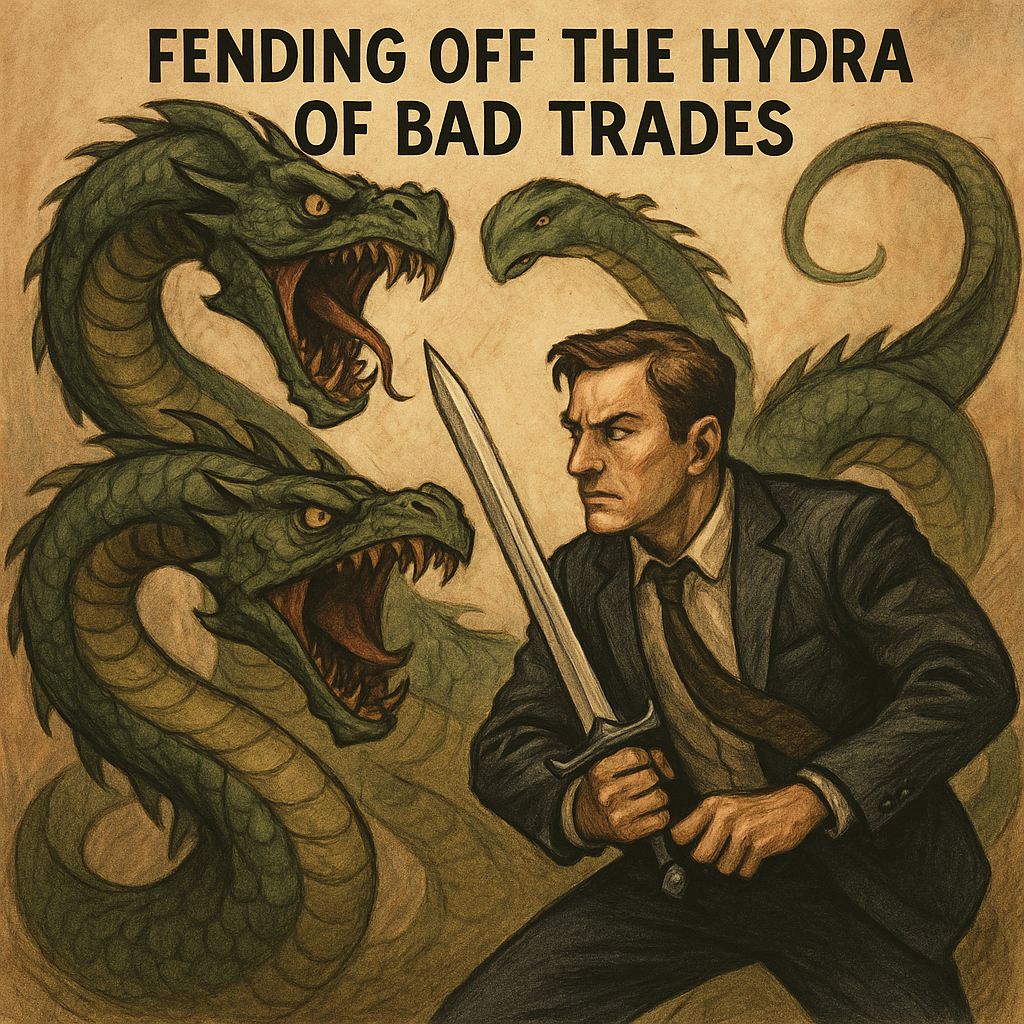
    I thought I’d finally beaten my worst trading habit with a perfect $120 stop loss. Instead, my brain used the safety net as an excuse to take worse trades, rack up losses, and go full revenge mode — proving the Hydra wasn’t dead, just plotting.

    Yesterday, I wrote about finally out-smarting myself. My biggest trading enemy wasn’t the market, the algos, or even Jerome Powell’s ability to tank gold with a single eyebrow twitch. It was me — specifically, me refusing to take the loss I knew I should take.

    I fixed that by wiring an automatic $120 hot stove exit onto every trade. If it hit, I was out. No debate. No “just one more tick.” No “maybe it’ll come back.” And it worked — instantly. My losses were clean, my head was clear, and I felt like I’d finally caged the beast.

    Victory, right?

    Not so fast. Anyone who’s read their mythology knows the Hydra doesn’t go quietly. Chop off one head, and another grows back — sometimes uglier.


    The New Head

    Now that my per-trade loss was capped, something shifted in my brain. The fear that used to keep me picky about entries got… lazy. I started taking lower-quality setups. Not garbage, but not my best.

    Here’s how it spiraled:

    1. Take a C+ setup.
    2. Lose. No biggie — the loss is capped.
    3. Take another mediocre setup. Lose again.
    4. By the third or fourth loss, I’m annoyed, so I take a bigger swing to “make it back.”
    5. That swing doesn’t work — and now the Hydra’s laughing while I nuke my day.

    The problem wasn’t my stop loss. It was what the safety net did to my discipline.


    The Kill Shot

    Same fix as last time: remove the choice.

    • $360 max session loss. When I hit it, I’m locked out. Revenge trade impossible.
    • Hard stop times. 11:00 AM ET for the NY Session, 10:00 PM ET for the Asia Session. The clock says stop, I’m done.
    • Back to A+, A, and A- setups only. No “just okay” trades because “what’s the harm?” The harm is right there in my P&L.

    The $120 HSE protects me from one bad trade. The $360 cap protects me from a bad stretch. The strict setup filter protects me from starting the slide in the first place.


    The Next Heads I’m Watching For

    • Setup dilution creeping back in when the market’s slow.
    • Cutting winners early after a losing streak, afraid to “let it come back.”
    • Trading on tilt when outside life distractions bleed into the session.

    Bottom Line

    An elite trader doesn’t beat the Hydra once — they keep sharpening the blade. Every time a new head appears, it gets chopped and the wound gets sealed.

    So yeah, I use crutches. Locks. Kill switches. Call them whatever you want. They work. And the only thing dumber than leaning on a crutch is limping without one.

    The Hydra can keep growing heads. I’ll keep swinging.

  • The Day I Finally Outsmarted Myself

    The Day I Finally Outsmarted Myself

    For a long time now, my biggest enemy in trading hasn’t been the market, the algorithms, or even Jerome Powell’s ability to tank gold with a single eyebrow twitch.
    It’s been me.
    More specifically, me refusing to take the loss I knew I should take — the hot stove exit, or HSE.

    The HSE is simple in theory: the moment a trade is clearly invalidated, you get out. You touch the hot stove, it burns, you pull your hand back.
    Except in my case, I’d leave my hand there a few more seconds, just to “see if maybe it stops hurting.”


    Why I Didn’t Just Automate It Earlier

    If you’re thinking, “Mike, just use a stop loss, problem solved,” you’re both right and wrong.
    My broker, Tradovate, has a group trading feature that lets me execute one trade and mirror it across all my accounts — but it doesn’t allow bracket orders. That means no automatic stop loss when using that setup. And my trades are too short in duration to manually type one in after entry.

    I thought about using a third-party copy trader before, but I talked myself out of it. Too much hassle. Too much potential for lag. Too many stories of things going wrong. And, in true trader fashion, I told myself, “I’ll just fix it with discipline.”
    (Insert laugh track here.)


    Why That Changed

    Fast-forward to this week. I finally reached the point where my manual HSE violations were costing me too much — not just in money, but in mental capital.
    So I set up Tradesyncer, connected it to all my accounts, and now every single trade I take has an automatic $120 stop loss. If it hits, I’m out. No debate. No “just another tick.” No “it’ll come back.”

    And the first day I used it?
    I felt calmer. More focused. More like an operator and less like a gambler negotiating with himself.


    A Crutch? Absolutely. And I’m Proud of It.

    Yes, it’s a crutch. But here’s the thing about crutches: elite athletes use them all the time. Not the wooden kind from the ER — the mental and technological kind that make their performance bulletproof.

    An elite trader doesn’t care whether the edge comes from discipline, experience, technology, or a three-legged goat that predicts FOMC outcomes.
    The only metric that matters is: does it make you money?

    So now I’ve got my crutch, and it’s keeping me from burning my hand on the stove. That’s not weakness — that’s just good risk management.

  • Market Update: August 8, 2025: When Gold Tariffs Mess with Prices: Spot vs Futures Chaos

    Market Update: August 8, 2025: When Gold Tariffs Mess with Prices: Spot vs Futures Chaos

    Alright traders, buckle up—because gold just got another plot twist.

    In the past 24–48 hours, the U.S. slapped tariffs on one-kilo and 100-ounce gold bars, blindsiding the market where these were previously exempt. Big flashpoint: these bars come largely from Switzerland—the global refining mecca. The result? Futures and spot prices went haywire—practically shouting at each other. Let’s break down what’s happening and how to trade through it.


    The Headlines You Couldn’t Ignore

    • Tariffs land: According to Reuters, U.S. Customs reclassified one-kilo bars under a tariff-able code, triggering Comex futures to surge to a record high of $3,534.10, while spot gold held around $3,386—creating a freakish $100+ gap.
    • Market reactionKitco and Bloomberg report a jittery bullion market—futures racing while spot hangs back, driven by disrupted supply chains and rising uncertainty. This is messy—and exactly the kind of chaos we trade with intent . Although, for me, it’s better to hang back because I like a market with a bit more predictability.

    Why Futures and Spot Prices Diverged Like Two Ships in the Night

    Trading gold is already a game of timing. Tariffs just turned it into a water-skiing rodeo.

    1. Swiss supply disruption: Switzerland refines a massive chunk of one-kilo bars used in COMEX deliveries. The tariffs make that route expensive or legally dicey, throwing futures supply into disarray.
    2. Backwardation madness: Futures popped because traders are betting supply will stay tight. Spot, however, reflects what’s actually trading in London—and that market isn’t reacting as sharply—or as soon—because the gold hasn’t moved yet.
    3. Arbitrage block: This crushes flush-your-wallet opportunities. Where traders once profited from shipping gold from London to New York, the $100+ gap now makes that path untenable.

    What This Means for Traders (That’s You)

    • Take prices one market at a time. Futures are crazy right now. Spot may feel calmer. Your edge? Use both them as signals.
    • Watch futures expirations. If October or December futures prices keep climbing without physical supply backing it, you could get trapped in a squeeze faster than a margin call.
    • Lean on structure, not chaos. Use your existing levels—pivots, trend lines—and observe how spot and futures each respect them differently for clues.
    • Expect volatility. This divergence won’t close neatly. Think bang-bang moves, not smooth transitions.

    Your One-Page Recap:

    FactorSpot BehaviorFutures Behavior
    Swiss Refining TariffHolding, slow to moveRocketing higher
    Arbitrage AbilityBlocked or closedN/A – futures detach
    Opportunity CostNoneHigher risk / reward
    Trading MoveWait for spot structureBe ready to fade futures rip

    Final Thought

    Gold isn’t broken. It’s acting perfectly in a market that’s just been yanked off normal rails.

    Don’t panic. Just trade—knowing that price action isn’t random, just chaotic. And chaos is where we earn edge.

  • The Problem With Large Payouts (That Nobody Warns You About)

    The Problem With Large Payouts (That Nobody Warns You About)

    Most aspiring traders have one clear goal:

    “If I could just make serious money, everything else will take care of itself.”

    It sounds logical.

    It sounds simple.

    And it’s dangerously incomplete.

    Because once you cross a certain income threshold — let’s say $20k, $50k, $100k per month — a new kind of problem quietly shows up:

    The market isn’t your biggest risk anymore.

    The system is.


    The fantasy of “big withdrawals”

    You dream of logging into your broker, seeing those beautiful six-figure profits stack up, clicking “Withdraw” and watching it land neatly into your bank account.

    What most people don’t realize is that the bigger your payouts get, the more invisible tripwires you step on:

    • Broker-side risk
    • Banking risk
    • Tax risk
    • Regulatory risk
    • Payment processor risk

    Suddenly, it’s not just you and your trading anymore.


    Flag #1 — The Broker’s Panic

    If you’re trading through certain offshore or lightly regulated brokers, your large, repeated withdrawals make them nervous. Why?

    Because many of these brokers are B-booking you (internalizing your trades, not routing them directly to the open market). When you start consistently draining serious cash from their system, they have a problem.

    • Delays happen.
    • Extra KYC “verifications” pop up.
    • Withdrawal rules mysteriously change.
    • Liquidity suddenly becomes “thin.”

    They may not be malicious. But your success was never their business model.


    Flag #2 — The Payment Processor’s Alarm

    Banks, wire services, and even crypto processors are programmed to notice:

    • Repeated five-figure inflows.
    • Unusual foreign sources.
    • Large transfers without clear business structures.

    At some point, you’ll get flagged for:

    • AML (Anti-Money Laundering) compliance checks
    • Source of funds audits
    • Account freezes or holds pending investigation

    Even if you’re 100% legitimate, you will be asked to prove it.


    Flag #3 — The Tax Man Cometh

    Governments don’t care where you made your money.

    They care that you made it.

    And they want their cut.

    • If you’re receiving payouts into personal accounts without proper business structuring, you’re waving a big red audit flag.
    • Trading income must be reported accurately.
    • Offshore income triggers additional reporting requirements (FBAR, FATCA, etc.)

    At scale, this gets very serious very quickly.


    Flag #4 — The Regulator’s Spotlight

    If you’re a US citizen or resident (or even if you’re not), using offshore brokers that technically aren’t allowed to service your jurisdiction invites regulatory scrutiny.

    • “Hey, how did you get this money?”
    • “Are you operating under an unlicensed brokerage?”
    • “Are you managing other people’s money without proper registration?”

    The bigger your payouts, the brighter the light shines.


    The deeper truth:

    The better you trade, the riskier your operation becomes—unless you build structure along with skill.

    This is why true professional traders eventually stop thinking like solo traders and start thinking like small businesses.

    • They incorporate.
    • They build proper legal and tax structures.
    • They trade through regulated brokers with clean banking rails.
    • They leave no ambiguity in their reporting or documentation.

    Because the market isn’t your enemy anymore. The system is.


    So when does this problem start?

    For most serious traders, the flags start rising somewhere between:

    • $10k/month consistent withdrawals (light flags)
    • $50k/month and higher (serious flags)
    • $100k/month and above (high-level financial scrutiny)

    The illusion most traders never see coming:

    “Once I finally get consistent, everything will be easier.”

    In truth, everything gets harder in new ways — operationally, legally, structurally.

    Which is why it’s so important to start building those systems before you need them.


    My personal journey

    I am actively building these systems for myself right now.

    Not because I’m afraid of succeeding — but because I know what success actually creates.

    • Copy trading? Needs structure.
    • Client accounts? Needs structure.
    • High income streams? Needs structure.
    • Trading multiple funded accounts? Needs structure.

    Success isn’t freedom from complexity.

    Success demands mastery of complexity.


    Final takeaway:

    If you think your trading journey is only about discipline and psychology, you’re not wrong — but you’re not done.

    Trading mastery is step one.

    Business mastery is step two.

    And most traders never even get far enough to realize that second step exists.


  • Market Update: Aug. 1, 2025: Trump Fired the BLS Commissioner. The Gold Market Noticed.

    Market Update: Aug. 1, 2025: Trump Fired the BLS Commissioner. The Gold Market Noticed.

    The Bureau of Labor Statistics has one job: tell the truth about the economy, even when it’s ugly.

    On Friday, it did just that. The July jobs report came in soft—only seventy-three thousand jobs added—and previous months were revised sharply downward. Nothing unusual there. The BLS releases initial estimates and then revises them as more data comes in. This is normal. Boring, even. Just how statistics work.

    But “boring” doesn’t play well in politics.

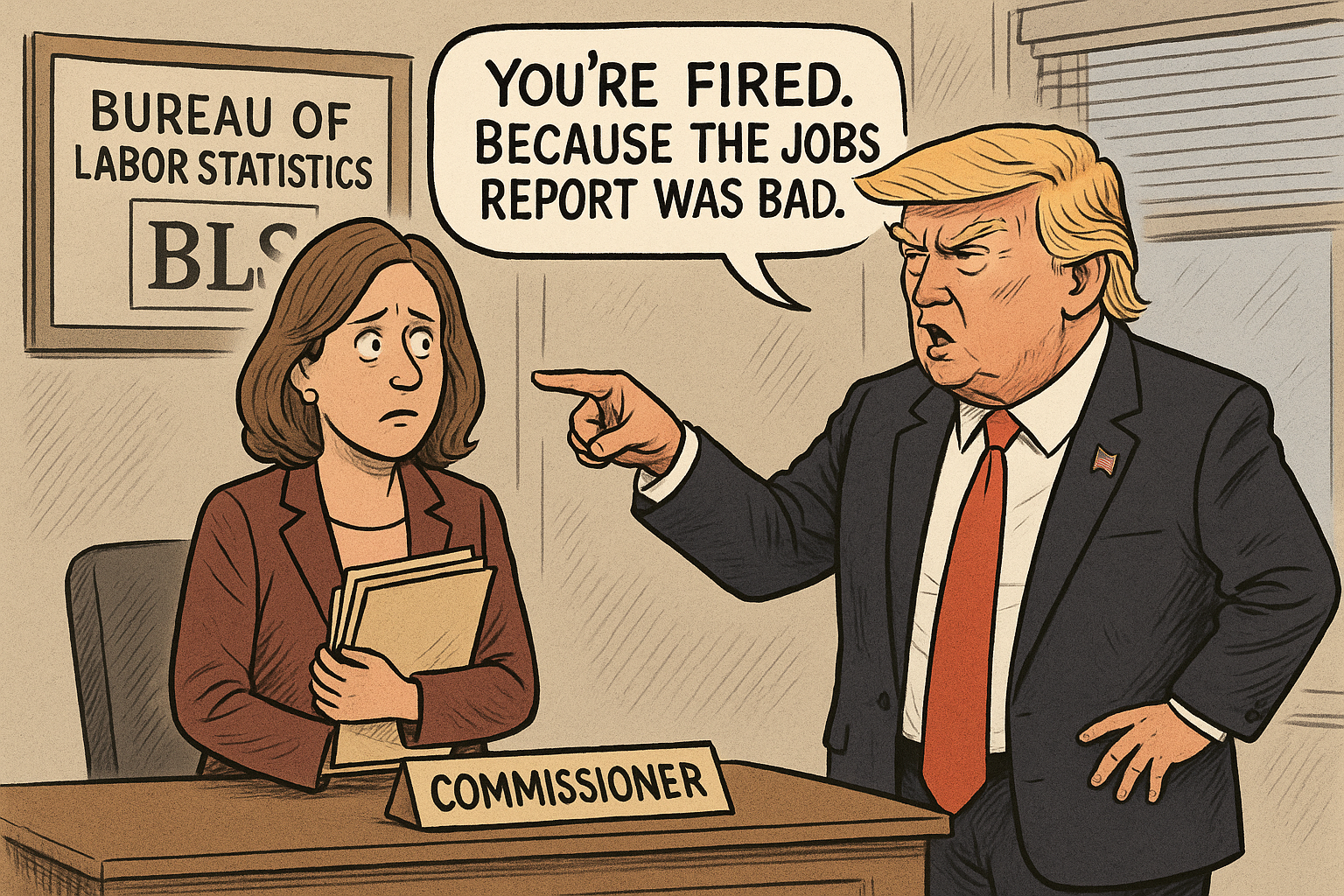
    Within hours, Donald Trump fired the BLS Commissioner, Erika McEntarfer. Not for breaking rules. Not for falsifying data. But for reporting a jobs number that made him look bad.

    And if you think this is just political drama with no market impact, think again. The gold market is already sniffing out what this kind of behavior signals—and it doesn’t smell like confidence.

    Let’s connect the dots.

    Markets don’t just care about jobs numbers. They care about whether the numbers are real. When you fire the referee because you don’t like the score, investors start asking: what’s next? Will future reports be massaged? Will we stop trusting U.S. data entirely? Will Fed policy decisions be distorted by manipulated inputs?

    This hits gold in two ways:

    1. Institutional Trust = Dollar Stability

    The U.S. dollar is the world’s reserve currency in large part because the world trusts U.S. institutions. If that trust wavers—even a little—gold becomes more attractive as a hedge. You don’t need hyperinflation for gold to rally. A few cracks in the wall of confidence will do just fine.

    2. Policy Uncertainty = Flight to Safety

    If economic reports are politically engineered, markets lose faith in the Fed’s ability to respond accurately. That drives volatility. And when volatility goes up, so does demand for gold. Fast.

    This isn’t hypothetical. The gold market ticked higher after the jobs report—not just because it missed expectations, but because the reaction from the White House was so extreme, it validated gold’s role as an insurance policy against institutional decay.

    And here’s the part no one wants to say out loud: if the numbers suddenly start improving next month, will anyone trust them?

    In the short term, the damage may be muted. But longer term, this kind of political interference puts a question mark next to every U.S. economic release. That’s not good for the bond market. It’s not good for the dollar. But it’s exactly the kind of slow-burning chaos that gold loves.

    So if you’re wondering why gold hasn’t broken down yet despite tightening policy and a cooling labor market—this is part of the answer.

    Trust is hard to build. Easy to destroy. And when it gets shaken? Traders buy insurance.

    And in case you forgot: insurance is spelled G-O-L-D.

  • Why Now Is the Perfect Time to Get Into Trading (Before Everyone Else Does, and Most of Them Quit)

    Why Now Is the Perfect Time to Get Into Trading (Before Everyone Else Does, and Most of Them Quit)

    There are moments in history when it pays to be early. Not just because you beat the rush, but because you’re already built for what comes next, long after the crowd burns out. This is one of those moments.

    As AI begins sweeping across white-collar industries, displacing analysts, marketers, consultants, and managers, a massive shift is coming: millions of people are going to try trading. Some already are. The pandemic was just the preview. What’s coming is bigger, more chaotic, and ultimately—more survivable for those who start now.


    Phase 1 (Now – 2026): The Flood

    AI is coming for jobs. Smart, ambitious people are about to be made redundant in record numbers. They’ll look for new income sources, and guess what keeps popping up on YouTube?

    “Trade from home!”

    “Make money in the markets!”

    “Prop firms will fund you!”

    Combine that with AI tools giving people a false sense of confidence, and you’ll get an explosion of new traders armed with:

    • A ChatGPT script
    • A few backtests
    • A dangerously inflated ego

    These traders will pile into the markets—and promptly get smoked.

    Because trading isn’t about having tools. It’s about having judgment under pressure. And that doesn’t come from TikTok. It comes from screen time, structure, and elite coaching.

    If you start now, you’ll be learning while the crowd is still overconfident. By the time they realize how hard this game really is, you’ll be calm, capable, and eating their exits.


    Phase 2 (2026 – 2028): The Great Washout

    As fast as they come in, they’ll start dropping like flies:

    • Failed prop firm challenges
    • Blown accounts
    • Social media silence
    • Regulation tightening

    Discords die. Reddit gets quiet. Influencers pivot to crypto mining or real estate. Everyone’s burned out or bitter.

    But not you.

    Because you’ve already:

    • Built your process
    • Learned real risk control
    • Tuned your emotional regulation

    You’re not chasing hype—you’re sharpening edge. You’re one of the few left standing, and it shows in your P&L.


    Phase 3 (2028 – 2032): The Thin Air

    By now, most humans have either quit, automated themselves out of trading, or become too afraid to click.

    AI is trading against itself. The market becomes faster, cleaner, colder. Behavioral mistakes are rarer—but when they happen, they’re massive.

    That’s your game now:

    • Fewer trades
    • Bigger size
    • Cleaner reads
    • Precision sniping

    There’s still money—serious money—but only for those who can wait, stalk, and strike without hesitation. Everyone else? Gone.

    And here’s the best part:

    New retail traders will still come in every cycle. Dumb money never dies. It just gets rebranded.


    So Why Get In Now?

    Because if you wait until everyone else floods in, you’ll be learning while they’re flailing.

    If you wait until they all leave, it’ll be too hard to learn.

    But if you start now, you get the best of both worlds:

    • You build competence while volatility is still rich with opportunity
    • You develop confidence while others are developing bad habits
    • You outlast the exodus and rise into the rare air where real traders live

    You won’t win by being faster than the bots. You’ll win by being better than the humans who think they can out-bot the bots.

    That takes a process. A system. And coaching that doesn’t sell you hype.


    One More Thing:

    If you’re going to get into trading right now, make sure you’re learning from people who:

    • Actually trade (not just teach)
    • Understand both human behavior and machine logic
    • Know what it takes to survive the phases ahead

    That’s what we do at The Barcelona Trader. We teach real systems. We coach real traders. And we’re doing it in real time—on Zoom, on stream, in the markets every day.

    If you’re ready to start before the flood and stay long after it recedes, you’re in the right place.

    Let’s build something that lasts.

  • What If “Giving It My All” Isn’t Good Enough?

    What If “Giving It My All” Isn’t Good Enough?

    Every trader has asked it. Usually in silence. Often in the dark.

    “What if I’m doing everything right… and I still fail?”

    It’s the kind of thought that doesn’t just whisper—it haunts. And it hits hardest when you’ve finally stopped half-assing it and gone all-in. When you’ve sacrificed time, pride, and a chunk of your identity to this pursuit.

    Because if your all isn’t enough—what’s left?


    The Fear That Only the Serious Feel

    Here’s the thing: This fear doesn’t show up for dabblers.

    People who aren’t taking trading seriously don’t ask this question. They’re too busy blaming the market, the broker, the indicator, the moon phase.

    But if you’re feeling this? You’re probably dangerously close to being good.

    That’s the irony. The self-doubt isn’t a sign you’re failing—it’s often a sign you’re leveling up. You’re noticing nuance. You’re battling the inner critic because you actually care.

    That’s not weakness. That’s growth.


    The Myth of the Natural

    Part of what feeds this fear is the myth that great traders are born with it. That some people just “have it”—and if you don’t, you’re doomed.

    That’s crap.

    Elite trading is learned. It’s painful. It’s repetitive. It requires more emotional rewiring than most people can stomach.

    So if you’re in the thick of that? You’re not broken. You’re becoming.


    But What If I Really Do Fail?

    Let’s get uncomfortable. Let’s say you give it your all. And after a year—or a few—you still don’t make it.

    Then you’ll know. And that alone is worth everything.

    Because the worst outcome isn’t failure. It’s not knowing. It’s years spent half-invested, always wondering if you could’ve made it if you’d just committed.

    If you go all-in and fail, you walk away with clarity, emotional toughness, and a better version of yourself. If you half-ass it and fail, you walk away with regret.


    Here’s the Truth

    Your all is already better than you think. Most people never even get to the point where they can recognize their mistakes, let alone articulate them in real time and improve them.

    Hopefully, you’re doing that.

    Maybe you’re stacking clean sessions. You should be managing emotional state. You shouldn’t be chasing, spiraling, or giving in to the noise.

    You’ve probably already passed the “could I do this?” test. Now you’re just in the “how far can I go?” phase.

    And if you keep showing up—clean, focused, honest—you’ll find out.

    You’ve got more in the tank than you think.

  • In The Beginning, I Just Wanted to Trade, Dammit

    In The Beginning, I Just Wanted to Trade, Dammit

    When I first started learning to trade, all I wanted to do was… well, trade.

    I didn’t want to read more theory.
    I didn’t want to wait for the “right market conditions.”
    I didn’t want to do visualization exercises or light a scented candle to regulate my nervous system.

    I just wanted to get in there and throw some punches.

    But the kind of trading we do—scalping gold using a mash-up of indicators from multiple platforms—has one tiny inconvenience:

    You can’t really backtest it.

    Not properly. Not cleanly. Not the way the backtesting bros on YouTube tell you to.

    Because some of our indicators are on TradingView…
    Some are on Meta Trader 4…
    One’s from EliteAlgo…
    A couple come from Tono’s vault of secrets…
    And the whole system is designed to be lived in, not simulated.

    There’s no drag-and-drop environment where you can recreate the pace, pressure, and psychodrama of a real session on a real market with real capital.

    So that left me with only one option:
    Learn by trading. Live. In session.


    And that’s when the rulebook came out.

    “You shouldn’t trade unless market conditions are ideal.”
    “You shouldn’t trade if you’re tired, emotional, or distracted.”
    “You shouldn’t trade unless you’re in flow state with a green smoothie and a low resting heart rate.”

    Great.
    So basically, don’t trade.

    Because in the early days?
    I was always a little emotional.
    The market was never ideal.
    And my “flow state” was somewhere between caffeinated rage and quiet despair.

    But I was determined.
    Determined to be the one trader who could rise above it all.
    The one who could power through less-than-perfect conditions.

    “Those rules are for weak-minded traders. I will train myself to ignore them. I will transcend.”

    Spoiler:
    I did not transcend.


    Turns out, I was just doing what new traders do:

    • I overestimated my resilience.
    • I underestimated the market’s indifference.
    • And I thought “rules” were optional for people with vision.

    I wasn’t training to become resilient.
    I was training to become delusional.


    The joke was on me.

    Because here’s what I learned the hard way:

    • If the market conditions aren’t right, your edge isn’t there.
    • If your emotional state is off, your execution will suffer.
    • If your ego says “I’ve got this” while your account says otherwise… guess who’s right?

    There is no shortcut.
    There is no version of you that becomes immune to conditions.

    There is only the version of you that respects the craft—or blows up trying to shortcut it.


    But here’s the good news.

    Eventually, I stopped fighting the guardrails.
    I stopped chasing every chart flicker as a “learning opportunity.”
    I stopped thinking I was the exception.

    And ironically, that’s when I actually started learning.

    Not just how to trade…
    But how to show up like a trader.


    Final thought:

    If you’re in that phase—desperate to trade, frustrated by rules, convinced that you’re built different…

    You’re not broken.
    You’re just at the beginning.

    But take it from someone who tried to brute force his way through the mountain:

    The rules aren’t your enemy.
    They’re the rope that keeps you from falling off the cliff.

    You can either learn that by listening…
    Or by learning the way I did.

    One red session at a time.

  • What Being a Good Trader Probably Says About You (Spoiler: It’s Not All Pretty)

    What Being a Good Trader Probably Says About You (Spoiler: It’s Not All Pretty)

    If you’re a good trader—or becoming one—there are probably some things it says about your character. Some flattering. Some… less so.

    Let’s start with the good stuff.

    You’ve got grit.

    Most people would rather eat a box of thumbtacks than sit through the psychological beatdown that trading hands out. But you? You stuck around after the first slap in the face. And the second. And the fifth. That means you’ve got a high pain tolerance and probably a dark sense of humor. Which is good, because the market thinks it’s hilarious.

    You’re self-aware—painfully so.

    Trading forces you to look in the mirror. Not a flattering, Instagram-filtered mirror, but one of those magnifying mirrors that shows every pore and mistake in 4K. You’ve faced your emotional impulses, your ego, your dopamine addiction—and you’ve named them. That’s rare. Most people go their whole lives blaming the market, their ex, or gluten.

    You’re patient… with a hair trigger.

    You’ve learned to wait. For your setup. For confirmation. For the trade to come to you. But once it’s there, you strike like a cobra who drinks espresso. That combo—slow hands, fast execution—isn’t natural. You trained it. You bled for it. And now it’s part of you.

    You’ve become a master of emotional containment.

    Outwardly calm, inwardly screaming is a fair description of 80% of your trades. But here you are, clicking exit instead of throwing your monitor through a window. That’s growth. That’s character. Or at least damage harnessed for good.


    But let’s be honest…

    Being a good trader might also mean:

    You trust yourself more than most people—and that can make you hard to live with.
    You’ve learned that only your judgment matters in the trade. That’s great in the market. At home? It can make you slightly unbearable when choosing restaurants, watching sports, or discussing politics.

    You’ve got control issues.
    You don’t just want to win trades. You want to understand every move, every wick, every pullback like it’s a personal message from God. You might say you’re just “data-driven.” Your spouse might say you’re impossible.

    You isolate when things go wrong.
    Because trading doesn’t just test your discipline—it tests your worth. When you mess up, you don’t want a hug. You want silence, charts, and maybe a whiskey. That’s not always the healthiest—but it’s real.

    You’re not a joiner.
    Good traders don’t do well in groupthink. You’ve learned to think alone, decide alone, and win or lose on your own terms. That independence is a superpower. But it can also make you the quiet one at the party who’s checking gold price on their phone while someone explains cryptocurrency “for real this time.”


    So what does being a good trader say about you?

    It says you’re battle-tested.
    It says you’re dangerous when focused.
    It says you’ve wrestled with your worst instincts—and sometimes even won.

    And it says that while you might still be a work in progress,
    you’re the kind of person who doesn’t flinch when the stakes are real.

    Not a bad character sketch. Especially in a world full of people chasing dopamine and blaming the Fed.

    You? You’re just here, clicking clean. One trade at a time.