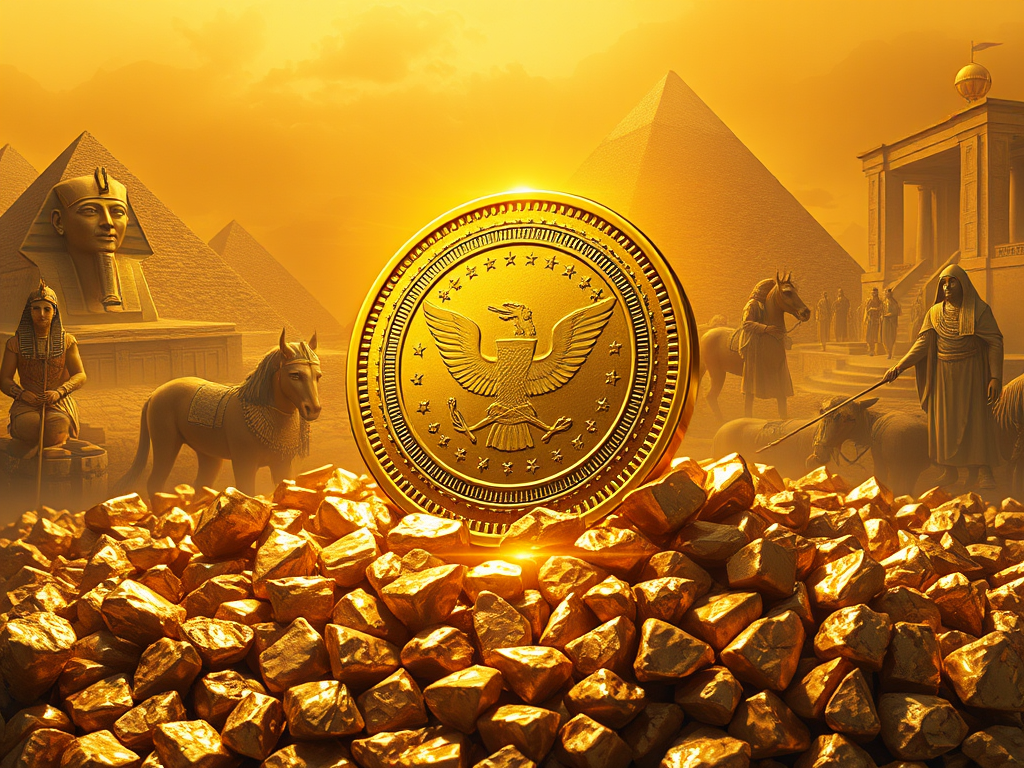
Gold has been many things: decoration, status symbol, cause of wars, excuse for bad tattoos. But at some point in human history, it crossed the line from “shiny trinket” to “medium of exchange.” That shift—turning lumps of cosmic shrapnel into money—might be the most consequential branding campaign of all time.
The First Spark: Egypt and Mesopotamia
The earliest recorded use of gold as money goes back over 4,500 years. Ancient Egypt was hoarding it as early as 2600 BCE, calling it the “skin of the gods.” They didn’t quite use it as pocket change—more as a divine bling repository. Pharaohs weren’t making it rain; they were burying themselves with it.
Meanwhile, in Mesopotamia, gold was being used in trade by about the same period, though not in neat little coins. It was weighed out in dust or bars, valued against silver and grain. Imagine buying your groceries with a handful of glitter and a scale—that was the system.
So did gold-as-money start in one place? The evidence suggests it emerged in multiple cultures around the same time, like a bad meme spreading without Wi-Fi. Humans, scattered across the Near East and beyond, independently looked at this rare, shiny metal that never tarnished and thought: This should probably run the world.
The Lydian Leap: First Coins
Fast forward to about 600 BCE, and we get the first real “coins” in Lydia (modern-day Turkey). The Lydians stamped lumps of electrum (a natural gold-silver alloy) with official marks to prove authenticity. This was revolutionary: suddenly, you didn’t need scales or trust issues. The king’s stamp meant the weight and purity were guaranteed.
This idea spread faster than bad financial advice on Reddit. Within a few centuries, the Greeks, Persians, and Romans were minting their own coins, and gold was firmly entrenched as the standard of value.
Gold Across Civilizations
- China: Used gold as a store of wealth but preferred bronze for day-to-day transactions. Gold was more of a status vault than a grocery fund.
- India: Revered gold spiritually and culturally, using it in both jewelry and trade. Even today, India is one of the world’s largest consumers of gold—not because they all want to hedge inflation, but because weddings are basically Olympic events in precious metal.
- The Americas: Civilizations like the Incas and Aztecs treated gold as sacred, a physical manifestation of the sun. They didn’t use it as currency in the Western sense; that brilliant idea came later when conquistadors showed up and said, “Oh cool, you call this the sweat of the gods? We call it collateral.”
From Coins to Standards to Chaos
Gold’s journey didn’t stop with coins. It went on to underpin empires:
- The Roman Empire minted the aureus, a gold coin that symbolized stability—until, of course, they started shaving edges and debasing it, proving governments have always been creative with money-printing.
- Medieval Europe ran on gold coins like florins and ducats, which became the global standard for trade.
- Modern Era: By the 19th century, the Gold Standard was born—currencies pegged to a fixed weight of gold. It gave the illusion of discipline until World War I blew it up.
- 1971: Nixon finally took the U.S. off the gold standard, which is why today the dollar is backed not by gold but by the world’s collective shrug and America’s military budget.
So, One Origin or Many?
Gold didn’t become “money” in just one place—it emerged organically across multiple civilizations. Human brains, separated by geography and culture, all zeroed in on the same thing: gold doesn’t corrode, it’s rare, it’s divisible, and it makes a great status flex. That convergence suggests it was less a cultural fad and more an inevitability.
In other words: if aliens exist, I wouldn’t be surprised if they also argue about whether their currency should be pegged to some shiny cosmic metal.
Why It Matters Now
Gold’s story is our story. It’s the tale of how something completely useless—seriously, try building a house out of gold—became the ultimate symbol of power. We didn’t choose it for practicality. We chose it for psychology. It was rare, it was beautiful, and it was eternal.
And that’s still true today. Every tick on the XAUUSD chart is a pulse of that ancient human obsession. The same force that drove Lydian kings to stamp coins, Egyptian pharaohs to hoard tombs, and conquistadors to plunder temples now drives traders, central banks, and yes, guys like me, staring at candles on a screen.
Gold: the original influencer.
Leave a Reply