Author: Mike McCready

  • What If “Giving It My All” Isn’t Good Enough?

    What If “Giving It My All” Isn’t Good Enough?

    Every trader has asked it. Usually in silence. Often in the dark.

    “What if I’m doing everything right… and I still fail?”

    It’s the kind of thought that doesn’t just whisper—it haunts. And it hits hardest when you’ve finally stopped half-assing it and gone all-in. When you’ve sacrificed time, pride, and a chunk of your identity to this pursuit.

    Because if your all isn’t enough—what’s left?


    The Fear That Only the Serious Feel

    Here’s the thing: This fear doesn’t show up for dabblers.

    People who aren’t taking trading seriously don’t ask this question. They’re too busy blaming the market, the broker, the indicator, the moon phase.

    But if you’re feeling this? You’re probably dangerously close to being good.

    That’s the irony. The self-doubt isn’t a sign you’re failing—it’s often a sign you’re leveling up. You’re noticing nuance. You’re battling the inner critic because you actually care.

    That’s not weakness. That’s growth.


    The Myth of the Natural

    Part of what feeds this fear is the myth that great traders are born with it. That some people just “have it”—and if you don’t, you’re doomed.

    That’s crap.

    Elite trading is learned. It’s painful. It’s repetitive. It requires more emotional rewiring than most people can stomach.

    So if you’re in the thick of that? You’re not broken. You’re becoming.


    But What If I Really Do Fail?

    Let’s get uncomfortable. Let’s say you give it your all. And after a year—or a few—you still don’t make it.

    Then you’ll know. And that alone is worth everything.

    Because the worst outcome isn’t failure. It’s not knowing. It’s years spent half-invested, always wondering if you could’ve made it if you’d just committed.

    If you go all-in and fail, you walk away with clarity, emotional toughness, and a better version of yourself. If you half-ass it and fail, you walk away with regret.


    Here’s the Truth

    Your all is already better than you think. Most people never even get to the point where they can recognize their mistakes, let alone articulate them in real time and improve them.

    Hopefully, you’re doing that.

    Maybe you’re stacking clean sessions. You should be managing emotional state. You shouldn’t be chasing, spiraling, or giving in to the noise.

    You’ve probably already passed the “could I do this?” test. Now you’re just in the “how far can I go?” phase.

    And if you keep showing up—clean, focused, honest—you’ll find out.

    You’ve got more in the tank than you think.

  • In The Beginning, I Just Wanted to Trade, Dammit

    In The Beginning, I Just Wanted to Trade, Dammit

    When I first started learning to trade, all I wanted to do was… well, trade.

    I didn’t want to read more theory.
    I didn’t want to wait for the “right market conditions.”
    I didn’t want to do visualization exercises or light a scented candle to regulate my nervous system.

    I just wanted to get in there and throw some punches.

    But the kind of trading we do—scalping gold using a mash-up of indicators from multiple platforms—has one tiny inconvenience:

    You can’t really backtest it.

    Not properly. Not cleanly. Not the way the backtesting bros on YouTube tell you to.

    Because some of our indicators are on TradingView…
    Some are on Meta Trader 4…
    One’s from EliteAlgo…
    A couple come from Tono’s vault of secrets…
    And the whole system is designed to be lived in, not simulated.

    There’s no drag-and-drop environment where you can recreate the pace, pressure, and psychodrama of a real session on a real market with real capital.

    So that left me with only one option:
    Learn by trading. Live. In session.


    And that’s when the rulebook came out.

    “You shouldn’t trade unless market conditions are ideal.”
    “You shouldn’t trade if you’re tired, emotional, or distracted.”
    “You shouldn’t trade unless you’re in flow state with a green smoothie and a low resting heart rate.”

    Great.
    So basically, don’t trade.

    Because in the early days?
    I was always a little emotional.
    The market was never ideal.
    And my “flow state” was somewhere between caffeinated rage and quiet despair.

    But I was determined.
    Determined to be the one trader who could rise above it all.
    The one who could power through less-than-perfect conditions.

    “Those rules are for weak-minded traders. I will train myself to ignore them. I will transcend.”

    Spoiler:
    I did not transcend.


    Turns out, I was just doing what new traders do:

    • I overestimated my resilience.
    • I underestimated the market’s indifference.
    • And I thought “rules” were optional for people with vision.

    I wasn’t training to become resilient.
    I was training to become delusional.


    The joke was on me.

    Because here’s what I learned the hard way:

    • If the market conditions aren’t right, your edge isn’t there.
    • If your emotional state is off, your execution will suffer.
    • If your ego says “I’ve got this” while your account says otherwise… guess who’s right?

    There is no shortcut.
    There is no version of you that becomes immune to conditions.

    There is only the version of you that respects the craft—or blows up trying to shortcut it.


    But here’s the good news.

    Eventually, I stopped fighting the guardrails.
    I stopped chasing every chart flicker as a “learning opportunity.”
    I stopped thinking I was the exception.

    And ironically, that’s when I actually started learning.

    Not just how to trade…
    But how to show up like a trader.


    Final thought:

    If you’re in that phase—desperate to trade, frustrated by rules, convinced that you’re built different…

    You’re not broken.
    You’re just at the beginning.

    But take it from someone who tried to brute force his way through the mountain:

    The rules aren’t your enemy.
    They’re the rope that keeps you from falling off the cliff.

    You can either learn that by listening…
    Or by learning the way I did.

    One red session at a time.

  • What Being a Good Trader Probably Says About You (Spoiler: It’s Not All Pretty)

    What Being a Good Trader Probably Says About You (Spoiler: It’s Not All Pretty)

    If you’re a good trader—or becoming one—there are probably some things it says about your character. Some flattering. Some… less so.

    Let’s start with the good stuff.

    You’ve got grit.

    Most people would rather eat a box of thumbtacks than sit through the psychological beatdown that trading hands out. But you? You stuck around after the first slap in the face. And the second. And the fifth. That means you’ve got a high pain tolerance and probably a dark sense of humor. Which is good, because the market thinks it’s hilarious.

    You’re self-aware—painfully so.

    Trading forces you to look in the mirror. Not a flattering, Instagram-filtered mirror, but one of those magnifying mirrors that shows every pore and mistake in 4K. You’ve faced your emotional impulses, your ego, your dopamine addiction—and you’ve named them. That’s rare. Most people go their whole lives blaming the market, their ex, or gluten.

    You’re patient… with a hair trigger.

    You’ve learned to wait. For your setup. For confirmation. For the trade to come to you. But once it’s there, you strike like a cobra who drinks espresso. That combo—slow hands, fast execution—isn’t natural. You trained it. You bled for it. And now it’s part of you.

    You’ve become a master of emotional containment.

    Outwardly calm, inwardly screaming is a fair description of 80% of your trades. But here you are, clicking exit instead of throwing your monitor through a window. That’s growth. That’s character. Or at least damage harnessed for good.


    But let’s be honest…

    Being a good trader might also mean:

    You trust yourself more than most people—and that can make you hard to live with.
    You’ve learned that only your judgment matters in the trade. That’s great in the market. At home? It can make you slightly unbearable when choosing restaurants, watching sports, or discussing politics.

    You’ve got control issues.
    You don’t just want to win trades. You want to understand every move, every wick, every pullback like it’s a personal message from God. You might say you’re just “data-driven.” Your spouse might say you’re impossible.

    You isolate when things go wrong.
    Because trading doesn’t just test your discipline—it tests your worth. When you mess up, you don’t want a hug. You want silence, charts, and maybe a whiskey. That’s not always the healthiest—but it’s real.

    You’re not a joiner.
    Good traders don’t do well in groupthink. You’ve learned to think alone, decide alone, and win or lose on your own terms. That independence is a superpower. But it can also make you the quiet one at the party who’s checking gold price on their phone while someone explains cryptocurrency “for real this time.”


    So what does being a good trader say about you?

    It says you’re battle-tested.
    It says you’re dangerous when focused.
    It says you’ve wrestled with your worst instincts—and sometimes even won.

    And it says that while you might still be a work in progress,
    you’re the kind of person who doesn’t flinch when the stakes are real.

    Not a bad character sketch. Especially in a world full of people chasing dopamine and blaming the Fed.

    You? You’re just here, clicking clean. One trade at a time.


  • Market Update: Why Gold Is Thriving in Trump’s Second Term

    Market Update: Why Gold Is Thriving in Trump’s Second Term

    Over the past several months, gold has remained one of the strongest-performing assets. Prices have reached above $3,300 an ounce and continue to show strength. While there are always short-term fluctuations, several larger trends are pushing gold into the spotlight—not just as a safe haven, but as a core part of many investors’ portfolios.

    Here are five reasons why gold is gaining strength during Trump’s second term.

    1. Central Banks Are Buying More Gold

    Governments around the world are increasing their gold reserves. This includes large, influential economies like China and India. When central banks buy gold, it’s usually because they want to reduce their reliance on the U.S. dollar. In uncertain times, gold is seen as a stable store of value. The more gold they buy, the more demand there is, which supports higher prices.

    2. The World Is Moving Away from the U.S. Dollar

    More and more countries are reducing their use of the U.S. dollar in trade and finance. This is known as “de-dollarization.” It’s happening faster now because of Trump’s trade policies and tariffs, which have made international trade more difficult. As countries look for alternatives to the dollar, gold becomes an attractive option. It’s seen as neutral and reliable.

    3. America’s Financial Health Is in Question

    The U.S. government is running large budget deficits. At the same time, long-term programs like Social Security are becoming more expensive. Credit rating agencies have downgraded the U.S. government’s creditworthiness. All of this creates concern about how sustainable the U.S. financial system is. When confidence in government finances weakens, gold often becomes more appealing as a long-term investment.

    4. Investors Are Buying Gold Through ETFs

    ETFs (exchange-traded funds) make it easier for everyday investors to buy and sell gold without holding the physical metal. In the first half of the year, investors put tens of billions of dollars into gold ETFs—one of the strongest showings since 2020. That level of demand shows that both large institutions and individuals are looking to gold as a key part of their investment strategies.

    5. Gold Prices Are Holding Strong Technically

    Even with ups and downs in the market, gold has stayed above important price levels. Technical traders—those who focus on charts and price behavior—see this as a sign that gold has strong support. This makes it more likely that prices could rise further if market uncertainty continues.

    What This Means Going Forward

    Gold is no longer just a short-term hedge during crises. It’s becoming a long-term asset that investors, governments, and institutions are treating with more seriousness. With ongoing concerns about inflation, government debt, and global instability, many are turning to gold not as a backup plan—but as a central part of how they protect and grow their wealth.

    If these trends continue, we may be entering a new era where gold takes on a much bigger role in the global financial system. For new traders and investors, it’s a good time to understand why gold matters—and how it might fit into a modern investment strategy.

  • The 8 Stages of a Trader: From Wide-Eyed Novice to Elite Trader

    The 8 Stages of a Trader: From Wide-Eyed Novice to Elite Trader

    Let’s be honest—most people who get into trading won’t make it. Not because they’re dumb. Most are actually pretty sharp. But they’re either impatient, overconfident, allergic to discipline—or some glorious cocktail of all three. So they flame out. They blame the markets. And they go back to their regularly scheduled life.

    But a few… a very few… make it.

    If you’re one of the lunatics who refuses to quit, here’s what that journey usually looks like. Think of it as your roadmap—or your obituary, depending on how the next few months go.


    🟤 Stage 1: The Novice

    Mindset: Hopeful. Clueless. Occasionally euphoric.
    Favorite quote: “I think I’ve figured this out.”
    Behavior: Trading like you’re in a casino, but with worse odds. Clicking buttons. Chasing trends. Watching YouTube videos with thumbnails that say “$5K in 5 Minutes.”
    Your job: Don’t blow up your life. Learn what a setup actually looks like. Understand risk. Get humbled. That’s the door you have to walk through.

    Milestone to escape:
    Your first real, gut-punch moment of clarity where you go, “Oh… this is going to take actual work.”


    🟡 Stage 2: The Aspiring Trader

    Mindset: Obsessed. Bouncing between hope and despair.
    Favorite quote: “Maybe this new strategy will work.”
    Behavior: You try 37 different approaches in a week. You change your rules hourly. You blame the market, your broker, or the moon phase when it doesn’t work.
    Your job: Pick a damn lane. Pick one approach. Learn its nuances. Build skill, not fantasy.

    Milestone to escape:
    You stop hunting for unicorn indicators and start learning to read price like it’s your job. Because it is.


    🟠 Stage 3: The System Student

    Mindset: Focused. Fragile. Easily spooked.
    Favorite quote: “I just need more data.”
    Behavior: You’ve chosen a system. Congrats. Now you hesitate when it shows up. You miss trades. You second-guess exits. You have moments of brilliance—and moments of sheer, uncut panic.
    Your job: Trade the setups. Log the trades. Watch your own patterns. Start developing emotional muscle memory. That’s where consistency is born.

    Milestone to escape:
    You complete a stretch of clean, rules-following sessions—regardless of profit. You’re showing discipline even when it sucks. That’s big.


    🔵 Stage 4: The Disciplined Operator

    Mindset: Calm. Still slightly dead inside.
    Favorite quote: “I don’t care what gold should do. I care what it is doing.”
    Behavior: You show up. You follow your rules. You protect capital. You take your losses like a grown-up. You journal. You review. You actually learn.
    Your job: Stack clean sessions. Refine execution. Tighten up your exits. Start to separate your thoughts from your actions. This is where you become dangerous.

    Milestone to escape:
    A solid streak of A-grade sessions with no drama. You’re now a real operator. Most never get here.


    🟣 Stage 5: The Funded Professional

    Mindset: Strategic. Accountable. Mildly paranoid.
    Favorite quote: “I protect capital above all.”
    Behavior: You trade prop firm capital or real size with confidence. You understand your edge. You don’t need to be right. You just need to not be stupid.
    Your job: Execute under pressure. Avoid overtrading. Don’t blow up when your edge is on break. Withdraw your winnings. Take yourself seriously.

    Milestone to escape:
    You pass challenges and get your first real payout. This isn’t a hobby anymore.


    🟢 Stage 6: The Consistent Money-Maker

    Mindset: Detached. In control. Zero theatrics.
    Favorite quote: “I’d rather be flat than forced.”
    Behavior: You withdraw money monthly. You let the good days ride and survive the boring ones. You don’t need the market to entertain you. You just need it to offer something once.
    Your job: Maintain rhythm. Don’t get greedy. Don’t get lazy. Just hit singles. The home runs show up on their own.

    Milestone to escape:
    12 consecutive green weeks. Clean trades. No rule-breaking. You’re now printing.


    🟠 Stage 7: The Adaptive Technician

    Mindset: Dynamic. Quietly elite.
    Favorite quote: “The market’s always changing. So am I.”
    Behavior: You notice subtle shifts in volatility and liquidity. You evolve your tactics without changing your core. You take what’s there—and only what’s there.
    Your job: Be water. Flow around obstacles. Keep your edge sharp without losing what made it work in the first place.

    Milestone to escape:
    You outperform in tough markets while the herd is complaining. You didn’t adapt—you evolved.


    🔴 Stage 8: The Elite Trader

    Mindset: Zen warlord. You trade. You don’t talk about it.
    Favorite quote: “That was a good loss.”
    Behavior: You size up with precision. You take trades no one else sees. You stop trying to be right and just play your game. You’re scaling multiple accounts, compounding monthly, and—if you feel like it—mentoring the next generation.
    Your job: Protect peace. Manage growth. Maintain dominance. And for god’s sake, don’t get cocky.

    Milestone:
    Consistent six-figure withdrawals, low drawdown, complete emotional detachment. Your trading is boring. Your results are not.


    Optional Final Stage: The Architect
    You don’t just trade. You build. You teach. You systematize. You leave a mark.
    You create something that helps others win—without selling your soul or your strategy.


    Wherever you are on this journey, the rules are the same:

    • Don’t overtrade.
    • Protect capital.
    • Obey your exits.
    • Observe your mind.
    • Don’t quit right before it gets good.

    Most won’t make it.
    But someone will.
    Might as well be you.

  • Market Update: July 17, 2025: What If Trump Fires Powell? Why It Matters for Gold Traders

    Market Update: July 17, 2025: What If Trump Fires Powell? Why It Matters for Gold Traders

    Can the President Even Do That?

    First things first: The short answer is probably no—but that hasn’t stopped Trump from testing the boundaries.

    Under the Federal Reserve Act, the President appoints the Fed Chair—but can only remove them “for cause”, meaning misconduct, inefficiency, or malfeasance. Disagreements over policy (like rate levels) don’t qualify.

    Plus, a recent Supreme Court ruling confirmed that the Fed Chair is protected from removal on political grounds . Some legal voices say it’s still an open question—but any attempt by Trump would almost certainly lead to a landmark court fight .


    Why Trump Wants Someone Else in the Chair

    Trump’s pressure on Powell isn’t random. He’s publicly criticized the Fed for not cutting rates fast enough, arguing that high rates stifle economic growth.

    And now—he’s found a new angle. He’s accusing Powell of overseeing a $2.5 billion Fed building renovation gone wild, potentially justifying a “for cause” removal.

    If Trump could replace Powell with someone who’ll slash rates, it might boost short-term sentiment—but at what cost?


    How Markets Would React (Especially Gold)

    Let’s break it down:

    MarketLikely Reaction
    Stock Markets & DollarInitial shock, a rally in stocks fueled by rate-cut optimism—but sentiment could crater if confidence in Fed independence collapses. Dollar weakness likely as markets angle for looser policy .
    Treasury BondsVolatility spikes. If independence erodes, bond yields might rise regardless of intended rate cuts—due to uncertainty .
    GoldBoom time. Gold shot up ~1.6% immediately after Powell-firing rumors surfaced . If markets begin to fear politicization of Fed, that rally could deepen. But the reverse—Trump standing down—can send gold lower.

    So What Would This Mean for Our Trading?

    1. Volatility spikes.— Emotional trades follow. This is your edge if you can stay calm.
    2. Watch correlation shifts. Dollar down = gold up—except when bonds mess with the mix.
    3. Trade structure, not rumor. Price will move fast after headlines—but obey structure, not hype.
    4. Stay nimble. These headlines could ignite short-lived freak-rallies that reverse fast.

    The Big Picture

    • Trump can’t legally fire Powell—for now. But he’s testing the boundaries, and that alone rattles markets.
    • A successful removal would be cataclysmic for market confidence, and gold would likely rally hard.
    • But even the rumor mill has already moved gold 1–2%—and then reversed on denials.
    • As scalpers, we don’t make macro predictions. We trade the liquidity pulses—this sort of drama can create ideal entry points.

    Final Thought:

    Whatever happens next—to Powell, or the Fed’s structure—just remember:

    Our job isn’t to guess who’s tweeting or suing.
    It’s to read the response: what the market actually does—right now.

    Stay aware. Stay calm. Stay grid-ready.

    Because in the end, political showdowns make the stage… but price action writes the play.

  • The Coin Flip Analogy: Trading Success Explained

    The Coin Flip Analogy: Trading Success Explained

    Let’s play a game.

    I flip a coin. Every time it lands on heads, I give you $10. Every time it lands on tails, you give me $5.

    Wanna play?

    You’d be a fool not to. It’s not even close. The longer we play, the more money piles up in your corner.

    Of course, you might lose the first flip. Or the second. Or even three in a row. But if you understand the rules of the game—and if you’re not sabotaged by emotion—you won’t flinch. You’ll keep flipping. Because you know how this story ends.

    Now here’s the twist:

    That’s trading.
    That’s exactly what trading should feel like—if you’re doing it right.

    But what do most people do?

    They lose a trade—or two—and suddenly they’re questioning the whole system. Their palms sweat. Their brain starts writing little horror stories about failure and doom. They tighten up. They hesitate. They stop flipping.

    Or worse—they panic, double down, and blow themselves up.

    All because they don’t understand the nature of the game.

    They want every flip to work. They want every trade to win. They want control in a game built on uncertainty.

    They can’t handle losses—even small, expected, built-into-the-math losses—because they haven’t trained themselves to see the bigger picture. They’re so focused on the last $5 they had to give back, they miss the $10 that was coming next.

    If that’s you—if you’re stuck in that cycle—it’s not your fault. The human brain is wired to hate loss. Loss aversion isn’t a bug in your system. It’s default code.

    But here’s the good news:
    You can reprogram it.

    You just have to play the game long enough—with the odds tilted in your favor—to see that the outcome of any one trade doesn’t matter.

    What matters is that you take the right kinds of trades.
    What matters is that your wins are bigger than your losses.
    What matters is that you keep flipping the damn coin.

    And when it lands on tails?
    Smile. You just paid your edge tax. Now flip again.

    This analogy came via The Duomo Initiative.

  • If Everyone Traded, They’d Have to Make It Illegal

    If Everyone Traded, They’d Have to Make It Illegal

    Let’s just say it out loud:
    If everyone became a trader, governments would have to shut it down.

    Not because trading is immoral.
    Not because it’s unsafe.
    But because nothing else would get done.

    No bridges would get built.
    No crops harvested.
    No packages delivered.
    No classrooms taught.
    Just a planet full of overstimulated humans staring at charts, scalping gold, and tweeting about “liquidity grabs.”

    And while that does sound kind of amazing (especially the no meetings part), it’s also the exact kind of thing that would trigger massive economic collapse and a swift legislative response.

    Because society needs plumbers.
    It needs nurses.
    It needs people who don’t panic when their stop gets hit by two pips.

    If everyone tried to trade for a living?
    You better believe governments would step in.

    They’d regulate it.
    They’d tax it like vice.
    They’d require a license to place a limit order and a psych eval before opening a funded account.

    Speculative activity would become the new black market.


    But here’s the twist…

    We’re not that far from this becoming reality.

    Because even if we all wanted to keep our jobs and contribute to society like good little worker bees…

    AI is coming for those jobs anyway.

    And not just the repetitive ones.

    We’re talking:

    • Graphic designers
    • Copywriters
    • Video editors
    • Coders
    • Financial analysts
    • Project managers
    • Customer service reps
    • Junior lawyers
    • Middle managers
    • You

    All of it. Gone.

    Replaced by increasingly intelligent, emotionally vacant software that works 24/7, doesn’t unionize, and doesn’t post memes on Slack during meetings.


    So what happens when the robots take the jobs?

    People do what people do:

    They look for the last place left to make money independently.

    And what’s still there?

    Trading.

    It’s permissionless.
    It’s global.
    It doesn’t care about your résumé, your GPA, or your criminal record.
    All it asks is:
    “Can you handle the truth? And the risk?”

    So the flood begins.
    Millions of displaced workers log onto TradingView.
    They open demo accounts.
    They buy ring lights and launch trading channels called things like “EdgeSniperFX” or “GoldWolvesUnited.”

    And then…


    All hell breaks loose.

    Liquidity spikes at weird hours.
    Entire nations start blowing accounts.
    The IMF launches a Prop Firm Regulation Division.
    Your neighbor who used to do your taxes is now shouting about Smart Money Concepts and swing highs.

    The world becomes one giant speculative casino.

    But worse than that?

    The markets get too crowded.
    Volume explodes.
    Noise increases.
    Algos weaponize retail behavior.

    And suddenly the thing that was once your quiet edge… becomes a global mosh pit.


    So… now what?

    We can’t all trade.
    We know that.

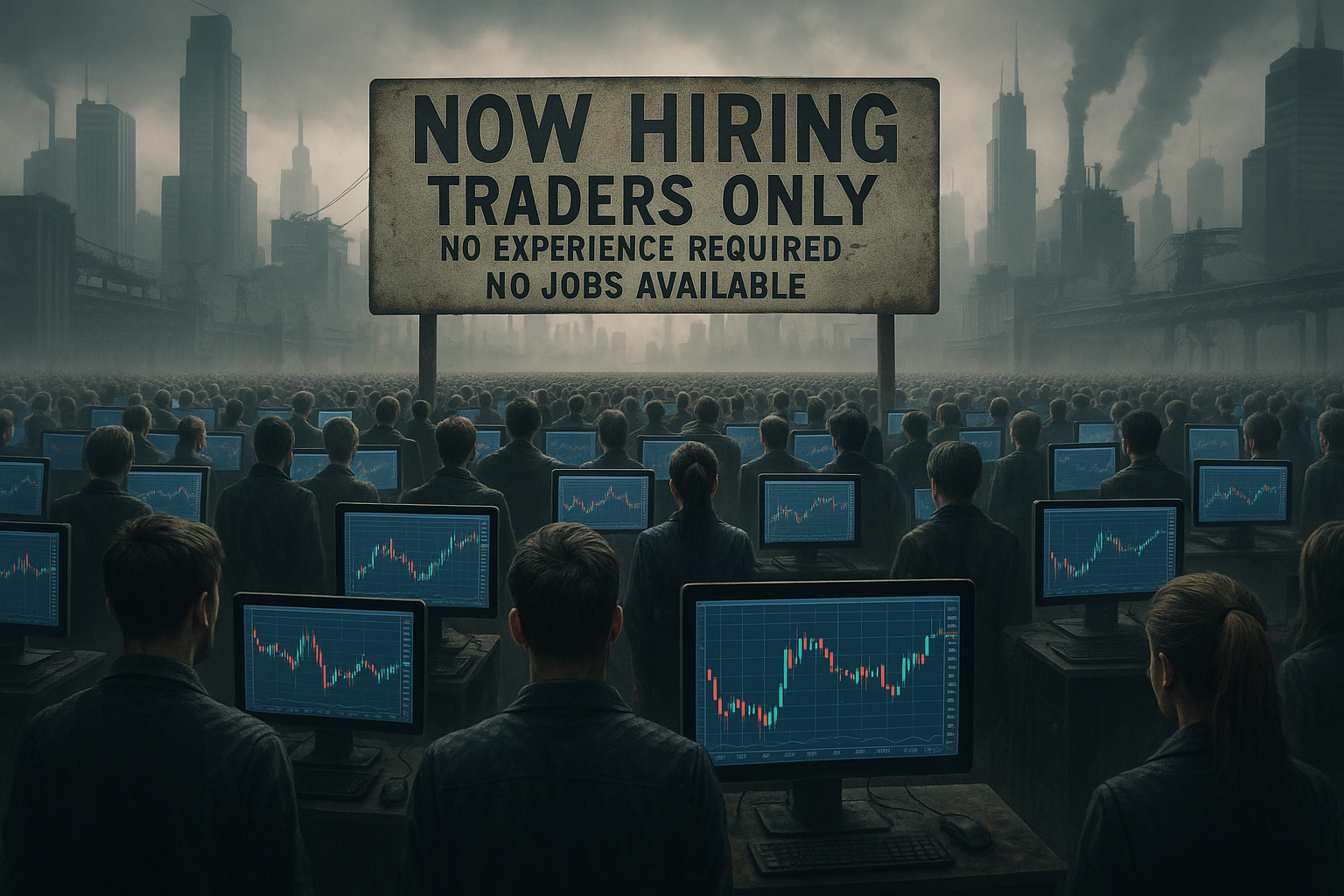
    But soon, a lot more people are going to try.

    Because once the machines take the jobs and the gig economy turns into an AI content farm, what’s left?

    Trading becomes the last frontier of uncapped income…
    and the first step on the ladder out of economic irrelevance.

    It won’t be for everyone.
    It can’t be for everyone.
    But for those who can do it—who can master the emotional discipline, the risk management, the math, the mindset?

    It will become a kind of superpower.


    So yes—if everyone traded, they’d make it illegal.
    But the irony is, we may be heading toward a world where everyone has to try.

    And if that happens?

    The traders who already have the skills, the rules, and the mental game dialed in…
    Will inherit the last, strangest, most chaotic version of capitalism the world has ever seen.

    Welcome to the final frontier.
    Let’s hope your stop holds.

  • What Happens to Gold Traders Like Us After Late-Stage Capitalism?

    What Happens to Gold Traders Like Us After Late-Stage Capitalism?

    You ever feel like the world is changing so fast that your charts need a geopolitical analyst and a therapist sitting next to you? Yeah. Me too.

    If you’ve been around long enough to trade through rate hikes, crypto booms, a pandemic, and the return of populism, you may have heard this phrase tossed around: late-stage capitalism. And you may be wondering: what happens after that?

    Let’s break it down—for gold traders like us. Because while the macro drama might seem a step removed from our scalps and hedges, the system you’re trading inside of is evolving fast. And if you’re not paying attention, it’ll run you over like a rogue CPI candle.


    Wait—What Is Late-Stage Capitalism, Exactly?

    It’s not a formal term. It’s more like an eye-roll from economists who see the system cracking at the seams. We’re talking about a phase where:

    • Mega-corporations run the show
    • Wealth inequality looks medieval
    • Markets are propped up by central bank steroids
    • “Jobs” become gigs with no benefits
    • Rent, healthcare, and education are luxury items

    Basically, capitalism stops being about opportunity and starts feeling like a casino rigged for the house.

    You’re not imagining it: the middle class is shrinking, trust in institutions is in freefall, and the word “freedom” is now a marketing slogan slapped on $70k pickup trucks and processed cheese.


    So What Comes After This? And What Does It Mean for Gold Traders Like Us?

    Good question. Nobody knows for sure, but there are a few likely paths. Some are survivable. Some are lucrative. Some… not so much. Let’s walk through the scenarios.


    1. State-Driven Capitalism

    The government doesn’t end capitalism. It just drives the bus now.

    Think: China-lite. National security becomes economic policy. Markets are “free,” but only as long as they don’t interfere with strategic goals.

    📌 What this means for you:
    Expect more interventions. Gold could surge or flatline based on policy whims, not price action. New regulations could restrict leverage, tax capital gains at higher rates, or limit short-term speculation. Brokers may face tighter controls. You’ll need to be nimble—and very plugged in to macro shifts.


    2. Technocratic-Neo-Feudalism

    Capitalism doesn’t die. It just puts on a hoodie and starts charging subscription fees for everything.

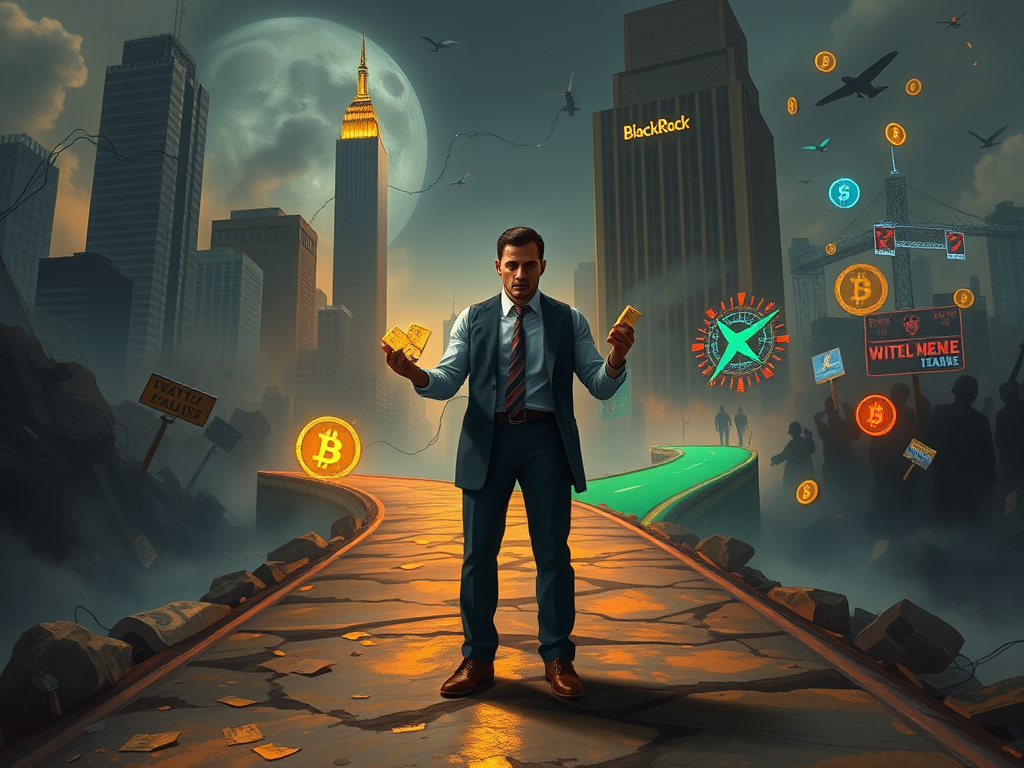
    This is where corporations become the real governments. BlackRock, Amazon, OpenAI—they’re not just companies anymore. They’re the new fiefdoms.

    📌 Impact for traders like us:
    If you’ve got elite tools, fast data, and discipline? You thrive. If not? You’ll drown in fees, algorithmic latency, and compliance screens. Getting access to real-time order flow and premium platforms might start to look more like joining a private club than opening a brokerage account.

    Welcome to trading as a privilege, not a hustle.


    3. Eco-Social Market Economies

    Capitalism with a conscience… and a carbon tax.

    Here, governments shift hard toward sustainability, worker protections, and climate action. Think UBI, green investments, and strict limits on speculation.

    📌 For us:
    Gold might benefit in the short term if fiat currencies wobble, but over time, financial speculation could be frowned upon—or taxed out of existence. Platforms might require stricter disclosures, and high-frequency scalping could be collateral damage in a crackdown on “unproductive capital.”

    Might be time to learn how to swing trade compost futures.


    4. Decentralized Utopianism

    Crypto wins. The empire falls. Welcome to the Wild West.

    A long shot, but not impossible. This is the future libertarians dream about: DAOs, DeFi, no central banks, and a peer-to-peer financial system that lives on-chain and outside the Fed’s reach.

    📌 For traders like us:
    The upside is huge—massive volatility, no middlemen, 24/7 liquidity. But it’s also the jungle. Scams, rug pulls, and total lack of recourse. You’ll need a PhD in digital security just to withdraw your profits.

    If you’re nimble and fast? It’s gold rush 2.0. If not? It’s game over in a flash crash.


    5. Collapse or Authoritarianism

    The system breaks. Markets get shut down. Gold becomes… gold.

    Worst case scenario. Political unrest, debt default, climate shocks, or military conflict tip the balance. In these cases, gold may skyrocket—but the ability to trade it might disappear.

    📌 Implications:
    You’re not scalping 10-second candles anymore. You’re holding physical bullion. Maybe burying it in the backyard. Maybe fleeing with it in a backpack. Trading platforms go dark. Capital controls come in. Trust is gone. It’s not a chart setup—it’s survival.

    Let’s hope we don’t get here.


    So… What’s the Move?

    For now, we’re still in the middle game. But the endgame pieces are moving. If you’re a serious gold trader—especially a scalper like me—you want to be:

    • More aware of the macro (and less reliant on the illusion of a stable system)
    • More adaptable (because the rules will change)
    • More strategic (build edge not just in entries, but in your understanding of the playing field itself)

    Late-stage capitalism may be giving us volatility—and volatility is oxygen for traders. But after that? The terrain gets wild.

    If you’ve got a system, a brain, and a sense of humor, you’ll make it.

    If you’re still looking for a savior or a shortcut… the next chapter might not be so kind.


    Want to keep up with the future of gold trading as it unfolds? Follow along, subscribe, or join the tribe. The system may change—but edge adapts.


  • When the World Gets Laid Off and Everyone Starts Trading

    When the World Gets Laid Off and Everyone Starts Trading

    Let’s play something out.

    Let’s say it’s a year or two from now.
    AI has finished doing what it’s been quietly doing in the background—decimating white-collar jobs.

    Not blue-collar. Not frontline.
    I’m talking mid-career, highly educated, salaried professionals—marketing managers, financial analysts, product leads, lawyers, consultants, you name it.

    The very people who used to smirk when someone said they were trading for a living.
    Gone. Displaced. Deskless.

    And now guess what?

    They start trading.


    From Meetings to Markets

    You’ll see them flood in by the tens of thousands—people who used to run brand strategy for fintech apps, or give quarterly updates to boardrooms, or write spreadsheets that made other spreadsheets nervous.

    And now they’re sitting in front of TradingView, eyes wide, asking ChatGPT,

    “How do I scalp gold futures on a 10-second chart?”

    And the internet will answer.

    And they will believe it.

    And they will get wrecked.

    Not because they’re stupid.
    Because they’ve spent their whole careers being rewarded for effortintellect, and showing up early to meetings.

    None of that helps here.


    Trading Isn’t the New Career. It’s the New Fantasy.

    In this scenario, trading becomes the next “learn to code.”
    A myth wrapped in urgency: “If I can just make $500 a day…”

    You’ll see:

    • YouTube channels with slick ex-consultants explaining breakouts they don’t actually trade
    • Discord servers filled with high-IQ people drawing perfect fib levels over completely random price action
    • LinkedIn posts that start with “After losing my job to AI, I found purpose in the markets…”

    It’ll feel like a revolution.
    But it will be a bloodbath.

    Because the market is not your therapist. It’s not your comeback story.
    And it does not care how many degrees you have.


    And Then Comes the Twist: AI Enters Trading Too

    While all these displaced professionals are trying to trade using AI tools, institutions are deploying next-gen AI againstthem.

    AI will:

    • Scrape forums and sentiment
    • Detect overused pattern bots
    • Trigger fake breakouts to trap GPT-trained retail traders
    • Adapt faster than the humans using it

    So now you’ve got millions of people trying to get rich using AI to trade…
    While actual market-moving AI is front-running their ideas and laughing in code.


    Trading Becomes a Combat Sport

    At this point, trading stops being a clever side hustle.
    It becomes a full-contact performance profession.

    Like boxing, or jiu-jitsu—except you’re fighting liquidity, latency, and your own impulse control.

    Edge becomes rare again.

    You won’t win because you’re smart.
    You’ll win because you’re:

    • Disciplined when others chase
    • Calm when others spiral
    • Structured when others are talking to their chatbot

    You’ll win because you trained.


    Where This Leaves You

    If you’re reading this, and you’re already walking the tightrope of trading mastery—discipline, clean execution, no sizing up out of boredom—then this flood of new traders?

    It’s not a threat.
    It’s an opportunity.

    Because most of them will bring brains and effort.
    But you’ve already built what actually matters:

    • Mechanical exits
    • Emotional containment
    • Trade-by-trade detachment

    They’ll bring tools. You’ll bring scars.
    And when the market gets noisy, twitchy, and crowded?

    You’ll still be here, hitting clean setups and walking away like a ghost.


    So What Happens When Everyone Starts Trading?

    Mostly?
    They lose.

    They treat trading like a new app to master, not a new identity to forge.

    And in a world where everyone’s using AI to predict the market, the only real edge left is knowing when to trust yourself instead.

    Because the bots will get smarter.
    The masses will keep flooding in.
    But the discipline? The self-trust? The rules that hold under fire?

    That’s still human.
    That’s still rare.
    And that’s still yours to own—if you’ve done the work.